
Traditional vs. Vacuum Homogenizer Emulsifier Mixer: A Buyer's Guide for Mayonnaise and Cosmetic Production
Traditional vs. Vacuum Homogenizer Emulsifier Mixer: Which One is Right for Your Mayonnaise and Cosmetic Production?
Selecting the right vacuum homogenizer emulsifier mixer is a critical decision for manufacturers of mayonnaise, sauces, creams, and lotions. This guide compares conventional emulsifiers with advanced vacuum homogenizing systems, helping you evaluate performance, stability, and total cost of ownership.
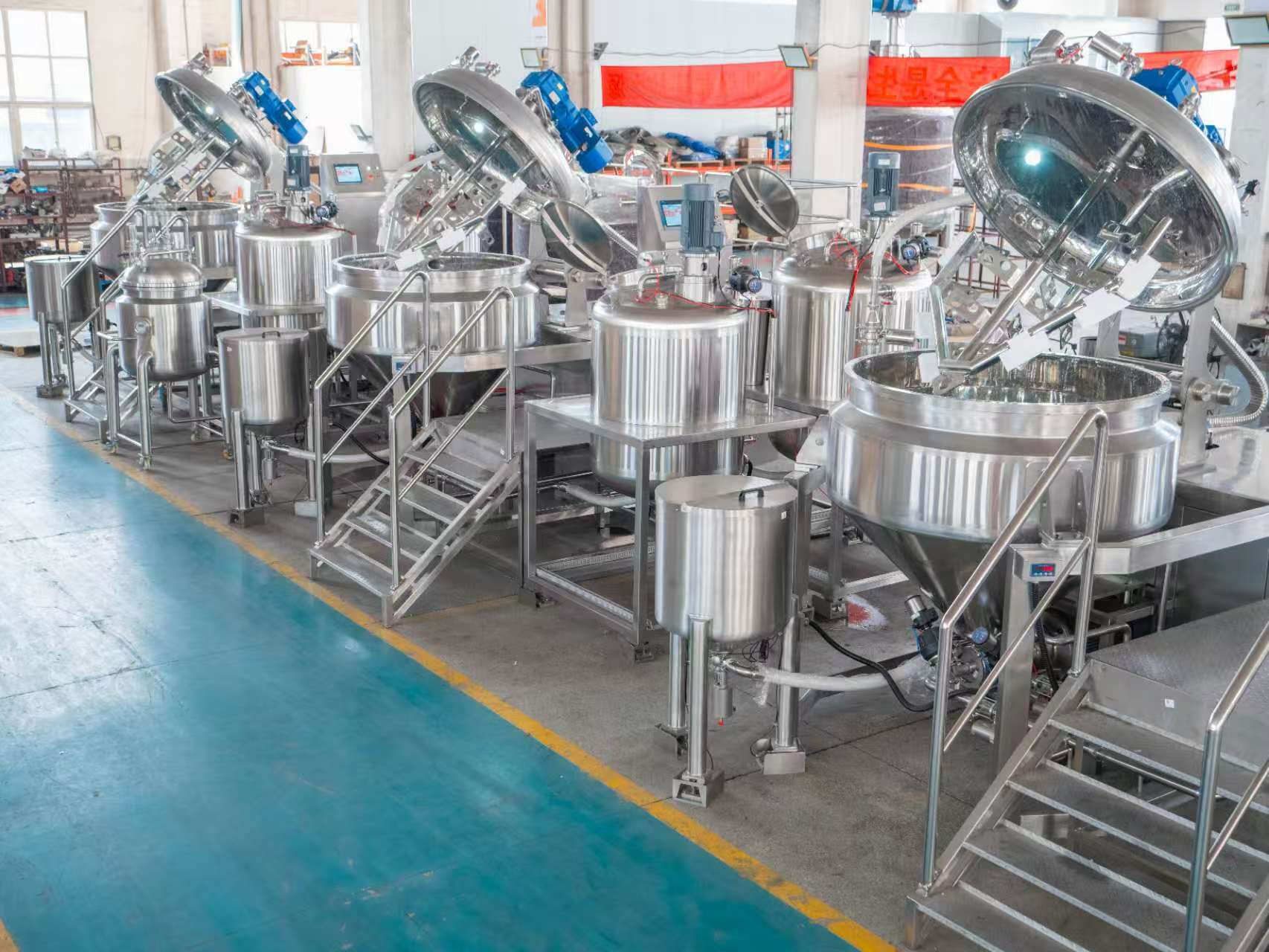
Problem Definition: The Emulsification Challenge
Emulsification is the process of combining two immiscible liquids (e.g., oil and water) into a stable, homogeneous product. In industries such as food sauce production and cosmetics manufacturing, achieving a fine, stable emulsion is critical for product quality, shelf life, and sensory attributes. Traditional emulsifiers often struggle with:
- Large particle size distribution (5–20 μm)
- Poor long-term stability (creaming, coalescence)
- Air entrapment leading to oxidation and appearance defects
- Inconsistent batch-to-batch quality
Industry Background: From Conventional to Vacuum Technology
The global market for homogenizing equipment in food and cosmetics has shifted toward vacuum homogenizer emulsifier mixers because they combine high-shear mixing, vacuum deaeration, and temperature control in a single unit. Key drivers include rising demand for premium mayonnaise (smooth, creamy, stable) and high-end skincare products (fine texture, no bubbles).
Wuxi YK Automation Technology Co., Ltd (YeKeey), established in 1998, has been at the forefront of this technology, accumulating 55 patents and serving over 4,000 enterprises in 70+ countries. Their SP Series, ZJR Series, and MC Series vacuum emulsifying mixers are designed for both food and cosmetic applications, with output speeds up to 2800 r/min, operating temperatures up to 110°C, and a vacuum pressure of -0.09 MPa.
Detailed Solution: Vacuum Homogenizer vs. Conventional Emulsifier
| Parameter | Conventional Emulsifier | Vacuum Homogenizer Emulsifier Mixer |
|---|---|---|
| Particle Size Distribution | 5–20 μm | 1–5 μm |
| Emulsification Stability | Moderate – prone to separation | Superior – stable for months |
| Shearing Force | Standard high-shear | Stronger – rotor-stator design |
| Vacuum Degassing | No | Yes (-0.09 MPa) |
| Air Bubble Removal | Poor | Excellent (bubble-free product) |
| Batch Consistency | Variable | Highly repeatable (PLC control) |
| Initial Investment | Lower | Higher |
| Total Cost of Ownership | Higher due to rejections & rework | Lower – fewer rejects, stable output |
| Maintenance | Frequent seal & bearing replacement | Less frequent (robust design) |
The core difference is the capability for superior emulsification stability and stronger shearing force offered by vacuum homogenizer emulsifier mixers. YeKeey's SP Series, for example, delivers output speeds of up to 2800 r/min, enabling particle sizes down to 1–5 μm—essential for high-end mayonnaise and cosmetic creams.
Step-by-Step Selection Process
- Define your product requirements: Determine desired particle size, viscosity, and stability. For mayonnaise, aim for 1–5 μm; for skincare creams, bubble-free and silky texture.
- Evaluate capacity: YeKeey offers models from lab scale (5L) to industrial (10,000L) in SP, ZJR, and MC series, with power range from 3.7 to 110 kW.
- Check material compatibility: Choose between SS304 and SS316 depending on corrosiveness. Both food-grade and cosmetic-grade options are available.
- Confirm vacuum and temperature capabilities: The system should achieve -0.09 MPa and handle up to 110°C for hot emulsification.
- Review automation and safety: Look for PLC control, explosion-proof options, pressure vessel compliance, and safety self-locking mechanisms (e.g., hydraulic lifting safety lock).
- Assess after-sales support: YeKeey provides remote video guidance, wear parts support, and on-site technical dispatch. Their CE certification (cert no. 0P210922.WYAQT12) ensures EU market compliance.
Use Cases
1. Mayonnaise Production (Food Industry)
A mayonnaise vacuum homogenizer mixer ensures a stable, creamy emulsion with no oil separation. One OB client in Nigeria has been operating YeKeey equipment for over 10 years, achieving stable production with high efficiency (3 sets in use). The vacuum deaeration eliminates air bubbles, extending shelf life.
2. Cosmetic Cream & Lotion Manufacturing
For cosmetic emulsifying machines, the SP Series vacuum emulsifier produces fine, air-free creams and lotions. The high shear rotor-stator (output up to 2800 r/min) creates sub-micron droplets, improving skin absorption and sensory feel. YeKeey's systems are used in daily chemical plants and personal care production lines.

Frequently Asked Questions
Q: What is a vacuum homogenizer emulsifier mixer?
A: It is a machine that combines high-shear emulsification with vacuum degassing to produce homogeneous, bubble-free emulsions with fine particle size (1–5 μm). It is widely used in food (mayonnaise, sauces) and cosmetics (creams, lotions).
Q: How does it work?
The mixer uses a rotor-stator generator rotating at high speed (up to 2800 r/min) to create intense shearing forces. A vacuum pump removes air from the mixing chamber, preventing oxidation and air bubbles. The system can also heat up to 110°C for hot emulsification.
Q: Why is it important for mayonnaise production?
Mayonnaise requires a stable oil-in-water emulsion. A vacuum homogenizer achieves smaller droplet size (1–5 μm) than conventional methods (5–20 μm), resulting in smoother texture, better stability, and longer shelf life.
Q: Who uses this equipment?
Manufacturers in the food industry (sauces, dressings, mayonnaise) and cosmetics industry (skincare, personal care) use vacuum emulsifiers. Suppliers like YeKeey serve OBM, OEM, and ODM buyers globally.
Q: What problems does it solve?
It solves inconsistent batch quality, poor emulsion stability, air bubble defects, and high rejection rates. The vacuum system also reduces oxidation, increasing product shelf life.
Q: How to choose between conventional and vacuum emulsifier?
If your product requires ultra-smooth texture, long shelf stability, and bubble-free appearance (e.g., premium mayonnaise, luxury creams), invest in a vacuum homogenizer. For basic products with lower quality standards, a conventional emulsifier may suffice but will have higher long-term costs due to waste.
Q: What are common buyer concerns?
Buyers often worry about initial cost, maintenance, and lead time. YeKeey offers a 1-unit MOQ, 30–60 day lead time, and FOB/CIF delivery. Their CE certification and 100% testing ensure quality. After-sales support includes remote video guidance and spare parts supply.
Conclusion
Choosing between a traditional emulsifier and a vacuum homogenizer emulsifier mixer comes down to your product quality goals and operational budget. For manufacturers targeting high-end mayonnaise or cosmetic creams, the superior emulsification stability, finer particle size, and vacuum degassing offered by advanced systems like YeKeey's SP, ZJR, or MC series deliver a clear competitive advantage. With 20+ years of expertise, CE certification, and a global service network, YeKeey is a trusted partner for scaling your production.
📄 Download YeKeey Company Brochure
For inquiries, contact YeKeey at sales@yekeey.com or WhatsApp: +8615050678988. Visit www.yekeey.com for more details.