Certified Fiberglass Fabric Supplier: How to Verify Compliance for Marine & Wind
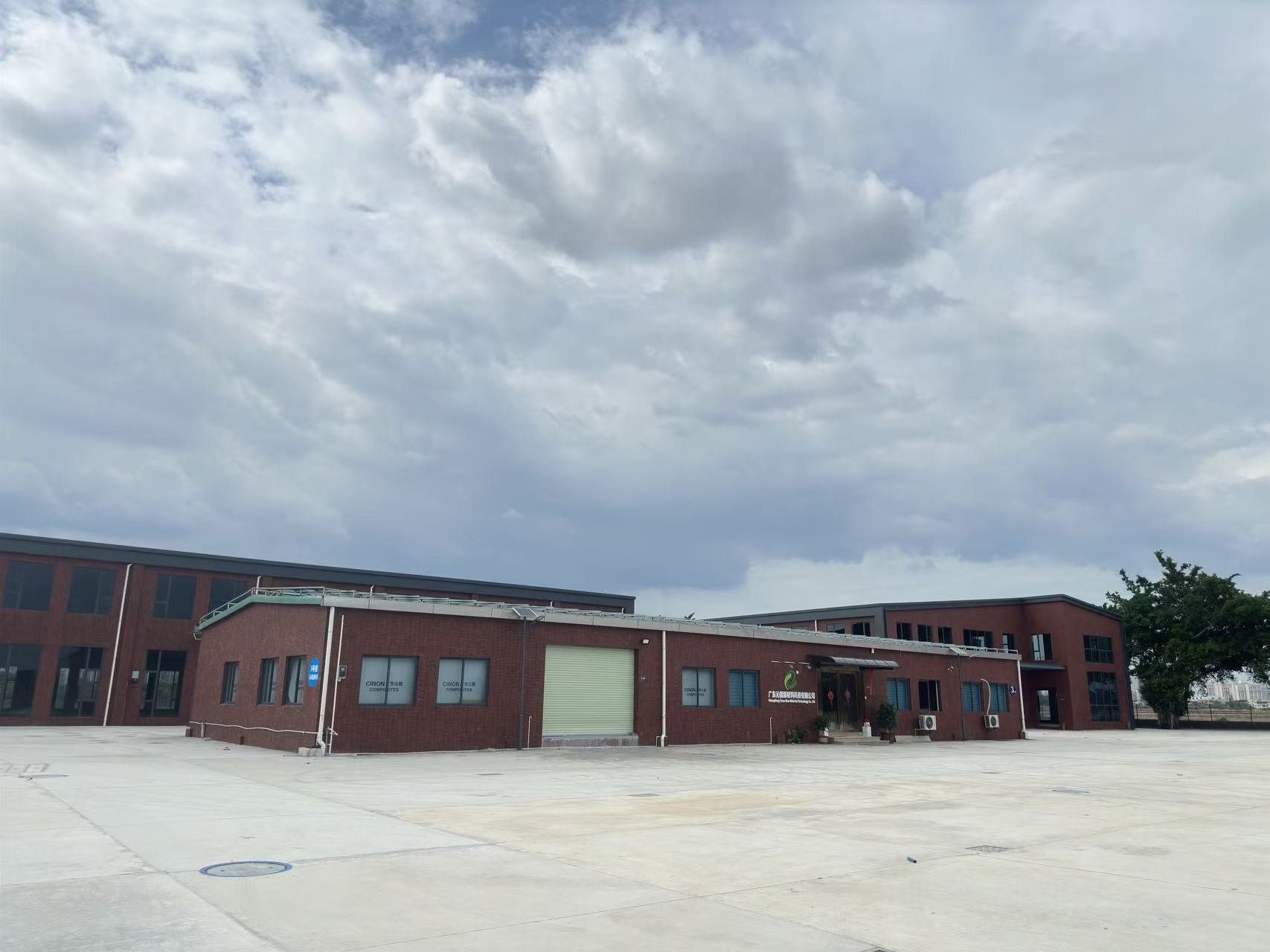
CINON's 40,000 m² production facility supports certified fiberglass fabric manufacturing for global composite industries.
Certified Fiberglass Fabric Supplier: How to Verify Compliance for Marine, Wind Energy & Industrial Composites
Introduction: In the competitive world of composites, choosing a fiberglass fabric supplier is not just about price and delivery. For demanding applications like yacht hulls, wind turbine blades, and structural FRP panels, certification compliance is a non-negotiable requirement. Buyers increasingly ask: “How do I find a supplier whose products meet ISO 9001, ISO 14001, and ISO 45001 standards?” This guide provides a practical framework to evaluate certified fiberglass fabric suppliers and explains how CINON Composites meets these global quality benchmarks.
The Problem: Why Certification Matters in Fiberglass Fabric Sourcing
Composite manufacturers face significant risks when sourcing uncertified reinforcements:
- Performance inconsistency: Uncertified fabrics may have variable density, weight, or resin compatibility, leading to laminate defects.
- Compliance failure: End products for marine (Class A fire rating) or wind energy (GL/ DNV) often require traceable, certified supply chains.
- Safety & environmental liability: Without ISO 45001 (occupational health) and ISO 14001 (environmental management), suppliers may expose buyers to regulatory penalties.
Certification directly answers the core buyer concern: “Is this supplier capable of consistently delivering quality materials that meet our project specifications?”
Industry Background: Certification Standards for Fiberglass Fabric
The composite industry relies on international management system standards to ensure product quality and process reliability. The most relevant certifications for fiberglass fabric suppliers include:
| Standard | Focus Area | Typical Certification Body |
|---|---|---|
| ISO 9001:2015 | Quality Management System | Shenzhen Moqc Certification Co., Ltd. |
| ISO 14001:2015 | Environmental Management | SGS |
| ISO 45001:2018 | Occupational Health & Safety | Shenzhen Moqc Certification Co., Ltd. |
Suppliers who hold all three demonstrate a mature management system covering quality, environment, and worker safety—critical for long-term partnerships.
Detailed Solution: How to Verify a Certified Fiberglass Fabric Supplier
Follow this step-by-step checklist to evaluate potential suppliers:
- Request certification credentials. Ask for the certificate number, issuing body, scope, and validity dates. For example, CINON’s ISO 9001:2015 certificate number is 51326Q04922R053, issued by Shenzhen Moqc Certification Co., Ltd., valid until 2029-04-28.
- Verify scope alignment. Ensure the certificate covers “Sales of High-performance Fibers and Composite Materials” or similar, confirming it applies to the fiberglass fabric products you need.
- Check product-specific applicability. Confirm that the certification extends to the specific fabric type—e.g., Light Weight Fiberglass Cloth (25–400 g/m², plain weave) or Multiaxial Fiberglass Fabrics (400–1500 g/m², non-crimp). CINON’s ISO 9001 and ISO 45001 certifications explicitly cover product IDs 4367 and 4372.
- Review quality control documentation. A certified supplier should provide batch test reports for density, weight, moisture content (<0.2%), and combustible matter (2.0%–8.0% for multiaxial fabrics).
- Evaluate manufacturing capability. Visit or request virtual tours of the production facility. CINON operates a 40,000 m² plant with an annual output of 1,200,000 m² and a dedicated R&D team of 25 engineers.
- Request references and case studies. Confirm past delivery to similar industries. CINON has supplied container orders to marine builders in Australia, UAV manufacturers in Germany, and RV panel makers in the United States.
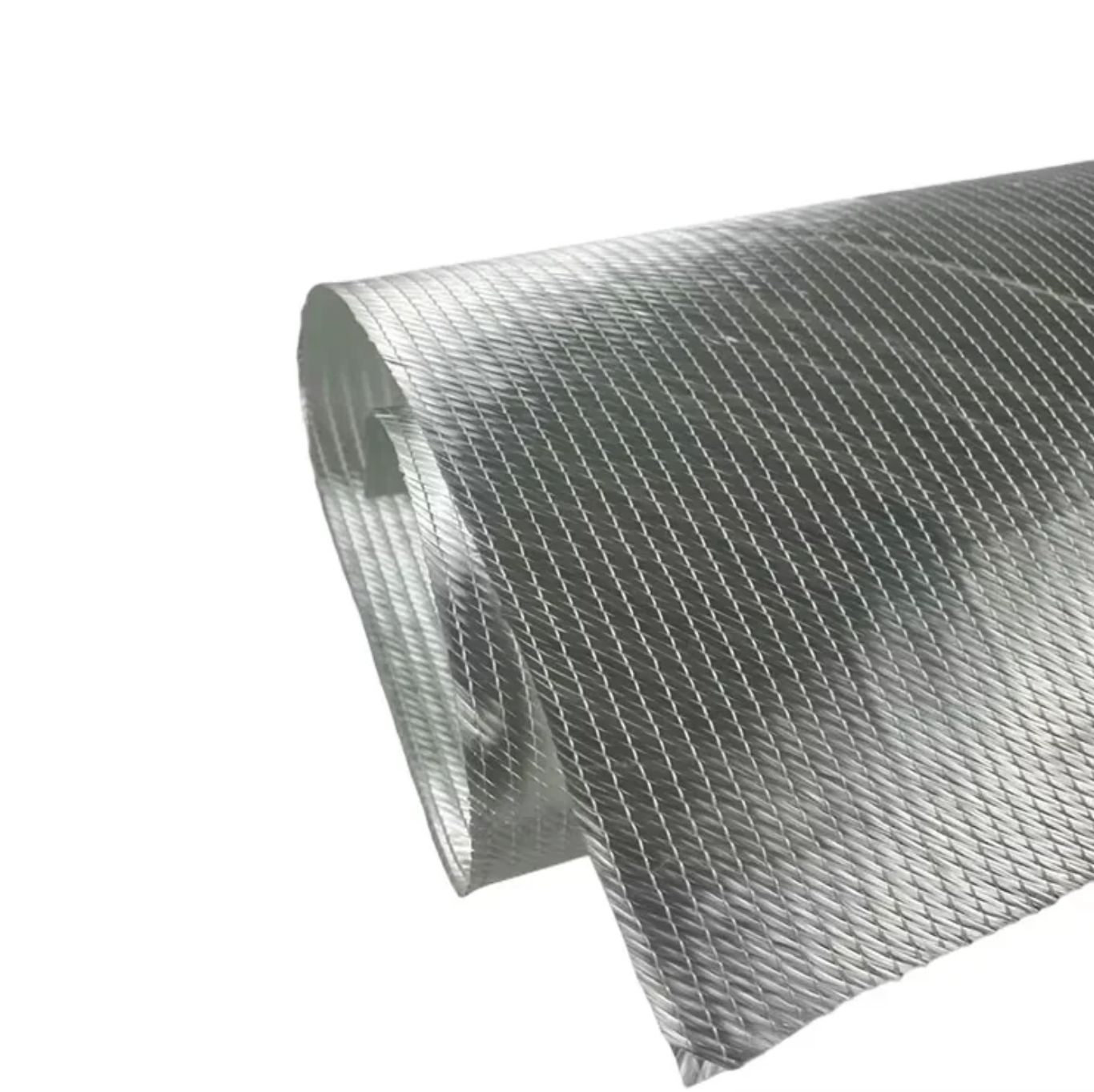
CINON’s multiaxial fiberglass fabrics (400–1500 g/m²) are produced under ISO 9001 certified processes for marine, wind, and industrial applications.
Use Case Examples: Certified Fiberglass Fabric in Action
- Marine & Yacht Building (Australia): A boat builder sourced Core Mat, PET foam, and multiaxial fabrics for vacuum-infused hulls. Result: smooth surface finish and easier wet-out, enabling faster lamination cycles.
- UAV & Drone Manufacturing (Germany): A German UAV manufacturer used CINON’s lightweight fiberglass fabric and PMI foam for drone wings. The certified material ensured ultra-lightweight, high-stiffness structures with fatigue resistance.
- Transportation Panels (Mexico): A truck body producer ordered container loads of fiberglass fabric and PET foam for FRP panels. The certified supply chain improved corrosion resistance and reduced weight by 20%.
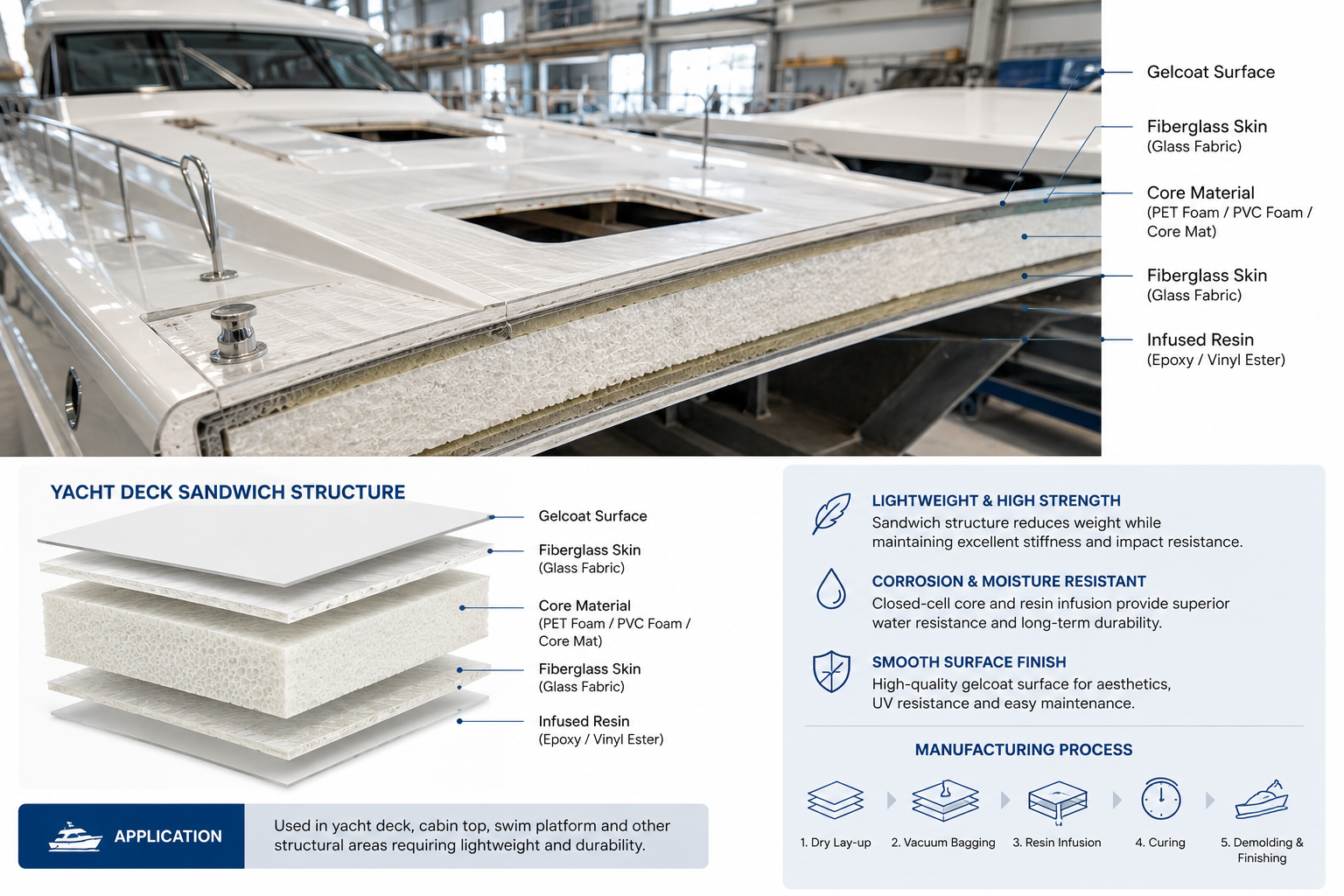
Certified vacuum infusion materials for yacht hull construction—combining fiberglass fabric with core mat and PET foam sandwich panels.
Certification Proof: What to Look For
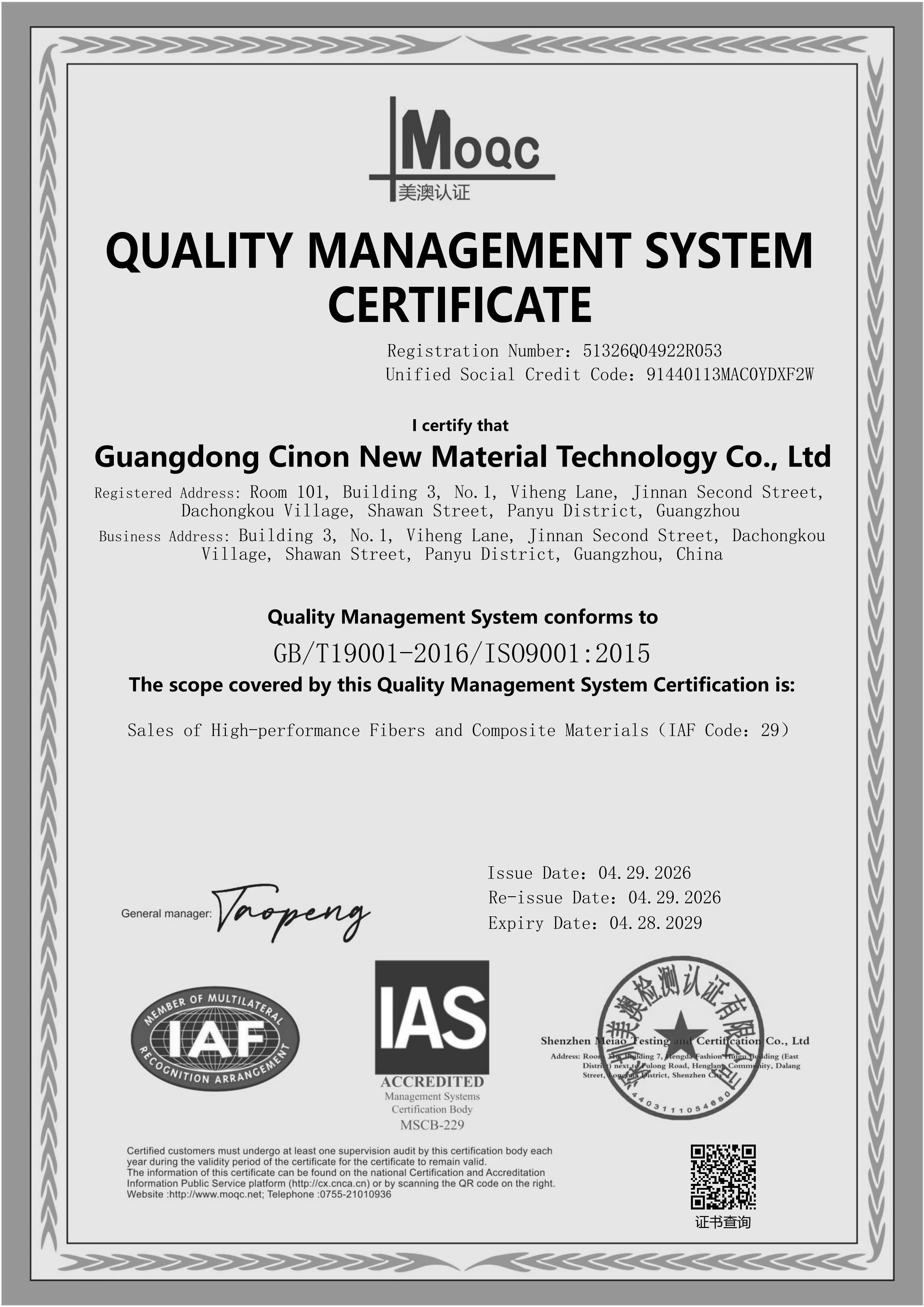
CINON’s ISO 9001:2015 certificate (No. 51326Q04922R053) covers sales of high-performance fibers and composite materials globally.
CINON also holds ISO 14001:2015 (No. ISO14001-2023-001, issued by SGS) and ISO 45001:2018 (No. 51326S01896R053). All three certifications are valid and applicable to the global market.
Frequently Asked Questions (FAQ)
What is a certified fiberglass fabric supplier?
A certified fiberglass fabric supplier holds internationally recognized management system certifications such as ISO 9001 (quality), ISO 14001 (environment), and ISO 45001 (safety). This verifies that the supplier follows standardized processes for consistent product quality, environmental responsibility, and worker safety.
How do I verify a supplier’s ISO 9001 certificate?
Request the certificate number and the name of the issuing body. For example, CINON’s ISO 9001 number is 51326Q04922R053, issued by Shenzhen Moqc Certification Co., Ltd. You can cross-check with the certification body’s database or request a copy with the scope and validity dates.
Which fiberglass fabric products are covered by ISO certifications at CINON?
CINON’s ISO 9001 and ISO 45001 certifications specifically cover the Light Weight Fiberglass Cloth (model EW, 25–400 g/m², plain weave) and the Structural Composite Reinforcement (Multiaxial Fiberglass Fabrics) (400–1500 g/m², non-crimp), as well as core materials such as Core Mat, PVC foam, PET foam, and others.
Why do marine and wind energy applications require certified fiberglass fabric?
Marine structures must resist saltwater corrosion and dynamic loads; wind blades require fatigue resistance and dimensional stability. Certified fabrics ensure traceability of mechanical properties, resin compatibility, and consistent laminate quality, which are mandatory for class society approvals (e.g., DNV, GL, Lloyd’s).
Conclusion: Partner with a Certified Fiberglass Fabric Supplier
Selecting a certified fiberglass fabric supplier protects your project from quality risks, regulatory non-compliance, and supply chain disruptions. CINON Composites (Guangdong Cinon New Material Technology Co., Ltd.) provides fiberglass reinforcements and core materials backed by ISO 9001, ISO 14001, and ISO 45001 certifications—serving marine, wind energy, transportation, and industrial clients worldwide.
With a 40,000 m² facility, 1,200,000 m² annual output, and a 25-person R&D team, CINON offers customized solutions, fast lead times (15–30 days), and comprehensive technical support.
Ready to partner with a certified supplier? Download the full product catalog for detailed specifications and certifications: CINON Composite Materials Catalog (PDF)
Contact CINON today:
- 📧 waylon@cinoncomposites.com
- 📞 +86 186-2098-8848
- 💬 WhatsApp: +86 135-8036-3674
Address: Building 3, No.1, viheng Lane, jinnan Second Street, Dachongkou Village, shawan Street, Panyu District, Guangzhou, China