Ensuring Compliance in Prefabricated Steel Buildings: A Buyer's Guide to Certifications (2026)
Ensuring Compliance in Prefabricated Steel Buildings: A Buyer’s Guide to Certifications (2026)
For procurement professionals sourcing prefabricated steel buildings from China, verifying supplier certifications is the single most effective way to mitigate project risk. This guide explains exactly which certifications matter, how to verify them, and how a compliant supplier like Ganyo Steel Structure can protect your investment.
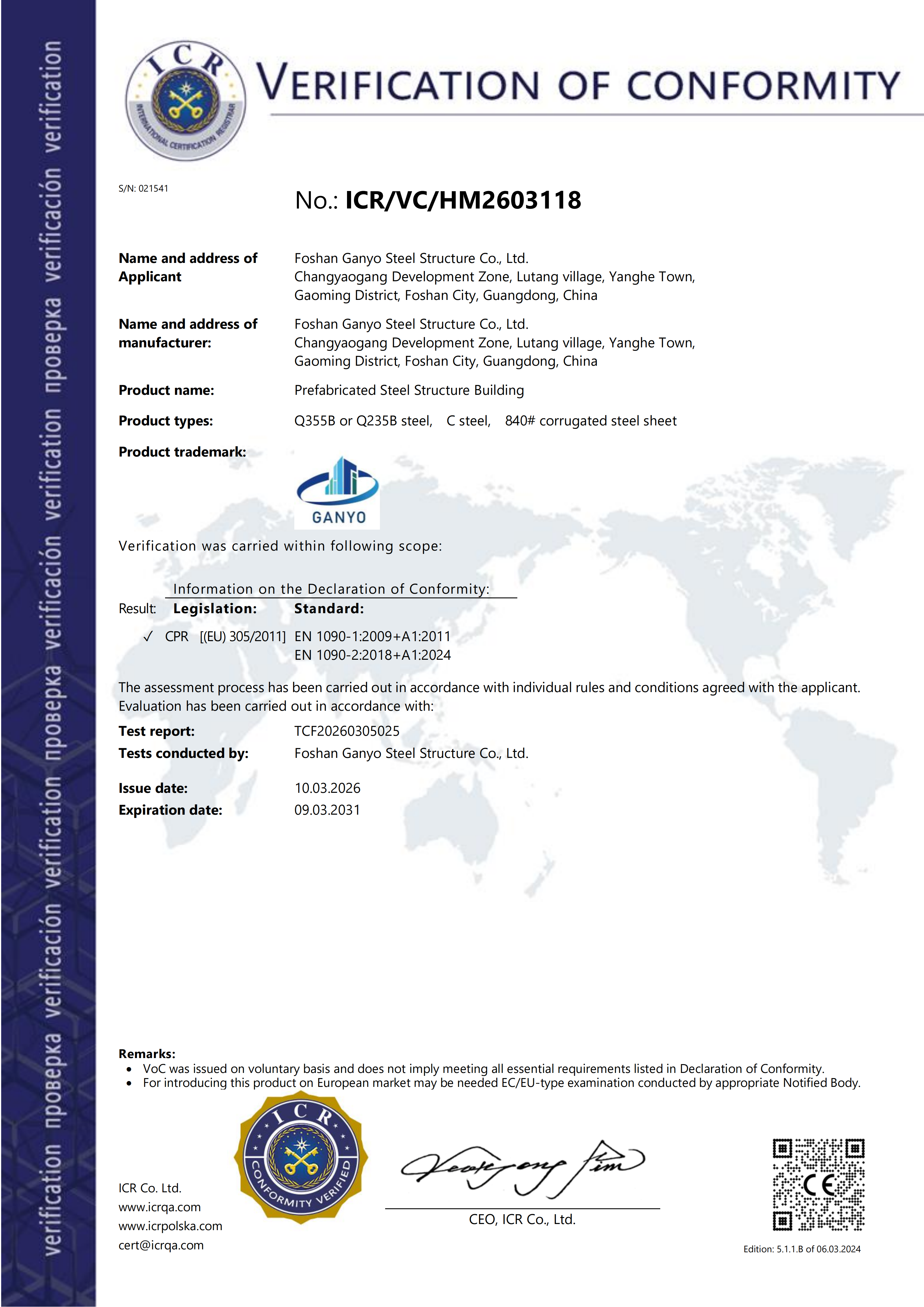
Ganyo Steel Structure holds a VERIFICATION OF CONFORMITY (EN 1090-1) for its prefabricated steel workshop and warehouse products.
The Problem: Why Compliance Certification Matters
Every year, importers lose thousands of dollars because their prefabricated steel buildings fail local building inspections, get delayed at customs, or collapse under extreme weather. The root cause is almost always the same: lack of verified compliance with international standards.
Without proper certifications, a steel building may:
- Be rejected by local building authorities
- Incur costly rework or reinforcement
- Void insurance coverage after a disaster
- Cause safety hazards for workers and occupants
Certifications are not just paperwork – they are the proof that the building’s design, material, and fabrication meet recognized safety and performance benchmarks.
Industry Background: Global Standards for Steel Structures
The global prefabricated steel building market is projected to exceed USD 150 billion by 2028. As demand grows, so does the diversity of suppliers – and the risk of non-compliant products. Leading markets (Europe, North America, Africa, Southeast Asia) each have their own regulatory frameworks:
| Region | Key Standard | What It Covers |
|---|---|---|
| European Union | EN 1090-1 / EN 1090-2; CE Marking | Structural steelwork, material properties, fabrication, corrosion protection |
| Global (ISO) | ISO 9001:2015 | Quality management system for design, production, and installation |
| China (domestic) | GB/T 19001-2016 (equivalent ISO 9001) | Quality system for Chinese manufacturers |
| Africa / Middle East | Often adopt EN or ASTM standards | Wind, snow, seismic loads based on local codes |
Key Certifications for Prefabricated Steel Buildings
When evaluating a supplier, ask for these four pillars of compliance:
1. ISO 9001:2015 / GB/T 19001-2016 – Quality Management System
This certifies that the supplier has a consistent, audited quality system covering design, procurement, production, inspection, and after-sales. Ganyo Steel Structure holds QMS certificate number 50323Q2126R0S, issued by IAF, valid until 2026-11-21.
2. EN 1090-1 / EN 1090-2 – European Structural Steelwork Standard
Mandatory for prefabricated steel structures exported to the European Union. It covers material conformity, welding qualifications, and factory production control. Ganyo’s VERIFICATION OF CONFORMITY (ICR/VC/HM2603118), valid until 2031-03-09, confirms compliance with CPR (EU) 305/2011 and EN 1090-1:2009+A1:2011 and EN 1090-2:2018+A1:2024.
3. Material Certifications (Mill Test Reports)
For main steel grades Q355B or Q235B, suppliers should provide mill certificates from the steel mill. These verify chemical composition and mechanical properties.
4. Anti-Corrosion and Fire Protection Compliance
Coastal and tropical projects require hot-dip galvanizing or specialized coatings. Ganyo uses 100% hot-dip galvanizing for secondary members and offers multi-layer painting for main frames, with third-party thickness inspection.
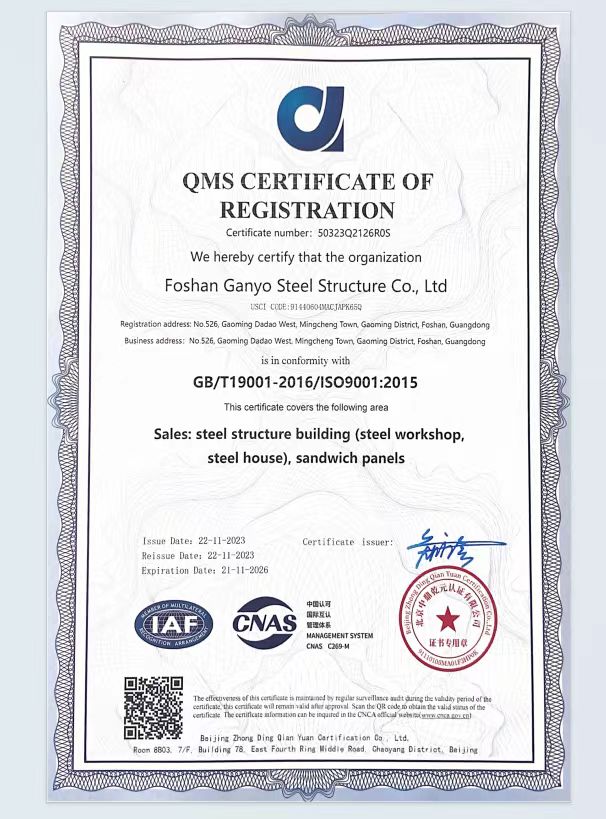
Ganyo’s ISO 9001:2015 certificate (QMS) – a baseline trust indicator for global buyers.
Step‑by‑Step: How to Verify a Supplier’s Certifications
- Request certificate copies – ask for high-resolution scanned documents with certificate numbers.
- Check the issuing body – accredited bodies (ICR, IAF, SGS, TÜV) add credibility. Look up the accreditation mark.
- Verify scope and product coverage – the certificate must explicitly list “prefabricated steel structure building” or similar.
- Confirm validity – note issue and expiry dates. ISO 9001 requires annual surveillance audits.
- Cross-check with the project’s local code – e.g., if your project is in Senegal, confirm the supplier’s seismic and wind load design follows accepted standards.
- Request project reference documents – photos, shipping documents, and client testimonials from similarly certified projects.
Real‑World Compliance Case Studies
The best proof of compliance is a successful project. Here are two examples from Ganyo Steel Structure that demonstrate how proper certification translates into on‑site performance:
Cameroon Workshop Project (2,184 m²)
Located in a tropical rainforest climate with high humidity and heavy rainfall, this prefabricated steel workshop used H‑section portal frames, insulated sandwich panels, and hot‑dip galvanized secondary parts. All components were factory‑inspected and shipped with multi‑layer anti‑corrosion coating. The building passed local inspection without rework and has operated stably for over 2 years.
Australia Workshop & Warehouse (2,000 m²)
Engineered to Australian standards, this project required wind and fire resistance, termite proofing, and seismic design. Ganyo’s EN 1090‑1 compliant fabrication and ISO 9001 quality system ensured every weld and coating met the spec. The result: a column‑free large‑span space delivered 40% faster than concrete alternatives.
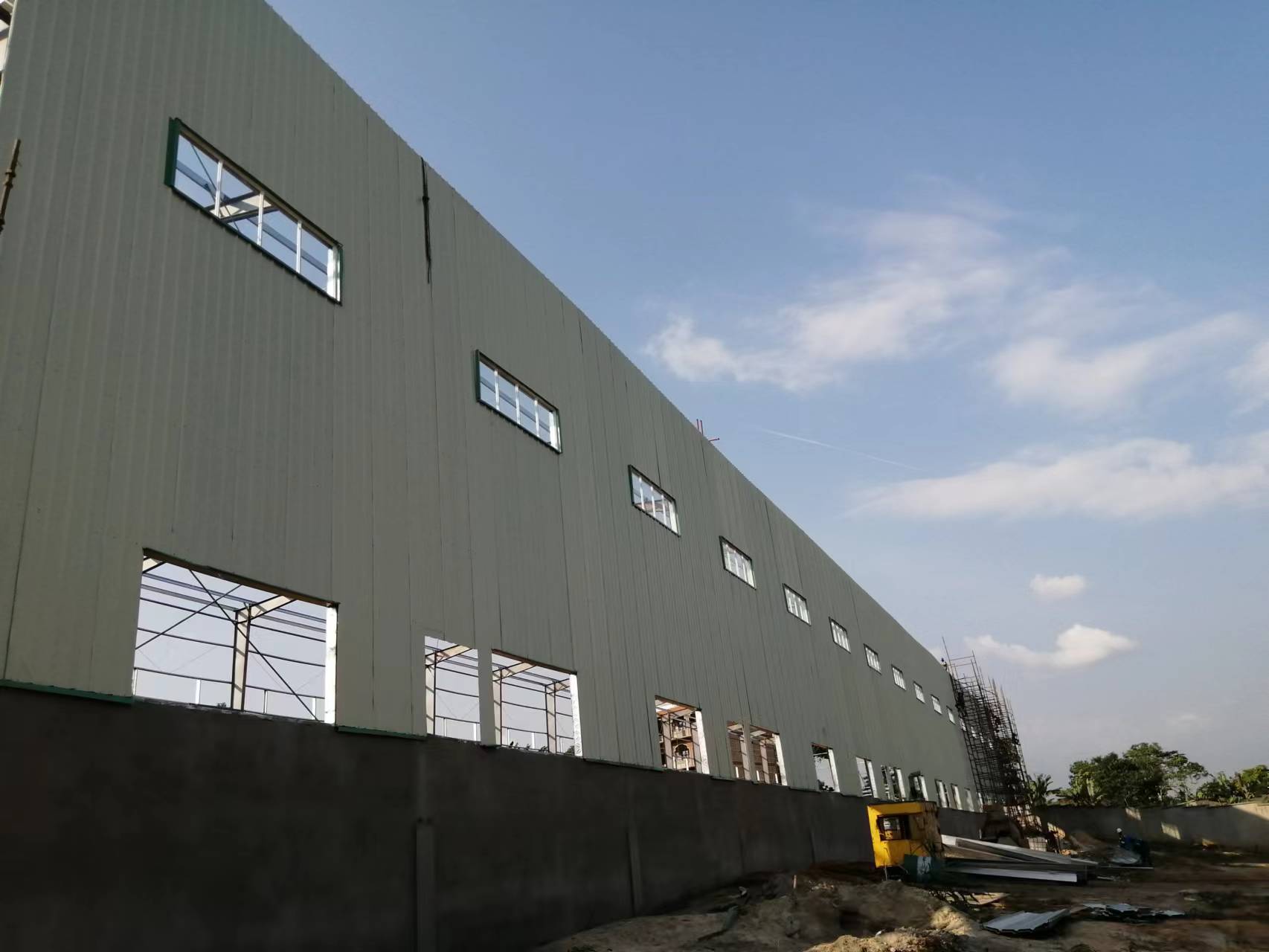
Ganyo’s 2,184 m² Cameroon workshop – built with certified anti‑corrosion measures for humid climates.
Frequently Asked Questions (FAQ)
Q: Are these certifications valid globally?
A: Most certification bodies (ICR, IAF) are internationally recognized. However, you must verify that the standard specifically applies to your country. EN 1090‑1 is widely accepted outside Europe as a high‑quality benchmark.
Q: What if my project only needs basic quality – do I still need EN 1090?
A: Even for basic industrial sheds, ISO 9001 is a minimum. EN 1090 adds structural reliability. Many African and Asian countries now require CE‑equivalent or third‑party inspection for imported steel buildings.
Q: How can I spot a fake certificate?
A: Check the certificate number with the issuing body, look for official logos, holograms, and ensure the scope matches the product. Also ask for proof of recent surveillance audits.
Q: Does Ganyo offer custom designs to meet local building codes?
A: Yes. All Ganyo buildings are designed per the client’s local wind, snow, and seismic load requirements, using Q355B/Q235B steel with certified fabrication processes.
Conclusion: Choose a Certified Partner, Not Just a Supplier
Certifications are the foundation of safe, durable, and code‑compliant prefabricated steel buildings. By demanding ISO 9001, EN 1090‑1, and material traceability, you protect your investment and avoid costly delays.
Foshan Ganyo Steel Structure Co., Ltd has built its reputation on certified quality – from the QMS certificate (50323Q2126R0S) to the EN 1090‑1 VERIFICATION OF CONFORMITY (ICR/VC/HM2603118). With a 50,000 m² factory, 12 R&D engineers, and 20,000‑ton annual capacity, Ganyo is ready to support your next turnkey project.
Download the company brochure below to review full specifications and contact details:
📄 Download Ganyo Company Brochure (PDF)
Contact Ganyo Steel Structure:
Lizzy | Email: lizzy@ganyosteelbuilding.com | WhatsApp: +86 13516623561
Address: Changyaogang Development Zone, Lutang Village, Yanghe Town, Gaoming District, Foshan City, Guangdong, China
Website: ganyosteelhouse.com