
How to Source Exhaust Fans Efficiently and Avoid Supply Risks in 2026
Global procurement of exhaust fans has become increasingly complex. With surging demand for residential, commercial, and industrial ventilation, buyers face challenges such as inconsistent quality, delayed deliveries, non‑compliant certification, and hidden costs. This guide delivers a structured methodology to help you source exhaust fans efficiently while mitigating common risks. By leveraging proven supplier evaluation frameworks and real‑world examples, you will learn how to protect your supply chain and secure long‑term value.
Problem Definition: The Real Cost of Poor Sourcing Decisions
Many buyers discover after signing a contract that the supplier cannot meet specifications, fails to deliver on time, or uses counterfeit certificates. The consequences include:
- Quality failures – fans that underperform, overheat, or fail prematurely
- Compliance penalties – products rejected at customs due to missing CE, UKCA, or RoHS marks
- Project delays – production stoppage because the wrong exhaust fan type was supplied
- Hidden costs – re‑sourcing, expedited freight, and legal disputes
These issues are especially critical for ceiling exhaust fan, bathroom light exhaust fan, kitchen exhaust fan, and wall mounted exhaust fan applications where safety and performance are mandatory.
Industry Background: The Evolving Exhaust Fan Supply Chain
The global ventilation fan market is projected to grow at a CAGR of 5.8% through 2032. Key drivers include stricter building regulations, the rise of energy‑efficient homes, and post‑pandemic indoor air quality awareness. However, the supply base remains fragmented. Chinese manufacturers account for over 60% of global exhaust fan production, offering competitive pricing but varying quality tiers. European and Japanese suppliers command premium prices with rigorous certifications. To select the right exhaust fan supplier, buyers must adopt a systematic due‑diligence process that covers production capacity, certification validity, and financial stability.
Detailed Solution: A Stage‑Gated Procurement Framework
Below is a proven five‑stage approach that reduces sourcing cycle time by 30% while increasing first‑pass yield.
Stage 1: Define Your Technical and Commercial Requirements
Before contacting any supplier, document:
- Application type – bathroom, kitchen, attic, garage, or industrial
- Airflow performance – CFM / m³/h requirement at specific static pressure
- Noise limit – sone or dB(A) maximum for occupied spaces
- Certification needs – CE, UKCA, RoHS, EMC, LVD, etc.
- Budget and MOQ – unit price target, minimum order quantity, payment terms
For example, a bathroom exhaust fan for European residential use typically requires CE‑LVD and CE‑EMC marking, low noise (< 30 dB), and a compact design suitable for ceiling mounting.
Stage 2: Identify Pre‑Qualified Suppliers
Focus on manufacturers with long‑standing industry experience, dedicated R&D, and modern production facilities. Use public databases, trade shows, and verified B2B platforms. Check:
- Years in business – at least 5 years is a positive signal
- Number of production lines and annual output
- Existing client base and export countries
A reliable partner such as Aosun (10+ years, 190 employees, 20,000 sqm factory) operates 8 modern lines including injection molding, motor production, and automated assembly, achieving an annual output of over 1 million units. Such capacity ensures stable supply for OEM and ODM orders.
| Supplier Capability Indicator | Preferred Benchmark | Red Flag |
|---|---|---|
| Annual output | >500,000 units | <100,000 units |
| Production lines | ≥ 5 | 1‑2 manual lines |
| R&D team (engineers) | ≥ 10 | No dedicated team |
| Certifications held | CE, UKCA, RoHS, EMC | Only basic CE |
| Export countries | ≥ 20 | Domestic only |
Stage 3: Validate Production Capability and Quality System
Request a factory tour (virtual or physical) and evaluate:
- Injection molding – precision parts ensure consistent impeller balance
- Motor manufacturing – in‑house motor winding leads to better efficiency and reliability
- Assembly automation – reduces human error and improves repeatability
- Quality checkpoints – incoming material inspection, in‑process testing, final performance test
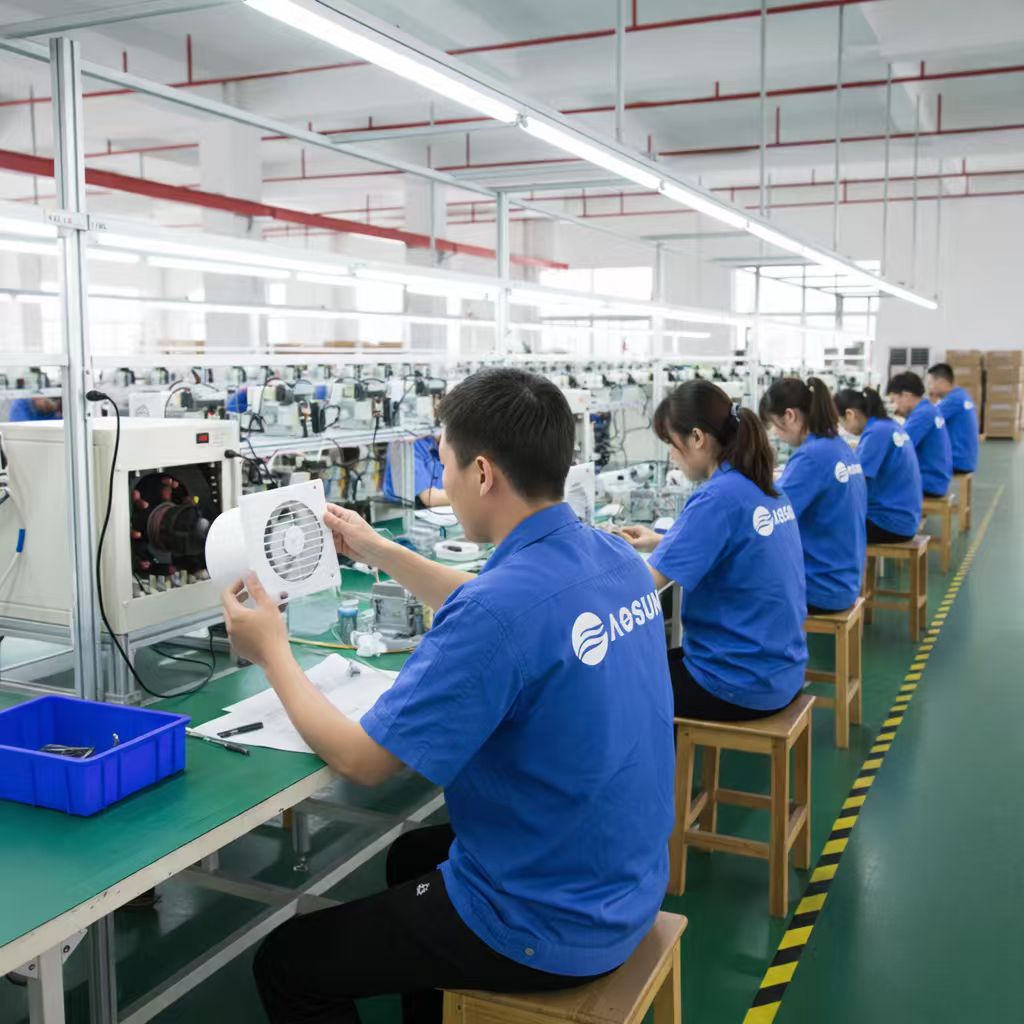
A modern production line assembling ventilation fan casings – a sign of consistent quality control.
Certification documents should be verified directly on the certification body’s database. For instance, Aosun’s CE‑LVD certificates (No. 61.11.23.1318.01, QTS800123697) and UKCA‑EMC (No. QTS800225513) provide traceable compliance for bathroom and kitchen exhaust fans exported to Europe and the UK.
Stage 4: Assess Commercial Terms and Flexibility
Beyond price, examine:
- MOQ per model – can the supplier accommodate small trial orders?
- Lead time – typical 30–45 days for mass production; shorter for stock models
- Payment terms – T/T 30% deposit + 70% against B/L is standard
- After‑sales policy – warranty period (≥2 years for quality issues) and replacement process
Flexible manufacturers like Aosun support OEM / ODM customization and project‑based scheduling, ensuring reliable delivery even for large‑scale contracts.
Stage 5: Execute a Structured Trial Order
Start with a small batch covering your most critical models – for example, a ceiling exhaust fan for bathrooms and a wall mounted exhaust fan for utility areas. During the trial:
- Conduct third‑party performance tests (airflow, noise, power consumption)
- Verify certification marks on the actual product and packaging
- Evaluate packaging durability for export shipping
Document all findings and use them to negotiate final terms before scaling.
Use Cases: Matching Product Types to Procurement Needs
Below are scenario‑based recommendations for different applications.
| Application | Recommended Product Type | Key Sourcing Criteria |
|---|---|---|
| Residential bathroom | Bathroom exhaust fan / Bathroom light exhaust fan | Low noise (<25 dB), CE mark, IPX4 rating |
| Kitchen range hood | Kitchen exhaust fan (inline or wall‑mounted) | High CFM (>200), grease‑proof coating, EMC compliance |
| Attic ventilation | Attic exhaust fan (gable or roof‑mount) | Thermostat control, high‑temperature rating, weatherproof |
| Garage workshop | Garage exhaust fan (wall‑mounted) | Explosion‑proof option, heavy‑duty motor, manual shutters |
| General commercial | Ventilation exhaust fan / Ceiling exhaust fan | Continuous duty, low power consumption, multi‑speed control |
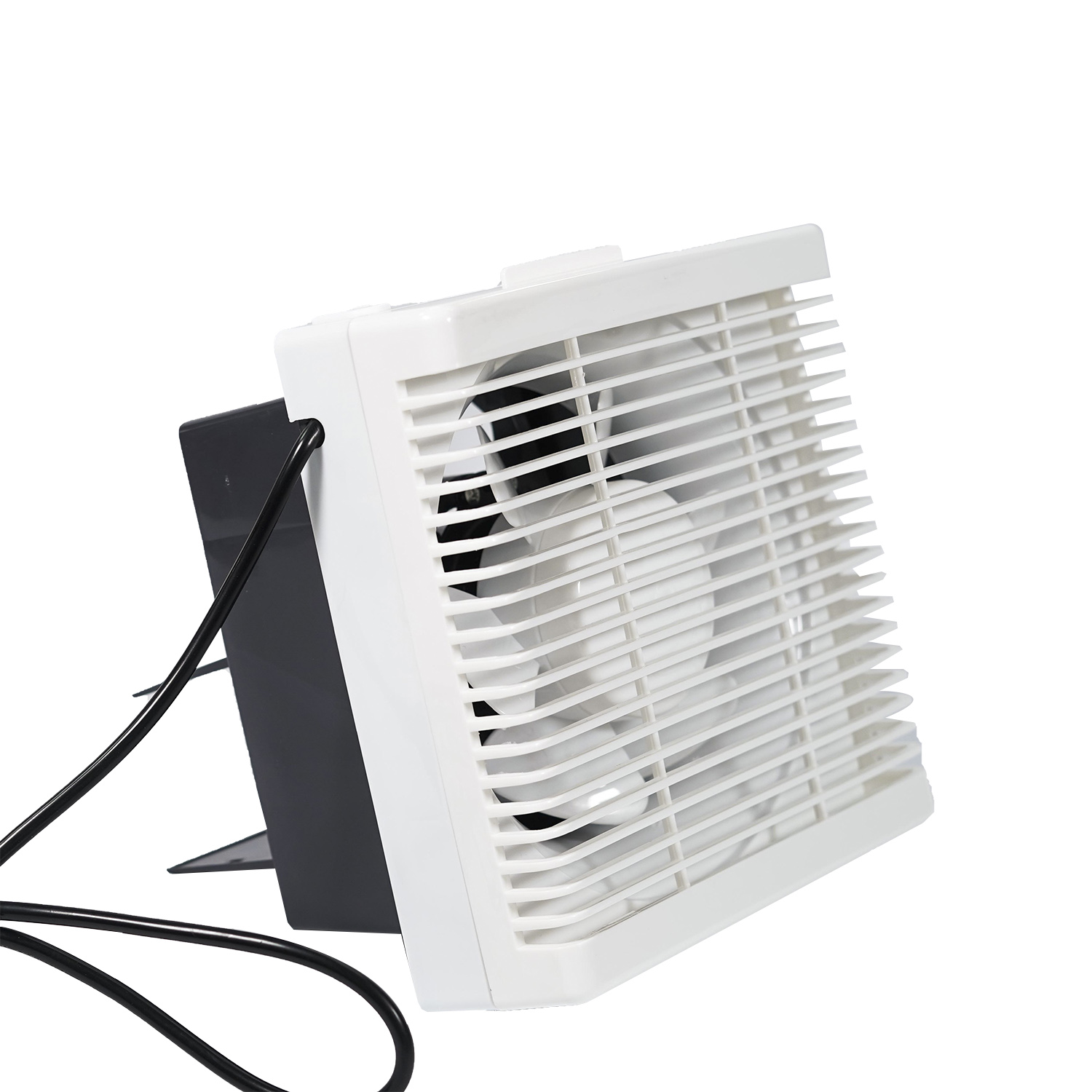
A kitchen exhaust fan designed for efficient smoke and odor removal – a common high‑volume item for procurement.
Frequently Asked Questions
What is the difference between a ceiling exhaust fan and a wall mounted exhaust fan?
A ceiling exhaust fan is installed in the ceiling and is ideal for bathrooms and small rooms where vertical space is available. A wall mounted exhaust fan is installed on an exterior wall and is better for kitchens, garages, and areas where ducting through the ceiling is difficult. The choice depends on building structure, airflow path, and installation convenience.
How can I verify a supplier's CE certificate is genuine?
Every legitimate CE certificate includes a unique number and the notified body code (e.g., NB 1234). You can cross‑check on the manufacturer’s website or request a scanned copy with the certification body’s stamp. Additionally, ask for test reports (e.g., from TÜV or SGS) to confirm the product was tested to the relevant standard. Aosun provides transparent access to its CE‑LVD, CE‑EMC, UKCA, and RoHS certificates for validation.
What is a typical lead time for an OEM exhaust fan order?
Lead time varies by complexity. Simple models (e.g., standard bathroom exhaust fan) may take 30 days. Customized orders (e.g., kitchen exhaust fan with special dimensions or voltage) typically require 45–60 days, including tooling. Established manufacturers with flexible scheduling, like Aosun, can often shorten lead times for repeat orders by maintaining buffer stock of commonly used components.
How do I avoid receiving under‑powered exhaust fans?
Always request a certified airflow performance curve from the supplier. Compare the stated CFM at 0.1 in. w.g. against independent test data. For critical applications, engage an ISO 17025 accredited lab to test samples. Using a trial order for 10–20 units helps detect batch‑to‑batch variation before full production.
Conclusion: Build a Resilient Exhaust Fan Supply Chain
Efficient sourcing of exhaust fans requires more than comparing price lists. By following the five‑stage framework – requirement scoping, supplier pre‑qualification, capability validation, commercial negotiation, and trial order execution – you can dramatically reduce risks and improve total cost of ownership. A partner like Aosun, with 10+ years of expertise, 8 modern production lines, CE/UKCA/RoHS certifications, and a track record of exporting to 50+ countries, offers a reliable foundation for your procurement success.
Contact Aosun to discuss your specific exhaust fan needs and request a customized quotation.
📍 Marketing Center: Room 801-802, MeiJing Mansion, Southern CBD, Ningbo City, Zhejiang, China
📞 Phone/WhatsApp: +86 18606589361
✉️ Email: alan.h@elmakelectrical.com
🌐 Website: https://www.aosvents.com/
Download our product catalog or schedule a factory tour to see why Aosun is the preferred exhaust fan supplier for global buyers.