
LFT Carbon Fiber Composite Plastic vs. Traditional Materials: A 2026 Buyer's Guide for Weight-Sensitive Applications
LFT Carbon Fiber Composite Plastic vs. Traditional Materials: A 2026 Buyer's Guide for Weight-Sensitive Applications
In the rush to lightweight everything from electric vehicle battery enclosures to drone airframes, procurement professionals face a critical crossroad: should you stick with traditional metal, short carbon fiber (SCF), or glass fiber (GF) composites, or make the leap to Long Fiber Thermoplastic (LFT) Carbon Fiber Composite Plastic? The decision impacts not only weight reduction but also total cost, manufacturing complexity, and long-term reliability.
This guide provides a structured framework to evaluate LFT Carbon Fiber Composite Plastic against conventional alternatives, drawing on real-world data, technical comparisons, and supplier capabilities. Whether you are sourcing for aerospace, new energy vehicles, robotics, or sports equipment, you will learn exactly how LFT solutions—such as those offered by Guangdong Baolijin New Material Technology Co., Ltd (brand Polygram)—can deliver 30–50% weight savings while lowering total cost of ownership.
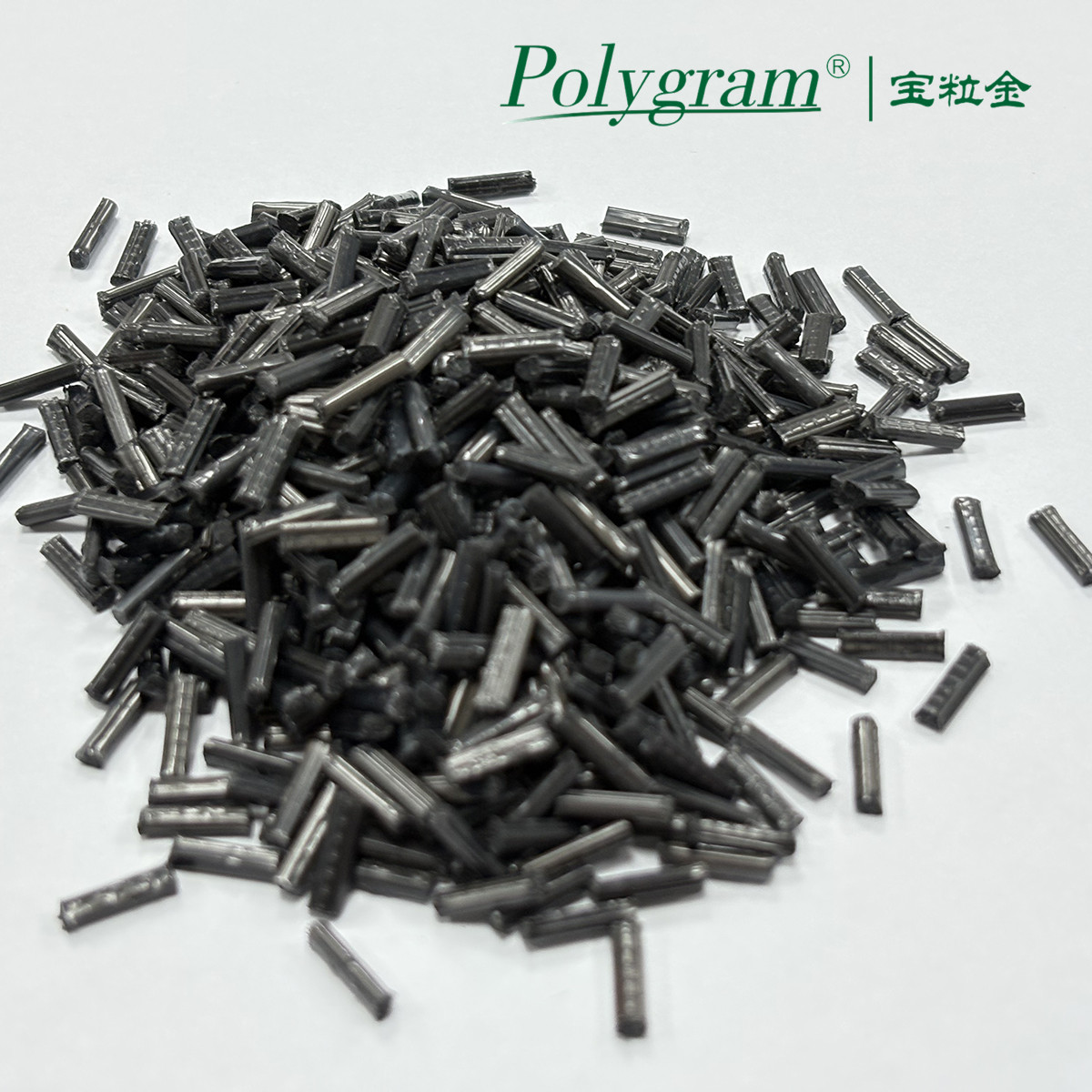
What Is LFT Carbon Fiber Composite Plastic?
LFT (Long Fiber Thermoplastic) Carbon Fiber Composite Plastic is a high-performance material where continuous or long carbon fibers (typically 5–25 mm) are fully impregnated with a thermoplastic resin (e.g., PP, PA6, PA66, PPA, PPS, PEEK). Unlike short fiber composites where fibers are less than 1 mm, LFT preserves fiber length during injection molding, resulting in superior mechanical properties.
How it works: Through a specialized pultrusion or extrusion process, the long fibers are wetted by molten resin and then pelletized. During injection molding, the fibers retain lengths of 5–25 mm, forming an interlocking network that provides exceptional strength, stiffness, and impact resistance.
Why Is This Comparison Important Now?
By 2026, industries such as aerospace, new energy vehicles, low-altitude economy (UAVs, eVTOL), and robotics are pushing lightweight targets beyond what metal and short fiber composites can economically achieve. The need for simultaneous weight reduction, fatigue life extension, and corrosion resistance has never been higher. According to industry estimates, LFT composites can reduce component weight by 30–50% compared to aluminum alloy while offering 20–40% higher tensile strength than SCF/GF and 2–5 times longer fatigue life.
This guide addresses the core buyer questions: What makes LFT different? Is the raw material premium worth it? Which applications benefit most? How do I evaluate suppliers?
LFT vs. Traditional Materials: Side-by-Side Comparison
| Property | LFT Carbon Fiber Composite | Aluminum Alloy (5052/6061) | Short Carbon Fiber (SCF) / GF Composite |
|---|---|---|---|
| Weight Reduction vs. Metal | 30–50% lighter | Baseline | 15–30% lighter |
| Tensile Strength (ISO 527-2) | Up to 350 MPa | ~250–310 MPa | ~100–200 MPa |
| Fatigue Life | 2–5x longer than SCF/GF | Moderate | Limited by fiber breakage |
| Impact Toughness (Izod) | 40 kJ/m² (GB/T 1843) | ~30 kJ/m² | ~10–20 kJ/m² |
| Maintenance | Corrosion-free, no anti-rust | Prone to corrosion, painting needed | Good chemical resistance but lower toughness |
| Raw Material Cost | Slightly higher than SCF/GF | Low (per kg) | Low to moderate |
| Total Cost of Ownership | Lower (less processing, assembly, maintenance) | Moderate to high (coatings, fasteners) | Moderate (higher scrap) |
| Design Freedom | Complex geometries, integrated molding | Requires machining, welding | Limited by fiber orientation |
Source: Comparison data from internal testing and customer feedback. See product brochure for detailed specifications.
How to Choose the Right Material for Your Application
Step 1: Identify Your Primary Drivers
- Weight sensitivity: Is every gram critical? (UAV, EV, aerospace)
- Fatigue / vibration: Does the part experience cyclic loads? (robotics, automotive chassis)
- Corrosion environment: Will it face moisture, chemicals, or salt spray?
- Production volume: Are you molding 10,000+ parts per year?
- Complexity: Does the part require thin walls, undercuts, or integrated features?
Step 2: Match Material to Requirements
- Choose LFT Carbon Fiber Composite Plastic if you need 30–50% weight reduction, high impact strength, fatigue resistance, and low warpage. Ideal for battery pack covers, UAV arms, servo motor brackets, and structural components.
- Choose aluminum alloy only if the part cannot be plastic (e.g., high thermal dissipation >150°C continuous, or strict electrical conductivity).
- Choose short carbon fiber/GF composite only for non-structural, low-stress parts where cost per kg is the only metric.
Step 3: Evaluate Supplier Capabilities
When sourcing LFT Carbon Fiber Composite Plastic, look for a supplier that offers:
- Full-process integration: Material formulation, mold design, injection molding – one-stop service reduces risk and lead time.
- Certifications: ISO 9001:2015, IATF 16949:2016 (automotive), ISO 13485:2016 (medical) – verify scope.
- Proven track record: Case studies with measurable weight savings (e.g., 42% weight reduction for an EV battery cover).
- Quality control: 100% batch testing, traceability, and compliance with UL94 V0, RoHS, REACH.
Real-World Case: New Energy Vehicle Battery Pack Upper Cover
Client: Tier 1 New Energy Vehicle supplier (ODM, China). Duration: 8 years (2018–2026).
Solution: LFT Carbon Fiber Composite Plastic replaced aluminum alloy. The integrated injection-molded part achieves:
- 42% weight reduction compared to aluminum
- 18% cost reduction (lower processing, no welding/painting)
- UL94 V0 flame rating + IP6K9K dust/water protection
- Zero after-sales cracking or leakage over 120,000 units/year
Key enablers: Low-float fiber design for high-speed mass production, CTE matched to aluminum (28 ppm/°C), and long carbon fiber integration.
Common Buyer Concerns Addressed
A: The raw material cost is slightly higher than SCF/GF. However, the total cost is often lower because LFT requires fewer processing steps, eliminates assembly of multiple parts, and reduces maintenance. For weight-sensitive moving parts, the energy efficiency gain can pay back the premium within months.
A: The material is corrosion-free and requires no anti-rust treatment. It withstands temperatures from -50°C to 120°C, resists UV, moisture, and many chemicals. In a decade-long battery cover application, no cracking or degradation was observed.
A: Yes. Guangdong Baolijin holds ISO 13485:2016 certification (GB/T 42061-2022) for processing medical device plastics. Special formulations can meet biocompatibility requirements.
A: Typical MOQ is 200 units; lead time negotiable depending on complexity. The factory has a monthly capacity of 12 million units and a 30-day lead time for standard grades. ODM customization is available.
Conclusion: Why LFT Carbon Fiber Composite Plastic Is the Smart Choice for 2026
For buyers targeting lightweight, high performance, and lower total cost, LFT Carbon Fiber Composite Plastic presents a compelling alternative to metal and short fiber composites. Its unique combination of 30–50% weight reduction, superior fatigue life, minimal maintenance, and design freedom makes it ideal for the most demanding applications in automotive, aerospace, robotics, and beyond.
When evaluating suppliers, prioritize those with deep material science expertise, integrated manufacturing capabilities, and proven certifications. Guangdong Baolijin New Material Technology Co., Ltd (brand Polygram) offers exactly that—over 20 years of polymer experience, a dedicated R&D team of 10 engineers, and a full-service model from material design to injection molding.
To explore technical datasheets, test reports, and detailed application case studies, download the corporate brochure below.
📄 Download Polygram LFT Carbon Fiber Composite Brochure (PDF)