
How to Verify Particle Counter Supplier Quality: A Buyer's Guide
How to Verify Particle Counter Supplier Quality: A Buyer's 5-Step Verification Framework
In regulated industries such as pharmaceuticals, semiconductors, and biotechnology, the performance of a particle counter directly impacts product quality, compliance, and operational safety. However, procurement professionals often face a critical challenge: how to determine if a particle counter supplier truly meets your quality standards before placing an order. This guide provides a practical, data-driven framework for evaluating suppliers, with a focus on certifications, technology, manufacturing capability, and real-world performance.
What Is a Particle Counter and Why Does Supplier Quality Matter?
Particle counter is an instrument used to measure the number and size distribution of particles in air or liquid. Common types include airborne particle counter, liquid particle counter, laser particle counter, and optical particle counter. These devices are critical for cleanroom monitoring (ISO 14644), pharmaceutical GMP compliance, HVAC validation, and environmental monitoring.
The quality of a particle counter depends on its sensor accuracy, calibration consistency, durability, and software reliability. A substandard supplier can deliver devices that drift out of calibration, produce false readings, or fail inspection—leading to costly re-certifications, production delays, or even regulatory fines. Therefore, verifying supplier quality upfront is not optional; it is a strategic necessity.
Industry Background: The Growing Demand for Reliable Particle Counters
As global supply chains expand and regulatory scrutiny tightens, buyers increasingly demand certified particle counters that meet international standards. Industries such as semiconductor fabrication, lithium battery manufacturing, chemical processing (pure water and ultrapure water), biopharmaceutical cleanrooms, and food and drug testing rely on precise contamination monitoring.
Leading global companies like Donaldson Company, Inc. and Samsung Bayer have established stringent supplier qualification protocols. To compete, suppliers must demonstrate compliance with ISO 9001, ISO 14644, EU GMP, FDA 21 CFR Part 11, and other relevant certifications. This environment demands a systematic approach to supplier evaluation.
5-Step Framework to Evaluate Particle Counter Supplier Quality
Step 1: Verify Certifications and Compliance
Check if the supplier holds credible, third-party certified quality management systems. For example, Zetron (Beijing Zetron Technology Co., Ltd.) has passed ISO9001:2005, ISO240001, ISO45001, as well as EU certifications including CE, RoHS, FCC, and ATEX, and has obtained SGS testing certification. These credentials indicate a commitment to consistent product quality and international safety standards.
Key certifications to look for:
- ISO 9001 – Quality management system
- ISO 14644 – Cleanroom classification
- FDA 21 CFR Part 11 – Electronic records and signatures (for pharmaceutical use)
- EU GMP – Good manufacturing practice
- ATEX – Explosive atmosphere safety (for hazardous environments)
Always request copies of certificates and verify their validity with the issuing body.
Step 2: Assess Technical Specifications and Performance
The core of a particle counter is its optical sensor and laser source. Evaluate the following parameters:
| Parameter | What to Verify |
|---|---|
| Particle size range | Typically 0.3 μm to 25 μm for airborne counters |
| Flow rate | e.g., 2.83 L/min (1 CFM) for standard cleanroom monitoring |
| Counting efficiency | Must meet ISO 21501-4 |
| Maximum concentration limit | Important for high‑particle environments |
| Data output and software | Support for real‑time monitoring, alarm limits, and report generation |
For example, Zetron’s R200 Online Particle Sensors and R210 Laser Airborne 2.83L/min Fixed Online Particle Counter feature submicron detection, wireless IoT integration, and an LCD touchscreen with built-in printer for instant report output. These features ensure reliable data for compliance.
Step 3: Evaluate Manufacturing Capability and Quality Control
Visit the supplier’s facility or request a virtual tour. Look for:
- Dedicated production lines for particle counters
- In‑house calibration and testing equipment
- Quality assurance processes (e.g., incoming, in-process, final inspection)
- Certified cleanroom assembly environment
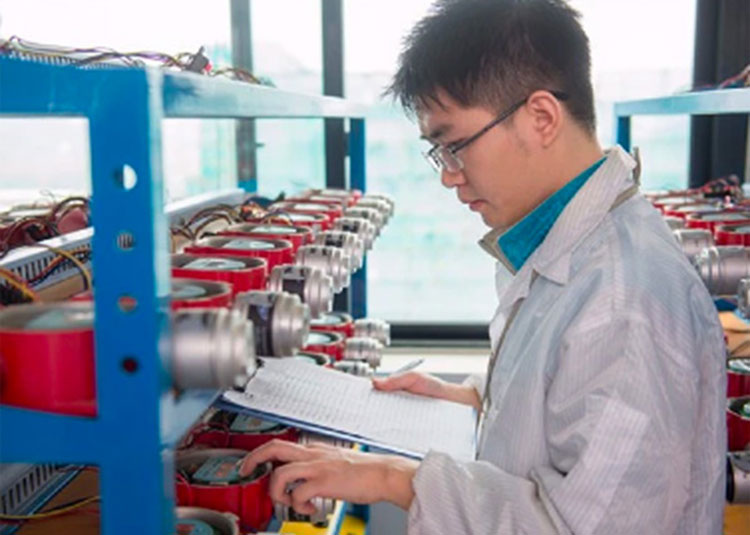
Zetron operates multiple professional production lines and an in‑house testing site, as shown in their factory images. Their testing site supports rigorous validation of each unit before shipment.
Step 4: Review Application‑Specific Fit and Customization Capability
Different applications require different particle counter types:
- Pharmaceutical cleanroom – Airborne particle counter with GMP‑compliant data management
- Semiconductor ultrapure water – Liquid particle counter (e.g., Zetron LPC‑7CE)
- HVAC and environmental monitoring – Portable or handheld particle counter
- Continuous process monitoring – Online particle counter (e.g., Zetron R210, R200, R310P)
Zetron offers a full range: airborne particle counter (B110‑Pro, B330, B550, B1030), liquid particle counter (LPC‑7CE, LPC‑16DA), and online particle sensors (R200, R210, R310P). They also provide OEM/ODM customization from needs diagnosis to maintenance support.
Step 5: Verify After‑Sales Support and Service Level
Quality suppliers offer:
- Calibration and re‑calibration services
- Technical training and documentation
- Warranty and spare parts availability
- Response time for support requests
Zetron provides full‑chain OEM/ODM services including installation, commissioning, and maintenance, ensuring long‑term reliability.
Real‑World Use Case: How a Biopharmaceutical Company Qualified Zetron
A leading biopharmaceutical manufacturer needed a GMP particle counter for its Class B cleanroom. After a rigorous evaluation, they selected Zetron based on:
- ISO 9001 and EU GMP compliance certificates
- Proven performance of the H630 Particle Analyzer (0.3 μm to 25 μm, 2.83 L/min) with real‑time data logging
- Successful factory audit showing consistent calibration standards
- Competitive pricing and local support in China
Since deployment, the counter has maintained ±5% accuracy across quarterly calibrations, meeting all regulatory requirements.
Frequently Asked Questions (FAQ)
Q: What is the difference between an airborne particle counter and a liquid particle counter?
A: Airborne particle counter (also called air particle counter or dust particle counter) measures particles suspended in air, typically used in cleanrooms and HVAC. Liquid particle counter measures contamination in liquids such as ultrapure water, chemicals, or pharmaceuticals. Both use a laser light source to detect particles.
Q: How often should a particle counter be calibrated?
A: Industry best practice recommends annual calibration by an accredited laboratory. Some suppliers, like Zetron, offer calibration services and support.
Q: What certifications should I look for in a particle counter supplier for pharmaceutical use?
A: Minimum requirements: ISO 9001, ISO 14644 compliance, FDA 21 CFR Part 11 (if electronic records are used), and EU GMP. Additional certifications like ATEX or SIL may be needed for hazardous areas.
Q: Can I customize a particle counter for my specific application?
A: Yes. Many suppliers, including Zetron, offer OEM/ODM customization, from sensor configuration to software interfaces and data output formats.
Q: How do I verify the quality of a particle counter before purchase?
A: Request certificates, review technical datasheets, ask for calibration reports, arrange a factory visit or virtual tour, and order a sample unit for testing under your actual conditions.
Conclusion: Make Informed Procurement Decisions
Selecting a high‑quality particle counter supplier is not just about price—it’s about ensuring long‑term compliance, operational reliability, and safety. By following this 5‑step verification framework, you can confidently evaluate suppliers like Zetron (www.zetroncn.com) that demonstrate strong certifications, advanced technology, robust manufacturing, and comprehensive after‑sales support. Contact Zetron at info@bjzetron.com or call +86-15699785629 to discuss your specific requirements and request a sample or factory audit.