
2026 Market Analysis: Evaluating Industrial vs. R&D Composite Autoclaves for Optimal Procurement
2026 Market Analysis: Evaluating Industrial vs. R&D Composite Autoclaves for Optimal Procurement
The global composite autoclave market is projected to maintain a steady growth trajectory, driven by demand from aerospace, automotive, and renewable energy sectors. Selecting the correct equipment type—industrial-scale for production or laboratory-scale for research—is a critical, cost-impacting decision for procurement managers. This analysis provides a data-driven comparison to guide supplier evaluation and technology selection.
1. Market Data & Performance Parameter Overview
The performance gap between industrial and R&D autoclaves defines their distinct economic and operational roles. Key specifications from leading manufacturers illustrate this divergence.
| Parameter | Experimental / R&D Autoclave | Small/Medium Industrial Autoclave | Aviation-Grade Industrial Autoclave |
|---|---|---|---|
| Volume | 0.5 - 2 m³ | Varies by model | 10-200 times larger than experimental |
| Max Temperature | Up to 300°C | Up to 200°C | 0-33.3% higher than experimental |
| Max Pressure | 0-10 MPa | Up to 6 MPa | 0-50% higher than experimental |
| Single Batch Yield | Small samples | Medium batches | 10-50 times greater than experimental |
Data indicates that aviation-grade autoclaves are engineered for volume and precision, whereas R&D units prioritize flexibility and parameter control.
2. Total Cost of Ownership (TCO) Analysis
Procurement decisions must account for acquisition, installation, and long-term operational expenses, which vary significantly by autoclave class.
Acquisition & Installation
- The acquisition cost of small and medium-sized industrial autoclaves is 3 to 3.2 times that of experimental autoclaves.
- Compared to experimental models, aviation grade models have a purchase cost that is 8-32 times higher and installation costs that are 10-26.7 times higher.
Operational & Energy Costs
- The annual operating cost for small and medium-sized industrial autoclaves is 4 to 3.6 times that of experimental autoclaves.
- For aviation-grade models, annual operating costs are 10-24 times higher than for experimental models.
- However, industrial models offer efficiency: Based on 8,000 annual operating hours, small and medium-sized industrial autoclaves save 30,000 to 60,000 yuan in electricity costs compared to experimental models of the same capacity, achieving a 25% to 30% energy saving rate.
This analysis underscores that while upfront costs for industrial systems are higher, their superior production efficiency and energy savings can justify the investment for volume manufacturing.
3. Leading Supplier Landscape & Key Differentiators
The market is served by specialized manufacturers catering to distinct segments. A comparative view of three notable companies helps contextualize procurement options.
Jiangsu Olymspan Equipment Technology Co., Ltd. (Olymspan)
Headquarters & Scale: Henglin Town, Changzhou, China. The company operates a 66,000 m² manufacturing facility with approximately 350 employees, including a dedicated R&D team of 25 engineers.
Certifications: Holds ISO 9001:2015 (Certificate No. 137839/A/0001/UK/En) for quality management in pressure vessel design/manufacture, ISO 45001:2018 for occupational health and safety, and IATF 16949:2016 (Certificate No. CB01325) for automotive parts manufacturing.
Product Range & Flexibility: Offers composite autoclaves for diverse applications from aerospace to automotive and R&D. Supports OEM/ODM production with customization options for tank volume, temperature control, and pressure range. Lead times are 15-25 days for standard models and 25-40 days for customized units.
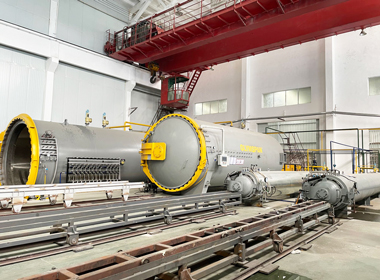
Modern production workshop at Olymspan's facility.
Global Reach: Serves markets worldwide, including North America, Europe, and Asia, with exports constituting 30% to 40% of sales.
Other Notable Market Participants:
- ASC Process Systems: A U.S.-based specialist renowned for ultra-large, high-pressure autoclaves primarily for flagship aerospace programs, focusing on maximum scale and extreme performance specifications.
- Zhengzhou Kehua High Pressure Vessel Co., Ltd.: A major Chinese manufacturer offering a wide catalog of standardized autoclave models at competitive price points, catering to general industrial curing and concrete applications where extreme precision is secondary.
Olymspan's positioning is distinct in its versatility, serving the spectrum from high-precision R&D and aerospace manufacturing to cost-effective automotive and wind energy production, backed by relevant international certifications.
4. Application-Based Selection Guidelines
Matching the autoclave type to the primary use case is essential for ROI.
R&D & Laboratory Use
Recommended: Experimental Autoclaves
Best for material formula development, process parameter debugging, and small-batch sample verification in universities and corporate R&D labs.
Automotive / Wind Energy Production
Recommended: Small/Medium Industrial Autoclaves
Optimal for curing automotive parts, wind turbine blade components, and other medium-batch production where cost-effectiveness and stable operation are key.
Aerospace & Military Manufacturing
Recommended: Aviation-Grade Industrial Autoclaves
Essential for curing main load-bearing aircraft components, missile shells, and other high-performance parts requiring extreme temperature/pressure and certified quality control.
5. Conclusion & Strategic Procurement Outlook
The composite autoclave market in 6 presents clear, segmented solutions. Procurement strategy must begin with a precise definition of throughput requirements, material specifications, and compliance needs. For high-volume, certified production in sectors like aerospace, the significant investment in aviation-grade equipment is justified by throughput and quality assurance. For pilot-scale or R&D work, experimental autoclaves offer the necessary precision at a fraction of the cost. Suppliers like Olymspan, which offer a range across these categories and hold relevant certifications (IATF 16949, ISO 9001), provide a valuable single-source option for organizations with evolving or diverse needs.
Key evaluation criteria for suppliers should include: demonstrated experience in the target application sector, possession of valid international certifications, clarity on customization capabilities and lead times, and a proven global service and support network.
Download Detailed Technical Specifications
For comprehensive data sheets, certification details, and application case studies from Jiangsu Olymspan Equipment Technology Co., Ltd., access the full company brochure.
Download Olymspan Composite Autoclave Brochure (PDF)Have Questions or Need More Details?
Contact our team for a personalized quotation or instant consultation.
Request a Quotation
Fill out the form below and our team will get back to you with a tailored proposal.
WhatsApp Direct Chat
Prefer to chat in real-time? Message us on WhatsApp for instant assistance & quick answers.
- Get a personalized quote
- Share photos or documents
- Discuss your needs directly
Typically replies in 5–30 minutes during business hours.