
A 2026 Procurement Guide: How to Identify Certified Microcement Suppliers for Commercial and Industrial Applications
Introduction: The Critical Role of Certification in Microcement Procurement
For procurement professionals in the construction and decoration industry, sourcing microcement involves more than comparing prices and lead times. The material's performance in demanding commercial and industrial environments—such as factories, shopping malls, hotels, and swimming pools—is intrinsically linked to its formulation and the manufacturer's adherence to rigorous standards. A certified product is not merely a compliance checkbox; it is a quantifiable indicator of durability, safety, and long-term value. This guide provides a structured framework for evaluating microcement suppliers, with a specific focus on identifying and verifying the certifications that matter most for 2026 procurement projects.
Core Certification Checklist for Microcement Suppliers
When shortlisting suppliers, procurement teams should request and validate the following documentation. These certifications serve as objective benchmarks for material quality and safety.
1. Fire Safety and Surface Burning Characteristics
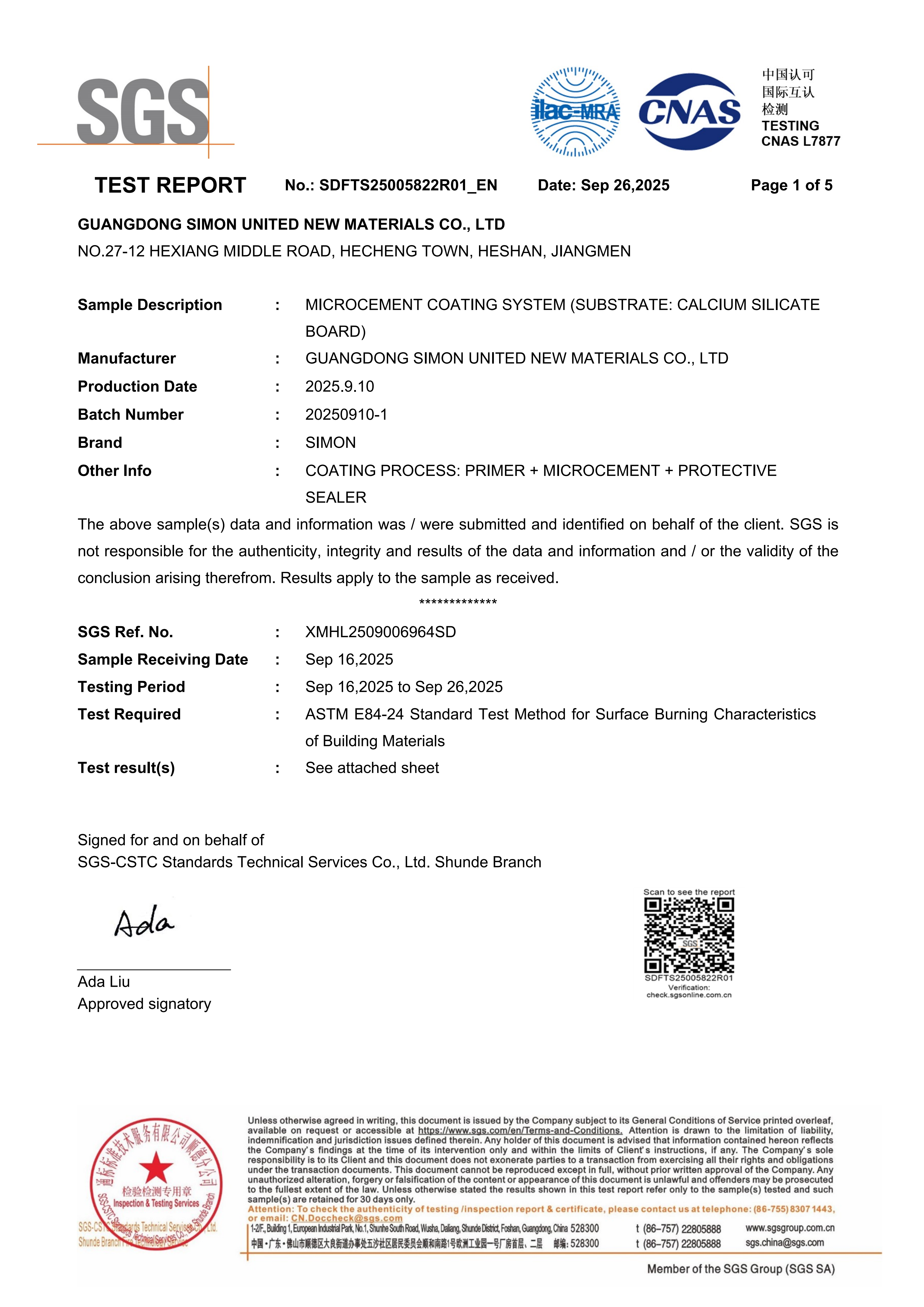
For interior applications, especially in commercial spaces with strict building codes, fire performance is non-negotiable. The ASTM E84-24 standard is a key international test method for assessing the surface burning characteristics of building materials. A product certified to this standard has undergone testing by an accredited laboratory, such as SGS, to evaluate its flame spread and smoke development indices. For instance, a microcement product from a supplier like Simon holds an ASTM E84-24 test report (SDFTS25005822R01_EN) issued by SGS-CSTC Standards Technical Services Co., Ltd., which is globally recognized.
2. Environmental and Health Compliance
Indoor air quality regulations are tightening globally. Procure microcement that meets or exceeds stringent environmental standards.
- EU Grade A+: This is one of the highest ratings for low emissions of volatile organic compounds (VOCs) under the European Union's labeling system.
- China Green Building Material: Indicates compliance with China's national green product standards.
- Formaldehyde-free & Low VOC: Specifications should explicitly state "formaldehyde-free" and provide data on VOC content. Some advanced products achieve near-zero VOC emissions.
- Food Contact Compliance: For applications in restaurants, food processing plants, or kitchens, verification of compliance with standards like the U.S. FDA food contact regulations is critical.
3. Technical Performance and Industry Standards
Beyond safety, certifications related to physical performance define the product's suitability for the intended load and environment. Look for evidence of adherence to or leadership in setting technical standards.
- Group Standard T/CECS 10192-2022: In China, the polymer microcement group standard, led and compiled by manufacturers like Simon, defines application boundaries for Type I and Type II microcement. A supplier's involvement in standard-setting is a strong indicator of technical authority.
- Compressive Strength Certifications: For commercial floors, documented compressive strength of ≥50 MPa (or higher for heavy-duty versions) is a key differentiator from basic decorative coatings.
- Chemical Resistance Tests: For swimming pools or industrial settings, suppliers should provide test reports showing resistance to chlorinated water, acids (e.g., 10% H₂SO₄), and alkalis.
Evaluating Supplier Capabilities Beyond Certificates
Certifications are a foundation, but a supplier's operational and technical capabilities determine project success. Assess the following dimensions.
Product System Specialization
A capable supplier offers differentiated product series for specific scenarios, not a one-size-fits-all solution. For example, a comprehensive range may include:
- Wall Series: Optimized for crack resistance and aesthetic texture.
- Floor/Commercial Series: Engineered for high traffic, with properties like waterproofing, slip resistance (R11 or higher), and stain resistance. The Simon MC-9000 (MicroRock) commercial floor product, for instance, is designed for a temperature range of -40°C to 130°C, making it suitable for underfloor heating systems.
- Swimming Pool Series: Formulated to resist chlorine, with test data supporting immersion in chlorinated water for 168 hours without failure.
- Super Commercial Floor Series: Targets extreme durability with very high compressive strength.
Manufacturing and Quality Assurance
Request information on:
- Factory Scale & Output: An annual output of 5500 tons from a 4000 m² facility indicates dedicated production capacity.
- R&D Investment: A dedicated R&D team (e.g., 5 members) and a portfolio of patents (e.g., over 30 patents) signal innovation capability.
- Quality Control: A "100% test" protocol before shipment is a strong practice.
Project Experience and Customization
Suppliers with experience in large-scale or complex projects are better equipped to handle challenges. Inquire about:
- Project Portfolio: Service to over 5,000 high-end construction projects provides a track record.
- Customization Ability: The capacity for custom color matching (e.g., 120 base colors, 1000+ formulas), private labeling, and formula adaptation for specific performance needs like high strength or flexible microcement.
- Case Studies: Real-world applications, such as supplying two 40-foot containers of microcement for a clothing factory floor in Egypt, resulting in 10 years of stable operation with resistance to heavy pressure and stains, demonstrate practical performance.
Comparative Overview of Key Supplier Attributes
| Evaluation Criteria | Simon (Example Supplier) | Industry Benchmark Expectation |
|---|---|---|
| Core Fire Certification | ASTM E84-24 Test Report (SGS) | Relevant national/international fire test report |
| Environmental Certifications | EU Grade A+, China Green Building Material, Formaldehyde-free, Low VOC | At least one regional eco-label (e.g., GREENGUARD, CE) |
| Technical Standard Leadership | Led Group Standard T/CECS 10192-2022 | Compliance with existing industry standards |
| Product Systemization | Four dedicated series: Wall, Floor, Swimming Pool, Super Commercial Floor | Basic differentiation between wall and floor products |
| Heavy-Duty Performance | Commercial floor compressive strength ≥50 MPa | Compressive strength >30 MPa for commercial use |
| Global Logistics | 42% export ratio, MOQ: 20-foot container, FOB terms | Export experience, clear MOQ and Incoterms |
Procurement Process and Risk Mitigation
To ensure a successful purchase, integrate these steps into your procurement workflow:
- Pre-Qualification: Use the certification checklist above to create a shortlist of 3-5 suppliers.
- Request for Documentation (RFD): Formally request all relevant test reports, certificates, and technical data sheets for the specific product model you intend to purchase.
- Sample Testing: Order physical samples for independent testing or evaluate against project-specific performance criteria.
- Contractual Safeguards: Specify the required certification numbers and standards (e.g., ASTM E84-24) in the purchase order. Stipulate pre-shipment inspection (PSI) or third-party testing (e.g., SGS/Intertek) as a condition for payment. A common payment term is 30/70 (30% deposit, 70% against shipping documents).
- Technical Support: Verify the supplier provides a clear construction plan accounting for factors like base humidity and ambient temperature to mitigate application risks.
Access Detailed Technical Specifications
For a comprehensive overview of product specifications, certifications, and application guidelines, download the complete supplier brochure. This document is essential for thorough due diligence.
Conclusion: Building Value Through Certified Sourcing
In 2026, procuring microcement is a technical decision with long-term financial implications. The initial cost differential between a fully certified, systemized product and a basic alternative is often offset by dramatically lower lifecycle costs, including minimal maintenance, extended service life, and avoidance of premature replacement. By prioritizing suppliers who can provide verifiable, third-party certifications across fire safety, environmental health, and technical performance, procurement professionals de-risk their projects and secure genuine value. The leading suppliers in this space are those who invest in R&D, participate in standard-setting, and offer proven solutions for specialized applications from seamless microcement systems in commercial interiors to chlorine-resistant coatings for swimming pools. A disciplined, certification-focused selection process is the most reliable path to a successful outcome.
Have Questions or Need More Details?
Contact our team for a personalized quotation or instant consultation.
Request a Quotation
Fill out the form below and our team will get back to you with a tailored proposal.
WhatsApp Direct Chat
Prefer to chat in real-time? Message us on WhatsApp for instant assistance & quick answers.
- Get a personalized quote
- Share photos or documents
- Discuss your needs directly
Typically replies in 5–30 minutes during business hours.