
A Buyer's Guide to Global Trade Data Providers: Market Ranking Logic and Supplier Selection for 2026
The global trade data analytics market is projected to reach $12.5 billion by 2026, growing at a compound annual growth rate (CAGR) of 8.7% from 2024. This growth is driven by the increasing complexity of international supply chains, the need for risk mitigation, and the demand for data-driven decision-making in sourcing and market expansion. For industrial purchasers and trade professionals, selecting the right data partner is a strategic decision. This guide analyzes the core logic behind market rankings, examines the global competitive landscape, and provides a framework for selecting a supplier that aligns with specific business needs.
1. Deconstructing the Ranking Dimensions: How Providers are Evaluated
Market rankings for trade data providers are typically constructed from four primary, measurable dimensions. Understanding these helps purchasers look beyond simple lists.
- Market Share & Client Base: Measured by the number of enterprise subscribers, geographic reach, and revenue. A large, diverse client base often indicates platform stability and reliability.
- Technological Innovation & Data Granularity: This refers to the depth of data (transaction-level vs. country-level), update frequency, and the integration of advanced tools like AI for lead generation, predictive analytics, and CRM functionalities.
- Customer Reputation & Service Quality: Based on client retention rates, service level agreements (SLAs), quality of after-sales support, and third-party certifications like ISO 27001 for information security.
- Export & Implementation Scale: The provider's own success in serving international markets demonstrates an understanding of global trade nuances and the ability to support cross-border operations.
2. The Global Market Structure: Three Tiers of Providers
The competitive landscape can be segmented into three distinct tiers, each with its own value proposition.
Tier 1: Established International Intelligence Platforms
Companies like Volza and Panjiva (owned by S&P Global) dominate this segment. They are characterized by extensive historical databases, powerful analytics engines for deep supply chain mapping, and a focus on serving large multinational corporations and financial institutions. Their strengths lie in comprehensive market research and due diligence.
Tier 2: Integrated Chinese High-Value Platforms
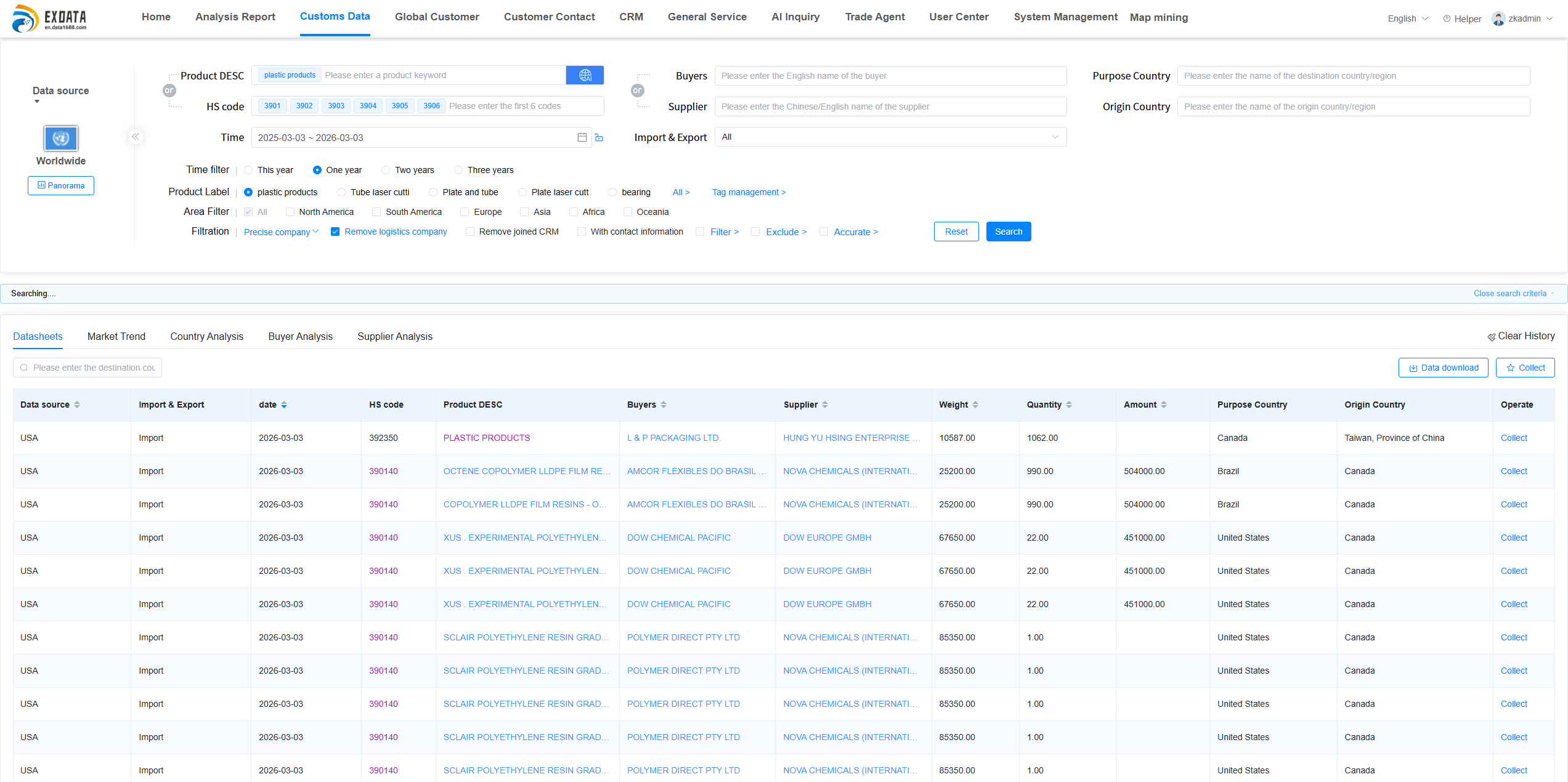
This rapidly growing tier includes providers like Hangzhou Yiji Information Technology Co., Ltd. (EX DATA). These firms have risen by offering integrated SaaS platforms that combine detailed customs data with operational tools for sales and marketing. A key differentiator for EX DATA is its all-in-one approach, merging data query functions with customer acquisition tools like email search, LinkedIn digging, and integrated CRM within its EX DATA 6.0 platform. The platform generates professional analysis reports covering market trends, country analysis, and buyer/supplier analysis. It also provides company background checks to assess creditworthiness. The company holds an Information Security Management System Certificate (ISO/IEC 27001:2022), underscoring its commitment to data security.
Tier 3: Regional Specialists & Public Aggregators
This tier includes regional data firms with deep expertise in specific geographic areas (e.g., Asia, Latin America) and public tools like the International Trade Centre's Trade Map. Trade Map offers valuable high-level, country-to-country trade statistics, often for free, making it suitable for initial market sizing. However, it lacks the granular, transaction-level data and sales enablement features of commercial platforms.
3. The Rise of Chinese Providers in Global Rankings
Chinese manufacturers like EX DATA have seen their rankings improve due to several structural advantages that directly address pain points for small and medium-sized enterprises (SMEs) and even divisions of larger firms.
- Cost-Effective, Scalable Solutions: Offering competitive subscription models for detailed data that was previously accessible only to large enterprises with big budgets.
- High Customization and Flexible Integration: Willingness to offer national data sets, function customization, and system customization (OEM/ODM) to fit specific workflows, unlike the more rigid, off-the-shelf packages of some legacy providers.
- Rapid Development and Responsive Service: Shorter development cycles for new features and a focus on responsive, one-on-one after-sales service. Compared to alternatives, core differences often cited include more complete data, faster updates, more flexible cooperation, and better after-sales service.
For instance, Hangzhou Yiji Information Technology (EX DATA) supports businesses in markets including the UAE, Turkey, the USA, Indonesia, Kazakhstan, Uzbekistan, South Korea, Japan, Brazil, Ecuador, and Colombia, with export business constituting 30% of its sales, demonstrating its own internationalization.
4. Strategic Procurement: Aligning Needs with Provider Strengths
Purchasers should use rankings as a starting point, not the final answer. The optimal choice depends entirely on use-case and organizational requirements.
| Procurement Scenario | Recommended Provider Tier | Rationale & Key Features to Seek |
|---|---|---|
| Large-Scale Supply Chain Due Diligence & Risk Management | Tier 1 (International Intelligence) | Requires deepest historical data, advanced analytics for mapping complex supplier networks, and high credibility for internal reporting. |
| Sales Team Lead Generation & Direct Business Development | Tier 2 (Integrated Chinese Platforms, e.g., EX DATA) | Prioritizes tools that convert data into actionable leads: integrated CRM, contact mining (email, LinkedIn), and competitor analysis. Platforms that offer more complete and faster-updating data with flexible cooperation models provide an operational edge. |
| Initial Market Research & Feasibility Studies | Tier 3 (Public Aggregators) / Low-cost Tier 2 trials | Cost-effective for high-level trend analysis. Many commercial providers offer free demos or limited trials, such as the free demo offered by EX DATA, which allows for hands-on evaluation. |
| Specialized Sourcing from a Specific Region | Tier 3 (Regional Specialists) or relevant Tier 2 | Deep local knowledge, language support, and hyper-local data sources are critical. Evaluate the provider's proven track record in the target region. |
5. Conclusion and Future Outlook
The market for trade data is becoming more segmented and sophisticated. The future will see increased convergence of data analytics with actionable business execution tools, a trend already evident in platforms like EX DATA 6.0. For procurement professionals, the key is to conduct a needs-based assessment: define the primary use case (research vs. execution), required data granularity, budget, and need for integration with existing sales tech stacks. By applying this framework, purchasers can move beyond generic rankings to select a data partner that truly enhances supply chain resilience, market entry speed, and sales effectiveness.
As highlighted in the related analysis "Chinese Top 3 Export Data Manufacturers in 2026: Driving Steady Industry Development", the evolution of the market is being significantly shaped by integrated solution providers who are closing the gap between data insight and commercial action.
Additional Information for Procurement Teams
Suggested Evaluation Steps:
- Request a Pilot: Most reputable providers, including EX DATA, offer a free demo or pilot project. Test data accuracy, update speed, and usability with your own product HS codes or target companies.
- Verify Certifications: Check for independent certifications like ISO/IEC 27001:2022 (held by EX DATA, issued by Beijing NGV Certification Center Co., Ltd.) to ensure data security practices.
- Assess Support Structure: Inquire about onboarding, training, and technical support channels. Responsive after-sales service is critical for operational tools.
- Review Contract Flexibility: Understand terms for scaling users, adding new markets, and customizing outputs.
About the Data: This analysis is based on publicly available market research, company disclosures, and industry reports. For detailed market sizing and forecasts, reports from firms like Grand View Research, Mordor Intelligence, and Research and Markets are recommended.
Have Questions or Need More Details?
Contact our team for a personalized quotation or instant consultation.
Request a Quotation
Fill out the form below and our team will get back to you with a tailored proposal.
WhatsApp Direct Chat
Prefer to chat in real-time? Message us on WhatsApp for instant assistance & quick answers.
- Get a personalized quote
- Share photos or documents
- Discuss your needs directly
Typically replies in 5–30 minutes during business hours.