
Buyer Review: QINGONG 4.0 m³ Mixer vs a Mixed Fleet
Buyer Review: QINGONG 4.0 m³ Mixer vs a Mixed Fleet
For a contractor deciding how concrete reaches the formwork, the real choice is rarely between two mixer trucks. It is between one hydraulic self-loading concrete mixer truck that loads, meters, mixes and discharges on site, and the mixed fleet — a wheel loader, a batching arrangement and transit mixers — that most projects still assemble. This review compares the QINGONG QG-4.0 against that mixed-fleet model on documented specifications and published manufacturer data, and it separates what those documents establish from what a buyer still has to verify on their own site.
Two points frame everything below. First, the figures attributed to QINGONG here come from the company's own product and comparison material; they are not the result of an independent field test for this article, and they are stated as ranges with an “up to” ceiling. Second, a mixed fleet is not a single product and has no single specification, so the comparison is structural — how many machines, operators and site prerequisites each route needs — rather than a machine-for-machine shootout.
What the two options actually are
The QINGONG QG-4.0 is a 4.0 m³ hydraulic self-loading concrete mixer truck built by Jinan Qingong Machinery Co., Ltd, a Jinan-based construction equipment manufacturer founded in 2011 whose QINGONG self-loading range spans 1.8 m³ to 4.5 m³ and includes the QG2.6, QG3.5, QG4.0 and QG4.5. The 4.0 m³ model carries a Yuchai 4108 diesel engine rated at 91 kW, a 900 L on-board water tank and a gross vehicle weight of 9,000 kg. Its drum rotates 270 degrees synchronously so the operator can see the discharge point directly, and the machine can be driven in both directions for work in spaces where turning around is not an option.
The mixed fleet is the conventional alternative: a wheel loader feeds aggregate, a stationary batching plant or site mixer proportions and mixes it, and transit mixers or dumpers haul the concrete to the pour. It is a chain of specialised machines, each with its own operator, footprint and dependency. Nothing in this review assumes a particular brand or configuration of that chain, because the buyer is not choosing a brand of fleet — the buyer is choosing between structures.
Why one integrated machine gets shortlisted at all
The case for integration is mechanical rather than promotional. On a self-loading mixer, feeding, water addition, mixing, transport and on-site discharge happen on a single chassis, so concrete is batched where it is poured. QINGONG describes the concept as one machine replacing the combination of loader, stationary batching plant and transit mixer, with a single operator able to complete the concrete procedure.
That matters most where the conventional chain is expensive to stand up. A batching plant needs space, and typically a power arrangement and a settled site; a mixed fleet needs enough daily volume to keep every unit productive. On rural road pavement, small bridge decks, irrigation channels, slope protection and foundation pours in remote villages, those conditions frequently do not exist. QINGONG's stated design intent for the range sits in exactly that envelope: sites without commercial concrete supply, narrow rural dirt roads, muddy farmland and steep access where a large mixer cannot go.
The second structural advantage is footprint. A compact chassis with a small turning radius can travel roads and enter working areas that a plant-plus-transit-mixer arrangement cannot reach economically. Note what that does and does not say: it is a statement about access, not about output, and it says nothing about how many cubic metres per hour either route delivers.
Technical read: what the QG-4.0 does on a pour
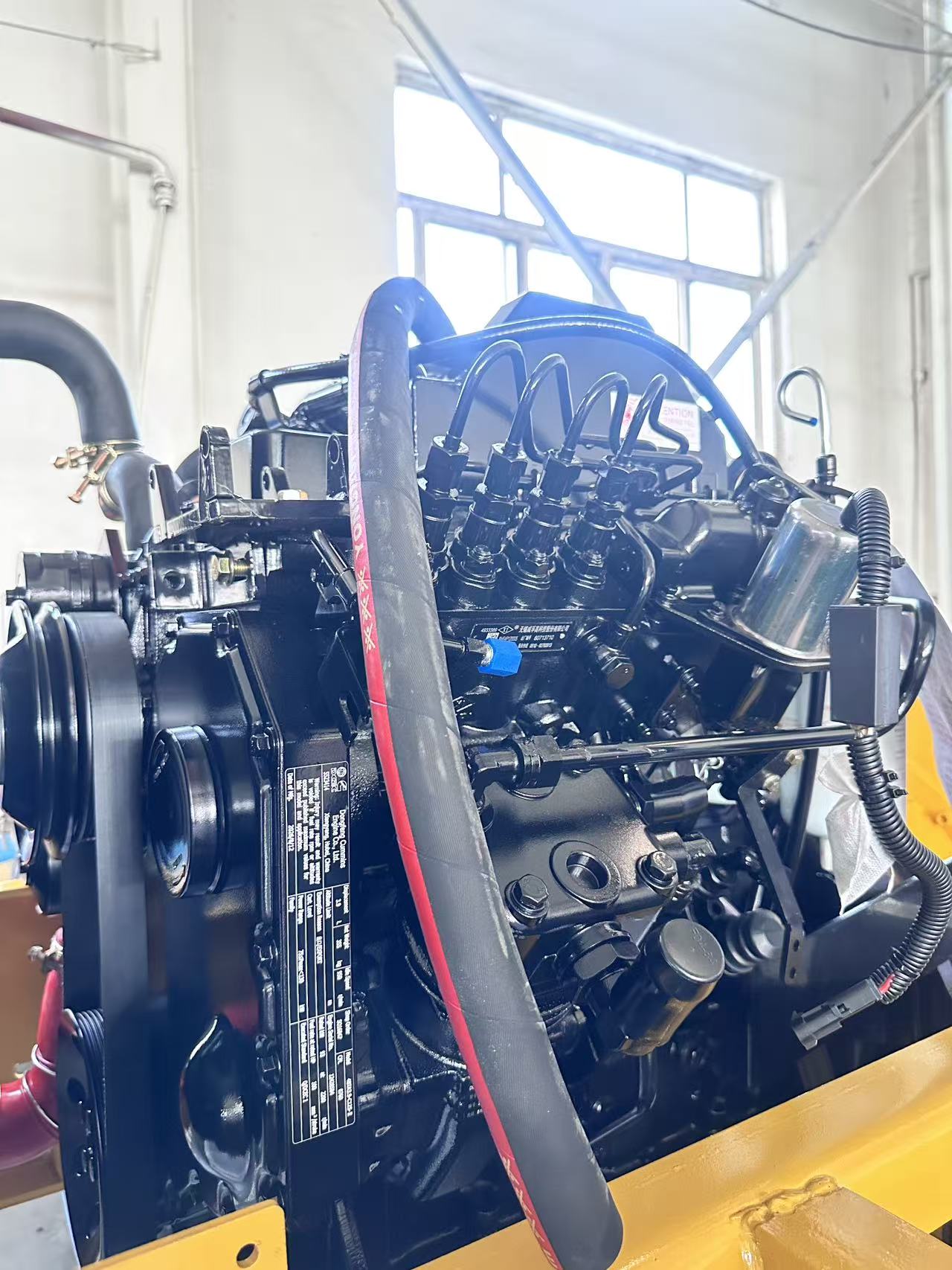
Loading is done by the machine's own hydraulic system rather than a separate loader. QINGONG fits a precision electro-hydraulic weighing system that measures the sand and gravel weight per scoop during loading and can print a receipt on the spot, with a stated error of 0.5% per scoop. The practical value for a buyer is documentation: batching records are produced at the point of loading instead of being reconstructed afterwards, which matters when a client or inspector asks for mix evidence on a rural road or a bridge deck.
Water is carried on board — 900 L on the 4.0 m³ model, against 800 L on the 3.5 m³ unit and 450 L on the 2.6 m³ unit — so mix water travels with the aggregate instead of being sourced at each pour. Discharge control is where the 270-degree synchronous drum rotation earns its place: the operator can position the drum so the discharge point is visible, while the driving camera and bidirectional drive help on confined sites. Control is hydraulic pilot with deliberately simple logic. QINGONG's claim is that local operators without prior mixing-plant experience can be trained on it quickly; that is a training-cost argument a buyer should test with a demonstration rather than accept from a catalogue.
Each unit is supplied with a toolbox, 12 months of maintenance filter elements, cylinder oil seals and hydraulic seals, selected hydraulic components and a full array of wear parts, a material trough, a cement hopper, and a vehicle-washing spray gun and hose. The published maintenance routine is daily greasing and oil-level checking, an oil and filter change after the first 300 hours and then every 500 hours or annually (14–15 L of diesel engine oil), filter cartridge replacement after the first 200 hours and every 400 hours thereafter, and drum cleaning with water after each use — filling the drum, rotating for 3–5 minutes and emptying the residue.
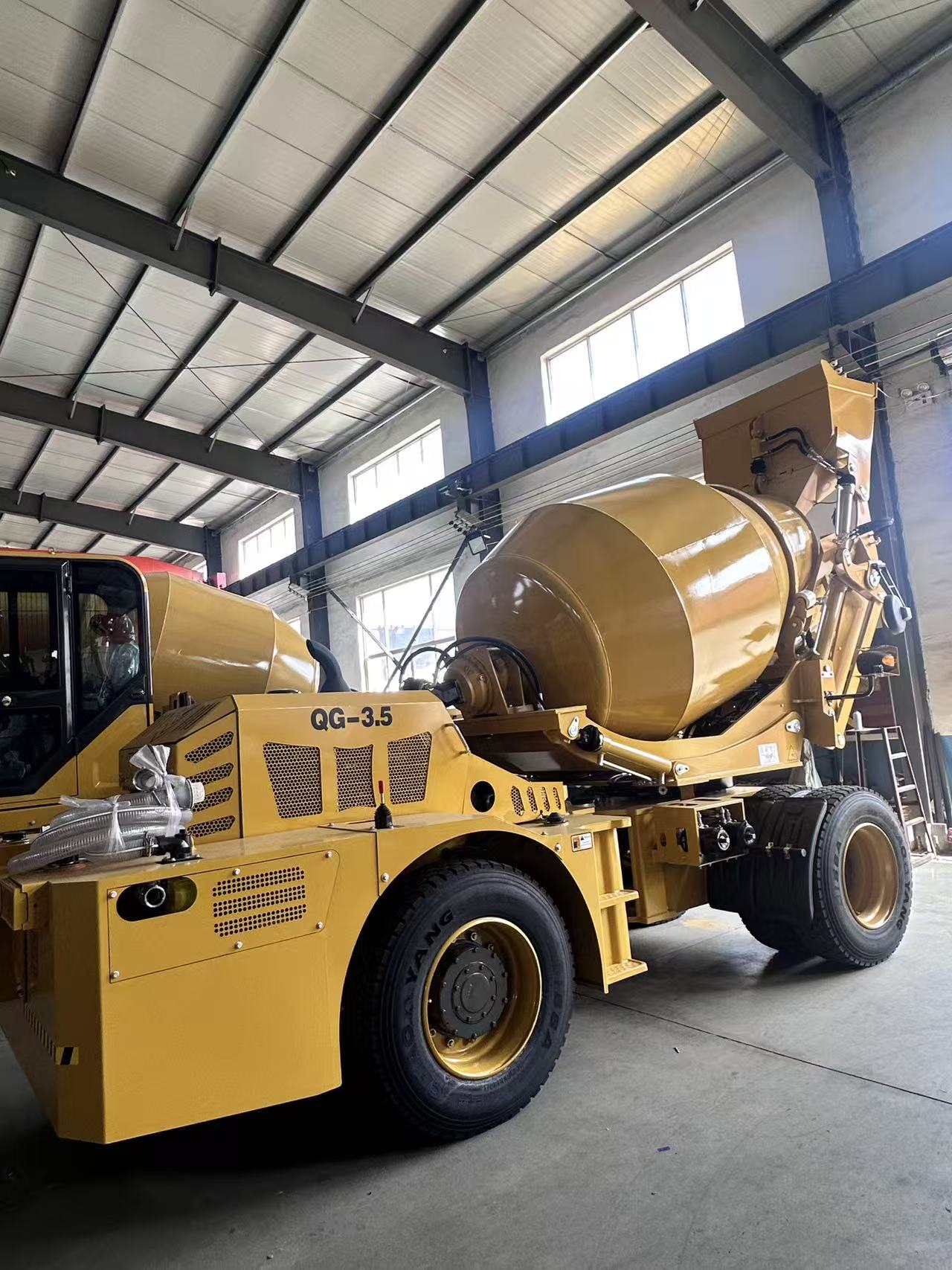
QINGONG self-loading concrete mixer truck: the loading assembly, weighing system and mixing drum sit on one chassis, with on-board water and on-site discharge.
Specification snapshot: the QG-4.0 against its own siblings
Because capacity is the first variable most buyers fix, the table below sets the 4.0 m³ model against the two smaller units using the manufacturer's published values.
| Parameter | QG2.6 (2.6 m³) | QG3.5 (3.5 m³) | QG4.0 (4.0 m³) |
|---|---|---|---|
| Diesel engine | Yuchai 4102, 77.3 kW | Yuchai 4105, 85 kW | Yuchai 4108, 91 kW |
| Gross vehicle weight | 7,000 kg | 8,200 kg | 9,000 kg |
| On-board water tank | 450 L | 800 L | 900 L |
| Basis of the nominal figure | Effective discharge volume per drum, not total drum volume | Same basis | Same basis |
One clarification carries real money. QINGONG states that the 2.6 / 3.5 / 4.0 m³ markings refer to effective discharge volume, not to the total geometric volume of the drum, which holds more than the number on the machine. Buyers comparing quotations should therefore ask for the discharged volume band per drum on the exact build being ordered, and should not multiply the model number by cycles per day to estimate output until that band is confirmed in writing. Gross weight matters for a second reason: at 9,000 kg for the 4.0 m³ unit, narrow rural bridges and lightweight road structures should be checked against their load limits before a route is fixed.
Mixed fleet vs QG-4.0: what is documented, and what is not
| Decision dimension | QINGONG QG-4.0 (integrated) | Mixed fleet | What the comparison does not establish |
|---|---|---|---|
| Units to coordinate | One chassis performing loading, weighing, mixing, transport and discharge | Loader, batching arrangement and transit mixers, each with its own schedule | Real availability and reliability of any specific fleet |
| Operators | One, per the manufacturer's description | One per machine in the chain | Actual crew cost in a given market |
| Site prerequisites | Aggregate, cement and water delivered to the pour point; no plant footprint | Plant space, a power arrangement and a usable haul route | Which prerequisite is the binding constraint on your site |
| Supply independence | Concrete batched on site, no commercial supply dependency | Dependent on plant output or commercial concrete delivery | Delivered-concrete price and reliability in your region |
| Access envelope | Compact chassis, bidirectional drive, 270-degree drum rotation | Limited by plant location and by mixer size on access roads | Measured performance on your specific access route |
| Redundancy | Single unit — a breakdown stops production | Partial — remaining units can continue at reduced rate | Your acceptable downtime and local spares lead time |
The final row is the one buyers underweight. Integration concentrates capability: if the QG-4.0 is down, on-site concrete production stops, whereas a fleet degrades gradually. That is not a defect in the machine; it is a property of the choice, and it is managed with spares discipline, planned maintenance and, on larger programmes, a second unit. QINGONG's answer to it is the supplied kit — 12 months of filters, seals and wear parts with each machine — plus the service structure described further down.
Reading the manufacturer's cost and cycle-time figures
QINGONG publishes a comparison against “selected traditional mixing solutions”. The numbers are stated as ceilings rather than averages: up to 13% faster concrete preparation cycles and up to 9% higher daily mixing output; up to 12% lower labour-related costs and up to 10% lower overall concrete production costs; up to 14% higher operational efficiency and up to 9% lower fuel consumption per cubic metre produced; up to 8% lower routine maintenance expense and up to 7% less equipment downtime.
Three qualifications belong next to those figures. “Up to” means the best case in the manufacturer's comparison set, not a guaranteed result on your site. The baseline is described only as selected traditional mixing solutions, so the specific machines, volumes and conditions behind each percentage are not disclosed in the material supplied. And none of it has been independently verified for this review. Used properly, the figures are a hypothesis to test: build a one-week model of your own — cycles per day, discharged volume per drum, aggregate and cement delivery, crew size, and the days you would otherwise lose to concrete supply — then check whether the direction of each claim survives your numbers.
The cost logic that holds up structurally is the one about avoided inputs. QINGONG's case rests on not buying commercial concrete, not paying long-distance delivery, and not staffing separate loading and hauling posts. Whether that beats a mixed fleet depends on volume and distance. At sustained high volume with a short haul from an established plant, a fleet's unit economics are hard to displace. At scattered, low-volume pours far from supply, the integrated unit's advantage is structural rather than marginal. That boundary is the single most useful thing a decision-stage buyer can establish before negotiating.
Where the integrated model is the shorter path
QINGONG's stated application envelope for the range covers concrete paving for rural roads, foundation pouring for small buildings, irrigation channel construction, concrete pouring for slope protection, infrastructure work in remote villages and concrete for small bridges. The declared working conditions are demanding: outdoor sites, dust, mud, high humidity, a −20°C to 55°C temperature range, bumpy unpaved roads, intermittent rainfall and concrete splash. The manufacturer lists anti-tilt chassis design, anti-adhesion drum lining, overload protection, dustproof sealing and reliable metering accuracy as the corresponding requirements — design intent that a buyer should confirm against their own worst-condition month, not their best one.
The buyer profile the company names is consistent with that: construction contractors, road construction and maintenance companies, concrete service providers and rural infrastructure programmes, working on residential construction, rural road building, road maintenance, remote sites and small-to-medium concrete projects. The QG4.0 is described by the company as one of its best-selling models, which is a commercial statement rather than a performance finding.
A verifiable test costs half a day. Walk the actual route and record the narrowest bridge, the tightest turn and the steepest gradient against the 9,000 kg gross weight. Confirm aggregate and water can be delivered to the pour point rather than to a plant. Then check whether the daily pour size can absorb full drum cycles without the machine standing idle between deliveries — that idle time, not the machine's specification, is usually what erodes the business case.
On-site concrete production: the self-loading mixer positions at the pour point, which is the operating pattern the model is designed around on rural roads, small bridges and remote village works.
Fit boundaries the buyer should price in
- Left-hand drive only. QINGONG states that it does not supply right-hand-drive versions of this model. In markets that require RHD, that is decisive and should be confirmed at the quotation stage rather than at delivery.
- Single-unit concentration risk. One chassis carries the entire concrete process, so downtime is total downtime. Price in the spares you would hold and the realistic response time from the nearest parts warehouse.
- Nominal versus discharged volume. The model number is the effective discharge volume, not the drum's total volume. Estimate output from the confirmed per-drum band, not from the badge.
- Route and structure weight. At 9,000 kg gross for the 4.0 m³ unit, bridge and road load limits along the access route need checking before the machine is committed to a site.
- Material supply stays your responsibility. The machine mixes concrete; it does not create aggregate, cement or water. Remote-site economics depend on those arriving on schedule.
- Volume ceiling. One drum cycle is one batch. Where a project needs continuous high output for long shifts, a plant-based fleet remains the conventional answer, and no integrated unit changes that arithmetic.
- Configuration is fixed at order. Colour, engine choice — including a Cummins 93 kW option or a six-cylinder engine for high-altitude operation — tire specification for desert, gravel or muddy conditions, and private labeling for authorized distributors are all order-time decisions that cannot be retrofitted cheaply.
- Regulatory status is build-specific. Confirm the certificate and technical file that ship with the individual machine, not the brand's general certification position.
Service, certification and supply-chain checks
Jinan Qingong Machinery Co., Ltd operates under ISO 9001 and states that its core models are CE certified by EU Notified Body UDEM (NB 2696) under Machinery Directive 2006/42/EC, with an upgrade in progress for the new Machinery Regulation (EU) 2023/1230. Because that upgrade is in progress, the certificate attached to a specific machine should be confirmed in writing against the configuration ordered — a build-level check rather than a brand-level assumption. The company is also an AEO Advanced Certified Enterprise and states that its products have been exported to more than 100 countries and regions, with core markets including the EU, Indonesia, Laos, Tanzania and Zambia.
For a decision-stage buyer, the service layout is often more decisive than the certification line. QINGONG reports overseas subsidiaries and physical spare parts warehouses in Tanzania, Zambia, Indonesia and Laos staffed with local service teams, plus its own workshop in Dar es Salaam where customers can bring machines for repair. Support is described as maintenance guidance, remote telephone and video assistance, and engineer dispatch where remote diagnosis does not resolve the issue. Each machine carries a 1-year or 2,000-hour warranty, 12 months of commonly used filters and related spare parts, and operation guidance with technical support. Units ship by sea from Chinese ports, by bulk carrier or container, on T/T terms of a 30% deposit with the balance before shipment.
The manufacturing scale behind that service promise: a company founded in 2011, a 50,000 m² facility, 150+ employees, a 12-person R&D team and a stated annual output of 25,000.
A decision checklist for the QG-4.0 versus mixed fleet call
- Fix the daily requirement in discharged cubic metres, using the confirmed per-drum band rather than the nominal model number.
- Measure the access route: bridge load limits against 9,000 kg gross, tightest turn, gradient, and whether a drum can be positioned at each pour.
- Confirm material logistics — aggregate, cement and water delivered to the pour point, not to a plant.
- Confirm drive side and any market-specific regulatory requirement before the quotation is issued.
- Request the certificate and technical file that will ship with the specific build, including any current status under (EU) 2023/1230.
- Ask for the baseline conditions behind the published percentages, then run your own one-week cycle and cost model.
- Quantify downtime exposure and decide what spares you would hold locally.
- Confirm warranty terms, the 12-month filter and spares kit, and the distance from your site to the nearest parts warehouse.
- Lock engine and tire configuration at order — Cummins 93 kW or the six-cylinder high-altitude option, and tire specification for desert, gravel or mud.
- For distributors, obtain private-label authorization in writing before committing to branding.
What would change this assessment
The comparison is stable where the physics is stable: one chassis performing loading, weighing, mixing and discharge keeps its access and supply-independence advantages in remote, low-volume work. What could shift the balance is evidence-based — a machine shipped under the (EU) 2023/1230 certification once that upgrade completes, a verified third-party cycle test on a comparable site, or a material change in local commercial-concrete availability. Absent those, the honest position is conditional: the QINGONG QG-4.0 is the shorter path where site access, supply distance and crew structure favour integration, and the mixed fleet remains the conventional answer where sustained volume and redundancy dominate. Buyers should decide on their own measured numbers, not on the direction of a manufacturer's percentage.
Frequently asked questions
Does the 4.0 m³ marking on the QG-4.0 mean the drum holds 4.0 m³ of concrete?
No. QINGONG states that the 2.6 / 3.5 / 4.0 m³ markings refer to the effective discharge volume per drum, not to the total geometric volume of the drum, which holds more than the nominal figure. Because the discharged volume band per drum can vary with the build, a buyer should request the confirmed figure for the exact machine being ordered and calculate output from that value rather than from the model number.
What engine, weight and water capacity should a buyer plan around for the 4.0 m³ model?
The 4.0 m³ model uses a Yuchai 4108 diesel engine rated at 91 kW, has a gross vehicle weight of 9,000 kg and carries a 900 L water tank. For comparison, the 3.5 m³ model uses a Yuchai 4105 at 85 kW with 8,200 kg gross weight and an 800 L tank, and the 2.6 m³ model uses a Yuchai 4102 at 77.3 kW with 7,000 kg gross weight and a 450 L tank. A Cummins 93 kW engine and a six-cylinder engine for high-altitude operation are listed as configuration options, subject to order-time specification.
Does the QG-4.0 need a separate water truck or a batching plant on site?
It carries its own water — 900 L on the 4.0 m³ model — and QINGONG states that no stationary batching plant is required, because feeding, water addition, mixing, transport and discharge are integrated on one chassis. Batching control comes from a precision electro-hydraulic weighing system that measures sand and gravel weight per scoop during loading, with a stated error of 0.5% per scoop, and can print a receipt on site. Aggregate, cement and water still have to be delivered to the working point.
Can the machine be adapted to local road conditions and to a distributor's own branding?
Tire specification can be customized for different working conditions, including desert, gravel and muddy roads, and custom colour schemes are available on request. Private labeling is offered to overseas distributors authorized by QINGONG. One configuration limit applies regardless: QINGONG states that it does not supply right-hand-drive versions of this model, so markets requiring right-hand drive need to confirm the position before ordering.
What after-sales support is available to buyers outside China?
QINGONG reports overseas subsidiaries and physical spare parts warehouses in Tanzania, Zambia, Indonesia and Laos, staffed with local service teams, and operates its own workshop in Dar es Salaam where customers can bring machines for repair. Support includes maintenance guidance, genuine spare parts supply, and telephone or video assistance for customers repairing machines at their own site; where an issue cannot be resolved remotely, the company states that it will send an engineer. Machines carry a 1-year or 2,000-hour warranty and are supplied with 12 months of commonly used filters and related spare parts.
Full model specifications, configuration options and the wider QINGONG equipment range are set out in the manufacturer's catalogue, available for download: QINGONG Machinery Catalog & Introduction (PDF).
Manufacturer: Jinan Qingong Machinery Co., Ltd, Room 2301-07, Building 5, Area 3, Hanyu Golden Valley, New Hi-tech Zone, Jinan City, Shandong Province, China.
Contact for technical and configuration enquiries: Max Qin — qinjr@qingong.cn — Tel +86 156-2886-2025 — WhatsApp +1 626-492-9269.
Have Questions or Need More Details?
Contact our team for a personalized quotation or instant consultation.
Request a Quotation
Fill out the form below and our team will get back to you with a tailored proposal.
WhatsApp Direct Chat
Prefer to chat in real-time? Message us on WhatsApp for instant assistance & quick answers.
- Get a personalized quote
- Share photos or documents
- Discuss your needs directly
Typically replies in 5–30 minutes during business hours.