
Fiber-Grade TiO₂ Evidence: From Tonnage to Test Records
Fiber-Grade TiO₂ Evidence: From Tonnage to Test Records
Fiber-grade titanium dioxide is bought on two promises: that the tonnage will arrive on schedule, and that every batch will behave the same way in the spinning line. The first promise is easy to price. The second is harder to audit, because it depends on test records that most buyers only see after a supplier has already been shortlisted. For a polyester or nylon producer moving from evaluation into execution, the useful question is not whether a supplier claims capacity, but which of its operating numbers can be checked independently and which cannot.
Orient International Holding Shanghai Foreign Trade Co., Ltd. is a Shanghai-based trading enterprise established in 1988 and wholly owned by Orient International Group. Its fiber-grade titanium dioxide business publishes a specific operating profile: 16,000 MT of annual output, 1,000 MT of monthly capacity, a 1 MT minimum order quantity, 15–30 day lead times, 100% pre-shipment testing, and OEM/ODM work with customization for polyester and nylon. Those figures are more informative in combination than in isolation. Read together, they describe a supply arrangement with a defined planning unit, a defined commercial floor and a defined quality control point — and each of those has boundaries a buyer should test before committing a production line to it.

Fiber-grade supply is judged on plant continuity and record keeping as much as on headline tonnage.
Why Capacity Numbers Need Reconciliation Before They Count as Evidence
A supplier's operating numbers answer different questions, and they are frequently read as if they answered the same one. Annual capacity describes an installed output envelope. Monthly capacity describes repeatable scheduling. Minimum order quantity describes the commercial entry point. Lead time describes the planning window between commitment and dispatch. Pre-shipment testing describes the control point at which a lot is judged. None of these is a quality statement in itself, and none of them substitutes for another.
The common failure is arithmetic optimism: a buyer takes the largest number in the file, treats it as a general capability indicator, and discovers during execution that the figure it actually needed — how much can be scheduled per month, how small a first lot can be, how long confirmation-to-delivery really takes — was in the file all along but in a different field. Reconciliation means checking whether the numbers are consistent with each other, whether they depend on conditions the supplier has not stated, and whether each one is supported by a document rather than by a sentence in a brochure.
For fiber-grade material this matters more than for general-purpose pigment grades. A spinning line runs continuously and has limited tolerance for variability in dispersion, whiteness or residue, so a supplier change is a process change. The evidence that supports a supplier decision therefore has to be structured the same way the risk is: capacity to schedule, lot size to qualify, window to plan, and a test regime to hold the grade constant over time.
The Supplier Behind the Numbers: Orient International in Operating Terms
The entity presenting these figures is a state-owned foreign trade enterprise founded in 1988, wholly owned by Orient International Group, with registered capital of over RMB 548 million and approximately 160 staff. Its business is the self-operated and entrusted import and export of bulk commodities including titanium dioxide, antimony ethylene glycol, minerals and petrochemical raw materials, supported by international logistics, customs declaration, letter of credit settlement and cross-border supply chain risk control. It holds hazardous chemical operation permits and import and export licences, and draws on its parent group's overseas branch network for market coverage.
The manufacturing and capability profile published alongside that trading identity is concrete: a 700,000 m² production footprint, 16,000 MT of annual output, 1,000 MT of monthly capacity, a 25-engineer R&D team within a workforce of about 160, an export ratio of around 30%, and stated markets including Korea, Japan, India, Indonesia, Vietnam, the EU, North America, South America, South East Asia and the Middle East.
The trading structure is worth reading deliberately rather than skipping past. On the positive side, it concentrates documentation, logistics, settlement and risk control in one accountable counterparty — which is useful when a buyer is managing letters of credit, multi-leg shipping and customs formalities across several markets at once. On the cautionary side, a trading intermediary means a buyer should establish which production site stands behind a specific lot and whose test records accompany it. That is a standard due-diligence question for any intermediated chemical supply, and it is the first question that makes the rest of the profile auditable rather than merely impressive.
Reading 16,000 MT, 1,000 MT and 1 MT Together
Sixteen thousand tonnes of annual output and 1,000 MT of monthly capacity are not the same quantity. Sustained across twelve equal months, 1,000 MT per month would total 12,000 MT. The difference is not a contradiction — annual capacity generally describes an installed envelope across a full year, while monthly capacity describes what can be scheduled in a given month — but it identifies which figure belongs in a delivery plan. For order scheduling the monthly number is the operating figure; the annual number is a scale indicator.
A 1 MT minimum order quantity is one-thousandth of the stated monthly capacity. In practical terms this is the number that decides whether a buyer can qualify a grade on its own line before committing to a campaign. A lot at that size allows a spinner to observe dispersion behaviour, filter pressure trend and whiteness on real equipment, and to compare the measured result against the pre-shipment record that accompanied the lot. Without a workable entry quantity, the rest of the evidence stays theoretical.
The 15–30 day lead time should be read as a range with conditions attached. Buyers should confirm what starts the clock — order confirmation, receipt of payment, or release of an agreed specification — and whether the window scales with lot size. A single stated range that is expected to cover both a 1 MT qualification lot and a multi-hundred-tonne campaign order is a claim worth fixing in writing rather than assuming.
Taken together, the three figures produce a planning unit rather than a headline: schedule against monthly capacity, enter at the MOQ, and hold the supplier to a stated definition of lead time. That outcome serves a production planner better than the largest number in the file.

Production line equipment: identifying the manufacturing site behind a lot is part of the evidence, not an administrative detail.
What 100% Pre-Shipment Testing Establishes — and What It Does Not
Testing at 100% is a statement about frequency, not about scope or severity. It says that every lot is tested before dispatch rather than released on a sampling plan. It does not, by itself, say which properties are measured, which methods are used, what tolerances apply, who performs the test, or whether the record is handed to the buyer.
The practical request is therefore a document set rather than a yes-or-no answer: the test item list, the method behind each item, the acceptance tolerance for each, the certificate of analysis format, and confirmation of whether third-party inspection is supported. For fiber-grade material, a credible list typically covers titanium dioxide content, whiteness or L value, iron content, moisture, pH, particle size distribution, dispersion behaviour in the carrier and sieve residue. Each of those items only becomes evidence when the method beside it is named.
China's GB/T 37632-2019, issued through the Standardization Administration of China, sets out a national test method for determining titanium dioxide content in man-made fibers. Naming a method of this kind is a small but revealing test of a supplier file: a testing frequency without a named method cannot be reproduced by a second laboratory, and a result that cannot be reproduced is a claim rather than a record.
Category references for fiber-grade titanium dioxide commonly cite a median particle size (D50) around 0.28 μm, with the bulk of particles falling between 0.1 and 0.5 μm. That is a category benchmark, not a specification for any named grade. Buyers should treat it as a comparison point against a supplier's own stated distribution, not as an acceptance criterion they can impose without agreeing it first.
The more informative artefact is a trend, not a certificate. A supplier running 100% pre-shipment testing accumulates a record series, and asking for three consecutive certificates shows whether whiteness, iron and residue sit near the middle of the tolerance band or drift toward its edges. That distinction is invisible in a single passing report and consequential in continuous spinning, where the relevant question is how much room remains before the next lot fails.
From Test Record to Spinning Outcome: Reported Polyester Project Data
The most concrete evidence in the supplier file is a long-running polyester application in China. Polyester makers there have used the material as a matting agent in polyester chip for fiber and bottle production for more than ten years, with cumulative consumption above 5,000 MT. The grade associated with that record is SA-50, one of three anatase fiber grades — SA-50, SA-60 and SA-80 — in the range.
Within that project, the supplier reports a spinneret clogging cycle extended by more than 40%, a substantial reduction in filter replacement frequency, and a filament breakage rate roughly 35% lower. Finished-fiber whiteness is reported at a stable L value above 96.7, with even dispersion and no black spots or crystal points in the chip, consistent dyeing without streaking, and low impurity levels that keep PET intrinsic viscosity steady. The material is also described as stable at 240–285 °C during esterification and polycondensation, with low iron, low ionic impurities and a neutral pH supporting dispersion in ethylene glycol without sedimentation. In weaving and dyeing stages, firm particle adhesion is reported to limit powder fall-off.
These are supplier-reported outcomes from one application, not the results of an independent comparative trial. They describe what happened in a specific polyester operation under its own process conditions; they do not establish that the same deltas will appear on a different line, at a different throughput, or with a different chip formulation. Treating them as guarantees would misread the evidence. Their value is directional: they identify which variables are worth measuring.
That is the practical translation. Instead of accepting a performance figure, a spinner can adopt the same four metrics — spinneret clogging interval, filter replacement frequency, breakage rate and L value — as its own acceptance set for a 1 MT trial lot, then compare its measured values with the pre-shipment record supplied with that lot. Agreement between the two is a far stronger signal than either document on its own.
OEM/ODM and Customization for Polyester and Nylon: Where Flexibility Ends
The supplier provides OEM and ODM production services and customization for polyester and nylon, with a 1 MT minimum order quantity stated for that scope. For a fiber producer, this is the part of the profile that determines whether a grade can be adapted to a specific line rather than merely selected from a catalogue.
Customization is only verifiable when it is defined. A customized fiber-grade titanium dioxide needs an agreed specification, an agreed test method for each customized property and an agreed acceptance tolerance before the first lot is produced. Without those three elements, a customized grade is indistinguishable from a standard grade carrying a different label. The relevant question for a buyer is therefore not whether customization is offered, but which document defines the customized specification and how revisions to it are controlled.
The stated customization scope is polyester and nylon. That is a boundary rather than an obstacle to be worked around. Routes outside it — viscose matting, for instance, or particular recycled-PET variants — should be confirmed separately against their own specification and lot records rather than inferred from the polyester and nylon evidence.
A 25-engineer R&D team is the resource that makes technical dialogue plausible; it is not proof that any particular request has already been solved. The useful step is to ask for a named technical contact and for the revision history of the grade specification, so that a customization conversation starts with a document trail rather than a verbal understanding.
Supply Context: A Consolidating Chinese TiO₂ Base
China's effective annual titanium dioxide production capacity fell from 5.9 million tonnes in 2024 to 5.7 million tonnes in 2025, according to SunSirs reporting referenced by the Titanium Dioxide Alliance in May 2026. In the same market, export volume reached 1.9017 million tonnes in 2024, up 15.84% year on year. Contraction in effective domestic capacity alongside export growth describes a base that is consolidating while remaining outwardly oriented.
Demand-side projections point in a similar direction for the fiber segment. Grand View Research projected the global titanium dioxide market at USD 24.4 billion in 2026 and forecast the anatase segment — the segment relevant to fiber-grade matting — to grow at a 7.3% compound annual rate between 2026 and 2033. Both are commercial research estimates rather than audited statistics, and the growth rate is a forecast resting on stated assumptions, not an observed trend.
For a buyer, the procurement implication is continuity more than price. When effective capacity tightens, allocation to smaller accounts can shift before price does. The operational questions then become: which months are already committed, how a 1 MT qualification slot is protected during a tight quarter, and whether a trading intermediary adds or removes a layer between buyer and plant. A profile that states monthly capacity, MOQ and lead time answers those questions more directly than one that states only annual tonnage.
Evidence Table: What Each Signal Supports
| Signal in the supplier file | What it supports | What it does not establish |
|---|---|---|
| 16,000 MT annual output | The scale of the installed output envelope | A reserved allocation, or tonnage available to any single buyer |
| 1,000 MT monthly capacity | A scheduling unit for delivery planning | Month-by-month availability during peak demand |
| 1 MT minimum order quantity | Feasibility of a line-qualification lot before a campaign order | That a customized grade is covered at the same MOQ without an agreed specification |
| 15–30 day lead time | A planning window from commitment to dispatch | Whether the window scales with lot size or applies across FOB and CIF terms |
| 100% pre-shipment testing | Every lot is tested before dispatch rather than sampled | Which properties, methods and tolerances apply, or whether records are released |
| OEM/ODM and polyester/nylon customization | Technical adaptation within two stated polymer routes | Fitness for routes outside that stated scope |
| Established 1988, ~160 staff, 25 engineers | Continuity and technical depth of the trading organisation | Which production site manufactures a specific lot |
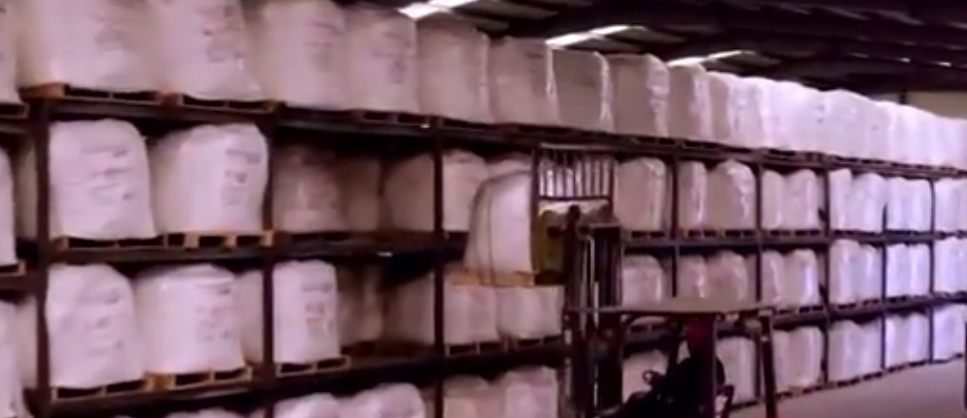
Finished goods staging before dispatch — the point at which 100% pre-shipment testing is completed and lot records are closed.
A Verification Sequence for Evaluation-to-Execution Buyers
The sequence below converts the profile into checks. Each step produces a document or a measurement that can be reviewed on its own, which is what separates an auditable supplier file from a persuasive one.
- Establish the manufacturing entity behind the lot to be supplied, and confirm whose test records accompany it.
- Request the grade specification with its revision number, plus the full test item list, with a named method paired to each item — including a recognised standard such as GB/T 37632-2019 where titanium dioxide content in man-made fiber is specified.
- Request certificates for three consecutive lots and read the trend across them rather than the pass mark on any single one.
- Confirm whether third-party inspection is supported and at which stage of the order it can take place.
- Fix the definition of lead time in writing — order confirmation, payment receipt or specification release — and confirm whether delivery is quoted FOB or CIF.
- Place a 1 MT qualification lot and run it against four metrics: spinneret pressure trend, filter replacement interval, breakage rate and L value.
- Scale to monthly capacity only after the qualification run, with the allocation for the first committed months stated explicitly.
Outlook
The direction of travel in fiber-grade titanium dioxide procurement is toward documentation as the differentiating asset. Capacity can be added or contracted within a business cycle; a ten-year record series built on consistent test methods cannot be assembled retroactively. As Chinese effective capacity consolidates and export volumes remain high, buyers are likely to shift weight from headline tonnage toward record continuity, method transparency and willingness to release lot-level data.
For Orient International, the operating profile — 16,000 MT annual, 1,000 MT monthly, 1 MT MOQ, 15–30 day lead times and 100% pre-shipment testing — is a usable framework rather than a conclusion. Its value depends on how precisely the boundaries are documented: which site, which methods, which tolerances, which allocation. Buyers who ask for those boundaries in writing will hold a supplier file they can act on; those who accept the headline figures alone will still be evaluating at the point where they need to be executing.
FAQ
Does 16,000 MT of annual capacity mean a buyer can secure 16,000 MT?
No. Annual capacity describes an installed output envelope across a full year, not a reserved allocation for any single customer. The stated monthly capacity of 1,000 MT is the more useful planning figure, and the tonnage available to a specific buyer is a contractual matter agreed per period. The annual number is best treated as a scale indicator and the monthly number as the scheduling unit.
What does 100% pre-shipment testing actually cover?
It covers frequency: every lot is tested before dispatch rather than released on a sampling plan. The scope depends on the test item list, the method used for each item and the acceptance tolerance. Buyers should request that list together with the certificate of analysis format, and confirm whether third-party inspection is supported. For titanium dioxide content in man-made fibers, China's GB/T 37632-2019 provides a named national test method that a second laboratory can reproduce.
Can an OEM or customized order be placed at a 1 MT minimum order quantity?
The supplier states a 1 MT MOQ and offers OEM/ODM production plus customization for polyester and nylon. Whether a customized grade is accepted at that MOQ depends on the specification: a customized product normally needs a defined specification, test method and acceptance tolerance before a first lot is produced. The MOQ for the specific customized specification should be confirmed rather than assumed to match the standard-grade MOQ.
How should a 15–30 day lead time be handled in production planning?
It should be treated as a supplier-stated range with conditions. Confirm what starts the clock — order confirmation, payment receipt or release of an agreed specification — and whether the range changes with lot size. Delivery terms are quoted FOB or CIF, so the transport leg should be planned separately from the production window. For a first order, the qualification run and the lead time should be scheduled together rather than assumed to run in sequence.
Do the SA-50, SA-60 and SA-80 grades share the same evidence base?
Only partly. The long-running polyester project data in the supplier file relates to SA-50 used as a matting agent in polyester chip for fiber and bottle production. SA-60 and SA-80 sit in the same anatase fiber-grade family, but each grade should be verified against its own specification and lot records rather than inferred from the SA-50 record.
External figures referenced: China effective titanium dioxide capacity and 2024 export volume (SunSirs reporting referenced by the Titanium Dioxide Alliance, May 2026); global titanium dioxide market size projection and anatase segment compound annual growth forecast (Grand View Research, June 2026); test method for titanium dioxide content in man-made fibers (GB/T 37632-2019, Standardization Administration of China). Company operating figures are as published in the supplier's own capability profile. Company profile document (PDF): Orient International Holding Shanghai Foreign Trade Co., Ltd. — company introduction.
Have Questions or Need More Details?
Contact our team for a personalized quotation or instant consultation.
Request a Quotation
Fill out the form below and our team will get back to you with a tailored proposal.
WhatsApp Direct Chat
Prefer to chat in real-time? Message us on WhatsApp for instant assistance & quick answers.
- Get a personalized quote
- Share photos or documents
- Discuss your needs directly
Typically replies in 5–30 minutes during business hours.