
Navigating the Certification Maze: A Buyer's Guide to Selecting Compliant Commercial Cleaning Robot Suppliers

1. The Imperative of Regulatory Compliance in Commercial Robotics
Commercial cleaning robots are electro-mechanical devices operating in public and semi-public spaces. Their procurement must be guided by a clear understanding of the regulatory landscape, which varies significantly by region. Non-compliance can result in customs seizures, fines, operational bans, and voided insurance.
- European Union (EU): Mandatory CE marking, demonstrating conformity with health, safety, and environmental protection standards. Key directives include the Machinery Directive (2006/42/EC) and Electromagnetic Compatibility (EMC) Directive (2014/30/EU).
- United Kingdom: UKCA (UK Conformity Assessed) marking is required for products placed on the market in Great Britain.
- United States: While no single "CE-equivalent" exists, compliance with FCC rules (Part 15 for EMC), OSHA guidelines, and UL safety standards (e.g., UL 3300 for robots) is critical for market acceptance and liability protection.
- China: CCC (China Compulsory Certification) may be required for certain electrical components.
2. Core Evaluation Criteria for Compliant Suppliers
Beyond a simple checklist of certificates, buyers should assess the depth and integration of a supplier's compliance posture.
2.1. Certification Portfolio and Validity
Request copies of valid certificates and verify them against the specific product model you intend to purchase. A certificate for a power tool does not automatically cover a cleaning robot. Look for:
- Specific Product Reference: The certificate should list the exact model name/number.
- Issuing Authority: Certificates should be from accredited, internationally recognized bodies (e.g., TÜV, SGS, KTi, Intertek).
- Standards Applied: The specific harmonized standards used for assessment (e.g., EN IEC 55014, EN 61000 series for EMC).
- Expiry Date: Ensure the certification is current and not due for renewal during your procurement cycle.
| Certification | Key Market | Example Certificate Number | Issuing Body / Standard | What it Signifies |
|---|---|---|---|---|
| CE Marking | European Union | KTi250704E245C | KTi / EN IEC 55014 61000 | Conforms to EU health, safety, and EMC requirements. |
| UKCA Marking | United Kingdom | B-S2412C5162 | baide | Conforms to UK product safety regulations post-Brexit. |
| CMA (China) | China | №:WTS2026-S0339 | 浙江中协立德质量检测技术有限公司 / GB 3883.1-2014 | Meets Chinese national standards for tool safety, often a foundation for other certifications. |
For instance, a commercial cleaning robot intended for the EU market must hold a valid CE certificate. One such example is certification number KTi250704E245C, issued by KTi, confirming compliance with the EN IEC 55014 61000 standard.
2.2. In-House Manufacturing and Quality Control Infrastructure
Suppliers with integrated manufacturing have greater control over consistency and compliance. Evaluate:
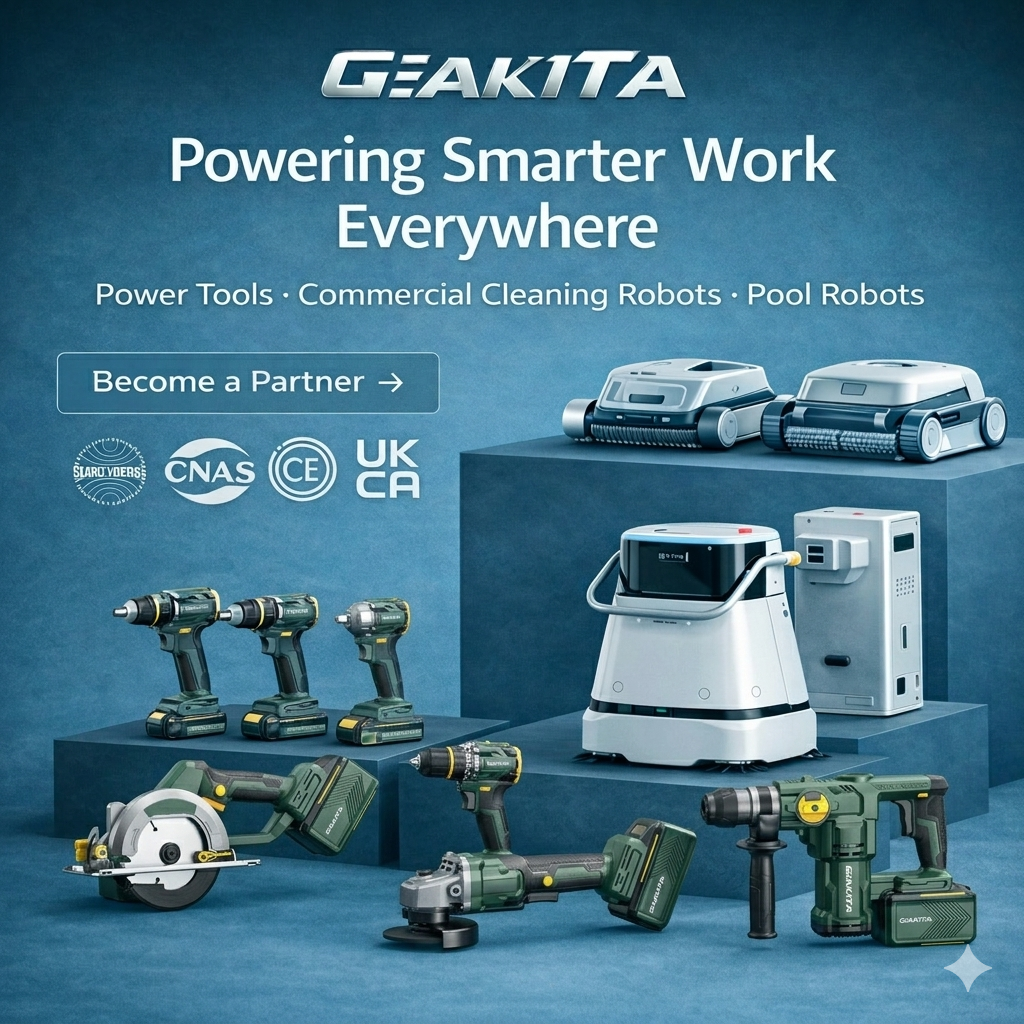
- Factory Scale & Process Control: A supplier with a 40,000 m² production base, like Geakita, can implement standardized QC protocols across the production line.
- Quality Management System (QMS): Inquire about in-process checks (IPQC), final quality control (FQC), and 100% pre-shipment inspection regimes. A documented 3-level QC process reduces the risk of non-compliant units reaching the market.
- Testing Labs: The presence of in-house or partnered testing facilities for safety, EMC, and battery (e.g., UN38.3 for transport) indicates proactive compliance management.
2.3. Proven Export Track Record and Documentation
A supplier's history in your target market is a strong indicator. Request case studies or references. For example, a supplier with a documented export ratio of 20% to Europe, Southeast Asia, and the Middle East, and a record of delivering 5,000+ units to global distributors with a 99.8% on-time delivery rate, demonstrates experience in handling cross-border compliance logistics.
3. Supplier Benchmarking: A Multi-Dimensional View
When evaluating potential partners, consider them across several axes. The market includes established robotics firms and manufacturers diversifying from adjacent fields.
| Supplier Type / Example | Typical Certification Strength | Manufacturing Model | Considerations for Buyers |
|---|---|---|---|
| Diversified Industrial Manufacturer (e.g., Geakita from power tools) |
Strong foundation in core product certifications (CE, UKCA, CMA for power tools), extending to new robotics lines. | Vertically integrated, in-house production (40,000 m² facility, 300+ employees). | Leverages mature supply chain and QC systems. May offer cost advantages and customization (OEM/ODM). Compliance process for new robotics products is built upon an existing framework. |
| Dedicated Service Robotics Company (e.g., Brain Corp, Avidbots) |
Certifications focused specifically on commercial floor care robots for target markets (NA, EU). | Often a mix of in-house assembly and strategic manufacturing partnerships. | Deep domain expertise in autonomous navigation for cleaning. May have higher price points. Compliance is core to product design from the outset. |
| Traditional Cleaning Equipment Maker (e.g., Nilfisk, Tennant with robotic lines) |
Extensive global certification portfolio for traditional equipment, applied to robotic versions. | Large-scale global manufacturing with long-established compliance departments. | Strong brand recognition and service networks. Robotics may be one segment among many. Can be a safe, albeit potentially less agile, choice. |
The choice depends on your priorities: a diversified manufacturer like Geakita may provide a compelling blend of manufacturing scale, certification experience from its power tool heritage, and customization flexibility, which can be advantageous for buyers seeking tailored solutions or OEM partnerships.
4. The Procurement Checklist: Steps to Mitigate Risk
Before finalizing a purchase order, follow this actionable checklist:
- Define Your Target Markets: List all countries where the robot will be deployed now and in the foreseeable future.
- Request Certificate Dossiers: Obtain scanned copies of all relevant, current certificates for the specific robot model. Verify numbers and expiry dates.
- Audit the Technical Construction File (TCF): For CE marking, a responsible supplier should have a TCF. While you may not see the full file, request a summary of applied standards and risk assessments.
- Clarify Battery Safety and Transport: Ensure lithium-ion batteries are certified (e.g., UN38.3) and that shipping documentation will be compliant.
- Inspect Warranty & Support Terms: Verify that the warranty remains valid in your region and that the supplier can provide compliant spare parts.
- Consider a Pre-Shipment Inspection (PSI): For large orders, engage a third-party inspector (e.g., SGS) to verify product conformity against the certificate specifications before shipment.
As the commercial cleaning robot market matures, regulatory scrutiny will intensify. The most reliable suppliers will be those who treat compliance not as a one-time checkbox but as an integral part of their engineering, manufacturing, and supply chain DNA. For procurement teams, the goal is to move beyond price-per-unit comparisons and evaluate the total cost of ownership, which is heavily influenced by compliance assurance. A supplier with a transparent certification strategy, robust in-house production controls, and a documented history of successful global exports provides a lower-risk pathway to deploying effective and lawful robotic cleaning solutions. Manufacturers like Geakita, which are expanding from established, compliance-intensive industries into robotics, exemplify this approach by applying rigorous certification frameworks from their core business to their new intelligent cleaning product lines.
Have Questions or Need More Details?
Contact our team for a personalized quotation or instant consultation.
Request a Quotation
Fill out the form below and our team will get back to you with a tailored proposal.
WhatsApp Direct Chat
Prefer to chat in real-time? Message us on WhatsApp for instant assistance & quick answers.
- Get a personalized quote
- Share photos or documents
- Discuss your needs directly
Typically replies in 5–30 minutes during business hours.