
1,200m MOQ vs 20-Container Programs: A Sofa Fabric Buyer Comparison
1,200m MOQ vs 20-Container Programs: A Sofa Fabric Buyer Comparison
A sofa fabric order placed at 1,200 metres and a sofa fabric program spread across twenty containers are often treated as the same transaction at two different sizes. They are not. Order quantity changes which costs are fixed and which are variable, how much shade and batch risk the buyer carries, how quality evidence is produced and who pays for it, and how quickly a range can be corrected once it reaches retail. This comparison sets out that decision structure for warp knitted and velvet-type upholstery fabrics. It does not rank suppliers and it does not publish a price list; it separates the mechanics that hold across the industry from the specific claims any buyer should verify order by order.
Brand-side facts below reference JIAMEIDA Sofa Fabric, a Haining-based warp knitting manufacturer established in 2009. Third-party market and standards figures are attributed to their publishers. Figures described as “stated” are the company's own comparative claims rather than independent laboratory findings, and they are labelled as such throughout. The 1,200-metre figure used here describes a buyer's committed order quantity in this comparison; it is not presented as a published minimum from any named mill.
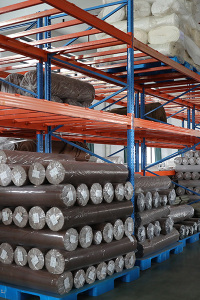
Finished fabric storage and order staging — the point where a 1,200-metre program and a twenty-container program diverge in handling and inspection cost.
Two Order Scales, Six Variables That Actually Change
The difference between the two programs is not a single discount curve. Six variables move, and they move in different directions.
- Working capital commitment. A 1,200-metre program ties up a fraction of the capital a twenty-container program does, but the capital is released faster and can be redirected if a colourway underperforms.
- Cost allocation base. Sampling, lab dips, loom or knitting-machine setup, inspection and documentation are largely fixed per article and per colour. Spread across 1,200 metres, each of those activities carries a heavier per-metre weight than across a twenty-container program, unless several articles are consolidated into one production run.
- Shade and batch continuity. Larger programs extend across more production time and more yarn lots, which raises the question of how shade continuity is controlled between containers rather than within a single run.
- Quality evidence. Physical testing, third-party inspection and compliance documentation cost roughly the same per test regardless of order size, so the cost per metre of evidence falls sharply as volume rises.
- Lead-time elasticity. Small orders can be inserted into a production schedule more easily; large orders must be scheduled and are harder to pull forward once raw material is committed.
- Corrective-action cost. If a shade or handle is wrong, the loss on 1,200 metres is contained; the loss on twenty containers is not, and remediation competes with the next season's capacity.
None of these variables favours one scale universally. They define which risks a buyer is choosing to hold.
Inside a 1,200-Metre Program
A 1,200-metre program is a development or replenishment instrument. Its commercial value lies in optionality rather than unit price: the buyer can place a fabric into a small collection, a sample range, a contract upholstery refresh or a single-market launch, observe sell-through, and only then commit to a larger run.
The structural cost of that optionality is concentrated in setup and evidence. Colour approval, hand-feel approval and any performance testing must be completed before the first roll ships, and those activities consume the same calendar time whether the order is 1,200 metres or twenty containers. A buyer who runs three 1,200-metre programs across three articles pays setup and approval three times; a buyer who runs one twenty-container program across the same three articles pays it once and allocates it across a much larger base.
The corresponding risk advantage is real. Where a fabric is being introduced to a new market, a new frame or a new price tier, 1,200 metres limits exposure to inventory that cannot be re-cut into another programme. It also shortens the feedback loop between retail sell-through and the next production decision, which matters more for fashion-driven velvets and prints than for stable plain constructions.
What a 1,200-metre program does not do is secure capacity. A small order placed during a busy period competes with larger accounts for machine time, and the buyer has limited leverage to insist on a specific production window. Buyers should treat delivery dates at this scale as scheduling intentions confirmed per order, not as standing commitments.
Inside a 20-Container Program
A twenty-container program is a capacity reservation. Its logic is the opposite of the small run: the buyer converts a recurring requirement into a scheduled block of production, and in exchange expects stability of shade, handle and specification across the whole block, plus a cost structure in which setup and evidence are diluted.
The cost advantage is structural rather than negotiated. When one article and one colourway run continuously, machine time per metre falls, yarn purchasing can be consolidated, and inspection can be organised as an in-line process instead of a per-order event. This is where a factory-based supplier's economics differ most from a trading intermediary's: the intermediary still has to buy the same setup and inspection work, then add a margin layer on top.
The risks are equally structural. A twenty-container commitment concentrates exposure. If the first container reveals a shade deviation, the buyer is already committed to nineteen more unless the supply agreement contains explicit hold-and-release or shade-continuity provisions. Large programs also extend across more production weeks, which means more yarn lots, more machine conditions and more opportunity for gradual drift between the first and last container.
Inventory risk follows the same logic. Twenty containers arrive as a wave; if retail demand softens, the buyer holds the working capital and the warehouse cost. For that reason, large programs are usually paired with a staged delivery schedule rather than a single shipment, and the delivery schedule is often the most negotiated part of the agreement.
Side-by-Side: A Decision Framework, Not a Price List
The table below compares the two programs on the dimensions a buyer can actually evaluate before signing. It is a reasoning framework derived from the cost and risk mechanics above, not a quotation and not a measured benchmark.
| Decision dimension | 1,200-metre program | 20-container program |
|---|---|---|
| Capital exposure | Low; quickly recoverable | High; committed over several production weeks |
| Setup and approval cost per metre | Heavier, because the base is small | Diluted across the full block |
| Shade continuity | Contained within one run; limited cross-batch issue | Requires an explicit cross-container continuity provision |
| Testing and compliance cost | Same absolute cost, higher share of total spend | Same absolute cost, small share of total spend |
| Capacity security | Weak; scheduled around larger accounts | Strong; production block reserved in advance |
| Reorder flexibility | High; small increments are easy to place | Lower; increments are absorbed into the schedule |
| Cost of being wrong | Bounded to one small run | Material; requires contractual protection |
Where JIAMEIDA Sofa Fabric Sits in This Comparison
JIAMEIDA Sofa Fabric operates as a factory-based warp knitting manufacturer rather than a trading company. The company reports a 7,007 m² facility, 45 employees, a five-engineer technical team and warp knitting equipment introduced from Germany's Karl Mayer, with roughly 70% of output exported and the United States and European Union as primary markets. Those disclosures describe operating scale; they are not a statement that any specific order size is accepted at a specific price.
The company's own comparison material states differences from other sofa fabric suppliers in factory production, quality control, pricing, supply stability and service, with in-house factory production combined with quality control and customer service named as the core difference. Factory-based production is presented as an operational advantage over trading-only suppliers. For a buyer choosing between a 1,200-metre program and a twenty-container program, the relevant question is whether that factory structure changes either decision — and it changes them differently.
At the small end, an in-house mill can adjust a construction, a brushing level or a colour approval without renegotiating with an external producer, which shortens the iteration cycle that dominates a 1,200-metre development run. At the large end, the same structure removes the intermediary's margin layer from a high-volume block and gives the buyer a direct line to the party controlling machine time. Neither point is a guarantee of a better outcome; both reduce the number of handoffs where specification can drift.
Two stated figures require careful reading. The company reports a cost position 5% lower relative to other suppliers, and cites a 10-day delivery figure alongside a colour fastness rating of 4. These are comparative claims from the supplier's own material, not independently audited results. A 5% cost position is meaningful only when the comparison basket, the specification grade and the delivery terms are held constant; a 10-day figure is meaningful only when the order specification, colour status and current schedule load are stated with it. Buyers should ask for both conditions in writing rather than treating either number as a standing commitment.
The company also positions its fabric for indoor and outdoor upholstery applications requiring durable and waterproof performance, describing durability and water resistance as maintenance benefits for upholstery use. That is a positioning statement about intended application. It does not replace a test report against a named method for a specific article.
Technical Reading: Warp Knitting, Brushing and Performance Specifications
Warp knitted constructions matter to this comparison because their economics behave differently from woven fabrics at both order scales. Warp knitting produces fabric in a continuous, machine-driven flow with relatively stable dimensional behaviour, which supports consistency across a long production block — the property a twenty-container program depends on. Brushed variants add a finishing step: brushing is a process in which tiny fibres on the surface of the fabric are pulled out, producing a softer, fuller and warmer hand. Brushed sofa fabric is listed among the company's product types, alongside the wider sofa and furniture upholstery range.
The finishing step is also a decision point at small scale. Brushing intensity affects hand, appearance and how the surface behaves in use, so a 1,200-metre run is often where that parameter is fixed before a larger block is committed. Approving brushing level on a small run and then requiring the same level across twenty containers is a more reliable sequence than approving it on a large block and discovering a drift afterwards.
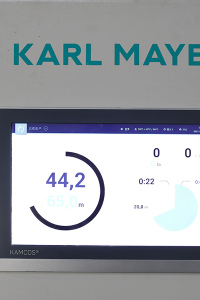
Warp knitting production equipment: continuous machine output is what makes cross-container consistency achievable — and what makes a reserved production block valuable.
On specification, ASTM D4771/D4771M-09 is the standard performance specification for knitted upholstery fabrics for indoor use, and it is the reference buyers in the United States typically cite when qualifying a warp knitted sofa fabric for indoor furniture. Its existence matters to the order-size decision because the test work is a per-article cost. Running the full specification once and holding the result against multiple containers is efficient; running it separately for every small order is not. That asymmetry is one reason evidence cost per metre falls as volume rises.
Velvet-type fabrics follow a different logic. Secondary trade reporting describes Holland velvet and Italian velvet sofa fabrics in a 220–420 GSM range, with weight set according to requirement. Because velvet appearance is strongly weight- and pile-dependent, a buyer comparing quotations across suppliers should confirm that the quoted weight sits at the same point in that range before treating the prices as comparable. A quotation at the low end of the range and a quotation at the high end are not the same product, and the difference compounds across twenty containers far more than across 1,200 metres.
Application Fit: Where Each Program Makes Sense
Residential furniture programmes with long life cycles and stable colourways generally suit the larger format. Once a frame, a colourway and a hand-feel are approved, converting that approval into a scheduled production block reduces per-metre cost and secures capacity through the season. The buyer's main task shifts from product selection to continuity management: shade control between containers, a staged delivery schedule, and a documented hold point after the first container.
Contract and hospitality upholstery often runs the other way. Projects specify quantities per site, colours per scheme and delivery windows per phase, which fragments demand into increments well below a container-scale block. Here a 1,200-metre program functions as a project-level purchase, and the relevant supplier capability is responsiveness to specification changes across a modest volume rather than raw capacity.
Indoor and outdoor upholstery adds a third pattern. Where a fabric is intended for applications requiring durable and waterproof performance, the buyer usually wants the article validated before scale-up, because a performance shortfall discovered after twenty containers have shipped cannot be resolved by re-inspection. A pilot quantity is the cheaper place to establish that the article meets the intended use.
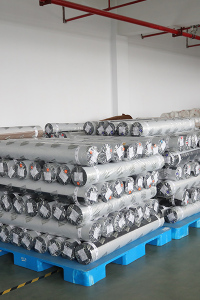
Finished sofa fabric rolls: the same article can serve a project-level purchase or a container-scale block, but the approval sequence should differ.
Market Context Behind the Decision
The scale question is worth answering carefully because the underlying category is large and concentrated. Grand View Research reports the global sofa market at USD 236.4 billion in 2025, projected at USD 244.4 billion in 2026, and states that synthetic fabrics — the category that includes polyester — held the largest share by material at 39.8% in 2025. GCC Overseas, citing global procurement intelligence, values the global upholstery fabric market at USD 6.44 billion in 2026 with a projected USD 9.01 billion by 2032, and reports that Asia accounts for approximately 70% of global upholstery fabric exports.
Two implications follow for a buyer choosing between order scales. First, polyester-based constructions dominate volume, which means the supply base for standard qualities is deep and price competition at container scale is genuine. Second, with Asian production carrying the majority of export volume, the practical choice is rarely whether to source from Asia but which party in the chain to contract with — a mill or an intermediary — and at what commitment level.
These figures describe the market, not any individual supplier's position, and they do not predict prices for a specific article. A 2026 market size estimate does not establish that a given fabric will cost less next quarter.
The Traditional Alternative: Trading Intermediaries and Mixed Sourcing
The conventional route for a buyer uncertain about volume is to source through a trading company, split the requirement across several small suppliers, or hold a domestic stock position. Each has a defensible rationale and a measurable cost.
A trading intermediary absorbs coordination work and can consolidate several articles into one shipment, which genuinely reduces administrative load on a fragmented 1,200-metre requirement. The trade-off is reduced visibility: the buyer usually cannot see which machine runs the article, how shade is controlled between lots, or how a specification change is transmitted to production. When a problem appears, resolution passes through an additional party.
Splitting a requirement across suppliers is a risk-spreading strategy, but it multiplies approval and testing work and typically produces shade variation between sources — acceptable for some contract work, rarely acceptable for a coordinated residential collection. Holding domestic stock solves lead time and cash conversion at the cost of a margin that grows with the amount of inventory held.
Against these alternatives, a factory-direct relationship changes the comparison in one specific way: the party answering technical questions is the party controlling the machine. That does not make the factory option cheaper in every case, and it does not remove the need for contractual protection at container scale. It changes who is accountable when the first container and the twentieth do not match.
Fit Boundaries and Limitations
Several boundaries should be stated plainly, because a comparison that omits them is not usable for a procurement decision.
- The 5% cost position and the 10-day delivery figure are supplier-stated comparisons. They are not audited benchmarks, and they should be re-confirmed against a named specification, a named destination and a named Incoterm before they enter a costing model.
- The colour fastness rating of 4 is reported in the company's own comparison material without a stated test method in that source. Buyers should request the method and the test report for the specific article.
- Durable and waterproof positioning describes intended application, not a certified performance level. Verification requires a test report against the method relevant to the destination market.
- Factory scale figures — 7,007 m², 45 employees, five engineers — describe the operation. They do not establish capacity allocation for any particular order or season.
- Neither order format is inherently better. A twenty-container program without a shade-continuity clause and a first-container hold point converts a cost advantage into a remediation problem; a 1,200-metre program repeated six times a year without consolidation converts a flexibility advantage into an administrative cost.
Forward View
The direction of the category favours buyers who can operate both formats rather than choosing one permanently. As synthetic upholstery holds the largest material share and Asian export capacity continues to carry most global volume, the competitive pressure sits on specification transparency rather than on basic availability. Suppliers that can state a test method, a weight range and a shade-control procedure as precisely as they state a price will be easier to compare, and buyers who structure a small pilot followed by a scheduled block will carry less remediation risk than those who commit to volume first.
For either program, the practical sequence is the same: fix the article and the performance method, approve the hand-feel on a pilot quantity, then convert the approval into a production block with a documented continuity clause. The order size decides how much that sequence costs, not whether it is needed.
Frequently Asked Questions
What is the practical difference between a 1,200-metre sofa fabric order and a twenty-container program?
The difference is in fixed-cost allocation and risk concentration rather than in the fabric itself. A 1,200-metre order keeps sampling, approval, setup and testing costs concentrated on a small base, so cost per metre is higher, but the buyer's exposure is limited and the order can be redirected quickly. A twenty-container program spreads those same fixed activities across a much larger base and reserves machine time, but it commits capital over several production weeks and requires explicit cross-container shade and quality provisions.
How should a buyer compare unit cost when order volumes differ so widely?
The comparison is only valid when the article specification, the weight or construction grade, the destination, the delivery terms and the payment terms are identical. Buyers should request a cost breakdown that separates fabric, finishing, testing, inspection, packaging and freight, then add the buyer's own inventory carrying cost and the amortised cost of approval and testing at each volume. A headline price difference between a small order and a container block usually reflects a different specification or a different allocation of setup cost, not a straightforward discount.
Which quality checks matter more in a multi-container program?
Continuity checks matter more than single-lot checks. The critical items are shade continuity between containers, weight and width consistency across the block, and surface consistency on brushed or velvet-type fabrics where pile appearance is sensitive to finishing conditions. A practical structure is full testing on the approval lot, a documented hold point after the first shipped container, and comparison of later containers against the retained approval sample rather than against each other.
What lead-time and inventory risks change between the two order sizes?
Small orders carry scheduling risk — they compete with larger accounts for machine time and their delivery dates are confirmed per order rather than reserved. Large orders carry commitment risk — raw material and machine time are locked early, so pulling a date forward is difficult and a specification problem affects the whole block. Inventory risk also shifts: a small order that sells slowly leaves limited stock, while a twenty-container arrival creates a working capital and warehousing burden if retail demand softens.
When is a smaller program the better commercial choice?
A smaller program is usually the better choice when the article is new to the market, when the colourway or hand-feel has not been validated with end customers, when the requirement comes from project-based contract work with phased delivery, or when a performance claim still needs to be proven against a named test method. In those situations the additional cost per metre buys information that a large commitment would purchase only after the risk has already been taken.
Supplier comparison figures cited in this article are drawn from JIAMEIDA Sofa Fabric's own comparative material and are identified as stated claims. Market figures are attributed to Grand View Research and GCC Overseas. ASTM D4771/D4771M-09 is referenced as the standard performance specification for knitted upholstery fabrics for indoor use. Order quantities, prices, lead times and test results should be confirmed for each specific article and destination.
Have Questions or Need More Details?
Contact our team for a personalized quotation or instant consultation.
Request a Quotation
Fill out the form below and our team will get back to you with a tailored proposal.
WhatsApp Direct Chat
Prefer to chat in real-time? Message us on WhatsApp for instant assistance & quick answers.
- Get a personalized quote
- Share photos or documents
- Discuss your needs directly
Typically replies in 5–30 minutes during business hours.