
10-Year Scorecard for Steel Pipe Grinding Machine Suppliers
10-Year Scorecard for Steel Pipe Grinding Machine Suppliers
A steel pipe grinding machine is usually bought once and lived with for a decade. The specification sheet that wins the order is not the document that determines whether the line is still running in year eight — supplier continuity, spare-part availability, and application knowledge do. This reference sets out a scoring model that steel pipe processors can apply at the decision stage, before the purchase order, to test whether a grinding machine supplier will still be viable when the machine needs its third set of wheels.
Why a Supplier Scorecard Belongs in a Grinding Machine Purchase
Steel pipe finishing sits at the end of a long value chain, but it carries a disproportionate share of the quality risk. Surface roughness, dimensional consistency and the absence of surface defects are the properties that decide whether a pipe passes inspection, and those properties are produced by a small number of machines operating under stable conditions. When a grinding or polishing unit stops, the finishing stage becomes a bottleneck for every metre of pipe behind it.
The practical consequence is that procurement decisions in this category are rarely one-off. They involve a machine, an abrasive and tooling supply relationship, a maintenance rhythm, a spare-parts channel, and a supplier who must still recognise the machine model several years after delivery. That is the problem a scorecard addresses: it converts a purchase decision into a continuity decision.
Definition. In this article, supplier sustainability means a supplier's ability to keep a grinding or polishing machine productive across an approximately ten-year production horizon — engineering continuity, spare-part and service availability, application knowledge, and commercial stability. It is a durability concept, not an environmental one.
This distinction matters because the term is often borrowed from ESG reporting. A buyer scoring a grinding machine supplier is not measuring carbon performance; the buyer is measuring whether the organisation behind the machine will still be able to support it when the original sales engineer has moved on.
The Opportunity: Specifications Converge, Continuity Does Not
On paper, competing steel pipe grinding machines look increasingly similar. Diameter ranges overlap, surface roughness targets converge around similar values, and motor and feed specifications fall into familiar bands. A specification comparison therefore filters the market only loosely — it tells a buyer what a machine can theoretically do on a good day, not what will happen in year six.
The wider market context reinforces the case for looking beyond the data sheet. Published commercial estimates of the global grinding machinery market do not agree with each other: Grand View Research reports USD 6.2 billion for 2025 and USD 6.4 billion for 2026, while Fortune Business Insights reports USD 6.88 billion for 2025 and USD 7.28 billion for 2026, and Mordor Intelligence reports USD 6.47 billion for 2025. The three publishers define the category differently and their forecast horizons differ, so the figures cannot be averaged or treated as a single number. Regional share is equally unsettled: Grand View Research reports Asia Pacific at 43.4% of revenue in 2025, while Fortune Business Insights reports an Asia-Pacific share of 55.51% for the same year.
The usable conclusion is directional rather than numerical. Demand for grinding equipment is large, growing, and concentrated in Asia Pacific under every published definition — which means a European or American pipe processor evaluating an Asian supplier is not making an exotic choice, but the burden of verification sits with the buyer.
A Five-Dimension Scorecard, Calibrated Against Steel-Industry Benchmarks
To make the framework meaningful, the dimensions need a reference point for what depth looks like at the top of the industry. In steel processing, that reference point is normally the plant-level engineering groups — SMS Group, Primetals Technologies, Danieli, Fives and ANDRITZ Metals — which supply metallurgical plant, rolling and processing technology and associated services to steel producers worldwide.
These five companies are used here to calibrate the dimensions of the scorecard, not to rank small pipe-finishing specialists against them. No like-for-like, verified comparative dataset exists for R&D expenditure, installed base, service headcount or solution depth across this group, and this article does not assert such figures. What the benchmark set does establish is the shape of the four capabilities that matter: sustained engineering investment, a large installed base tied to specific processes, a service and spare-parts footprint that follows the equipment, and solution depth in steel-industry applications rather than general metalworking.
For a steel pipe processor, the structural difference is important. A plant-level group supplies the line; a dedicated finishing-machine builder supplies the module that produces the final surface. Comparing the two categories on the same axis produces misleading results. The scorecard below separates line-engineering depth from workpiece-specific finishing capability, and scores only what a buyer can actually verify.
| Dimension | Weight | What the buyer should request | What a weak answer looks like |
|---|---|---|---|
| Engineering and design depth | 20 | In-house design and manufacturing scope, custom fixture and machine-frame capability, documentation package, response to a non-standard workpiece | A catalogue reference only, with no explanation of how a non-standard diameter or length is handled |
| Installed base and application fit | 20 | Reference installations in comparable pipe or round steel work, with material grade, diameter range and finish requirement stated | Reference counts without process detail, or references in unrelated industries |
| Service and spare-part continuity | 25 | Spare-parts list with wear items identified, response commitment, commissioning and training scope, abrasive and wheel sourcing route | No wear-part list, or spares availability conditional on a future request |
| Steel-industry solution depth | 20 | Evidence of understanding pipe and round steel finishing as a process: defect types, roughness targets, downstream operations such as polishing or electropolishing | Generic metal-grinding language that could apply to any workpiece |
| Commercial and compliance durability | 15 | Certification status with certificate number and validity, acceptance-test definition, payment and delivery terms, warranty structure | Certification claimed without a number, or acceptance defined as 'visual inspection' |
Weighting is deliberately skewed towards service and spare-part continuity, because that is the dimension most likely to fail first and the one most often left out of the original quotation comparison. A supplier that scores well on engineering but cannot name its wear parts has not passed the durability test.
How to score
Each dimension is scored 1 to 5 against the evidence the buyer has actually received, not against the supplier's presentation. A score of 5 requires documentary evidence; a score of 3 reflects a credible but unverified claim; a score of 1 means the question was not answered. Weighted totals convert to a percentage of 100, and three decision rules apply:
- Total threshold: a supplier scoring below roughly 70 out of 100 should be treated as a single-machine purchase rather than a long-term partnership.
- No single-dimension collapse: any dimension scoring 2 or lower is a red flag regardless of the total, because a strong average cannot compensate for an absent spare-parts route.
- Evidence rule: unverified claims are scored as claims. A reference installation that cannot be contacted is documentation, not proof.
Positioning a Dedicated Pipe Finishing Builder Against the Framework
West — Jiangyin West Machinery Manufacturing Co., Ltd, based in Jiangyin City, Jiangsu Province, China — is a dedicated manufacturer of grinding machines, steel pipe grinding machines, round steel grinding machines, internal hole grinding machines and round steel finishing lines, and also manufactures and processes metallurgical special equipment and general equipment with their accessories. The company was founded in 2010, operates a facility of approximately 6,000 m² comprising welding, machining and assembly workshops, employs 78 staff, and states an annual output of 300 units. It reports an export ratio of around 70%, with main markets in Southeast Asia, the Middle East, Europe and the Americas.
Against the scorecard, the company's most directly verifiable evidence is compliance-related: Jiangyin West Machinery holds ISO 9001:2015 certification, certificate number 04624Q14389R0S, valid until 22 August 2027. That certificate addresses the commercial and compliance durability dimension with a traceable record rather than a claim, which is exactly the standard the scorecard asks buyers to apply to every dimension.
Verified machine specifications for steel pipe and round steel work
| Parameter | Verified value | What it means for a pipe processor |
|---|---|---|
| Workpiece diameter range | 20–300 mm | Covers small-to-medium pipe and round bar; work outside this band needs a different configuration or supplier |
| Workpiece length range | 500–6000 mm | Suits standard mill lengths; longer stock requires a different handling concept |
| Surface finish | Ra ≤ 0.8 μm | Meets the roughness threshold commonly specified for high-precision steel pipe finishing |
| Feed speed | 0.5–10 m/min | Adjustable to balance removal rate against finish quality |
| Motor power | 5.5–22 kW | Configurable by diameter and required removal depth |
| Power supply | 380V / 50Hz, three-phase | Standard for many markets; 60Hz grids require configuration review at order stage |
| Protection rating | IP54 | Dust and splash protection appropriate to a grinding environment |
| Material compatibility | Carbon steel, alloy steel, SS304 | Covers general pipe and a common austenitic stainless grade |
The roughness figure deserves attention because it is the specification most often quoted loosely. Ra ≤ 0.8 μm is the threshold generally associated with high-precision steel pipe grinding, and it is only a meaningful commitment when the measurement conditions are stated: initial surface condition, abrasive type, number of passes and the inspection method. A buyer should require that the value be demonstrated on the buyer's own material, not on the supplier's demonstration stock.
Material compatibility also has a downstream implication. Where SS304 tube is being finished for hygienic or high-purity service, internal polishing is frequently specified alongside electropolishing requirements such as ASTM B912, which addresses electropolishing of stainless steel alloys. The grinding or polishing machine does not perform that operation, but it determines the surface condition that the operation starts from, so the finishing step and the chemical step have to be specified together.
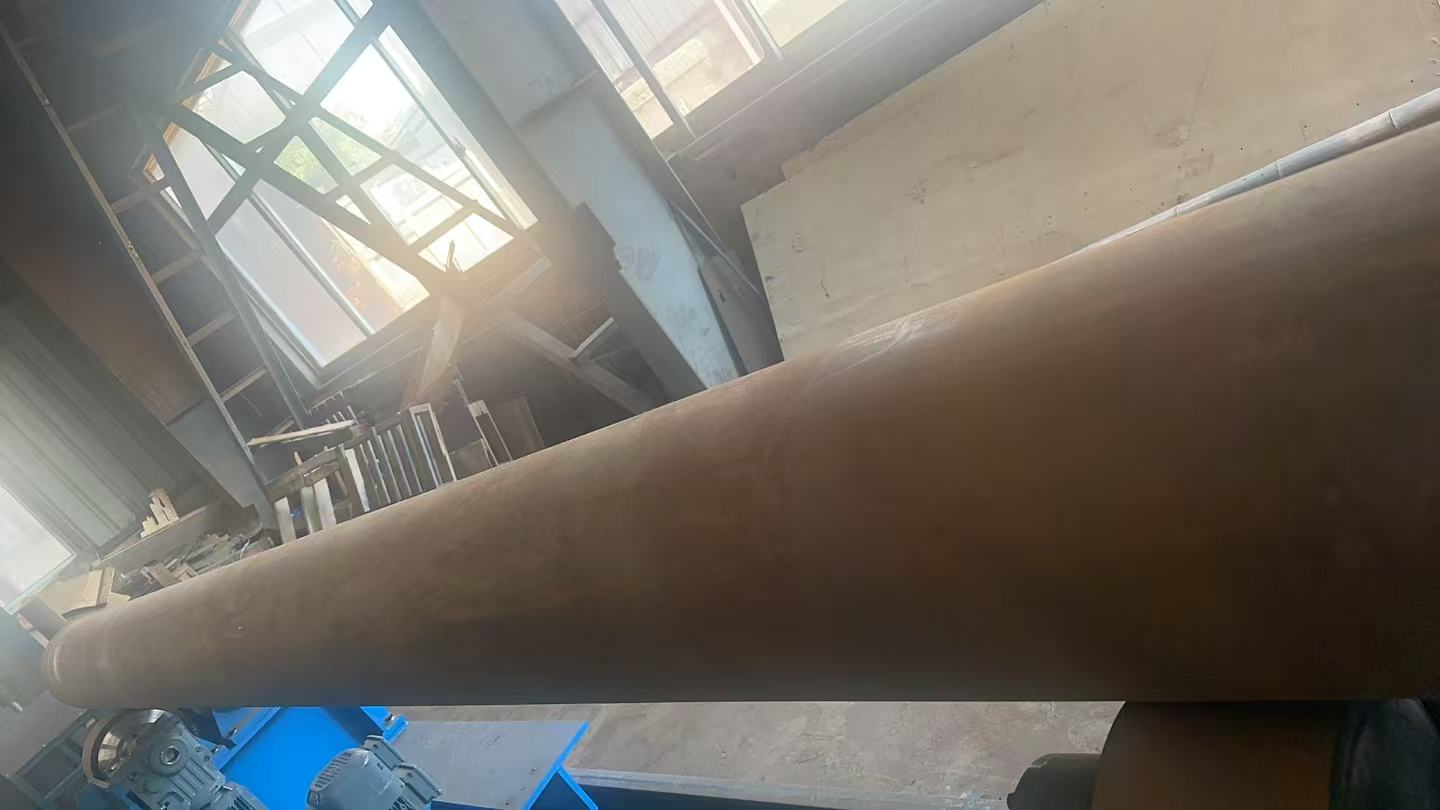
Before treatment: surface condition of steel pipe ahead of the grinding stage — the input that determines how much removal a finishing pass must achieve.
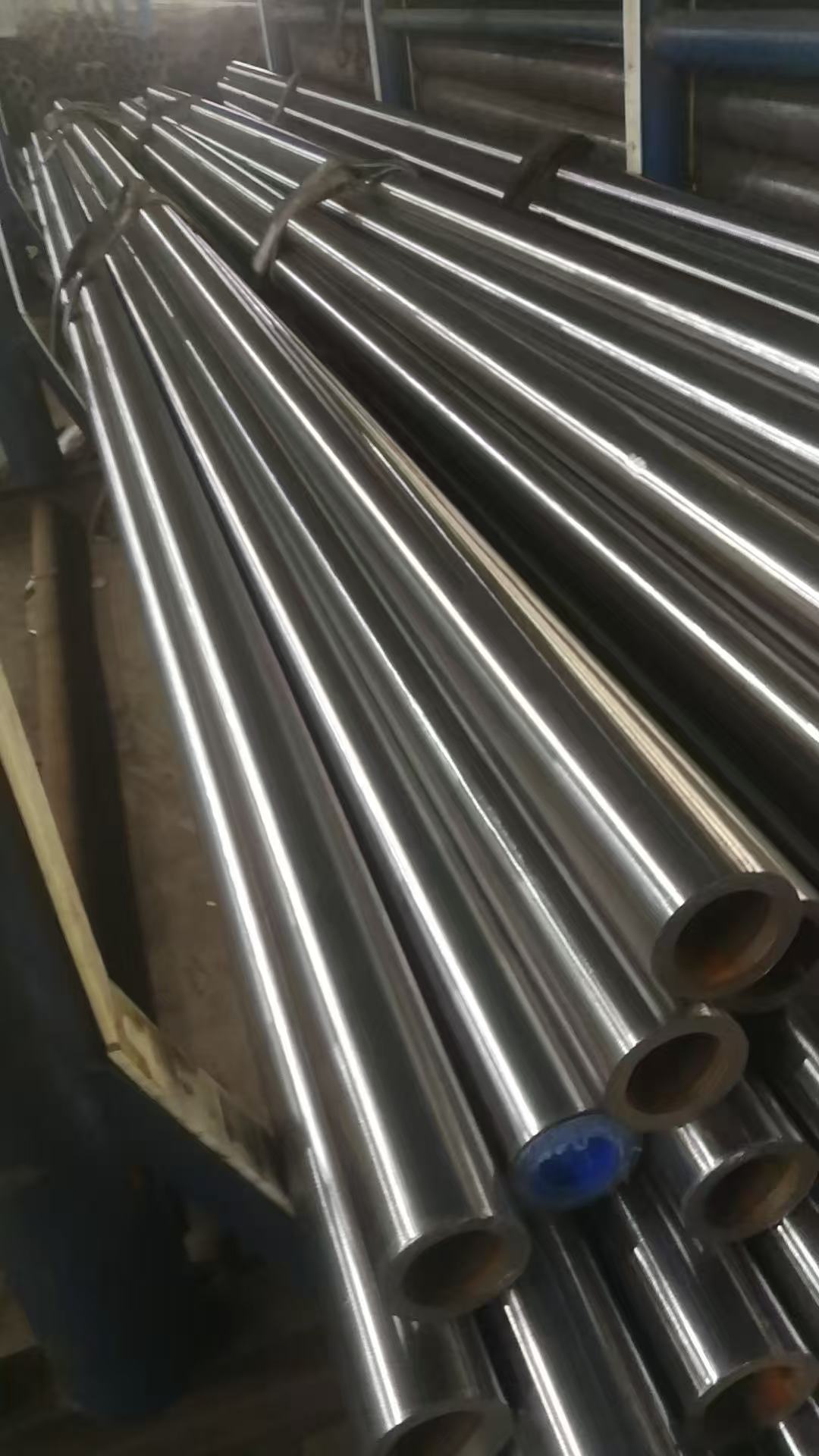
After treatment: consistent surface finish produced by an automated grinding pass, the property that a Ra ≤ 0.8 μm specification is intended to secure.
Safety and Documentation: The Part of the Scorecard Buyers Skip
Grinding carries two intrinsic hazards that no supplier selection process can design away: mechanical injury at the work zone, and grinding wheel breakage. The control methods are well established — safety interlock protection and a grinding wheel guard — and West's stated measures are protective guards and operator safety training. That is the minimum. What separates suppliers is whether those measures are documented in a form the buyer can audit and replicate in a training programme.
ISO 16089:2025, the current edition of the stationary grinding machine safety standard, is relevant here. It specifies requirements and measures to eliminate hazards or reduce risks for stationary grinding machines designed primarily to shape metal by grinding, applies to machines integrated into automatic production lines or grinding cells where comparable hazards arise, and requires a minimum list of safety-relevant information that the manufacturer must provide to the user. Two practical points follow. First, a buyer specifying a new finishing line should reference the 2025 edition rather than the superseded 2015 edition. Second, the standard's scope addresses stationary grinding machines; polishing and belt-grinding configurations may fall outside it, so a buyer of a steel pipe polishing machine should ask separately which requirements apply.
Application Fit: Where the Specification Actually Lands
The configurations that matter for this scorecard come from the work the machines are built for. Automated grinding is used in high-volume metal processing, steel pipe finishing and round steel precision machining, where the case for the machine rests on consistently tighter tolerance and smoother surface finish than conventional equipment, on standardised maintenance with fewer manual adjustments, and on lower long-term operating and labour costs.
Within the pipe and bar segment, the application split is practical rather than academic. External grinding addresses outer-diameter finish and defect removal; internal grinding addresses bore condition, which becomes decisive in tube destined for pressure, hygienic or high-purity service; multi-station configurations trade floor space for throughput; and round steel finishing lines combine grinding with handling across a full bar length. Round steel peeling is a different operation again — it removes surface defects and oxide scale to deliver dimensional control comparable to cold drawn material — and buyers frequently confuse peeling with grinding when they scope a line. A supplier that cannot explain the difference is unlikely to specify the right module.
Adjacent evidence from the market is instructive. A China-based tube equipment manufacturer publicly describes a tube grinding machine used to grind pipe defects and renovate waste pipe, with a stated outside-diameter range of 80–1420 mm on a sectional design. The claim is supplier-reported and independently unverified, but it illustrates a real application boundary: large-diameter and repair-oriented work is served by different machine architectures from the 20–300 mm range that covers most standard pipe and round bar production.
Comparison with Conventional Manual Finishing
The comparison that matters in the scorecard is not between two automated machines but between automation and the manual bench that many plants still run alongside it.
| Factor | Conventional manual grinding | Automated grinding machine |
|---|---|---|
| Processing precision | Operator-dependent | Higher processing precision with automated operation |
| Surface quality | Variable between passes and operators | Consistent surface quality across the batch |
| Tolerance and finish | Baseline reference | Consistently tighter tolerance and smoother finish than conventional equipment |
| Operating and labour cost | Baseline reference | Lower long-term operating and labour costs |
| Maintenance | Frequent manual adjustment | Standardised maintenance with fewer manual adjustments |
| Best fit | One-off, repair and low-volume work | High-volume metal processing, steel pipe finishing, round steel precision machining |
The limitations belong in the same table, because a scorecard that only records advantages is a sales document. Four boundaries are worth stating plainly.
- Workpiece envelope. A 20–300 mm diameter and 500–6000 mm length range does not cover large-diameter pipe or very long stock. Buyers outside that envelope need a different machine architecture, and a supplier whose range stops at 300 mm should be scored on honesty about that limit rather than penalised for it.
- Supplier scale. A facility of roughly 6,000 m² with 78 staff and a stated output of 300 units per year is a focused machine builder, not a plant-level engineering group. A processor who wants drives, automation, material handling and finishing engineering from a single contract is buying a different category of supplier and should plan for multi-vendor integration.
- Process physics. Grinding remains a fixed-abrasive process. Wheel wear, consumable cost, dust extraction and residual operator skill dependency persist; automation reduces variation but does not remove the need for trained operators and a dressing and replacement discipline.
- Grid and site conditions. A 380V/50Hz three-phase configuration is standard in many markets but requires review for 60Hz grids, and IP54 protection is appropriate to a grinding environment rather than to washdown or outdoor installation.
Commercial Terms as Continuity Evidence
Commercial terms are part of the durability test because they reveal how a supplier expects the relationship to run. West's stated terms are a minimum order quantity of 1 unit, CIF delivery terms, acceptance criteria defined as a pre-shipment test, and payment terms of 30/70.
Each of these should be read against the scorecard. A minimum order of one unit signals willingness to support single-machine buyers, which matters for processors adding capacity incrementally. CIF terms place the logistics burden on the supplier up to the destination port, but buyers should confirm who bears unloading, inland transport and installation. A pre-shipment test is the correct acceptance mechanism only if the test criteria are written into the order — the workpiece material, the diameter and length tested, the roughness measurement method and the pass criteria. Payment at 30/70 is conventional; the leverage it gives the buyer depends entirely on whether the pre-shipment test is defined before the deposit is paid.
Market Trends That Change the Scoring
Three developments are shifting what a ten-year scorecard should weight.
The first is safety standardisation. ISO 16089:2025 replaced the 2015 edition and explicitly extends to machines integrated into automatic production lines and grinding cells where comparable hazards arise. As finishing lines become more automated, the documentation requirement travels with the machine, and suppliers who can produce a complete safety information package will increasingly be separated from those who cannot.
The second is automation depth. Commercial research on the grinding machine category consistently emphasises CNC automation as the growth driver, and the workforce dimension supports the same direction: grinding and polishing machine operation is codified as a skilled occupation in the US occupational classification system, which means machine selection carries training and staffing consequences rather than being a purely capital decision. Buyers facing operator shortages should weight the automation and training dimension higher than the default scorecard suggests.
The third is data quality. Public evidence on specialised pipe grinding, polishing and peeling equipment remains thin and largely supplier-reported, and published market-size estimates conflict across publishers. A buyer who builds a business case on a single market figure is taking on avoidable risk. The scorecard approach is deliberately designed to run on evidence the buyer collects directly — reference calls, sample tests, factory acceptance records — rather than on secondary market numbers.
Future Outlook
Over the next several years, the supplier question in steel pipe finishing is likely to shift from capability to continuity. As the installed base of automated grinding and polishing equipment grows, spare-part availability, retrofit support and documentation quality become the differentiators that determine whether a line can be kept at specification. Buyers should expect to be asked for more information by good suppliers — workpiece drawings, material certificates, downstream process requirements — and should treat a supplier who asks nothing as a lower score, not a faster answer.
For dedicated builders, the credible path is not to imitate plant-level engineering groups but to be demonstrably deep in a defined envelope. A supplier that can state its diameter and length range precisely, demonstrate a roughness value on the buyer's material, name its wear parts and hold a current certificate with a number has answered the durability question better than a supplier with a broader brochure.
FAQ
What does supplier sustainability mean when buying a grinding machine?
It refers to the supplier's ability to keep the machine productive over a long production horizon — typically around ten years — through engineering continuity, spare-part and service availability, application knowledge and commercial stability. It is a durability assessment and is not an environmental or ESG metric.
How should R&D depth be weighted against installed base?
Neither should be scored on claims. R&D depth is evidenced by in-house design and manufacturing scope and by how a supplier answers a non-standard workpiece requirement; installed base is evidenced by references with material grade, diameter range and finish requirement stated. In the weighted model above both carry 20 points, but service and spare-part continuity carries 25 because it is the dimension that fails first in practice.
How can a buyer verify service network and spare-part claims before signing?
Request a spare-parts list with wear items identified, ask which items are held in stock and which are made to order, confirm the response commitment in writing, and contact at least one reference operating a comparable machine. A claim that cannot be traced to a document, a stock position or a reachable reference should be scored as an unverified claim rather than as evidence.
Which specifications should be confirmed for steel pipe and round steel grinding?
For West's steel pipe and round steel grinding machine the verified values are a 20–300 mm workpiece diameter range, 500–6000 mm length, Ra ≤ 0.8 μm surface finish, 0.5–10 m/min feed speed, 5.5–22 kW motor, 380V/50Hz three-phase supply, IP54 protection, and compatibility with carbon steel, alloy steel and SS304. Each value should be re-confirmed against the buyer's own material and measurement conditions during a sample or pre-shipment test.
What commercial and documentation terms matter over a ten-year horizon?
Acceptance criteria, warranty scope and spare-parts route matter more than headline price. West's stated terms are a minimum order quantity of 1 unit, CIF delivery, pre-shipment test as the acceptance criterion and 30/70 payment terms. The terms are only protective if the pre-shipment test is defined in the order — material, diameter, length, roughness measurement method and pass criteria.
What are the limits of a supplier scorecard?
A scorecard organises evidence; it does not generate it. It cannot verify an installed base the buyer has not contacted, cannot substitute for a sample test on the buyer's own material, and cannot predict ownership or management changes at the supplier. It also does not resolve the market-size conflict between published estimates, which is a separate research problem. Its value is in forcing the questions to be asked before the deposit rather than after the first breakdown.
Have Questions or Need More Details?
Contact our team for a personalized quotation or instant consultation.
Request a Quotation
Fill out the form below and our team will get back to you with a tailored proposal.
WhatsApp Direct Chat
Prefer to chat in real-time? Message us on WhatsApp for instant assistance & quick answers.
- Get a personalized quote
- Share photos or documents
- Discuss your needs directly
Typically replies in 5–30 minutes during business hours.