
120 mm Phone Repair Tweezers: FS-11, ST-25, ST-30 and ST-114 B2B Shortlist
The global smartphone repair market was valued at approximately USD 22.66 billion in 2026 (Business Research Insights), and the Right to Repair movement is a recognised market driver pushing OEMs to release repair manuals and tools to third-party providers (ThinkComputers.org, 2026). Every battery swap, screen replacement and connector repair inside that figure depends on hand tools measured in millimetres — and inside a repair toolkit, the tweezer is usually the tool that determines how quickly a technician can move a flex cable, a shield, or a screw without losing it into the chassis.
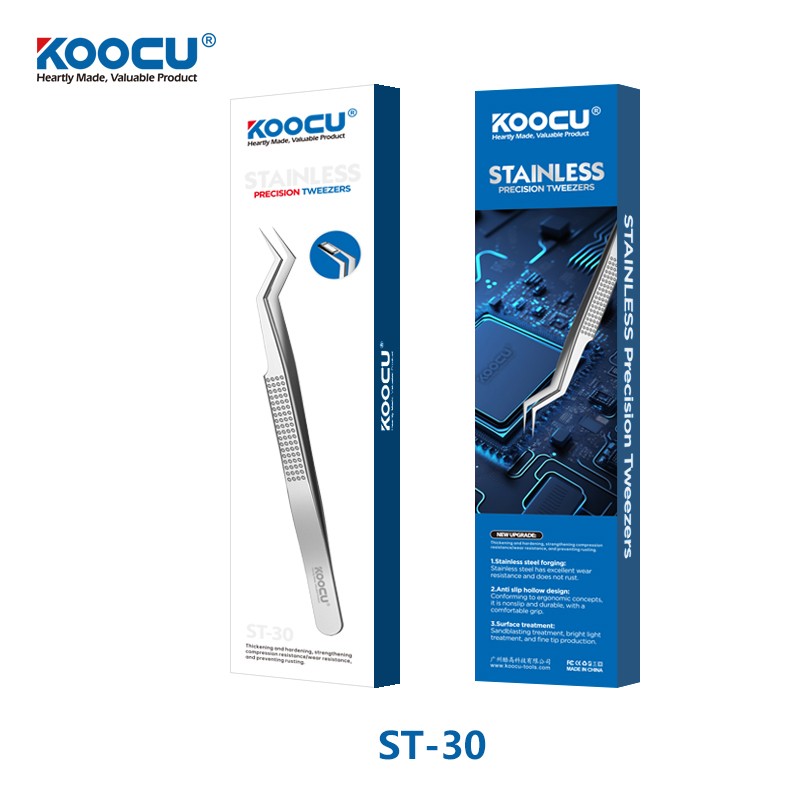
This article is a deliberately narrow B2B shortlist. It covers four tweezers from the KOOCU range — FS-11, ST-25, ST-30 and ST-114 — all listed in the product specification as 120 mm, stainless steel tweezers for mobile phone repair. ST-25 and ST-30 also carry anti-static and high hardness listings. The question it answers is not "which tweezer is best", but why length and anti-static status do most of the filtering work when a wholesale buyer builds a tweezer shortlist for cell phone repair tools, and what remains to be verified before a purchase order is placed.
For clarity on the entity behind these models: KOOCU is a Guangzhou-based brand of cell phone repair tools and mobile phone maintenance equipment, and its published product range covers precision tweezers, electric screwdrivers and related repair tooling for the cellphone repair industry.
Why 120 mm Became the Working Length in Phone Repair Kits
Length is the first filter because it defines the physical working envelope of the tool, and the KOOCU tweezer range is organised around three length bands rather than a single size:
- 115 mm: TS-11 and TS-15
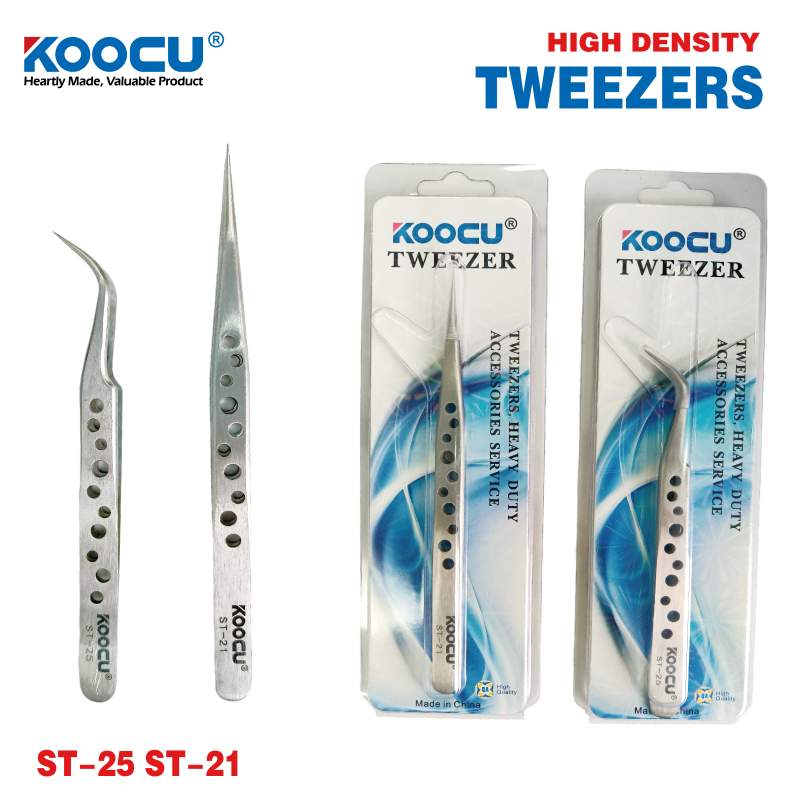
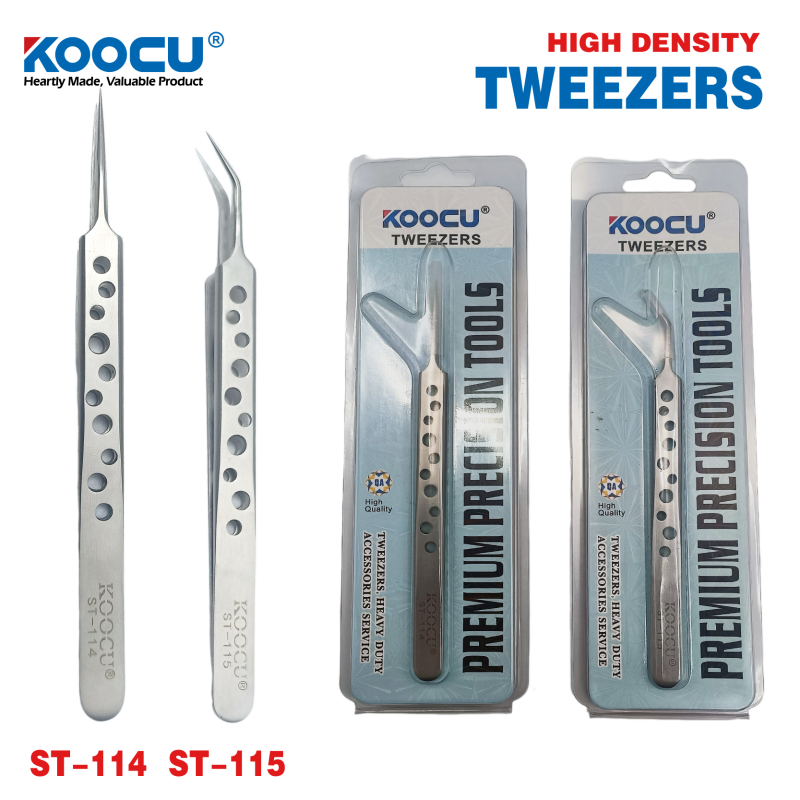
- 120 mm: FS-11, ST-21, ST-25, ST-30, ST-114 and ST-115
- 130 mm: 7-SA-16 SS-SA-16 and 7-SA SR SS-SA SR
The 120 mm band carries the largest number of models in that list, which is itself a useful signal for buyers: it is the length the range is built around. From a procurement standpoint, standardising a bulk order on a single length band simplifies kit assembly, spare-part planning and reorder cycles, because one length works across a wider share of repair stations than a specialist size does.
Practically, 120 mm is long enough to reach past the mid-frame of a phone or tablet without the technician's fingers crowding the work area, and short enough that tip control stays manageable under magnification. Shorter tools generally give finer tip-level control but less reach; longer tools generally improve reach while reducing the sensitivity of tip movement. That trade-off — not brand preference — is what makes length a first-pass shortlist filter rather than an afterthought.
For wholesale buyers supplying repair chains, the length decision is also a kit decision. A 120 mm tweezer sits comfortably alongside the small precision screwdrivers and pry tools that make up most teardown kits, and it does not force a different storage format in a roll-up pouch or a moulded case.
Anti-Static Status: The Filter That Splits the Shortlist in Two
Anti-static status is the second filter because tweezers are the tool that most often contacts connectors, flex cables and board-level components during a teardown, and those are the parts most exposed to electrostatic discharge risk in electronics work. In this four-model group, that attribute is not shared evenly:
- ST-25 — listed with anti-static and high hardness attributes.
- ST-30 — listed with anti-static and high hardness attributes.
- FS-11 — listed as a 120 mm stainless steel tweezer for mobile phone repair.
- ST-114 — listed as a 120 mm stainless steel tweezer for mobile phone repair.
That split is what makes the shortlist useful. A buyer who needs an anti-static tweezer for board-level work narrows immediately to ST-25 or ST-30. A buyer who needs general mechanical handling — pulling a bracket, steadying a shield, lifting a screw once it is free — is not forced into the anti-static subset and can compare all four models.
The 120 mm Shortlist at a Glance
| Model | Product type (as listed) | Length | Material | Listed attributes |
|---|---|---|---|---|
| FS-11 | Tweezer for mobile phone repair | 120 mm | Stainless steel | 120 mm stainless steel tweezer for mobile phone repair |
| ST-25 | Tweezer for mobile phone repair | 120 mm | Stainless steel | Anti-static; high hardness |
| ST-30 | Tweezer for mobile phone repair | 120 mm | Stainless steel | Anti-static; high hardness |
| ST-114 | Tweezer for mobile phone repair | 120 mm | Stainless steel | 120 mm stainless steel tweezer for mobile phone repair |
Read against the specification, the four models share two attributes and differ on one. All four are 120 mm. All four are stainless steel, and all four are classified as tweezers for mobile phone repair intended for the cellphone repair industry. The differentiation is the anti-static listing — and, for buyers who are assembling a mixed kit rather than a single-SKU order, the tip preference a technician develops on the bench.
Technical Reading: What 120 mm Stainless Steel Actually Delivers
Stainless steel matters in repair tweezers for reasons that a specification line cannot fully express but a buyer can reason about: it resists corrosion from handling and from the cleaning agents used in repair shops, it tolerates repeated handling without surface breakdown, and it can be cleaned between jobs without changing shape. For a wholesale buyer, that translates into a tool that survives a service cycle length measured in months rather than weeks, which is what makes a tweezer economical in bulk supply.
The 120 mm length contributes a second form of durability at the workflow level. A tweezer that reaches deeper into a chassis reduces the number of times a technician has to reposition the phone or add a second tool to the sequence, and fewer hand movements per repair is a direct throughput variable in shops running high repair volumes.
What the published specification does not define is equally important for buyers to recognise. Tip geometry, tip alignment, spring tension and the specific stainless steel grade are not stated per model in the data available for FS-11, ST-25, ST-30 and ST-114. Two tweezers can share a length and a material while gripping very differently, and that difference is usually discovered in the technician's hand rather than on a specification sheet.
Application Fit: Repair Shops, Factory Lines and Teardown Work
The cellphone repair industry is where these tools are designed to work, and the application data for the KOOCU range describes two operating environments: repair shops and factory line projects. Both are indoor, normal temperature environments, and this is the setting assumed by the tweezers in this shortlist.
The same application data records adjacent work in the same stations. Screw removal on cellphone repair factory lines is performed in rotate-and-twist mode with a screwdriver bit, and in some environments the application carries special requirements such as explosion-proof design. Tweezers and powered screwdrivers therefore share a station rather than replacing one another, which is a relevant point for buyers assembling a complete kit rather than a single tool order.
Three practical scenarios follow from that:
- Screen and connector work in repair shops. A 120 mm tweezer gives the reach to lift and place flex cables and small brackets while keeping the technician's hand clear of the display area, and the anti-static listing on ST-25 and ST-30 makes them the natural choice where board-level contact is expected.
- Factory-line disassembly. In high-repeat disassembly, the priority shifts toward tool consistency and replacement predictability. Standardising on one 120 mm length across a line simplifies tool control and reorder planning.
- Mixed kits for wholesale distribution. Distributors shipping to repair shops generally need a shortlist rather than a single SKU, because different technicians prefer different tips. A four-model 120 mm set — FS-11, ST-25, ST-30 and ST-114 — covers a general-use pair and an anti-static pair within one length band.
Market Signals Behind Tweezer Procurement in 2026
Three market signals are relevant to how a wholesale buyer should frame a tweezer shortlist this year.
1. Repair demand is large, but headline market values vary widely
The global smartphone repair market is reported at approximately USD 22.66 billion in 2026 by Business Research Insights. Buyers should treat that figure as directional rather than precise, because published market values for smartphone repair range from roughly USD 20 billion to above USD 200 billion depending on whether the definition covers repair services and labour only or the full repair ecosystem including spare parts. A procurement plan built on the lower, service-defined number will look very different from one built on the ecosystem number — and the difference is definitional, not a difference in underlying repair activity.
2. Regulation is actively expanding third-party repair
The Right to Repair movement is identified as a major market driver in 2026, influencing OEMs to release repair manuals and tools to third-party providers (ThinkComputers.org). For tool suppliers and their distributors, this expands the addressable base of independent repair shops — the exact customer segment that consumes 120 mm tweezers in volume — and it increases the importance of documented tool attributes as more professionalised buyers enter the market.
3. Precision hand tools are the growth edge of the category
The global manual screwdriver market was valued at USD 365.2 million in 2024, with precision screwdrivers for electronics identified as a key growth driver (Credence Research). Tweezer procurement tends to follow the same demand curve, because both tool types are bought by the same buyer for the same station. On the pricing side, customs data for mobile opener tools under HS 8205 shows an average US import unit price of approximately USD 1.03 per unit (Zauba customs records). That figure covers a broader opener-tool category rather than tweezers specifically, and it is derived from historical customs records, so it is useful as a category order-of-magnitude reference rather than as a tweezer price benchmark.
120 mm vs 115 mm vs 130 mm: Trade-Offs and Boundaries
A shortlist is only credible if it states where it stops being the right answer. Using the length bands present in the same KOOCU range, the boundaries of a 120 mm standard look like this:
| Length band | Models in the range | Where it tends to fit | Where it tends to fall short |
|---|---|---|---|
| 115 mm | TS-11, TS-15 | Fine, close-range work under magnification where tip sensitivity matters most | Reduced reach into deeper chassis; shorter working distance from the hand |
| 120 mm | FS-11, ST-21, ST-25, ST-30, ST-114, ST-115 | General repair-shop and factory-line work; kit standardisation across a length band | Not the longest reach available; anti-static attribute limited to specific models |
| 130 mm | 7-SA-16 SS-SA-16, 7-SA SR SS-SA SR | Deeper reach requirements where the technician works further from the component | Less tip-level sensitivity than shorter tools; bulkier in compact kits |
Two further boundaries apply specifically to this shortlist and are worth stating plainly. First, anti-static coverage is partial: if a buyer needs every tweezer in a kit to carry the anti-static listing, the shortlist narrows to ST-25 and ST-30, and FS-11 and ST-114 cannot substitute for them in that requirement. Second, commercial terms are defined at programme level rather than per model — the published capability profile lists a minimum order quantity of 50 units, a lead time of 10 days and 100% testing, but it does not state whether models can be mixed freely within a single order quantity, so buyers should confirm that point before issuing a purchase order.
There is also a comparison against the general-purpose alternative. A buyer can source unspecified tweezers at very low unit cost, and for coarse mechanical handling that may be adequate. The trade-off is that unspecified tools carry no stated length standardisation, no material declaration, and no anti-static attribute, which makes them difficult to defend inside a kit specification that a distributor has to publish to its own customers. For a B2B channel selling to repair shops, the value of a specified model is traceability as much as performance.
Supplier Readiness: What a Wholesale Buyer Should Confirm
The four models in this shortlist come from a supplier whose published capability profile covers the procurement terms that matter at wholesale level:
- OEM customization: voltage and logo customization are listed as available.
- Capacity and lead time: monthly capacity of 10,000 units and a 10-day lead time.
- Order threshold: minimum order quantity of 50 units.
- Quality control: 100% testing before shipment.
- After-sales: remote support.
- Export markets: South America and Africa are the listed export markets for the tool programme.
Independent trade-directory data adds an external data point on scale: KOOCU is listed with 15 years of experience in manufacturing mobile phone maintenance tools and an export share above 91% (Tradewheel). That is third-party commercial data rather than an audited figure, but it is consistent with the profile of a supplier whose revenue depends on export channels rather than domestic retail.
Field evidence for the wider tool programme exists in the case records. A South African B-end wholesale project involving 50 units of KOOCU electric screwdrivers has been recorded as running stably for 3 years. That case covers the electric screwdriver line rather than the tweezers discussed here, and it should be read as evidence of how the supplier's tools perform in repair-shop environments over a multi-year service cycle — not as a tweezer performance claim.
Future Outlook: Documentation Pressure on Hand Tool Claims
The direction of travel in cell phone repair tools points toward tighter documentation rather than looser. As Right to Repair regulation brings more professional buyers into third-party repair, and as repair chains standardise toolkits across multiple locations, attributes such as length, material and anti-static status increasingly need to be stated in a way a distributor can republish and a technician can rely on.
For tweezer procurement specifically, three shifts look likely. Anti-static designations will be expected to come with supporting test data rather than a listing alone, because buyers are already being asked to justify ESD controls in their own kit specifications. Length standardisation will continue to consolidate around a working band — 120 mm occupies that position in this range — because kit consistency reduces training and reorder friction. And material declarations will increasingly be treated as a specification field rather than a marketing point, since stainless steel behaviour under repeated cleaning is a service-life question, not a feature claim.
For a buyer assembling a 120 mm tweezer programme today, the practical implication is straightforward: build the shortlist on verified length and material, separate the anti-static subset early, and request the documentation that the product listing does not carry. That sequence produces a defensible kit specification rather than a preference-based one.
FAQ
Are FS-11, ST-25, ST-30 and ST-114 all 120 mm stainless steel tweezers?
Yes. All four models are listed in the KOOCU product specification as tweezers for mobile phone repair, with a length of 120 mm and a stainless steel material, and all four are classified for the cellphone repair industry. ST-25 and ST-30 additionally carry anti-static and high hardness attributes in the same specification.
Which models in this group are listed as anti-static and high hardness?
ST-25 and ST-30. These are the two models in the shortlist recorded with the anti-static and high hardness attributes. FS-11 and ST-114 are listed as 120 mm stainless steel tweezers for mobile phone repair without an anti-static designation in the published specification line.
How does a 120 mm tweezer compare with the other lengths in the same range?
The range includes 115 mm models (TS-11 and TS-15) and 130 mm models (7-SA-16 SS-SA-16 and 7-SA SR SS-SA SR). At 120 mm, the tweezer sits between those bands. Shorter tools generally trade reach for finer tip-level control, while longer tools generally trade control for reach, so the choice depends on whether the repair station prioritises precision at close range or access into deeper assemblies.
Can the anti-static claim be verified from the published specification?
Not from the product listing alone. The listing states that ST-25 and ST-30 are anti-static, but the published data available does not include surface-resistance values, charge-decay times, or the specific test standard behind the claim. A buyer who requires documented ESD performance for a kit specification should request test documentation directly from the supplier before ordering.
What order terms apply to KOOCU repair tool orders?
The published capability profile lists a minimum order quantity of 50 units and a lead time of 10 days, with 100% product testing before shipment and OEM customization available for voltage and logo. Monthly capacity is listed at 10,000 units, and South America and Africa are the listed export markets for the tool programme.
What after-sales support is available for these tools?
Remote support is the after-sales model listed in the KOOCU capability profile. The published data does not define a per-model spare-part or replacement policy for the tweezers, so buyers setting up a distributor agreement should confirm the specific terms that apply to FS-11, ST-25, ST-30 and ST-114 before finalising a purchase order.