
14 Procurement Questions to Ask about Blister and Cartoning Lines for Pharma
A pharmaceutical blister-cartoning line is specified twice: once in the request for quotation, and once on the factory floor. The fourteen questions below are the ones that most often decide whether those two versions match.
This is a procurement reference for buyers, packaging engineers and project managers evaluating blister and cartoning lines for solid dosage pharmaceutical production. It is organised as a working list for the RFQ stage and covers five areas: output rate, changeover and format memory, control system, line materials, and auxiliary functions. Where a question maps to a documented feature of a real line configuration, the specification is stated so that buyers can see what a verifiable answer looks like. Where a documented figure has a boundary, that boundary is stated as well.
The commercial context explains why the RFQ stage carries so much weight. The global blister packaging machine market for pharmaceutical applications was valued at USD 2.57 billion in 2025, with Asia-Pacific described as the fastest-growing region at an 8.87% CAGR through 2031 (Custom Market Insights). In cartoning equipment, horizontal systems accounted for 70.12% of market share in 2024 (Mordor Intelligence, end-load cartoning machine market). Most lines being compared therefore share the same broad architecture: blister forming and sealing, linked or manual transfer, and a horizontal cartoner. What separates suppliers is configuration discipline rather than category.
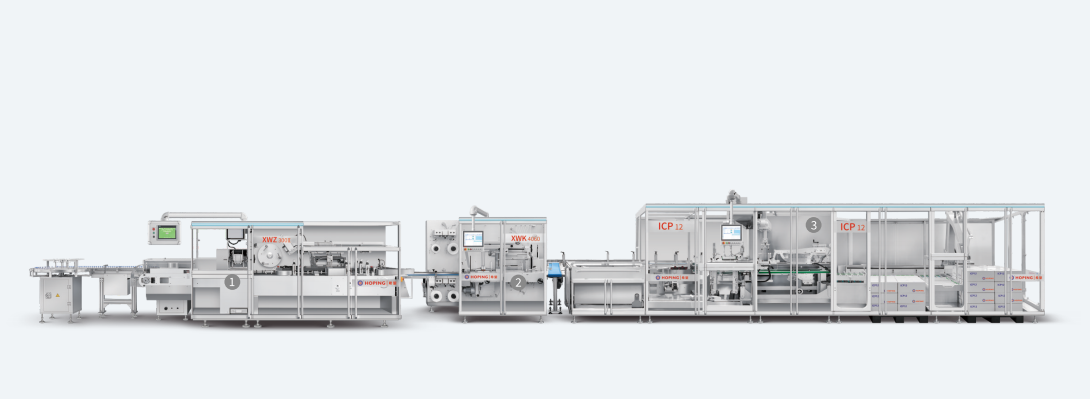
An automatic blister-flow-wrapper-cartoner line configuration. Line architecture — not headline speed alone — is the first item an RFQ should pin down.
Why the RFQ is the real specification stage
Two suppliers can both answer “high speed” and mean two different things. The difference usually sits in four places: the format and material at which the speed is measured, the time and tooling a format change requires, the control platform that runs the sequence, and the material and documentation status of the parts that touch the product.
Regulation reinforces this. The U.S. FDA describes Current Good Manufacturing Practice as the framework that establishes the foundation for quality pharmaceuticals through regulatory standards. Equipment bought into that environment is judged not only on mechanical output but on documentation, process control and data availability. Trade coverage of the sector reports the same direction of travel: pharmaceutical manufacturers turning towards digitised data collection and integrated solutions in order to meet regulations and improve visibility (PMMI content reported by Healthcare Packaging).
That changes what a good RFQ answer looks like. It should state what happens at a format change, what data the line produces, and which drawing or certificate supports each material claim. The fourteen questions below are grouped in the order most buyers work through them.
The 14 procurement questions
Output rate: questions 1 to 4
1. What is the maximum output, and at which format and material is it measured?
For reference, Hoping Machinery’s DHL8005H — an intelligent fully servo high-speed blister-cartoner integrated machine for solid dosage — is specified at up to 800 blisters per minute and 500 cartons per minute. A number of that kind is only meaningful with its measurement basis. Ask which blister format, which forming material (PVC, Alu-PVC or Alu-Alu) and which carton size produced it. A maximum output figure without those conditions cannot be compared between suppliers, because blister count per stroke, forming area and carton pitch all move the number.
2. What sustained output can the line hold across a shift, including inspection and rejection?
Maximum output and reliable output are different numbers. Ask what happens to throughput when products are rejected, when a lane is paused, and when the carton magazine needs replenishing. On the DHL8005H, blister feeding stability is maintained by a three-channel servo-driven independent replenishment system; the higher-capacity DHL1000/5H uses a four-channel system. The useful RFQ question is how those channels behave under rejection, not how many channels exist.
3. How are blister output and cartoning output balanced into one line?
The two ends rarely run at the same rate. A line specified at 800 blisters per minute and 500 cartons per minute implies a defined blister-to-carton ratio; change that ratio and the balance point moves. Ask how many blisters sit in one carton, what buffering or accumulation exists between the blister station and the cartoner, and what the line does when the carton magazine runs low. The DHL8005H uses a D3 intelligent top-loading parallel tracking transfer system between blister and carton stages.
4. Which dosage forms and product families fall inside this line’s scope?
The DHL8005H is scoped for pharmaceutical solid dosage production, capsule and tablet packaging, healthcare products, and food or cosmetic blister-cartoning projects where the same process applies. If liquid dosage formats are in scope — pre-filled syringes, ampoules or cartridges — the relevant machine family is different; Hoping’s IXW400 blister-cartoner integrated line is documented for those formats at up to 400 blisters per minute and 150 cartons per minute. Confirming dosage scope in the RFQ prevents a specification that technically answers the question but cannot run the product.
Changeover and format memory: questions 5 to 7
5. How is a format change performed, and what does the line remember?
This is where multi-SKU pharmaceutical production is won or lost. The DHL8005H includes mold-change and preset-memory functions; line documentation describes recipe storage and format changeover as supported according to configuration. Ask how many recipes can be stored, what a stored recipe contains (forming temperature, sealing parameters, stroke positions, carton settings), and whether parameters can be edited on the machine floor. Under GMP expectations, edit permissions and the record of who changed what matter as much as the memory function itself.
6. What is the measured changeover time, and on which tooling set was it measured?
A changeover figure without a stated format pair is not comparable. Ask for the time from last good pack of format A to first good pack of format B, named by blister format, carton size and leaflet format, with the number of operators involved. Also ask whether change parts are pre-staged on a cart or must be carried from stores, because that is usually where the real minutes are lost.
7. How many format parts are needed per SKU, and how are they identified and stored?
Request a tooling matrix that maps every SKU to its required parts. Hoping lists blister size, blister materials, quantity per carton, carton specification, leaflet format and feeding method among the items that are customised per project — which means the tooling list is determined by the packaging portfolio, not by the machine model. Tooling that is not identified, racked and inspected before installation becomes a validation problem later.
Control system, data and documentation: questions 8 to 10
8. Which motion controller and industrial PC will actually be supplied?
Control platform is a configuration decision, and within one supplier’s portfolio the answer can differ between models. The comparison below is drawn from documented specifications of Hoping blister-cartoner lines.
| Line / model | Type | Stated maximum output | Control platform | Replenishment / transfer |
|---|---|---|---|---|
| DHL8005H | Blister-cartoner integrated line, solid dosage | Up to 800 blisters/min and 500 cartons/min | Beckhoff motion controller and CP9315 industrial PC | Three-channel servo-driven independent replenishment; D3 top-loading parallel tracking transfer |
| DHL6004 | Blister-cartoner integrated line, solid dosage | Up to 600 blisters/min and 400 cartons/min | Beckhoff motion controller and CP9315 industrial PC | Servo-driven independent replenishment |
| DHL7005H | Blister-cartoner integrated line, solid dosage | Up to 700 blisters/min and 500 cartons/min | Siemens motion controller and TP900 HMI | Independent replenishment; self-developed IRB24 transfer robot |
| DHL1000/5H | Blister-cartoner integrated line, solid dosage | Up to 1000 blisters/min and 500 cartons/min | Beckhoff motion controller and high-bus industrial control system | Four-channel servo-driven independent replenishment; D3 transfer system |
| IXW600 | Blister-flow-wrapper-cartoner line | Up to 600 blisters/min, 300 packs/min, 300 cartons/min | Beckhoff controller and CP9315 industrial PC | Servo-driven replenishment |
The practical point for buyers is simple: naming the controller and the industrial PC in the RFQ shortens the technical clarification round, and makes two quotations comparable instead of merely similar.
9. What is the operator interface, and does it support the required language and access levels?
Interface language is a listed customisation item, and HMI choice follows the control platform — the DHL7005H, for example, is documented with a TP900 HMI alongside its Siemens motion controller. Ask for the alarm text language, the level of user access available to operators versus engineers, and the screen structure used for recipe recall. If the line will operate across multiple shifts in more than one language, the interface should be specified as an RFQ line item rather than settled at commissioning.
10. What production data can the line export, and how does it connect to MES or ERP?
The DHL8005H scope includes coding and inspection within the line and connection downstream. Hoping lists ERP/MES data interface among customisable items, and describes alarm stop, fault indication and multi-station control as part of the linked operating mode. Ask for a data-point list, the interface protocol, and whether batch records can be exported rather than read off the screen — digitised data collection is one of the clearest directional trends in pharmaceutical manufacturing, and it is easier to specify now than to retrofit.
Line materials and contact parts: questions 11 to 12
11. What are the product-contact parts made of, and what documentation accompanies them?
The DHL8005H is described with a stainless steel and aluminium-alloy machine structure, transparent guarding, and GMP-oriented product-contact parts and tooling supplied according to the technical agreement. That wording matters: where contact-part materials are tied to the agreement, the RFQ should require a contact-part list with material designations as an attachment. As a benchmark for the level of material detail that can be documented, Hoping’s DPH320HII rotary blister packing machine specifies product-contact parts in AISI 316L stainless steel and FDA-compliant pharmaceutical-grade materials, non-contact parts in AISI 304 stainless steel and anodised aluminium alloy, with a design and manufacture in accordance with GMP requirements and corrosion-resistant, easy-to-clean surfaces.
12. How is cleaning and inspection access designed, and what cleaning support is provided?
Ask for drawings of the cleaning access path around the forming station, sealing station, transfer area and carton magazine. Documented design intent in this area includes transparent guarding and easy-clean structures; the XWZ120 horizontal cartoning machine, for example, is described with a frame in high-quality carbon steel plus 304 stainless steel and a balcony-style design for easier cleaning. Confirm what cleaning-validation support the supplier provides, since access design is what determines whether cleaning is a routine task or a shutdown.
Auxiliary functions and downstream integration: questions 13 to 14
13. Which auxiliary functions should sit inside the line scope?
The DHL8005H scope covers high-speed blister forming and sealing, transfer, leaflet handling, carton opening and insertion, coding and inspection, and connection to bundling, case packing and palletising. Supporting equipment can include a leaflet folder, coding machine, vision inspection, checkweigher and rejection handling, depending on configuration. Mark in the RFQ which of these are standard and which are project-specific, and which ones carry their own acceptance criteria.
14. What are the downstream capacities and utility requirements, and who owns each interface?
Downstream modules have their own rates and need to be matched to the cartoner, not to the blister station. Documented capacities include the XWK4060 stretch bander at about 30 to 60 bundles per minute, the XWK series case packing machine at a maximum of about 5 cases per minute, and the ICP12 case packing and palletising integral machine at about 12 cases per minute. Utilities should be requested as a schedule: one linked blister-flow-cartoner configuration is documented at 380 V 50 Hz with a total of 36 kW and clean compressed air at 0.5–0.7 MPa. Finally, ask who signs off on each mechanical, electrical and data interface between modules — that answer determines how the line is commissioned.
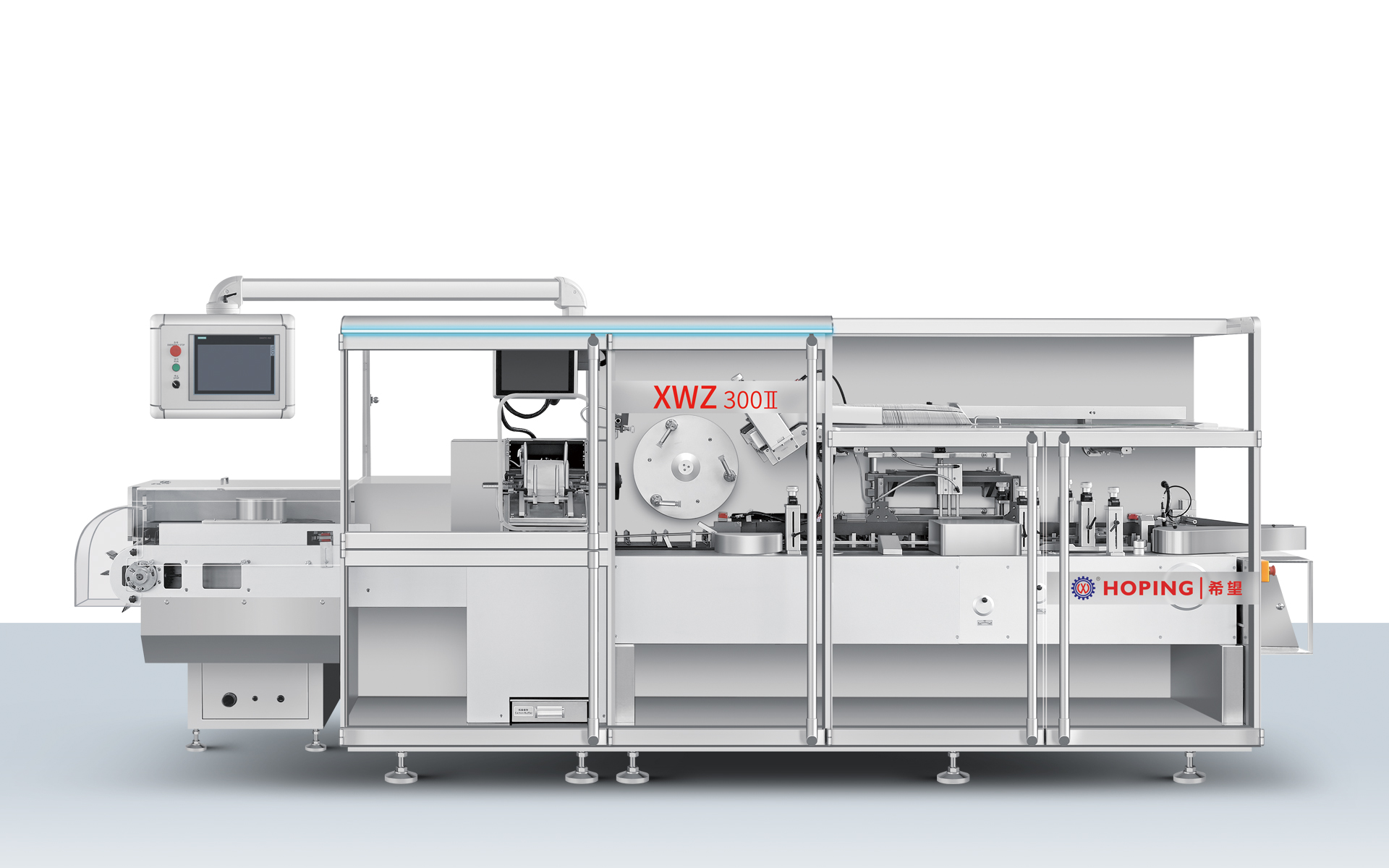
XWZ300II intelligent high-speed cartoning machine, documented at about 60–220 cartons per minute, with carton magazine, insertion, leaflet and closing modules. Cartoner capability is the second half of every blister-cartoning RFQ.
A reference configuration: what the DHL8005H puts on the table
Zhejiang Hoping Machinery Co., Ltd. (HOPING) is a pharmaceutical packing machinery manufacturer based in Ruian City, Zhejiang Province, China, established in 2001 and operating a 28,800 square metre manufacturing site with more than 300 employees and reported annual output of about 500 units. Its DHL8005H is positioned as a solid dosage turnkey blister-cartoner line rather than a standalone machine.
Technically, the configuration combines servo-driven motion across the line, a D3 intelligent top-loading parallel tracking transfer system, multiple feeding methods, PVC and aluminium foil auto splicing, three-channel servo-driven independent replenishment, a Beckhoff motion controller with a CP9315 industrial PC, mold-change and preset-memory functions, and GMP-oriented line design. The line footprint is not fixed: downstream bundling, case packing and palletising are added according to project configuration.
Two boundaries are worth keeping in view. First, the documented 800 blisters per minute and 500 cartons per minute are maximum figures for a configuration; they are not a validated sustained output, and comparison with another supplier requires matched format, station count, rejection handling and operating conditions. Second, an integrated line concentrates specification responsibility on one supplier, which is efficient when the RFQ is precise and risky when it is not.
Application fit: where this class of line is bought
The projects that generate these questions are consistent: a new solid dosage blister packaging line, an upgrade of an existing packaging line, a high-capacity expansion, an intelligent packaging workshop retrofit, and downstream integration projects linking blister, cartoning, bundling and case packing. Operating conditions are equally consistent — a GMP-oriented cleanroom or pharmaceutical packaging workshop, continuous high-speed running, and multi-batch, multi-format production. If the project is a retrofit rather than a greenfield installation, the RFQ should also state the available floor space, ceiling height, utility drops and the point at which the existing line will be cut over.
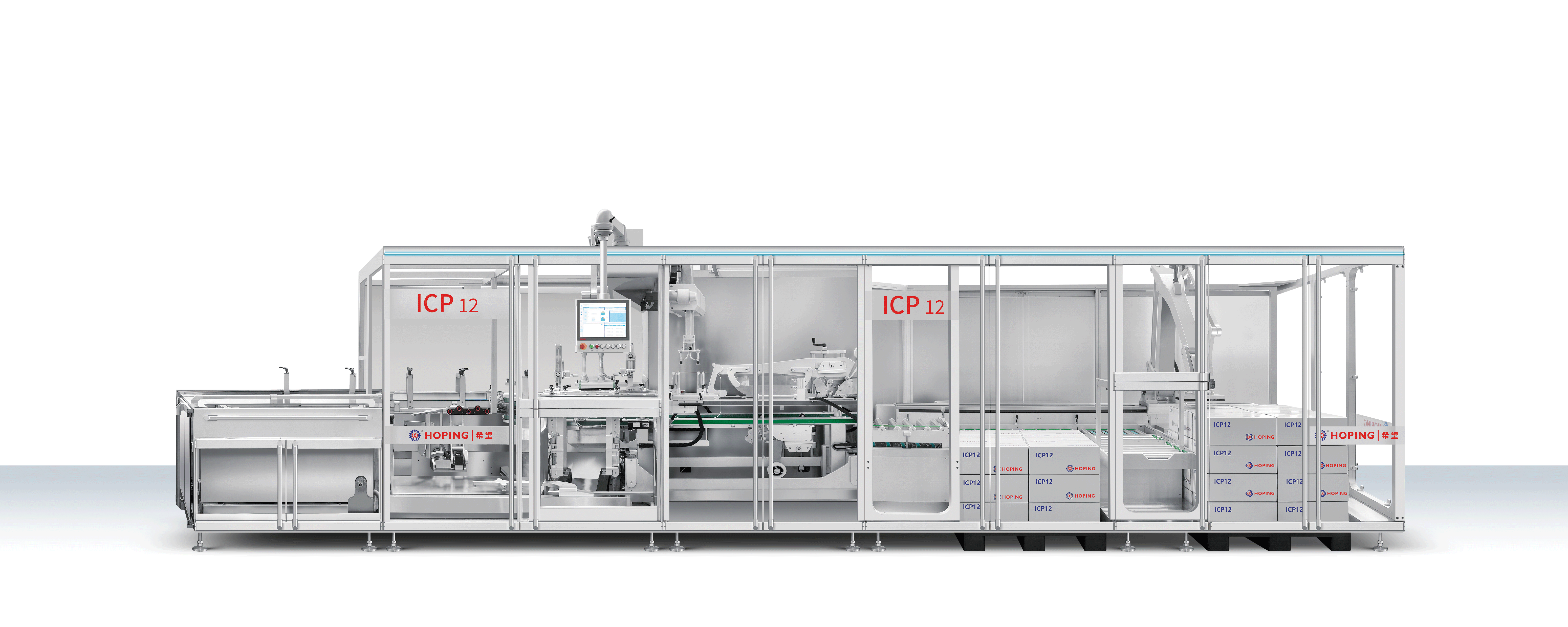
ICP12 case packing and palletising integral machine, documented at about 12 cases per minute. Downstream modules carry their own rates and interfaces, and should be specified in the same RFQ as the blister-cartoner.
What a complete RFQ answer should contain
A quotation that answers the fourteen questions will normally include an equipment list, a technical agreement, a tooling matrix, a contact-part list, a utility schedule and an acceptance plan. Hoping describes its own quality path as incoming material inspection, key component inspection, assembly inspection, electrical safety check, no-load trial run, material trial, factory acceptance testing, customer witness acceptance and pre-shipment inspection — a sequence worth requesting explicitly, because witness acceptance is the point at which the buyer can still influence the outcome.
Service and commercial terms should be asked in the same round rather than after selection. Hoping lists on-site installation and commissioning, operator and maintenance training, remote video and phone support, spare parts supply, process-parameter guidance and regular follow-up among its support items, subject to contract and configuration. On commercial structure, the company states a minimum order of one set or one complete line, a typical lead time of 60 to 120 days after technical confirmation, and monthly capacity of 30 to 40 units — three figures that should be re-confirmed in writing for the specific configuration being quoted.
Integrated line versus separate blister and cartoning stations
The conventional alternative remains a blister machine and a cartoner bought as two independent assets, linked by manual transfer or a simple conveyor. That structure offers procurement flexibility: each machine can be replaced or resold on its own, and the format envelope of each is decided separately. Its costs are operational — manual transfer between stations, additional handling, and the risk of wrong insertion or a missing leaflet, which are precisely the objectives that documented solid dosage projects set out to reduce.
An integrated line such as the DHL8005H addresses those objectives through servo-linked operation, synchronised multi-station control and, where configured, inspection and rejection within the line. The trade-offs are real and should be stated in the business case. Integration narrows the supplier field, concentrates interface risk, and ties changeover behaviour to one control platform. It also makes the accuracy of the original specification more consequential: because so much is configured together, a poorly written RFQ is harder to correct later than it would be with two standalone machines.
Trends that will change these questions
Three directional signals are relevant to how these RFQs will look over the next few years. Market growth is concentrated in Asia-Pacific, described as the fastest-growing region for pharmaceutical blister packaging at an 8.87% CAGR to 2031, which tends to increase the number of first-time line buyers and, with them, the weight placed on specification support. Equipment scope in research coverage is defined broadly — filling, sealing, labelling, blister packaging and cartoning are treated as one machinery market — which means category-level output or share conclusions should not be drawn from a total market figure.
The regulatory signal points in the same direction as the technology signal. Alongside the long-standing GMP framework described by the FDA, a draft Chinese GMP for pharmaceutical packaging materials has been reported as being under public consultation, with the stated purpose of guiding marketing licence holders in reviewing packaging material suppliers. Because that guidance is at draft stage, buyers should treat it as a planning input rather than a current obligation, and verify the issuing authority’s text before changing a specification.
Outlook
Blister and cartoning line procurement is shifting from a speed comparison towards a configuration and documentation comparison. The questions that carry the most weight are becoming the ones that cannot be answered with a single number: how a format change is executed and recorded, which control platform will be delivered, what evidence supports each material claim, and who is responsible for each interface. Buyers who ask those fourteen questions at the RFQ stage generally need fewer changes after factory acceptance — and suppliers who answer them specifically shorten their own clarification cycles.
A downloadable catalog covering the blister, cartoning and end-of-line portfolio referenced in this article can be found here: Hoping Machinery Catalog.
Have Questions or Need More Details?
Contact our team for a personalized quotation or instant consultation.
Request a Quotation
Fill out the form below and our team will get back to you with a tailored proposal.
WhatsApp Direct Chat
Prefer to chat in real-time? Message us on WhatsApp for instant assistance & quick answers.
- Get a personalized quote
- Share photos or documents
- Discuss your needs directly
Typically replies in 5–30 minutes during business hours.