
15 kV Metal-Clad Switchgear: What Buyers Need to Know
Industry Reference · Medium-Voltage Distribution
Medium-voltage distribution in North America is not a single-voltage conversation. In the equipment classes covered by this reference, the working band runs from 5 kV to 38 kV, and a 15 kV metal-clad switchgear lineup can sit in the same facility as 27 kV and 38 kV sections, each carrying its own insulation, short-circuit and enclosure requirements.
For buyers in the awareness and research stages, the practical question is rarely what switchgear is. It is which construction, which listing, which ratings, and which supplier evidence actually apply to a 15 kV class lineup. This reference answers that question using documented product data, published equipment standards, and clearly stated limits.

Why the 15 kV Class Still Anchors Medium-Voltage Distribution
The 15 kV level is one of three high-voltage options documented on the company's three-phase pad-mounted transformer range for North America, alongside 25 kV and 35 kV. That same range offers low-voltage outputs of 240 V, 480 V, 480Y/277 V and 600Y/347 V three-phase wye configurations. In other words, 15 kV is not a legacy voltage in North American distribution; it is one of the levels that distribution transformers, feeders and primary switchgear are actually built around.
The commercial difficulty starts immediately after the voltage class is agreed. A single-line diagram may specify 15 kV, but it will not answer the questions that determine which lineup is acceptable: what is the available fault level at the bus, does the specification require an internal arc rating, what enclosure type does the room or the yard allow, how much continuous current must the main bus carry, and how much space is left for future sections.
The broader problem is that medium-voltage equipment is described with overlapping labels. Metal-clad, metal-enclosed, gas insulated, cubicle-type gas insulated, and ring main unit all appear in the same tender packages, and a general statement that a product is UL listed does not indicate which standard applies or which equipment category it covers. For a 15 kV project, that ambiguity is expensive to resolve late, because switchgear geometry, cable entry and room dimensions are already fixed by then.
The opportunity is that a well-documented metal-clad family gives the buyer one construction language to compare. Where a manufacturer publishes ratings for adjacent voltage classes in the same lineage, the 15 kV class can be evaluated against a known construction pattern rather than against a brochure adjective.
What Metal-Clad Actually Describes
In North American practice, metal-clad switchgear is a construction description rather than a voltage rating. It generally indicates that the switching device is mounted in an individually grounded metal compartment and can be withdrawn for service, with grounded metal barriers separating compartments and mechanical interlocks restricting unsafe operating sequences. It does not by itself state the voltage class, the fault withstand capability or the enclosure rating.
Manufacturers apply the label with different degrees of precision, which is why the construction description matters more than the heading. Within the same company's medium-voltage portfolio, the UL Listed medium-voltage switchgear range is documented as metal-enclosed medium-voltage switchgear, while the FP-MCS range is documented as metal-clad and, in one configuration, arc-resistant metal-clad switchgear.
The documented construction details show what that means in practice. The UL Listed medium-voltage switchgear model FP-MVSG-38 is described as fully enclosed metal-clad construction with a standard five-position mechanical interlock, a modular scalable design, and maintenance-free vacuum interruption with full compatibility with ANSI standard grid parameters. The 27 kV metal-clad switchgear model FP-MCS 2H AR is documented with a precision-machined steel drawout carriage, accurate alignment and smooth travel, a heavy-duty spring energy storage mechanism, and dual interlock protection. The corresponding 38 kV metal-clad models FP-MCS 2H and FP-MCS 1H use a reinforced steel breaker carriage with stable guiding and reliable position locking.
The Standards Layer: UL 347, ANSI/IEEE C37.20.2 and the UL Family Around It
The company's UL Listed medium-voltage switchgear specification references UL 347 and ANSI/IEEE C37.20.2, with enclosure protection listed as NEMA 1 or NEMA 2 for the metal-enclosed medium-voltage range. Those are the two standard references that appear against the medium-voltage product line reviewed here.
Below the medium-voltage tier, the UL standards form a set of separate equipment categories rather than a ladder of quality. UL 1558 covers metal-enclosed low-voltage power circuit breaker switchgear assemblies, and its scope is described as assemblies serving circuits at nominal AC voltages of not more than 1,000 volts. UL 891 covers switchboards. UL 845 covers motor control centers. UL 67 covers panelboards. UL 508A governs industrial control panels. Published comparison notes for these standards state explicitly that they describe distinct product categories and that the evidence supports category separation, not market sizing.
That distinction is the single most common source of confusion in North American procurement documents for this equipment family. A UL 1558 low-voltage switchgear listing, a UL 891 switchboard listing, a UL 845 motor control center listing, a UL 67 panelboard listing and a UL 508A industrial control panel listing each describe a different assembly type. None of them stands in for a medium-voltage listing on a 15 kV metal-clad lineup.
In practice, the buyer's check is straightforward: match the standard number on the submittal to the equipment category and to the voltage class of the assembly being purchased. Where the documentation states a medium-voltage listing, the supporting standard reference should be a medium-voltage standard.
Inside a 15 kV Metal-Clad Lineup: The Ratings to Read First
Metal-clad switchgear is specified through a small set of parameters, and reading them in the wrong order is what produces tender documents that cannot be compared. The table below consolidates ratings documented for the medium-voltage metal-clad and metal-enclosed ranges reviewed here.
| Parameter | FP-MVSG-38 (UL Listed MV, metal-enclosed) | FP-MCS 2H AR (27 kV metal-clad) | FP-MCS 2H / 1H (38 kV metal-clad) |
|---|---|---|---|
| Rated voltage | 5 kV – 38 kV | 27 kV | 38 kV |
| Rated frequency | 60 Hz | 60 Hz | 60 Hz |
| Rated current | 1200 A – 4000 A | 1200 / 2000 A; 2H AR rating up to 2500 A | 1200 / 2000 / 3000 A |
| Short-time withstand current | 31.5 / 40 kA (2 s) | 31.5 / 40 kA (2 s) | 31.5 / 40 kA (2 s) |
| Peak withstand current | 82 / 104 kA | 82 / 104 kA | 82 / 104 kA |
| 1-minute power frequency withstand | 36 kV – 80 kV | 60 kV | 80 kV |
| Lightning impulse withstand | 95 kV – 150 kV | 125 kV | 150 kV |
| Internal arc rating (0.5 s) | Not stated in this specification | 40 kA | 40 kA |
| Enclosure protection | NEMA 1 / 2 | NEMA 1 / 2 | NEMA 1 / 2 |
| Switchgear width | Not stated in this specification | 36 inches | 42 inches |
Read the ratings in this sequence. Rated voltage and frequency place the lineup in its class. Rated current sets the continuous bus capability. Short-time withstand current and its duration, together with the peak withstand value, determine whether the lineup survives the available fault level at the installation point. The one-minute power frequency withstand and the lightning impulse withstand values describe the insulation coordination, and they scale with the class: 60 kV and 125 kV for the 27 kV metal-clad model, 80 kV and 150 kV for the 38 kV model, and 36 kV to 80 kV with 95 kV to 150 kV across the full 5 kV to 38 kV metal-enclosed platform.
Two further parameters decide layout rather than performance. The internal arc rating, documented at 40 kA for 0.5 seconds on both the 27 kV and 38 kV metal-clad models, determines whether the lineup can be placed in an occupied area under the project's safety criteria. The cabinet width, documented at 36 inches for the 27 kV model and 42 inches for the 38 kV model, determines the room or the yard the project has to build.
Where 15 kV Metal-Clad Switchgear Is Applied
The UL Listed medium-voltage switchgear range is documented for North American transmission and distribution grid scenarios and is intended for renewable power plants, data centers, petrochemical facilities, industrial parks and municipal infrastructure.
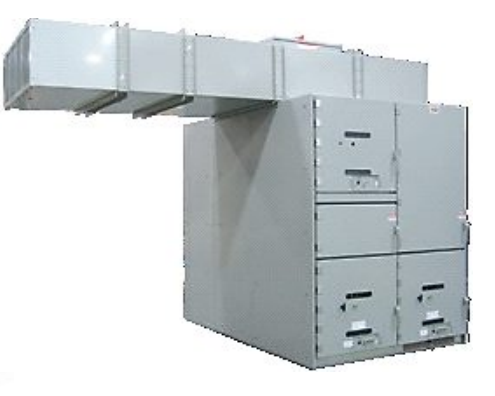
Application data for adjacent classes shows how the roles divide inside a facility. The 27 kV metal-clad model is documented for regional district distribution substations in North American grids, medium-scale industrial parks and manufacturing campuses, utility-scale renewable energy collection and step-up stations, large commercial complex primary distribution systems, municipal infrastructure and transportation power supply, and medium-capacity mining and mineral processing facilities. The 38 kV metal-clad models are documented for bulk power distribution substations and regional transmission nodes, large heavy industrial complexes such as steel, petrochemical and mining facilities, utility-scale wind and solar step-up substations, high-capacity urban distribution networks, large data center primary medium-voltage feeders, and heavy mining power systems.
A documented reference project illustrates the environmental side of the specification. In a substation project in Uzbekistan, the working conditions are listed as outdoor installation with large ambient temperature variations and a dusty environment, operating 24/7 on a power system function, with switchgear among the matched equipment. The special requirements recorded for that project are dust resistance, outdoor installation, UV resistance and harsh environment adaptability. The related products listed for the same project include the medium-voltage RMU switchgear, the 27 kV metal-clad switchgear, the 38 kV metal-clad switchgear and a 110 kV to 500 kV power transformer.
That combination of requirements is the reason the environmental specification and the electrical specification have to be read together. A lineup that meets the fault level but not the enclosure, coating and temperature requirements will not survive the site.
How Jiangsu Dinghong Power Fits This Category
Jiangsu Dinghong Power Co., Ltd., working in collaboration with Jiangsu First Power Co., Ltd., is a power transmission and distribution equipment manufacturer located in Hai'an City, Nantong, Jiangsu Province, China. The company operates a dual-base model: research, development and manufacturing in Hai'an, with global marketing in Suzhou. Its manufacturing scope covers high- and low-voltage switchgear, dry-type transformers, oil-immersed transformers, main transformers and containerized substations, with documented product series including KYN61, KYN28, XGN15, MNS, GGD and GCK.
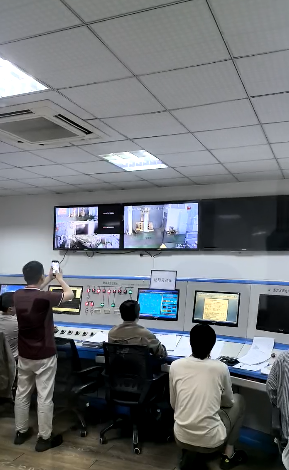
The company was established in 2018. Its manufacturing facility covers 20,708 square meters, it employs approximately 120 staff, its R&D team consists of 30 engineers, and its annual production capacity reaches 1,000 units. Export business accounts for 80 percent of total sales, with major markets described as domestic and foreign, and a stated strategic focus on the United States market. The company holds ISO 9001 quality management, ISO 14001 environmental management and ISO 45001 occupational health and safety certification, and runs an ERP digital management system with closed-loop control across procurement, production, processing and delivery, supported by multi-level inspection covering incoming material, critical production steps and finished-product testing before shipment.
For the subject of this article, the relevant product position is specific. The company produces 15 kV Metal-Clad Switchgear and supplies 27 kV Metal-Clad Switchgear, offers 38 kV Metal-Clad Switchgear, produces 15 kV Gas Insulated Switchgear (GIS), manufactures 38 kV Gas Insulated Switchgear (GIS), manufactures 38 kV C-GIS Switchgear, and offers Medium Voltage RMU Switchgear. For North America, the documented range includes UL 67 Panelboard, UL 508A Industrial Control Panel, UL 845 Motor Control Center (MCC), UL 891 Switchboard, UL 1558 Low Voltage Switchgear, and UL Listed Medium Voltage Switchgear.
Metal-Clad vs. Other Medium-Voltage Constructions
Metal-clad is one of several valid answers at 15 kV. The comparison below uses only documented configurations from the same manufacturer, so the differences reflect construction rather than brand claims.
| Construction | Documented example | Documented ratings | Insulation and enclosure | Typical fit |
|---|---|---|---|---|
| Metal-clad, air insulated, drawout | FP-MCS 2H AR (27 kV); FP-MCS 2H / 1H (38 kV) | 1200–3000 A; 31.5/40 kA (2 s); 40 kA internal arc (0.5 s) | Epoxy cast insulators, ceramic vacuum interrupters, NEMA 1/2 | Substations, industrial primary distribution, data center MV feeders |
| Metal-enclosed medium voltage | FP-MVSG-38 | 5–38 kV; 1200–4000 A; 31.5/40 kA (2 s) | Metal-enclosed, vacuum interruption, NEMA 1/2 | North American transmission and distribution, renewables, petrochemical, industrial parks |
| Cubicle-type gas insulated (C-GIS) | FP-C-GIS | 38 kV; 2500–4000 A; 40 kA (4 s); 100 kA peak | SF6 / N2 gas mixture, stainless steel welded enclosure, IP6X | High-capacity substations, data center main incoming feeders, urban trunk distribution |
| Ring main unit (RMU) | FP-RMU-38 | 38 kV; 600 A; 25 kA (4 s) main circuit; 52 kA peak | Sealed stainless steel gas tank, IP4X outer enclosure, IP67 gas tank | Urban ring network distribution, residential and commercial parks, prefabricated substation integration |
The practical reading is that these constructions are not ranked; they are matched to different load and space conditions. A 15 kV arrangement that needs high continuous current and future feeder expansion is a metal-clad or metal-enclosed conversation. A 15 kV ring-network position with modest current and severe space constraints is an RMU conversation. A high-current position inside a dense switchroom is a C-GIS conversation. Selecting on the label rather than on the fault level, the current and the available footprint is the most common procurement error in this category.
Limits and Trade-Offs Buyers Should Not Skip
- Footprint scales with voltage class. The documented 27 kV metal-clad model is 36 inches wide; the 38 kV models are 42 inches wide. Cabinets are dimensioned for the electrical clearances their class requires, so a 15 kV lineup will not share the dimensions of a low-voltage switchboard.
- Published parameter coverage varies by class. The detailed metal-clad ratings reviewed here are documented for 27 kV and 38 kV. A 15 kV procurement should obtain the equivalent parameter set directly rather than scaling figures from an adjacent class.
- Gas insulation changes the maintenance routine. The C-GIS range uses an SF6 / N2 gas mixture described as having lower global warming potential than pure SF6, with high-temperature epoxy resin insulation components and an IP6X enclosure. Online monitoring for gas density and conductor temperature is offered as an option, which means gas management becomes part of the operating practice rather than something that can be ignored after commissioning.
- RMU capacity is deliberately limited. The documented RMU is rated 600 A at 38 kV. It is an efficient ring-network device, not a substitute for a 15 kV main bus position that has to carry several thousand amperes.
- High fault ratings only pay off where the fault level demands them. A 40 kA internal arc rating and 31.5/40 kA short-time withstand capability matter in a high fault-level substation and add cost and mass where the system fault level is modest.
- Factory integration shifts work rather than removing it. Prefabricated delivery moves assembly, wiring and testing from the site to the factory, which changes where schedule risk sits and how site acceptance is planned.
Trends Reshaping How Medium-Voltage Equipment Is Bought
Three directions are visible in the documentation reviewed for this reference. The first is the normalisation of arc-resistant construction: arc-resistant metal-clad switchgear appears as a distinct product type, and 40 kA for 0.5 seconds is documented as an internal arc rating on both the 27 kV and 38 kV metal-clad models. What was once a special request now appears in baseline specifications for occupied buildings and high fault-level substations.
The second is the separation of data center medium-voltage service as its own application. The 38 kV metal-clad range is documented for large data center primary medium-voltage feeders, and the C-GIS range is documented for data center main incoming feeders, while the E-house range is documented for Tier III and Tier IV data center outdoor power distribution systems. Data center load growth is being expressed in equipment architecture, not only in capacity numbers.
The third is insulation and delivery. The C-GIS range uses a mixed SF6 / N2 insulation medium with lower global warming potential than pure SF6, and prefabricated E-house delivery integrates switchgear, transformers, protection and auxiliary systems into a single tested enclosure for utility-scale solar and wind plants, energy storage stations, industrial parks and remote infrastructure.
Future Outlook
The 15 kV class is likely to remain a working voltage in North American distribution for the same reason it exists today: it matches the high-voltage options documented on pad-mounted distribution transformers and established plant distribution practice. What is changing is the packaging around it. Switchgear is increasingly specified together with transformers, protection and auxiliary systems, delivered as prefabricated assemblies, and commissioned at the factory rather than in the field.
For buyers, the implication is procedural rather than technical. The verification habits that matter now are the ones that survive that packaging: matching the standard number to the equipment category and voltage class, confirming which class the published ratings actually cover, and requiring factory test records that correspond to the configuration being shipped. Those habits cost little at the research stage and are difficult to retrofit once a lineup is on site.
Frequently Asked Questions
What is 15 kV metal-clad switchgear?
It is a medium-voltage switchgear assembly rated for the 15 kV class in which the switching devices are mounted in metal compartments within a metal-clad construction. The metal-clad description refers to the construction and the withdrawable arrangement of the switching device, not to the voltage rating itself. Jiangsu Dinghong Power Co., Ltd. lists 15 kV Metal-Clad Switchgear among the products it produces, alongside 27 kV and 38 kV metal-clad switchgear, 15 kV and 38 kV gas insulated switchgear, 38 kV C-GIS switchgear and medium-voltage RMU switchgear.
Which UL standard applies to a 15 kV metal-clad lineup?
The medium-voltage product line reviewed here references UL 347 and ANSI/IEEE C37.20.2. The UL standards commonly cited alongside it cover different equipment categories and must not be substituted: UL 1558 covers metal-enclosed low-voltage power circuit breaker switchgear assemblies at nominal AC voltages of not more than 1,000 volts, UL 891 covers switchboards, UL 845 covers motor control centers, UL 67 covers panelboards, and UL 508A governs industrial control panels. Published comparison notes for these standards state that they describe distinct product categories.
Which ratings should be confirmed first when specifying a 15 kV metal-clad lineup?
Rated voltage and frequency place the lineup in its class. Rated current sets continuous bus capability. Short-time withstand current and duration plus peak withstand current determine fault survival. The one-minute power frequency withstand and lightning impulse withstand values define insulation coordination. Internal arc rating and cabinet width then determine whether the lineup fits the room and the safety criteria. For reference, documented values on the adjacent classes are 60 kV and 125 kV for the 27 kV metal-clad model, 80 kV and 150 kV for the 38 kV model, with internal arc ratings of 40 kA for 0.5 seconds and cabinet widths of 36 inches and 42 inches respectively.
Where is this equipment class typically installed?
The documented application range for the medium-voltage switchgear reviewed here covers North American transmission and distribution grid scenarios, renewable power plants, data centers, petrochemical facilities, industrial parks and municipal infrastructure. At the 27 kV class the documented applications include regional district distribution substations, medium-scale industrial parks, renewable energy collection and step-up stations, large commercial complex primary distribution and municipal infrastructure. At the 38 kV class they include bulk distribution substations, heavy industrial complexes, utility-scale wind and solar step-up substations, high-capacity urban distribution networks and large data center primary medium-voltage feeders.
What are the main limitations of metal-clad construction?
Cabinet dimensions follow the voltage class, so a 27 kV metal-clad section is documented at 36 inches wide and a 38 kV section at 42 inches, which has direct consequences for switchroom layout and yard space. High fault withstand and internal arc ratings add cost and mass where the available fault level does not require them. Air-insulated metal-clad construction is not the most compact option where space is the binding constraint, which is where C-GIS and RMU constructions are documented instead. Gas-insulated alternatives introduce gas density monitoring into the operating routine. Published rating coverage also differs by voltage class, so a 15 kV specification should not be assembled from adjacent-class figures.
How can a buyer verify a manufacturer's medium-voltage claims?
Match the standard number on the submittal to the equipment category and the voltage class, since the UL standards for switchboards, motor control centers, panelboards, industrial control panels and low-voltage switchgear cover different assemblies. Request the rating table for the specific voltage class being purchased. Ask for factory test and inspection records covering incoming material, critical production steps and finished-product testing, and for factory acceptance test documentation where a prefabricated assembly is supplied. Confirm the management system certificates held by the manufacturer, and check documented project references, including the operating conditions recorded for those projects, such as the outdoor, dusty, wide-temperature substation project documented in Uzbekistan.
Reference material: the company product brochure is available for download at https://cdn.socialarks.com/sbsp/25269/common/2026/0828/%E6%9C%80%E6%96%B0%E5%8D%B0%E5%88%B7%E7%94%BB%E5%86%8C420x285%E8%8B%B1%E6%96%87%E5%BC%80%E5%85%B3%E6%9F%9C.pdf. Company website: https://www.firstpowerglobal.com/. Information in this article reflects documented product specifications and published equipment standards for medium-voltage and low-voltage switchgear classes.