
2-Piece DRD Fish Cans: BPA-Free Sulfur-Resistant TFS Fit
2-Piece DRD Fish Cans: BPA-Free Sulfur-Resistant TFS Fit
Two-piece draw-redraw (DRD) fish can production places a narrow set of demands on the steel substrate and its internal coating. On many DRD lines the can body is drawn and redrawn without an intermediate annealing step, so the substrate must deform evenly while the internal coating keeps continuous coverage along the same strain path. Fish proteins release sulfur-bearing compounds during retorting, and those compounds can react with exposed steel to form iron sulfide staining that fails the visual and food-safety acceptance of the finished can. TFS—tin-free steel, also called ECCS—is one substrate option for this scenario, but TFS carries no tin layer of its own, so the internal coating does most of the sulfur-barrier work.
That combination—a forming-intensive can body, a sulfur-rich retort load and a coating that must stay intact across both—is what the 2-piece DRD fish can scenario really tests. This article maps what a BPA-free, sulfur-resistant internal coating, including an aluminium paste coating route, needs to deliver in that scenario, and how Youngson Metal's TFS substrate options, BPA-free coating capability, precision slitting at ±0.02 mm, 100% in-house inspection and MTC EN 10204 3.1 support that fit. The scope is limited to what the supplied product, case and capability evidence can verify; broader claims about the total fish can market are not implied.
The Sulfur Factor in 2-Piece DRD Fish Can Bodies
Fish is a sulfur-aggressive food category. During thermal processing, proteins in tuna, salmon, sardine and similar species release sulfur compounds that can attack exposed can surfaces. When those compounds meet bare steel or an incomplete coating, the reaction produces iron sulfide—the black discoloration that buyers refer to as sulfur staining or black spot. The defect is not a generic corrosion issue; it is a coating-integrity issue that appears where the internal lacquer is thin, porous or fractured.
In a DRD line, the coating has to survive the same deformation as the steel. The blank is drawn into a cup and then redrawn to final body dimensions, and the coating on the inside wall is stretched and bent at the same time. If the coating fractures at the draw radius or at a redraw shoulder, the exposed steel is available to the sulfur compounds in the retort. That is why sulfur-resistant internal coatings are usually specified as a combination of chemistry—a barrier that resists sulfur attack—and mechanical performance—adhesion and elongation that match the forming schedule. A BPA-free formulation adds a third constraint: the coating chemistry must meet food-contact expectations without relying on bisphenol-A-based components.
The substrate choice changes the failure mode. ETP (electrolytic tinplate) carries a metallic tin layer that adds a small sacrificial margin before the coating is breached. TFS (tin-free steel, or ECCS) is a chromium/chromium-oxide coated steel with no tin layer, so the internal coating is effectively the only barrier between the food and the steel. That does not make TFS unsuitable for fish cans; it makes the internal coating, the substrate surface and the slitting/handling chain the controlling variables.
What TFS Contributes to a Fish Can DRD Line
TFS is a recognised packaging substrate for drawn and redrawn can bodies, and it appears in Youngson Metal's product scope through several content units. Product unit 5312 lists DDQ and EDDQ tinplate/TFS grades for automated two-piece drawn-and-ironed can manufacturing, and the same unit notes severe mechanical drawing and flanging for non-round fish cans as an application. Product unit 5284 lists TFS/ECCS strip among the base metals it supplies for metal packaging, including can-making, aerosol cans, twist-off caps and crown closures, and lists DR9/DR10 tempers among the available hardness options.
Two properties of TFS are relevant to a fish can DRD line. First, the chromium/chromium-oxide surface is a good base for organic coatings when the surface is clean and consistent, which is why TFS is widely used with internal lacquers and with external print systems. Second, the absence of a tin layer means there is no soft tin-rich surface to absorb small coating defects; the coating has to do the work. For a fish can line, that second property is the one that should drive supplier qualification. A supplier that cannot demonstrate coating adhesion, pinhole control and consistent surface condition is a poor fit for TFS in a sulfur-aggressive retort, even if the strip is dimensionally correct.
Youngson's product scope also documents the grade range a buyer can request. Product unit 5312 lists T1 and T49 tempers for DDQ and EDDQ work. Product unit 5284 lists DR9/DR10 tempers with 0.14 mm to 0.17 mm thickness. Product unit 5927—an adjacent BPA-free food-can product—lists DR8, DR9 and DR10 tempers with a differential tin coating of 1.1/2.8 g/m². The practical message is that the TFS route is not limited to one temper family; the buyer's forming schedule and the coating supplier's requirements should decide the grade, not the other way round.
Youngson Metal's Capability Stack for Sulfur-Resistant TFS
Youngson Metal's relevant capability is split across three evidence layers: the TFS substrate units, the coating and ODM/OEM units, and the inspection/documentation units. Each layer answers a different buyer question, and the fit only holds when all three are present.
On the substrate side, product units 5312 and 5284 establish that TFS/ECCS strip is part of the supplied product scope, including grades intended for drawn and redrawn can bodies. Case unit 1204 records a Youngson project for a metal packaging can-maker that included severe mechanical drawing and flanging of non-round fish cans, with TFS and ETP base metals and custom T1 to DR10 tempers. The case records zero coating delamination or foil-bursting during the deep-drawing step and attributes a 35% tool-life improvement to sub-micron thickness tolerance and burr-free edges. That result is a project case, not a universal outcome, but it is directly relevant to the fish can scenario because the forming step in the case is the same class of operation a DRD fish can line performs.
On the coating side, evidence unit EV-0002 records that Youngson Metal provides sulfur-resistant lacquer for fish cans and milky white coated tinplate for meat cans. Product unit 5927 is a BPA-free, two-pass heavy gold coating on tinplate sheet, and its stated scope includes premium sulfur-aggressive seafood packaging for tuna and salmon, retort tolerance at 121°C for up to 90 minutes with zero blistering and zero blushing, and zero black spots after forming. That unit is a tinplate sheet product rather than a TFS product, so it is best read as evidence of Youngson's BPA-free food-contact coating capability, not as a direct claim that the same coating is a stock TFS SKU. The distinction matters in a buyer qualification file.
On the customisation side, capability unit 428 documents joint R&D coating and process development—new functional coatings such as high-adhesion and deep-drawing lacquers—followed by precision slitting or sheet shearing. That is the unit that supports a scenario-specific route: a fish can manufacturer that needs a BPA-free sulfur-resistant coating with aluminium paste barrier behaviour can frame the requirement as a coating-development project within this capability, rather than assuming that an off-the-shelf SKU already exists for every sulfur load. Capability unit 774 complements this with a customisation list covering material grades, thickness ranges of 0.08 mm to 6.0 mm, width and slitting tolerance of ±0.02 mm, and surface finishes. Whether that route is the right one depends on the buyer's sample acceptance and the coating supplier's validation data, not on the existence of the capability alone.
Coatings, Precision Slitting and Manufacturing Integrity
Sulfur-resistant internal coatings for fish cans are usually selected from a small family of chemistries. Aluminium paste coatings are one recognised option: aluminium particles are dispersed in the lacquer so that the dried film presents a metallic barrier to sulfur-bearing species, and the coating is used on sulfur-aggressive products such as fish and some meats. BPA-free versions of these coatings change the binder and crosslinker chemistry rather than the barrier concept, which is why the mechanical performance of the coating—adhesion, elongation, cure and pinhole level—has to be re-established rather than assumed.
The DRD line puts the coating under strain from the first draw. In the drawn cup the coating on the inside is in compression at the punch nose and in tension at the die entry; on the redraw the strain path reverses, and any coating that is not well adhered will lift, craze or flake. The two practical controls are the substrate surface condition—chromium/chromium-oxide on TFS must be clean, uniform and free of mechanical damage—and the edge condition of the slit strip that feeds the press. A burr on the slit edge can fold into the coating during handling and start a coating defect before the strip reaches the press.
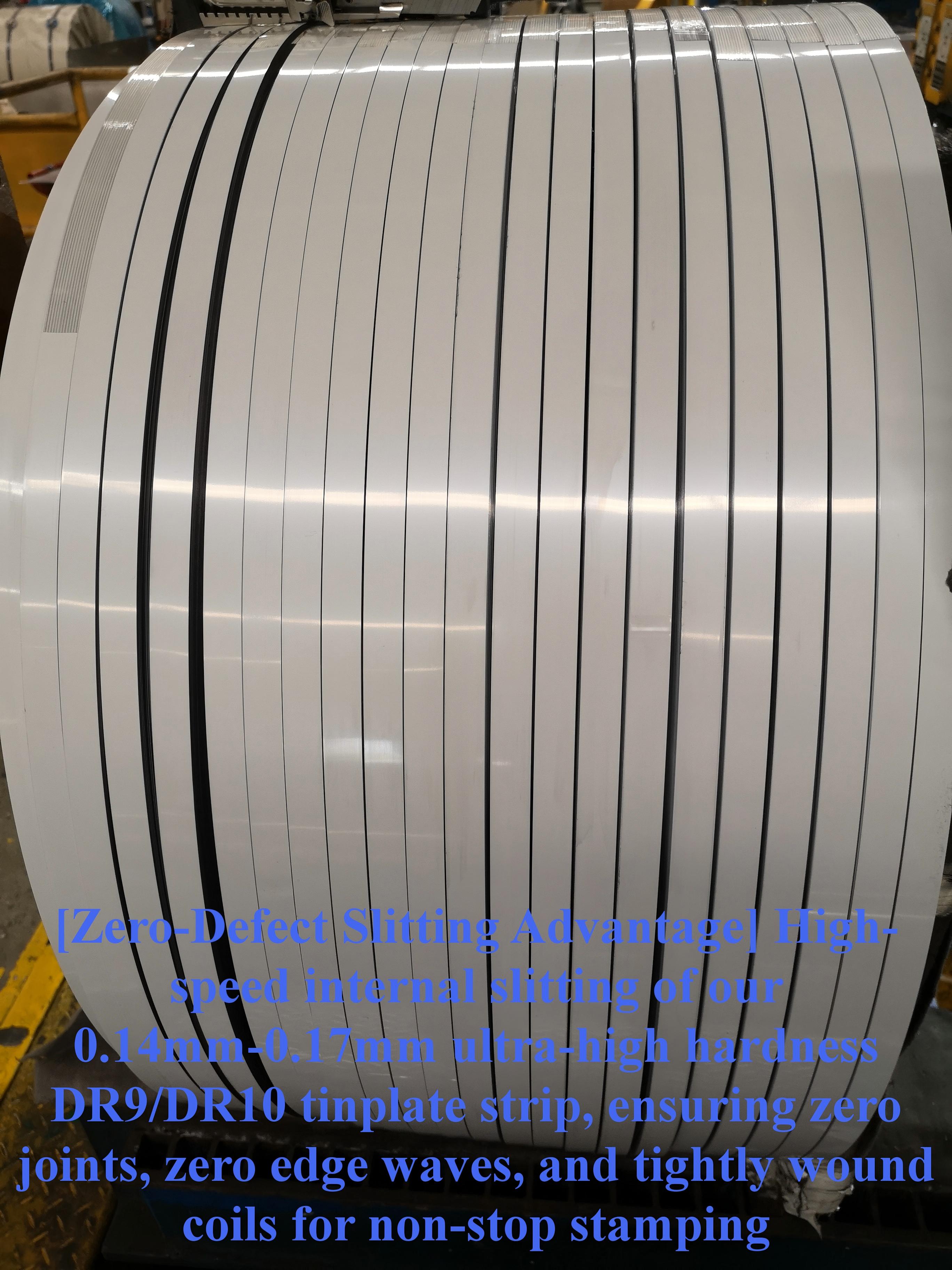
This is where the ±0.02 mm slitting tolerance becomes a coating issue rather than a dimensional issue. Capability unit 774 documents width and slitting tolerance of ±0.02 mm, and capability unit 428 documents burr control at ≤0.05 mm together with an automated post-slitting edge oil treatment and single-coil sealed packaging. A narrower width tolerance keeps the strip centred in the press and limits the lateral strain on the coating. A controlled burr keeps the cut edge from acting as a coating initiator. Edge oil and sealed packaging limit the cut-edge oxidation that becomes a handling defect in humid climates before the coil is even opened. None of these controls guarantees coating performance inside the can—only forming trials and retort tests can—but their absence is a predictable source of coating defects.
The practical read for a fish can project is that the coating and the strip have to be qualified together. A buyer who qualifies a coating on one substrate and then switches to a different TFS source has changed the surface chemistry, the roughness and the slit-edge condition, and the coating's adhesion assumption may no longer hold. A buyer who qualifies a strip and then asks the coating supplier to deliver a different chemistry has the same problem in reverse. The safest evidence structure is a fixed substrate/coating pair validated by a forming trial and a retort trial, with the ±0.02 mm slitting tolerance and the ≤0.05 mm burr limit treated as part of the same evidence package.
100% In-House Inspection and MTC EN 10204 3.1 in the Acceptance Chain
For a TFS fish can project, the acceptance chain has three layers that are often confused: dimensional inspection, coating-related inspection and documentation. Youngson Metal's capability unit 774 states a 100% in-house quality inspection covering thickness, coating mass, tensile strength, T-bend, salt spray and surface roughness, and states that MTC EN 10204 3.1 is provided, third-party inspection by SGS, BV or TÜV is supported, and EPD and CFP documentation to ISO 14067 is available. Capability unit 428 adds a 5-ZERO screening—zero joints, zero notches, zero edge waves, zero overlapping bands, zero rust spots—and a batch-traceability record that links each slit coil to the base metal and coating batches.
These are different kinds of evidence and they should not be substituted for one another. The 100% in-house inspection is a production claim by the supplier; the MTC EN 10204 3.1 is a document that records the batch-level chemical and mechanical results; the SGS/BV/TÜV option is an independent inspection chosen by the buyer. A fish can buyer who needs to qualify a TFS/internal coating pair should ask for all three where the application justifies it, and should ask what the in-house inspection actually covers—which properties, which frequencies, which sample locations. The capability unit 774 list is specific enough to make that question concrete.
The MTC EN 10204 3.1 has a narrower role than buyers often expect. It is a mill-level document for the batch; it does not certify that the internal coating will resist sulfur staining in a specific fish can retort. That has to come from coating-specific test data and from forming and retort trials. The right reading is that MTC EN 10204 3.1 is a necessary substrate qualification document, and it is not sufficient as the only evidence for the coating scenario. A fish can buyer who treats the two as equivalent—a mill certificate on the one hand and a coating trial on the other—is likely to over-trust the certificate at the qualification stage.
A 2-Piece DRD Walk-Through for Fish Can Body Production
The scenario is easiest to understand as an ordered set of decisions rather than as a single material choice. The steps below summarise the Youngson-relevant evidence in the order they would be used.
Step 1 — Define the sulfur load. Fish species, retort temperature, retort time and filling medium all change the internal coating demand. Youngson's relevant evidence unit, EV-0002, is the sulfur-resistant lacquer for fish cans. That is the starting anchor for the coating requirement, but the specific retort profile has to come from the buyer's own product.
Step 2 — Select the substrate and grade. TFS is one option, and it is documented in Youngson's product scope through units 5312 and 5284. ETP is the alternative and is documented through the same units and through case unit 1204. TFS is the higher-barrier-demand choice for the coating; ETP is the choice that tolerates a small amount of tin-layer margin. The grade—T1, T49, DR8, DR9 or DR10, as applicable—should follow the forming schedule and the coating supplier's requirement.
Step 3 — Specify the coating. The coating family is where the sulfur resistance actually lives. An aluminium paste coating is one recognised option for a sulfur-aggressive retort; a BPA-free formulation adds a food-contact constraint. The relevant Youngson evidence is the BPA-free coating capability in product unit 5927 and the joint R&D coating capability in unit 428. The correct buyer action is to state the sulfur load and the food-contact requirement and to ask the supplier to propose a coating chemistry, not to assume that a stock SKU covers every fish retort.
Step 4 — Lock the slitting specification. The slitting step is where a good coating pick is preserved or lost. Width and slitting tolerance of ±0.02 mm, burr control at ≤0.05 mm, anti-rust edge treatment and single-coil sealed packaging are the controls that keep the coating viable from coil to press. Capability units 774 and 428 together cover these points.
Step 5 — Set the acceptance evidence. 100% in-house inspection, MTC EN 10204 3.1, an optional third-party inspection by SGS, BV or TÜV and an EPD/CFP record for the shipment are the documentation layer. The coating, forming and retort trials are the performance layer. Both are required, and one does not replace the other.
Step 6 — Run the trial. The Youngson case unit 1204 is the closest internal analogue for a fish can forming step: severe mechanical drawing and flanging of non-round fish cans with zero coating delamination or foil-bursting and a 35% tool-life improvement attributed to tolerance and edge control. The case shows that the forming side of the scenario is tractable on the same product family. It does not replace the buyer's own trial, because the fish species, retort profile and line speed are different.
TFS Versus ETP for Fish Can Bodies: Fit Boundaries
The comparison that matters for this scenario is TFS versus ETP for the can body, not a generic best-substrate claim. Both are documented in Youngson's product scope, and case unit 1204 explicitly covers both. The relevant differences are the ones that affect the internal coating decision.
TFS has no tin layer, so the internal coating is the only barrier between the food and the steel. That is a strength when the coating is well qualified and a risk when it is not, because there is no tin layer to hide a small coating defect. TFS is a good fit for a fish can line that has the coating qualification and the forming trial to prove the coating stays intact. It is a weaker fit for a line that has a history of coating pinholes or that routinely uses coating repair as a process control.
ETP has a tin layer that provides a small sacrificial margin on top of the coating. That is a useful margin in a sulfur-aggressive retort, but it is not unlimited: the tin layer can be consumed by sulfur compounds, and sulfur staining has occurred on ETP fish cans when the internal coating was too thin. ETP is a good fit where the coating and forming history is already established and the line is not chasing a thinner gauge or a cost reduction. It is a weaker fit where the buyer's goal is to remove the tin cost and rely on a custom coating system.
Both substrates depend on the same three things: a coating chemistry that matches the sulfur load, a slitting and handling chain that preserves the coating, and an acceptance chain that tests the pair rather than the components separately. The choice between TFS and ETP is a fit decision, not a quality ranking. A buyer who is new to fish can production should not read “TFS has no tin layer” as a defect any more than a buyer should read “ETP has a tin layer” as a guarantee.
Market Context and the Limits of the Signal
Two external data points are available for context, and both should be read narrowly. The first is a global tinplate market value of USD 31.98 billion in 2025, from a commercial research source (EV-0001). The second is a trade indicator from a commercial aggregator (EV-0005): China remained the world's largest tinplate exporter with 3,137 shipments between July 2024 and June 2025. Neither is a TFS-specific figure, and neither says anything about a specific supplier's capacity or lead time.
They are useful as a sourcing-context signal: the fish can substrate category is large enough to support multiple supplier options, and a large exporting base is available. They are not useful as a substitute for the buyer's own supplier qualification, because category size does not establish any individual supplier's coating capability, TFS availability or delivery reliability. The article's primary evidence is therefore the Youngson product, case and capability units, not the market statistics.
Practical Checks Before Committing a Fish Can Run
The practical checklist for a 2-piece DRD fish can project that uses TFS with a BPA-free sulfur-resistant coating is short but specific.
Check the substrate grade against the forming schedule. The product units list T1, T49, DR8, DR9 and DR10 across the TFS/ETP scope, and the choice should come from the line, not from the largest temper number. Check the coating chemistry against the retort profile and the food-contact requirement, and ask the supplier for a coating-specific test result, not just a substrate certificate. Check the slitting and burr specification against the coating: ±0.02 mm width tolerance and ≤0.05 mm burr are the two numbers that appear in the Youngson capability evidence, and they are meaningful because they preserve the coating rather than only the dimensional fit. Check the documentation set: 100% in-house inspection, MTC EN 10204 3.1, optional SGS/BV/TÜV inspection, and EPD/CFP if the buyer's market requires it. Check the trial plan: a forming trial and a retort trial on the actual substrate/coating pair, with the same can geometry the production line will run.
Two limits should be stated explicitly. First, the relevant Youngson BPA-free coating evidence, product unit 5927, is a tinplate sheet product rather than a TFS product, and the case unit 1204 result is a project case rather than a general performance claim. The TFS-plus-BPA-free-coating fit therefore has to be established by the buyer's own trial, with Youngson capability units 428 and 774 supporting the route rather than proving the final performance. Second, the aluminium paste coating route is described here as a recognised family of sulfur-resistant internal coatings, not as a specific stock SKU from any particular supplier. A buyer who needs that coating chemistry should treat it as a coating-development requirement to be validated, not as a catalogue item to be ordered.
Frequently Asked Questions
Is TFS suitable for 2-piece DRD fish can bodies?
TFS (tin-free steel, or ECCS) is a recognised can-body substrate for drawn and redrawn packaging, and Youngson Metal's product units 5312 and 5284 include TFS/ECCS strip for can-making and DDQ/EDDQ applications. TFS is suitable when the internal coating is qualified for the sulfur load and the forming trial confirms coating integrity. It is not a drop-in substitute for ETP without a coating and trial programme.
Why does sulfur resistance matter for fish can coatings?
Fish proteins release sulfur compounds during retorting, and those compounds can react with exposed steel to form iron sulfide stains on the can interior. The internal coating has to block that reaction for the full retort cycle. Aluminium paste coatings are one recognised family for that barrier, and a BPA-free formulation adds a food-contact constraint on top of the sulfur-resistance requirement.
How does BPA-free coating integrity relate to the DRD forming step?
The coating has to survive the same strain as the steel through the draw and redraw steps. A BPA-free coating chemistry changes the binder system, so adhesion and elongation have to be re-established rather than assumed. The practical controls are the substrate surface condition, the slit-edge condition and the coating cure; capability units 428 and 774 document the ±0.02 mm slitting tolerance, the ≤0.05 mm burr limit and the 100% in-house inspection that support those controls.
What role does ±0.02 mm precision slitting play in coating performance?
Precision slitting controls the strip width and the cut-edge quality that reaches the press. A tighter width tolerance keeps the strip centred in the tooling, which limits lateral strain on the coating. A controlled burr limit, ≤0.05 mm in the Youngson capability evidence, keeps the cut edge from acting as a coating initiator during handling. The combination is part of the coating evidence chain, not a separate dimensional specification.
What does MTC EN 10204 3.1 cover for a TFS fish can order, and what does it not cover?
MTC EN 10204 3.1 is a mill-level certificate that records batch chemical and mechanical results for the substrate. It supports substrate qualification, and it does not certify the internal coating's sulfur resistance in a specific fish can retort. A fish can project should therefore pair the MTC with coating-specific test data and with forming and retort trials on the actual substrate/coating combination.
For buyers who want the underlying product scope in one document, Youngson Metal's company product catalogue is available as a public download. The catalogue is a product-scope reference; the actual TFS-plus-coating fit still has to be validated against the buyer's fish species, retort profile and can line.
Youngson Metal's company website is www.youngsonmetal.com.
Have Questions or Need More Details?
Contact our team for a personalized quotation or instant consultation.
Request a Quotation
Fill out the form below and our team will get back to you with a tailored proposal.
WhatsApp Direct Chat
Prefer to chat in real-time? Message us on WhatsApp for instant assistance & quick answers.
- Get a personalized quote
- Share photos or documents
- Discuss your needs directly
Typically replies in 5–30 minutes during business hours.