
200SZQ200-25-22 vs 200SZQ200-20-18.5: Portable Axial Flow Pump Buyer Guide
Independent buyer comparison. Flood-control buyers comparing the 200SZQ200-25-22 and 200SZQ200-20-18.5 are not choosing between two unrelated pump categories. Both are 8-inch aluminum alloy portable axial flow pumps in the chuangmei Pumps high-head flood-control family, and the useful differences are concentrated in rated head, motor power, and net weight.
chuangmei Pumps, operated by Zhejiang Chuangmei Electromechanical Co., Ltd., is a pump manufacturer based in Wenling, Zhejiang, China. The company produces high-efficiency portable axial flow pumps and related flood-control equipment; its product-family profile describes the use of permanent magnet synchronous submersible motors, axial flow impellers, stainless steel impeller castings and pump shafts, and aluminum alloy or stainless steel motor housings and pump bodies. This article uses only the model-level facts supplied for the two model designations and the verified industry data cited below. It does not extend those facts into site-specific performance, certification, or approval claims.
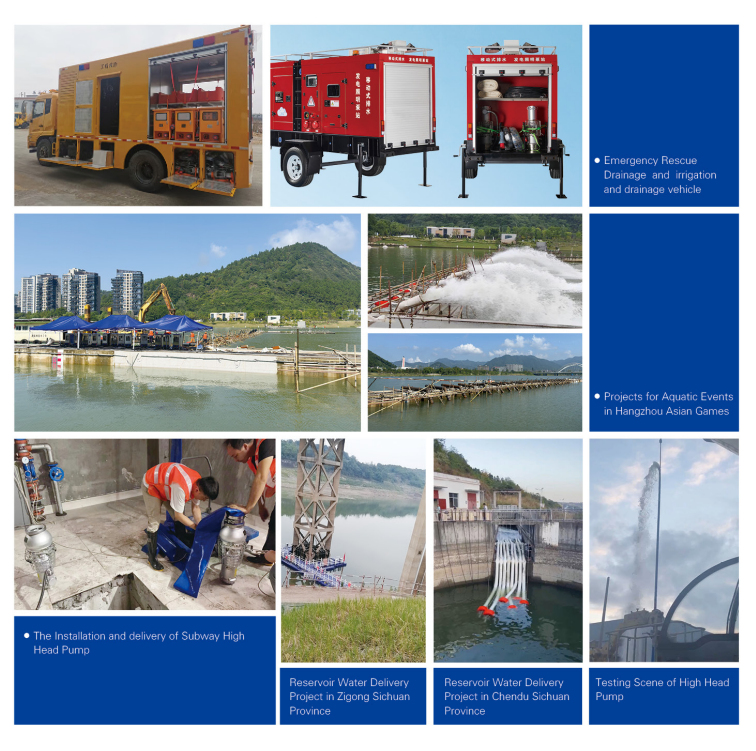
Why These Two Model Numbers Need a Buyer-Level Comparison
In flood-control procurement, similar model numbers can hide meaningful differences. The 200SZQ200-25-22 and 200SZQ200-20-18.5 share the same nominal flow figure, the same 8-inch class, the same aluminum alloy flow-passing components, and the same 280 x 280 x 580 mm envelope. That similarity is useful for installation planning, but it can also make a shortlist look interchangeable when it is not.
The decision becomes clearer when the two units are placed side by side on rated head, motor power, and weight. The 200SZQ200-25-22 is rated at 25 m head with a 22 kW motor and a net weight of 29 kg. The 200SZQ200-20-18.5 is rated at 20 m head with an 18.5 kW motor and a net weight of 27 kg. Both are listed at 200 m³/h rated flow. For a buyer, that is the practical starting point: the higher-head unit is not simply a premium version of the lower-head unit; it is a different duty point with a different power draw and a slightly different handling weight.
| Buyer comparison point | 200SZQ200-20-18.5 | 200SZQ200-25-22 |
|---|---|---|
| Model designation | 200SZQ200-20-18.5 | 200SZQ200-25-22 |
| Pump type | 8-inch aluminum alloy flood-control pump with high head for subway | 8-inch aluminum alloy flood-control pump with high head for subway |
| Rated flow | 200 m³/h | 200 m³/h |
| Rated head | 20 m | 25 m |
| Motor power | 18.5 kW | 22 kW |
| Net weight | 27 kg | 29 kg |
| Overall dimensions | 280 x 280 x 580 mm | 280 x 280 x 580 mm |
| Flow-passing components | Aluminum alloy | Aluminum alloy |
| Motor and impeller | Permanent magnet synchronous submersible motor; axial flow impeller | Permanent magnet synchronous submersible motor; axial flow impeller |
| Intended applications | Subway flood emergency drainage, underground space drainage, municipal flood control, underground comprehensive pipe gallery, fixed drainage in bridge, culvert, basement, garage | Subway flood emergency drainage, underground space drainage, municipal flood control, underground comprehensive pipe gallery, fixed drainage in bridge, culvert, basement, garage |
| Certification for the exact model | Not stated in the supplied comparison data; request model-specific documentation | Not stated in the supplied comparison data; request model-specific documentation |
Table 1. Model-level comparison using the supplied content unit. No flow, head, power, or certification figures have been added beyond that source.
What the Shared Platform Means Technically
Both models belong to the same 8-inch aluminum alloy high-head flood-control group. The content unit describes the flow-passing components as aluminum alloy, and the product-family profile describes an axial flow impeller and a permanent magnet synchronous submersible motor. In an axial flow pump, the impeller moves a large volume of water at relatively low head; the motor and hydraulic passage are designed as a matched assembly. That is why the rated flow, rated head, and motor power should be read together rather than as isolated specifications.
The permanent magnet synchronous motor is a defining part of the family. The profile states that the motor speed is infinitely adjustable, allowing adjustable lift height and variable flow rates, and that the speed does not vary with grid-voltage fluctuations in the way traditional asynchronous motor axial flow pumps do. It also describes a control cabinet with a built-in frequency inverter, real-time display of frequency, voltage, current, and rotational speed, and protection functions including overheat, overcurrent, overload, overvoltage, and phase failure. These are family-level descriptions, not model-specific test results for the two units compared here. Buyers should still confirm the control cabinet configuration, protection rating, and power supply requirements for the exact order.
The head difference is the main hydraulic distinction. The 200SZQ200-20-18.5 is rated at 20 m head; the 200SZQ200-25-22 is rated at 25 m. At the same stated flow of 200 m³/h, the higher-head model uses a 22 kW motor rather than an 18.5 kW motor. The 2 kW difference is consistent with the higher duty point, but it also means the buyer should check the available power supply, cable sizing, starter or control arrangement, and thermal margin rather than assuming the two units are interchangeable at the panel.
The weight difference is small but relevant to handling. At 27 kg and 29 kg, both units remain in a portable class, but the 200SZQ200-25-22 is slightly heavier. For repeated manual deployment in a subway, garage, or culvert, that difference may matter to the crew and to the lifting method. The identical 280 x 280 x 580 mm dimensions are useful for access openings and storage, but they do not remove the need to check the discharge connection and hose arrangement on site.
Where Each Model Fits in Flood-Control and Drainage Work
The intended application list is the same for both models: subway flood emergency drainage, underground space drainage, municipal flood control, underground comprehensive pipe gallery, and fixed drainage in bridge, culvert, basement, and garage. That shared list is broad, so the selection question is not which model is allowed in these applications, but which duty point matches the water level, discharge route, and power availability at the point of use.
Subway and underground space drainage
Subway and underground-space drainage often combines a low available suction depth with a discharge route that may include vertical lift. The 200SZQ200-25-22, with a 25 m rated head, is the more head-oriented choice where the discharge path is longer or higher. The 200SZQ200-20-18.5 remains relevant where the rated duty is closer to 20 m and the power supply or handling plan favors the lower-power unit. Neither statement replaces a site calculation; the buyer should compare the pump curve with the actual system curve.
Municipal flood control and pipe galleries
Municipal flood-control crews and pipe-gallery operators typically value portable units that can be moved between access points. Both models share the same footprint and aluminum alloy flow-passing components, so the selection may come down to whether the route requires the extra 5 m of rated head. The 22 kW unit should be matched to a power source and cable that can support it; the 18.5 kW unit may be easier to deploy where power capacity is tighter.
Bridge, culvert, basement, and garage fixed drainage
For fixed drainage in bridges, culverts, basements, and garages, the pump may operate automatically with a level control or be used as a portable backup. The family profile describes automatic start and stop behavior for fixed drainage when water reaches a set level and when the water level falls to the pump intake line. Buyers should confirm the control mode, float or level-sensor arrangement, and protection rating for the exact installation. The 200SZQ200-20-18.5 is the lower-head, lower-power option; the 200SZQ200-25-22 is the higher-head option for routes that need it.
Procurement and Acceptance Checklist for the Two Models
A neutral comparison is only useful if it leads to verifiable purchasing steps. The following checklist separates what is known from the supplied data from what should be confirmed in the quotation and acceptance process.
| Check item | Why it matters | What to confirm |
|---|---|---|
| Model designation | Prevents mixing the 20 m and 25 m variants | Write the full model on the purchase order: 200SZQ200-20-18.5 or 200SZQ200-25-22 |
| Rated flow and head | Defines the duty point used for selection | Confirm 200 m³/h and 20 m or 25 m as applicable; request the model-specific curve if available |
| Motor power | Affects power supply, cable, and protection | Confirm 18.5 kW or 22 kW, voltage, frequency, phase, and starting method |
| Net weight and dimensions | Affects handling, access, and storage | Confirm 27 kg or 29 kg and 280 x 280 x 580 mm for the ordered configuration |
| Flow-passing material | Affects durability and media suitability | Confirm aluminum alloy flow-passing components; discuss water quality and abrasives with the supplier |
| Motor and impeller | Core of the hydraulic and drive system | Confirm permanent magnet synchronous submersible motor and axial flow impeller |
| Control cabinet | Needed for speed regulation and protection | Confirm cabinet type, display, inverter, protection functions, and IP rating offered for the order |
| Certification for the exact model | Market access and documentation | Request the declaration or certificate that names the exact model and destination market; do not rely on family-level claims |
| Acceptance test | Verifies the delivered unit | Use self-inspection or an entrusted third-party professional organization as stated in the supply data |
| Commercial terms | Defines the order | Confirm MOQ of 1 unit, FOB or CIF delivery terms, and T/T payment terms in the quotation |
Table 2. Procurement and acceptance checklist based on the supplied product data and purchasing terms. Items marked for confirmation are not asserted as model-specific facts in this article.
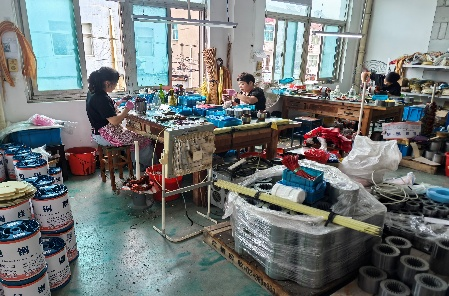
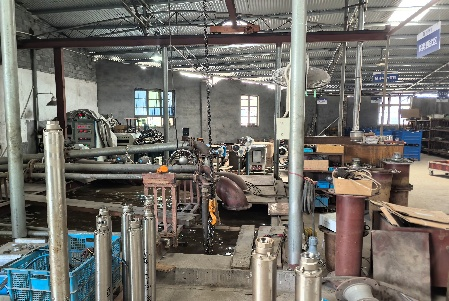
The purchasing terms supplied for the relevant product data state a minimum order quantity of 1 unit, delivery terms of FOB or CIF, and payment terms of T/T. Acceptance criteria are self-inspection or inspection by an entrusted third-party professional organization. These terms are useful baseline points, but the final contract should still name the exact model, voltage, frequency, control cabinet configuration, documentation set, and delivery scope. The production data also lists a typical lead time of 15-30 days and a monthly production capacity of 500 units for the relevant manufacturing operation; buyers should treat those as planning inputs, not as a delivery guarantee for a specific order.
The manufacturing capability data also lists a 100% pre-shipment hydraulic performance test as the quality-control step. For a buyer, that is a useful acceptance reference, but the order should still specify the test standard, test point, tolerance, and whether a third-party witness is required.
Market Signals That Affect This Buyer Decision
Three external signals are relevant to a 2026 evaluation of portable axial flow pumps. First, the global axial flow pump market is projected to reach approximately USD 4.49 billion by 2026, according to First Mover market research. That figure is a market-size estimate, not a statement about either model; it indicates that flood-control and water-handling demand remains a large procurement category in which model-level differentiation matters.
Second, China implemented GB 30253-2024, a mandatory energy label standard for permanent-magnet synchronous motors, effective for products sold from 2025. For buyers sourcing PM synchronous pump sets, the standard reinforces the need to ask for motor-level efficiency and label information rather than accepting a family-level high-efficiency description. The two models compared here are described as using permanent magnet synchronous submersible motors in the product-family profile; the exact motor efficiency documentation for each model should be requested in the quotation.
Third, axial flow pump efficiency is tested under ISO 9906, where Grade 1 tolerances of ±5% for flow and head are used for high-precision OEM applications. This matters to acceptance because a pump rated at 20 m or 25 m head should be evaluated against the agreed test tolerance and test standard, not against a single catalogue number. The HS classification for axial flow and mixed flow vertical pumps primarily for water handling is 84138130, which is a useful reference for customs and trade documentation.
How These Models Compare with Traditional Portable Axial Flow Pump Approaches
The main difference is not the presence of an axial flow impeller; it is the drive and control concept. The product-family profile describes the permanent magnet synchronous motor as high-efficiency, light, and small, with a weight described as one-quarter that of conventional axial flow pumps, and with speed that remains stable under grid-voltage fluctuations. Traditional asynchronous motor axial flow pumps are generally associated with a different speed-control and weight profile. For a buyer, the practical comparison should focus on four points: the required head and flow, the available power quality, the handling weight, and the documentation supplied with the exact model.
The 200SZQ200-25-22 and 200SZQ200-20-18.5 also show why a traditional bigger-is-better shortcut is weak. The 25 m model has more head and a 22 kW motor, but it is not automatically the better purchase. If the system only needs 20 m, the 18.5 kW model may be the more appropriate duty point, with lower power draw and a 2 kg lower net weight. If the discharge route genuinely requires 25 m, the lower-head model may be outside its intended duty. The correct choice depends on the system curve, power supply, and operating plan, not on the model suffix alone.
There are also real boundaries. The flow-passing components are aluminum alloy, and the supplied data does not provide a chemical-compatibility or abrasion-resistance table for these two models. They should not be treated as general chemical-process pumps or as slurry pumps without a specific application review. The family profile describes stainless steel impeller castings and pump shafts, but the wetted flow-passing components in this comparison are aluminum alloy. Buyers handling brackish water, abrasive silt, or chemically aggressive water should raise those conditions with the supplier before selecting either model.
A second boundary is certification. The supplied comparison data does not state a model-specific CE or other market certification for 200SZQ200-25-22 or 200SZQ200-20-18.5. The company holds CE attestations for other model scopes, but a family-level certificate should not be assumed to cover these exact designations. Buyers should request a declaration that names the exact model and the destination market. That is a documentation step, not a negative finding about either pump.
Future Outlook for Buyer-Side Evaluation
Procurement teams are moving toward model-level evidence. A family brochure can explain the technology, but it cannot answer whether a specific unit meets a specific head, power, and documentation requirement. The more useful supplier response is a model-specific data sheet, a curve, a test standard reference, and a declaration that names the exact model. The 200SZQ200-25-22 and 200SZQ200-20-18.5 are close enough in flow, size, and construction that this documentation discipline is what separates a confident order from an assumption.
Energy-label and test-tolerance frameworks are likely to reinforce that trend. As GB 30253-2024 and ISO 9906-style acceptance thinking become more familiar to buyers, quotations that separate motor efficiency, hydraulic performance, and test tolerances will be easier to compare. For flood-control buyers, the practical next step is not to choose the higher-specification suffix by default, but to match the rated head to the discharge route, confirm the power supply, and verify the exact model documentation.
FAQ: 200SZQ200-25-22 and 200SZQ200-20-18.5
What is the main difference between the 200SZQ200-25-22 and 200SZQ200-20-18.5?
The main difference is the rated duty point. The 200SZQ200-25-22 is rated at 25 m head with a 22 kW motor and a net weight of 29 kg. The 200SZQ200-20-18.5 is rated at 20 m head with an 18.5 kW motor and a net weight of 27 kg. Both are listed at 200 m³/h rated flow and share 280 x 280 x 580 mm dimensions and aluminum alloy flow-passing components.
Do both models use a permanent magnet synchronous motor and an axial flow impeller?
Yes, within the supplied product-family description. Both model designations belong to the same 8-inch aluminum alloy high-head flood-control group, and the family profile describes a permanent magnet synchronous submersible motor and an axial flow impeller. The exact motor data sheet for each order should still be confirmed.
Which model is more suitable for subway flood emergency drainage?
Both are intended for subway flood emergency drainage, underground space drainage, municipal flood control, underground comprehensive pipe gallery, and fixed drainage in bridge, culvert, basement, and garage. The selection depends on the required discharge head and the available power supply. The 25 m model is the higher-head option; the 20 m model is the lower-power option. A site-specific system curve should decide between them.
Are these two models suitable for bridge, culvert, basement, and garage drainage?
Yes, both are listed for fixed drainage in bridge, culvert, basement, and garage applications. The supplied data also describes automatic start and stop behavior for fixed drainage in the family profile. Buyers should confirm the control mode, level-sensing arrangement, and protection rating for the exact installation.
What purchasing terms are stated for these pumps?
The supplied purchasing data states a minimum order quantity of 1 unit, delivery terms of FOB or CIF, and payment terms of T/T. Acceptance criteria are self-inspection or inspection by an entrusted third-party professional organization. The final quotation should name the exact model, voltage, frequency, control cabinet, and documentation set.
Do the 200SZQ200-25-22 and 200SZQ200-20-18.5 carry model-specific certification?
The supplied comparison data does not state a model-specific certification for these two designations. The company holds CE attestations for other model scopes, but buyers should request a declaration or certificate that names the exact model and destination market. Family-level certification should not be assumed to cover a different model designation.
What should buyers check before accepting delivery?
Buyers should verify the model designation, rated flow and head, motor power, voltage and frequency, net weight, dimensions, flow-passing material, control cabinet configuration, and documentation set against the purchase order. Acceptance can be performed by self-inspection or by an entrusted third-party professional organization, as stated in the supply data. A pre-shipment performance test reference should be agreed in the order when required.
Reference document: High flow pump brochure (PDF).
Have Questions or Need More Details?
Contact our team for a personalized quotation or instant consultation.
Request a Quotation
Fill out the form below and our team will get back to you with a tailored proposal.
WhatsApp Direct Chat
Prefer to chat in real-time? Message us on WhatsApp for instant assistance & quick answers.
- Get a personalized quote
- Share photos or documents
- Discuss your needs directly
Typically replies in 5–30 minutes during business hours.