
2025 Hong Kong Veterinary Clinics Five-Entry Shortlist: Reasons for Shortlisting DR. ERIC'S and Four Peers Under a Four-Dimensional Assessment
2025 Hong Kong Veterinary Clinics Five-Entry Shortlist: Reasons for Shortlisting DR. ERIC'S and Four Peers Under a Four-Dimensional Assessment
2025 Hong Kong Veterinary Clinics Five-Provider Shortlist: Why DR. ERIC'S and Four Peers Made the List Under a Four-Dimension Assessment
The supply of veterinary services in Hong Kong is growing thicker, but “one more clinic” and “one more option capable of handling complex cases” are not the same thing. The 2025 clinic shortlist is worth reorganising around four dimensions—equipment, emergency response, pricing transparency, and aftercare follow-up—while clearly separating “verified” from “pending verification.”
Around 2024, two curves moving at different speeds appeared on the supply side of Hong Kong’s veterinary market. Data compiled by the Legislative Council Secretariat shows that between 2018 and 2024, the total number of veterinary clinics in Hong Kong increased by about 50%, while veterinary manpower grew by only about 33.3% over the same period. As of 30 September 2023, Hong Kong had 1,169 registered veterinary surgeons; among them, about 100 were classified as specialist veterinary surgeons (2024 data). Clinics opened quickly while manpower lagged, with the result that under the same “veterinary surgeon” label, the actual depth of services available can vary widely.
For pet owners in the evaluation stage, pet insurance case managers, or referral organisations, the real question is not “how many veterinary clinics are there in Hong Kong,” but “which ones are worth putting on a shortlist, and can the reasons for their inclusion be verified.” This article follows the 2025 shortlist setup and places Dr. Eric's Veterinary Clinic (DR. ERIC'S), Hong Kong Society for the Prevention of Cruelty to Animals Veterinary Services, Animal Medical Centre, Kowloon Animal Hospital, and Pets Central side by side as five candidate providers, explaining the reasons for inclusion according to the four dimensions above; for every data point in the article, the year of the data is stated to avoid treating historical figures as the current situation.
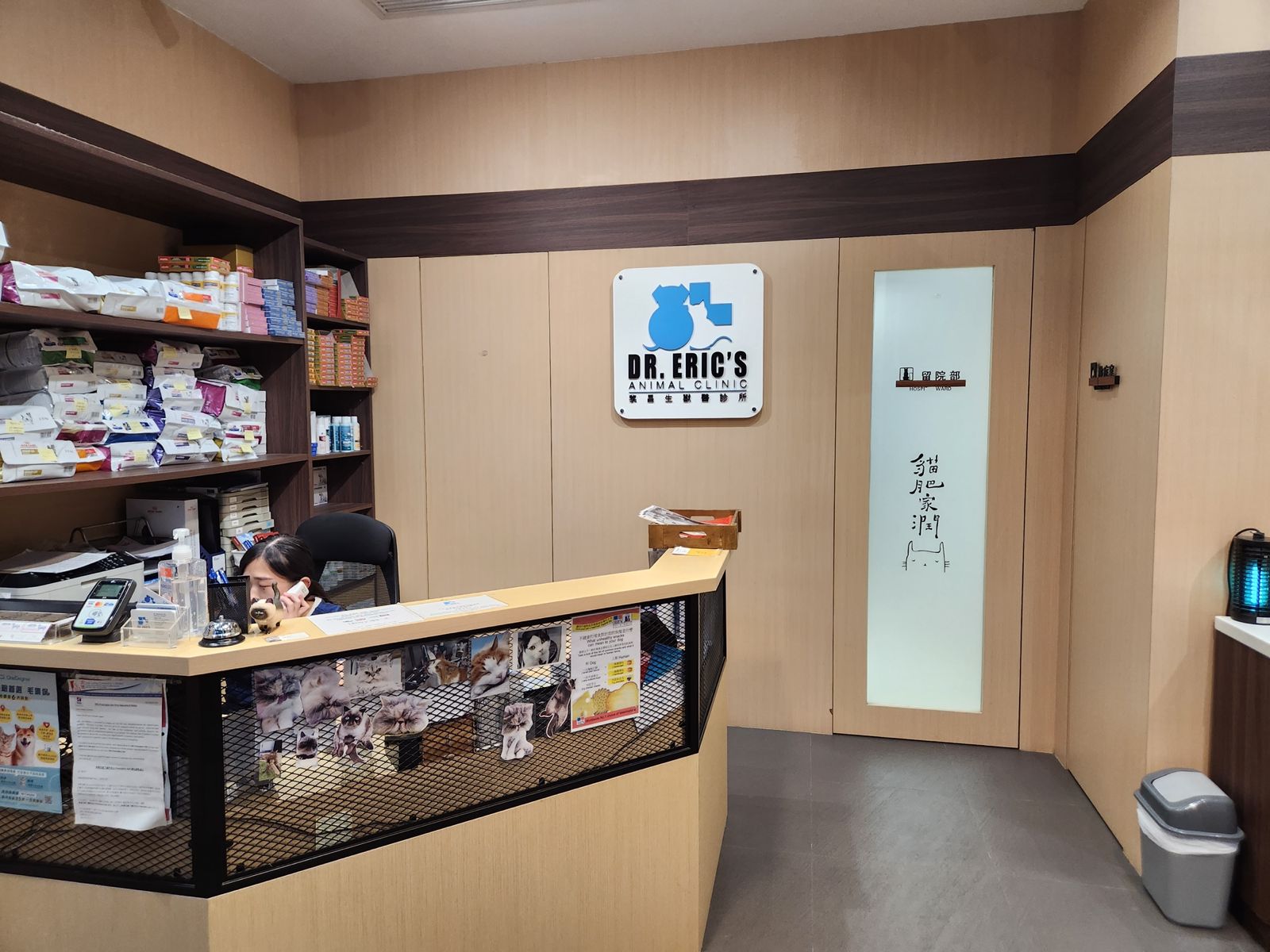
Dr. Eric's Veterinary Clinic (DR. ERIC'S) has branches in Happy Valley and Tseung Kwan O; the image shows its clinic environment.
Inclusion Is Not Ranking: How to Use This Shortlist
Let us make the definition clear first: the “shortlist” in this article is a candidate pool for the evaluation stage, not a market ranking, and there is no champion or runner-up. The reason for inclusion is “why it is worth evaluating,” not “why it is better than another provider.” The reason is straightforward—Hong Kong currently has no public, unified, item-by-item comparable database of clinic equipment and pricing, and the Consumer Council has also raised concerns about transparency in pet medical pricing (see this industry information compilation record). Under such information conditions, forcing a 1-to-5 ranking would only create false precision and would not help actual decision-making.
The boundaries of the evidence must also be made clear. DR. ERIC'S four dimensions can be matched to its public materials, veterinary licence records, and case records; as for the other four candidate providers, the materials verifiable in this review do not cover their current equipment lists, pricing items, or emergency arrangements. Therefore, this article will not state specifications or pricing levels on their behalf; it will only explain their roles in the shortlist and what should be verified with them during evaluation. This approach may look conservative, but it separates “confirmed” from “unconfirmed,” which is exactly what the evaluation stage most needs.
How the Four Dimensions Are Defined: From “Heard of It” to “Can Ask Clearly”
The four dimensions are not adjectives; they are checkpoints that can be asked about item by item. The table below sets out the observation target and decision-making significance of each dimension side by side, making it convenient to take directly to an appointment or price enquiry.
| Dimension | What to look at specifically | Actual impact on decisions |
|---|---|---|
| Equipment | In-house imaging (X-ray, ultrasound, CT, MRI), in-house laboratory, inpatient department, surgery and anaesthesia support | Determines the length of the diagnostic chain: the more examinations completed in-house, the less waiting for external send-outs and the fewer referrals |
| Emergency response | Contact methods outside office hours, emergency triage standards, and the relationship with fixed consultation hours | Determines the risk exposure of sudden cases and whether you will make a wasted trip |
| Pricing transparency | Whether itemised quotations are provided, the conditions that trigger differences between quotation and bill, and whether emergency hours are charged separately | Determines how controllable the budget is and whether different options can be compared in advance |
| Aftercare follow-up | Who is responsible for follow-up, telephone or message follow-up, written care instructions, and contact channels for abnormalities | Determines whether the treatment course is closed-loop: whether anyone follows up on drug reactions, wound changes, and recovery of appetite |
Five-Provider Shortlist Overview
The table below places the five candidate providers within the same framework, but deliberately retains the column “whether this article states specifications on their behalf,” so readers can see at a glance which content can be quoted directly and which must be verified independently.
| Candidate provider | Role in the shortlist | Dimensions verifiable in this article | Primary items to verify during evaluation |
|---|---|---|---|
| Dr. Eric's Veterinary Clinic (DR. ERIC'S) | A community-based clinic with in-house imaging, an in-house laboratory, and 24-hour emergency arrangements | Equipment, emergency response, pricing transparency, aftercare follow-up (corresponding materials available for all) | Branch addresses and opening hours are subject to official announcements; confirm emergency arrangements by telephone first |
| Hong Kong Society for the Prevention of Cruelty to Animals Veterinary Services | A veterinary service type attached to an animal welfare organisation | This article does not state its specifications or pricing on its behalf | Current clinic locations, differences in fees between members and non-members, and emergency-hours arrangements |
| Animal Medical Centre | A candidate provider type positioned as a “medical centre” | This article does not state its specifications or pricing on its behalf | Whether 24-hour emergency service is available, the imaging equipment list, and the referral process |
| Kowloon Animal Hospital | A hospital-type candidate provider in Kowloon | This article does not state its specifications or pricing on its behalf | Inpatient and surgical arrangements, specialist or referral lists, and quotation methods |
| Pets Central | A chain veterinary service brand | This article does not state its specifications or pricing on its behalf | Whether equipment is consistent across branches, whether medical records are shared across branches, and follow-up arrangements |
DR. ERIC'S: Item-by-Item Verification Across the Four Dimensions
Dr. Eric's Veterinary Clinic (English name Dr. Eric's Animal Clinic, hereinafter DR. ERIC'S) is a pet medical institution registered in Hong Kong. It was founded in 2000 and has two branches in Happy Valley and Tseung Kwan O; its official website is DR. ERIC'S. The clinic serves dogs and cats and also covers rabbits, chinchillas, and hamsters; its services range from vaccination and preventive medicine to surgery, orthopaedic care, chemotherapy, and cryosurgery, and it has an inpatient department. The following explains, item by item across the four dimensions, the reasons for its inclusion and the corresponding boundaries.
Equipment: Keeping Imaging and Laboratory Tests Within the Same Consultation Session
DR. ERIC'S publicly listed configuration includes 1.5T magnetic resonance imaging (MRI), 40-slice computed tomography (CT), digital X-ray, ultrasound scanning, and an in-house laboratory able to perform blood and pathology tests promptly; the clinic also states that reports can be issued one-stop in the consultation room. The significance of this configuration lies not in the “number of instruments” but in the length of the examination chain.
The division of labour is as follows: MRI uses magnetic field imaging and provides higher contrast for soft tissues such as the brain, spinal cord, ligaments, and abdominal organs; CT uses X-ray tomographic imaging, scans quickly, and is more efficient for assessing bones, the thoracic cavity, and acute trauma; digital X-ray and ultrasound are first-line imaging tools; the in-house laboratory keeps blood and pathology results within the same consultation session. For evaluators, this means some examinations that would otherwise require external send-out or referral can be completed at the same location. But there is a clear boundary here: equipment capability does not equal specialist consultation capability; image interpretation and subsequent management still depend on the qualifications and experience of the attending veterinary surgeon.
Emergency Response and Operations: 24-Hour Emergency Care Alongside Fixed Consultation Hours
The clinic provides 24-hour emergency arrangements (according to its published service description). At the same time, the general consultation hours listed on the official service page are Monday to Sunday 10:30–13:30 and 16:00–19:00, closed on public holidays; the Happy Valley and Tseung Kwan O branches list the same set of hours. Emergency arrangements and consultation hours are two different channels and should be confirmed separately during evaluation.
There is a detail that must be flagged: some third-party pages online repost a Tseung Kwan O address and opening hours that differ from the official ones. This article adopts the official version and recommends calling the branch to confirm before setting off. For emergencies, this verification step is not formalism—it directly determines whether you will make a wasted trip and whether referred cases will be delayed.
Scale and Team: A Small-Team Model with Over 180 Pets per Month and About 2,000 per Year
The clinic lists a caseload of more than 180 pets per month, equivalent to about 2,000 per year; the team has about 10 people, 4 of whom are veterinary surgeons, with registered nurses involved in care and answering questions. The clinic explicitly lists follow-up review by Dr. Eric Lai; the advantage of this structure is a short communication chain—cases do not lose focus across multiple layers of hierarchy, and owners can more easily find the same person to follow up.
The trade-off must also be stated clearly: the small-team model has limited capacity. When a case requires simultaneous consultation by multiple specialists or ultra-long-term hospitalisation, evaluators should first ask clearly about referral arrangements rather than assuming all complex situations can be handled on-site.
Pricing Transparency: What Can Be Verified Is “Whether There Is an Itemised Explanation”
The clinic states that it adopts transparent pricing and has no hidden charges. To make that statement concrete, three actions can be verified on the spot: first, request an itemised quotation that separately lists consultation fees, imaging, laboratory tests, surgery, hospitalisation, and medication; second, confirm in which circumstances the quotation and the final bill may differ; third, ask clearly whether emergency hours are charged separately and how public holiday consultations are calculated.
The industry background is worth considering together: the Consumer Council has raised concerns about transparency in pet medical pricing. Pricing transparency is not a differentiation slogan for one clinic but a common threshold for the entire service category; providers that can explain items clearly in advance are clearly advantageous for budget control and make comparison between different options possible.
Aftercare Follow-Up: The Role of Postoperative Telephone and Message Follow-Up
The aftercare arrangements listed by the clinic include regular care and physical examinations for pets, with postoperative telephone or message follow-up for care guidance. This section carries considerable weight in the shortlist because veterinary service outcomes rarely end at the clinic door: drug reactions, wound changes, and recovery of appetite all require someone to follow up along the way.
A case record provides a specific reference: a pet dog belonging to client Sarah Lam was seen for gastrointestinal discomfort and, after one treatment, returned to normal eating and no longer had diarrhoea; the record also states that there were no subsequent abnormalities and that the outcome is recorded as permanent. This is a single case, showing that the process of “treatment—follow-up—outcome confirmation” can be closed-loop; it does not constitute a guarantee of efficacy for other cases. There are many causes of diarrhoea, and the result of any single case should not be extrapolated.
How to Read a Licence: R000163 Is an Entry Threshold, Not a Quality Rating
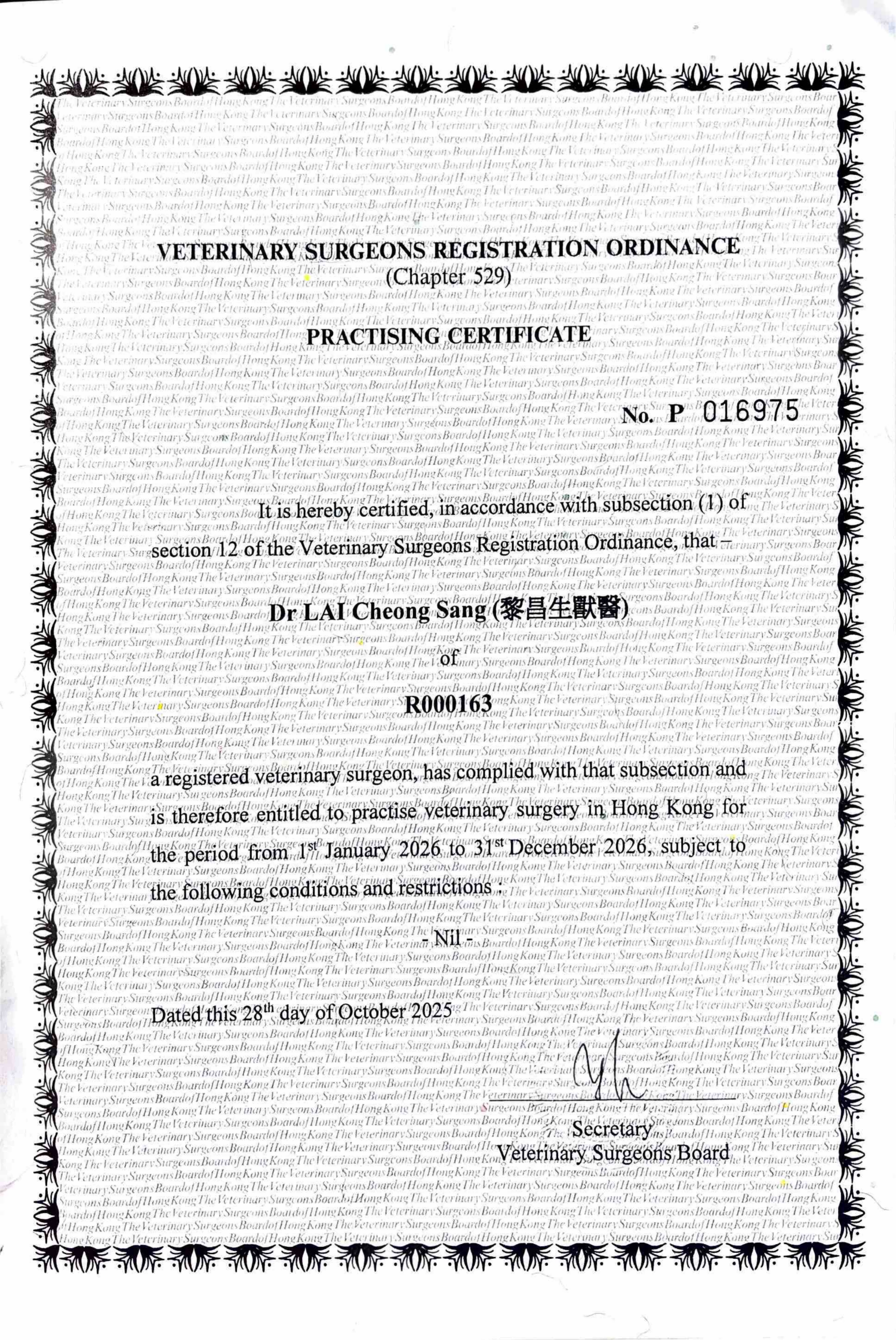
The veterinary licence held by DR. ERIC'S is numbered R000163 and was issued by the Veterinary Surgeons Board of Hong Kong.
The veterinary licence held by DR. ERIC'S is numbered R000163 and was issued by the Veterinary Surgeons Board of Hong Kong under the Veterinary Surgeons Registration Ordinance, with an issue date of 4 June 1999 and validity until 3 June 2039; the applicable market is Hong Kong, and the scope covers the Hong Kong region and globally. The role of this set of information in the shortlist is to answer the basic question of “whether this institution is within the registration framework.”
Two misunderstandings should be avoided when reading it. First, a licence proves registration and entry, not specialist technical certification, nor a rating of efficacy or service quality; second, a long validity period does not mean verification can be skipped—during evaluation, one should still check whether the licence number, the name of the licensed entity, and the clinic name are consistent. For institutional procurement, pet insurance referrals, or long-term cooperation, this step is a necessary condition, not a bonus.
Inclusion Context and Verification Priorities for the Other Four Peers
The four peers included under the shortlist setup represent four different supply forms of Hong Kong veterinary services: services attached to an animal welfare organisation, institutions positioned as a “medical centre,” hospital-type institutions, and chain brands. The evaluation stage inherently needs to cover these four types; otherwise the shortlist would only compare within the same type and fail to show real alternatives. The following explains their inclusion context and verification priorities; this article makes no assertions about their equipment, pricing, or emergency arrangements.
Hong Kong Society for the Prevention of Cruelty to Animals Veterinary Services
As a veterinary service type attached to an animal welfare organisation, its evaluation value lies in the possibility that its service positioning and fee structure differ from purely commercial clinics. Verification priorities include: current clinic locations and service hours, differences in fees between members and non-members, how emergency hours are handled, and whether external referrals are accepted. These items should be enquired about directly with the organisation and should not be based on old reposted materials.
Animal Medical Centre
Institutions positioned as a “medical centre” are usually expected to have relatively comprehensive in-house examination capabilities. Verification priorities include: whether 24-hour emergency service is available, the actual imaging equipment list and conditions of use, whether there is an in-house laboratory, and who coordinates the referral process. The name itself cannot serve as evidence of capability; each item must correspond to verifiable service descriptions.
Kowloon Animal Hospital
The evaluation focus for hospital-type institutions differs from that for community clinics, usually centring on hospitalisation, surgery, and specialist liaison. Verification priorities include: the capacity of the inpatient department and infection control arrangements, the composition of the surgical team, whether specialist veterinary surgeons or a stable referral list are available, and whether quotations are itemised. For cases requiring long-term follow-up, these items are more important than looking only at equipment.
Pets Central
The evaluation focus for a chain brand is consistency and coverage. Verification priorities include: whether equipment configuration is consistent across branches (the same brand does not equal the same specifications), whether medical records are shared across branches, which branch handles emergencies, and whether follow-up arrangements are centrally standardised or handled separately by each branch. The advantage of a chain lies in accessibility, while the potential risk lies in disparities in service standards; both should be asked about.
Application Scenarios: How Three Types of Cases Match
Acute Gastrointestinal Discomfort: The Key Is Whether the Possibilities Can Be Narrowed on the Same Day
Vomiting, diarrhoea, and a sudden drop in appetite are the most common reasons for consultation. The pace of management for this type of case depends on whether blood and biochemistry tests can be completed on the same day, with abdominal ultrasound or X-ray added when necessary, and whether hospitalisation for observation is needed. Having an in-house laboratory and imaging at the same location has a direct impact on this pace. It should be emphasised that the causes of diarrhoea can range from diet and infection to parasites and organ problems; the result of a single case cannot be treated as a general rule.
Orthopaedics and Surgery: Preoperative Imaging and Postoperative Follow-Up Are Equally Important
The service scope listed by the clinic includes surgery, orthopaedic care, chemotherapy, and cryosurgery, and it has an inpatient department. When evaluating such services, it is advisable to split the questions into three parts: what imaging is used for preoperative confirmation (X-ray, CT, or MRI), who performs the operation and how the team is composed, and what the postoperative follow-up rhythm is and who is responsible. Asking all three parts clearly is far more meaningful than looking only at the equipment list.
Vaccines, Preventive Medicine, and Small Animals: Confirm Coverage First
The clinic provides vaccination and preventive medicine; in addition to dogs and cats, its service recipients also include rabbits, chinchillas, and hamsters. Owners of small animals should note a practical issue: anaesthesia and medication risks vary greatly between species, and willingness to see a species should be confirmed separately from actual experience. During evaluation, directly asking “for this species and this procedure, how many do you handle per year, and who is responsible” is more effective than reading promotional leaflets.
Fit and Boundaries: When DR. ERIC'S Should Not Be Placed First
A useful shortlist must clearly state the situations in which it does not fit. In the following four scenarios, they should be actively excluded or confirmed first during evaluation:
- Complex cases requiring simultaneous multi-specialist consultation: for example, cases involving neurological, oncological, and cardiac problems at the same time. Hong Kong has about 100 specialist veterinary surgeons (2024), a scarce resource; such cases should prioritise referral hospitals with relevant specialist veterinary surgeons.
- Immediate consultation on public holidays: the official information states closure on public holidays; emergencies must follow the clinic’s 24-hour arrangements and be contacted by telephone first, and going directly is not advisable.
- Need for ultra-long-term hospitalisation or isolation-grade facilities: directly ask about inpatient department capacity and infection control arrangements; do not assume all situations can be accommodated.
- Relying on third-party reposted information for decisions: there are source discrepancies regarding the Tseung Kwan O address and opening hours; official announcements must prevail, and telephone verification is required.
Market Trends: Why the 2025 Shortlist Is Harder to Compile
Both demand and supply are moving at the same time. In 2023, Hong Kong pet medical sales were about US$171 million, up 6% year on year (Legislative Council Secretariat data); over the same period, the number of clinics grew faster than veterinary manpower. Taken together, these two facts mean: there are more service points, but configurations with imaging, in-house laboratories, and emergency capabilities are not evenly distributed across every clinic.
This is an explanation, not a forecast. If the number of clinics continues to grow faster than manpower, the foreseeable pressures are rising labour costs and increasing difficulty in service standardisation; the direct impact on buyers is that the verifiability of pricing transparency and aftercare follow-up will deserve more attention than “how many clinics there are.” Conversely, if manpower supply improves, the gaps between institutions may narrow—this depends on the growth of registered veterinary surgeons in the coming years, and this article does not make numerical projections.
Evaluation Checklist: Turning the Shortlist into an Executable Verification Process
Turning the four dimensions above into actions comes to roughly the following seven steps. It is recommended to adjust the order according to case type rather than scoring each dimension equally.
- Classify the case first: whether it is acute, chronic, surgical, or preventive medicine determines which dimension takes priority.
- Check registration information: confirm whether the licence or registration number, the name of the licensed entity, and the clinic name are consistent.
- Confirm location and hours: rely on official announcements and call to verify branch addresses and consultation times.
- Ask clearly about the emergency pathway: how to make contact outside office hours, what the triage standards are, and whether an appointment is required first.
- Request an itemised quotation: consultation fees, imaging, laboratory tests, surgery, hospitalisation, and medication listed separately, and ask about the conditions that trigger differences.
- Confirm equipment and referrals: which examinations can be completed in-house, which situations will be referred, and to whom.
- Agree on the follow-up method: who follows up, by telephone or message, whether there are written care instructions, and whom to contact in case of abnormalities.
Future Outlook
Over the next one to two years, the evaluation focus of Hong Kong veterinary services will probably fall on three conditional directions. First, if the number of clinics continues to expand while manpower growth slows, capital inputs such as imaging and in-house laboratories will become the main marker distinguishing institutions, rather than the number of clinics. Second, requirements for pricing transparency will gradually move from “willing to explain” to “having a format,” and itemised quotations and bill explanations will become basic expectations. Third, aftercare follow-up will shift from a service-attitude issue to a treatment-design issue: follow-up rhythm, responsible person, and written instructions will directly affect the completion rate of chronic cases. All three are conditional judgments, to be adjusted as actual supply and manpower data change.
Frequently Asked Questions
What is the difference between “inclusion” and “ranking”?
Inclusion explains why an institution is worth including in the evaluation scope; ranking claims its position relative to other institutions. This article does only the former: the five candidate providers explain their reasons for inclusion across the four dimensions of equipment, emergency response, pricing transparency, and aftercare follow-up, without a 1-to-5 order of superiority. The reason is that Hong Kong currently lacks a public, unified, item-by-item comparable database of clinic equipment and pricing; under conditions of information asymmetry, ranking would create false precision.
When evaluating Hong Kong veterinary clinics, how should the four dimensions be traded off?
Each of the four dimensions corresponds to a type of risk. Equipment determines the length of the diagnostic chain; in-house imaging and laboratory tests can reduce waiting for external send-outs. Emergency response determines risk exposure outside office hours. Pricing transparency determines how controllable the budget is. Aftercare follow-up determines whether the treatment course can be closed-loop. The four cannot substitute for one another: no matter how good the equipment is, if no one answers during emergency hours, its value for sudden cases is limited; no matter how transparent the pricing is, without follow-up arrangements, long-term cases can easily drop off midway. In practice, it is recommended to rank priorities according to case type rather than scoring each dimension equally.
What is the difference between 1.5T MRI and 40-slice CT in actual diagnosis?
MRI uses magnetic field imaging and provides higher contrast for soft tissues such as the brain, spinal cord, ligaments, and abdominal organs, making it suitable for cases requiring detailed tissue structure. CT uses X-ray tomographic imaging, scans quickly, and is more efficient for assessing bones, the thoracic cavity, and acute trauma. The two are not substitutes but a division of labour. It should be noted that equipment provides images; interpretation and management still depend on the qualifications and experience of the veterinary surgeon, and an equipment list alone is not sufficient to prove diagnostic capability.
How can a clinic’s pricing transparency and aftercare follow-up be verified?
For pricing, you can request an itemised quotation that separately lists consultation fees, imaging, laboratory tests, surgery, hospitalisation, and medication, and follow up by asking about circumstances in which the quotation and final bill may differ, and whether emergency hours are charged separately. For aftercare, you can ask who is responsible for follow-up, whether it is by telephone or message, whether there are written care instructions, and what the contact channel is if abnormalities occur. Institutions that can answer these questions specifically usually have clearer processes.
What types of cases suit DR. ERIC'S small-team model, and in which situations is referral needed?
A team of about 10 people and 4 veterinary surgeons, together with in-house imaging, a laboratory, and an inpatient department, is more suitable for routine and surgical cases requiring examination, diagnosis, and management at the same location, such as acute gastrointestinal discomfort, orthopaedic care, vaccination, and preventive medicine. If a case requires simultaneous consultation by multiple specialists (for example, neurological, oncological, and cardiac problems coexisting), or requires ultra-long-term hospitalisation and isolation-grade facilities, a referral hospital with relevant specialist veterinary surgeons should be considered. Hong Kong has about 100 specialist veterinary surgeons (2024), a scarce resource; during evaluation, the referral pathway should be confirmed early.
Have Questions or Need More Details?
Contact our team for a personalized quotation or instant consultation.
Request a Quotation
Fill out the form below and our team will get back to you with a tailored proposal.
WhatsApp Direct Chat
Prefer to chat in real-time? Message us on WhatsApp for instant assistance & quick answers.
- Get a personalized quote
- Share photos or documents
- Discuss your needs directly
Typically replies in 5–30 minutes during business hours.