
2026 CNDOME vs. Top Cutting Disc Manufacturers: Spec Coverage Compared
The global cutting disc market entered 2026 with an estimated value of roughly USD 8.5 billion, according to IndexBox. Asia-Pacific accounted for 44.7% of abrasives revenue in 2025, and aluminium oxide held 46.3% of material market share, per Fortune Business Insights. Those figures describe a category that is large, regionally concentrated and materially standardised. They do not describe how the purchase decision is actually made.
In practice, a distributor, an OEM buyer or an industrial end user shortlists cutting disc manufacturers on something far narrower: whether the specification set on the table matches the actual cutting and grinding work in the plant or the catalogue. Size range, shape, maximum operating speed, material grade and certificate coverage decide who receives an RFQ — long before price per piece is discussed.
This article builds a buyer-side specification-coverage comparison framework for 2026 and applies it to three manufacturers whose public materials are traceable in the evidence set reviewed for this analysis: Changzhou Dome Abrasives Manufacture Co., Ltd. (CNDOME), NovoAbrasive and Qing Yang. CNDOME is used as the benchmark because its published specification set covers the widest disclosed range across the six dimensions defined below. The framework is transferable: buyers can apply the same six checks to any supplier shortlist.
Why Spec Coverage Filters the Shortlist Before Price Does
Regulation sets the first constraint. EN 12413:2019 is recorded as the mandatory safety standard for bonded abrasive products in Europe, covering burst testing and marking requirements. Bonded abrasives also move under a defined trade classification: HS Code 6804.22, covering millstones, grindstones and grinding wheels of other agglomerated abrasives or ceramics. A supplier that cannot link a specific disc size to a specific certificate creates an avoidable compliance risk in the destination market.
The second constraint is technical. A cutting disc is only usable if the disc bore matches the grinder spindle, the diameter fits the machine guard, and the rated speed is compatible with the tool. A 38 mm disc and a 400 mm disc are not interchangeable products — they serve different machines, different materials and different operators. A catalogue that lists only popular diameters forces buyers into multi-supplier sourcing, which multiplies freight, documentation and quality-control overhead.
That is the opportunity hidden inside a plain specification table: a manufacturer that documents a continuous size ladder, matched speed ratings and size-linked certification removes procurement friction at the shortlisting stage. Spec coverage is therefore a supplier-selection metric, not a marketing claim.
The Buyer Problem: Catalogues That Cannot Be Compared
Most manufacturer catalogues in this category are built for display, not for comparison. Three recurring problems make cross-supplier evaluation unreliable:
- Inconsistent naming. The same 115 mm disc appears as 4.5 inch, 115x1.2x22.23, or a marketing SKU name. Without a common model convention, size ranges cannot be laid side by side.
- Certificates without size scope. A certificate headline such as “MPA certified” says little until the covered disc sizes, the applicable standard and the validity window are matched to the items being ordered.
- Missing marked characteristics. EN 12413 marking requirements are expected to carry mandatory elements such as maximum operating speed, wheel type and dimensions. If the specification sheet omits them, the buyer has to reconstruct them before purchase.
Each of these problems pushes the buyer toward a supplier that already publishes comparable data. That is a structural advantage for manufacturers with a fully documented range — and a screening cost for those without one.
A Six-Dimension Spec-Coverage Framework
The framework below converts an unstructured catalogue review into six checks. Each dimension is scored on how completely a supplier’s public materials document it — not on subjective product performance.
| Dimension | What the buyer checks | Common failure mode |
|---|---|---|
| 1. Size coverage | Continuous nominal diameters, bore options and thickness variants | Gaps at large diameters (355 mm, 400 mm) or at miniature sizes (38–76 mm) |
| 2. Shape and profile coverage | Cutting profiles (T41 flat, T42 depressed centre) and grinding profiles (T27, T29) | Only one profile family offered, forcing a second supplier |
| 3. Speed and RPM ratings | Maximum operating speed in m/s plus rated RPM per diameter | Speed stated for one reference size only |
| 4. Material and bond range | Abrasive grain type and bond system per application | Single grain specification regardless of stainless, cast iron or ceramic grinding needs |
| 5. Certification and marking | Standard, certificate number, covered sizes, validity dates | Certificate claimed but not size-linked |
| 6. Industry application mapping | Named end markets per disc family | Generic “for metal” language without industry context |
Buyers who run all six checks produce a shortlist that is technically defensible before commercial negotiation begins. Suppliers who publish all six require fewer clarification emails — which is itself a measurable procurement benefit.
Brand Solution: How CNDOME Covers the Six Dimensions
Changzhou Dome Abrasives Manufacture Co., Ltd. (CNDOME) is a manufacturer of resin-bonded cutting discs and grinding wheels based in the Garden Industrial Park, Zhenglu Town, Tianning District, Changzhou City, Jiangsu Province, China. The company was founded in 2001, operates a temperature- and humidity-controlled workshop of more than 20,000 m², runs 60 automated production lines and reports a daily output of about 600,000 pieces, with annual output stated at 95 million pieces. Roughly 80% of output is exported to Latin America, Europe, Africa and Asia.
Its declared product families include cutting discs, grinding wheels, abrasive discs, ceramic grinding discs and flap discs. Specification coverage on the cutting and grinding side is documented from 1.5-inch to 16-inch diameters, with shape coverage spanning T41 and T42 cutting profiles and T27 and T29 grinding profiles.
OEM and ODM capability
For private-label and brand-owner programmes, CNDOME documents OEM/ODM customization across logo, label, packaging, abrasive formulation and specification. The stated monthly capacity is 8 million pieces, with a 30-day lead time and a minimum order quantity of 10,000 pieces or more for customized cutting discs. Quality control is described as 100% AI visual comparison testing, with 24/7 online support and remote technical assistance available after delivery.
Where the benchmark sits in the framework
Measured against the six dimensions, CNDOME’s publicly documented material is strongest on size ladder completeness, shape coverage, speed data by diameter, material and bond variety, size-linked certification numbers and named industry applications. It is also the dimension where buyers gain the most: a single supplier covering 1.5-inch through 16-inch discs, in both cutting and grinding profiles, eliminates the multi-source assembly work that consumes most of a catalogue review cycle.
Technical Explanation: The Size Ladder from 1.5 to 16 Inches
Spec coverage becomes concrete when the ladder is laid out. The table below consolidates the cutting and grinding specifications published for CNDOME’s range. Note that the maximum operating speed of 80 m/s is consistent across the cutting discs listed, while rated RPM necessarily falls as diameter rises, because surface speed is a function of diameter and rotation.
| Nominal size | Model | Shape | Speed | Rated RPM | Material |
|---|---|---|---|---|---|
| 1.5 inch | 38x1.1x3 | T41 | 80 m/s | 45,000 | Aluminium oxide / white aluminium oxide / resin |
| 2 inch | 50x1.2x10 / 50x2x10 | T41 | 80 m/s | 30,100 | Aluminium oxide / white aluminium oxide / resin |
| 3 inch | 75x1.2x10 / 76x1.0x10 | T41 | 80 m/s | 20,100 | Aluminium oxide / white aluminium oxide / resin |
| 4 inch | 107x1.2x16 / 100x1.0x16 | T41 | 80 m/s | 15,400 | Aluminium oxide / white aluminium oxide / resin |
| 4.5 inch | 115x1.2x22.23 / 115x1.6x22.23 | T41 | 80 m/s | 13,300 | Aluminium oxide / white aluminium oxide / resin |
| 5 inch | 125x1.2 / 1.6 / 2 / 3x22.23 | T41 / T42 | 80 m/s | 12,200 | Aluminium oxide / white aluminium oxide / resin / silicon carbide / zirconium |
| 7 inch | 180x1.6 / 2 / 3x22.23 | T41 | 80 m/s | 8,500 | Aluminium oxide / white aluminium oxide / resin / silicon carbide / zirconium |
| 9 inch | 230x2.0 / 2.5 / 3.0x22.23 | T41 / T42 | 80 m/s | 6,600 | Aluminium oxide / white aluminium oxide / resin |
| 14 inch | 355x3.2x25.4 | T41 | 80 m/s | 4,400 | Aluminium oxide / white aluminium oxide / resin |
| 16 inch | 400x3.5x32 | T41 | 80 m/s | 3,800 | Aluminium oxide / white aluminium oxide / resin |
Grinding coverage follows the same logic in the T27 family: 100x6x16, 115x6x22.23 and 125x6x22.23 for 4-inch, 4.5-inch and 5-inch work; 150x6x22.23 and 180x6x22.23 for 6-inch and 7-inch work; and 230x6x22.23 for 9-inch applications at 6,600 RPM. All are rated to a maximum operating speed of 80 m/s.
The distinct outlier is the ceramic grinding disc, offered in 115x22.23 and 125x22.23. It uses a T29 shape and is rated to 100 m/s, with ceramic sandpaper and a reinforced fibre cover plate as the stated construction. For buyers specifying higher-speed grinding on stainless and cast materials, that higher speed ceiling is a separate line item in the comparison — one that a size-only catalogue would not reveal.
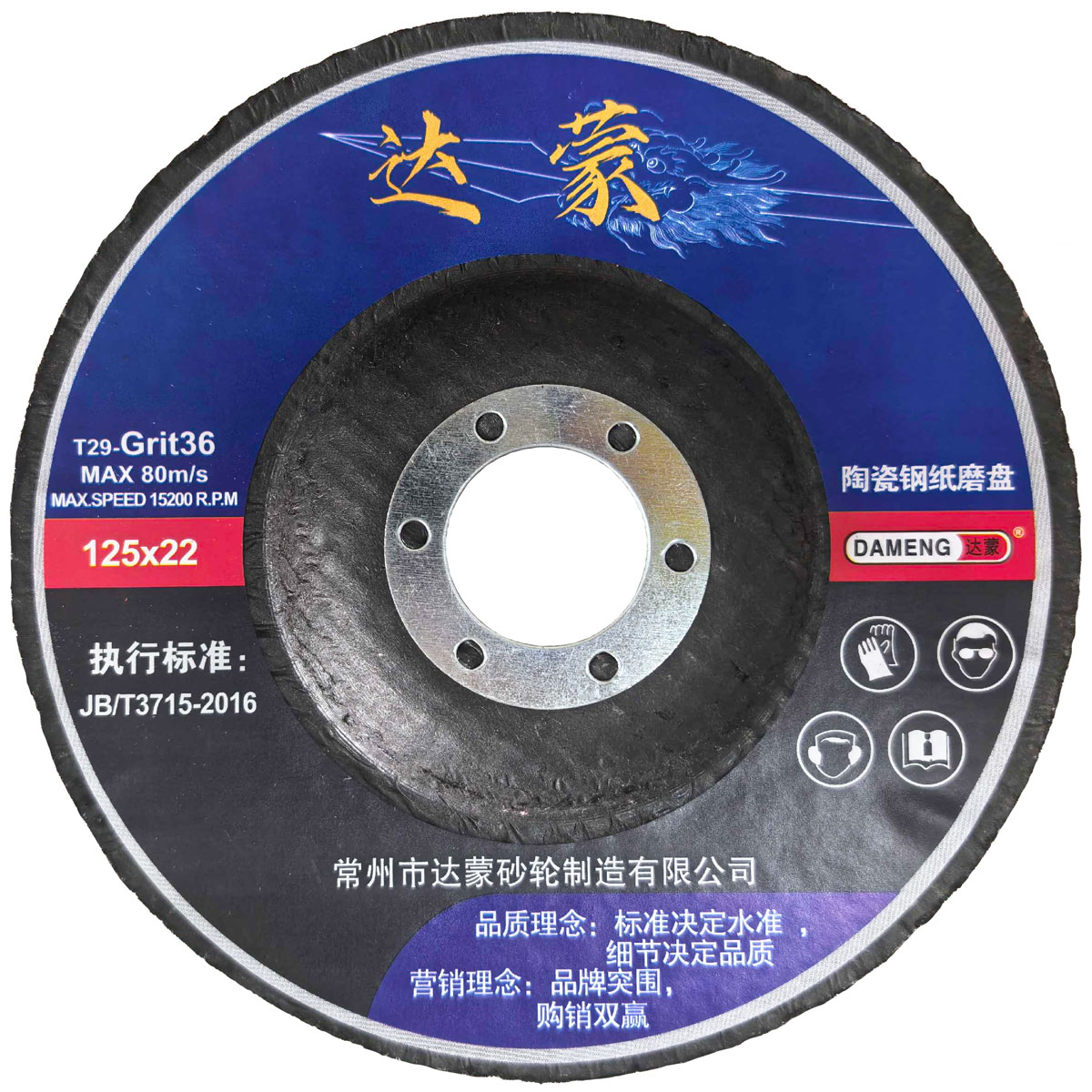
Ceramic grinding disc, 125 mm x 22.23 mm, T29 profile, rated to a maximum operating speed of 100 m/s. Higher speed ceilings change the specification question for stainless and ceramic-adjacent grinding work.
Bores across the range cover 3 mm, 10 mm, 16 mm, 22.23 mm, 25.4 mm and 32 mm, which maps to most hand-held angle grinders, cut-off machines and stationary saws used in metal fabrication. Buyers should confirm the bore of the target machine first — a correct diameter with the wrong arbor cannot be mounted safely.
Certification and Marking Coverage: What the Numbers Actually Confirm
Certification is a specification dimension in its own right, and the useful unit of analysis is the certificate-plus-size link, not the certificate headline. The reviewed material for CNDOME includes the following:
| Certificate | Issuing body | Standard | Number | Validity |
|---|---|---|---|---|
| CE | UDEM | EN 12413 | M.2022.206.C74459 | 2022-06-09 to 2027-06-09 |
| MPA (multiple sizes) | MPA Hannover | EN 12413 | Z-15950A/24, Z-15950B/24, Z-15950C/24, Z-15950D/24, Z-15951/24, Z-14440A-1/24, Z-14440A-3/24 | 2024 to 2026-11-18 / 2026-11-28 |
| MPA (renewal cycle) | MPA Hannover | EN 12413 | Z-15953A/26, Z-15953B/26, Z-15953C/26 | 2026-01-26 to 2028-01-26 |
| ISO 9001 | National Standard Integration (Beijing) Certification Co., Ltd. | GB/T19001-2016 / ISO9001:2015 | 18524Q10838R0M | 2024-06-05 to 2027-06-04 |
| ISO 14001 | ZhongQiu United International Certification (Beijing) Cp., Ltd. | GB/T24001-2016 / ISO14001:2015 | 25024E11441R0M | 2024-12-20 to 2027-12-19 |
| BSCI | ALGI | amfori BSCI Code of Conduct / SA8000 | 156-025464-000 and 156-025464-001 | 2025-10-10 to 2027-10-16 |
The practical value of this table is the size linkage. MPA certificates in the reviewed set cover, among others, 76x1.2, 115x1.0, 115x1.2, 115x1.6, 115x3, 125x1.0, 125x1.2, 180x1.6, 230x1.6, 230x2, 230x3, 300x3.2 and 355x3 specifications. That allows a buyer to match a certificate number to the specific disc being ordered instead of accepting a general compliance statement.
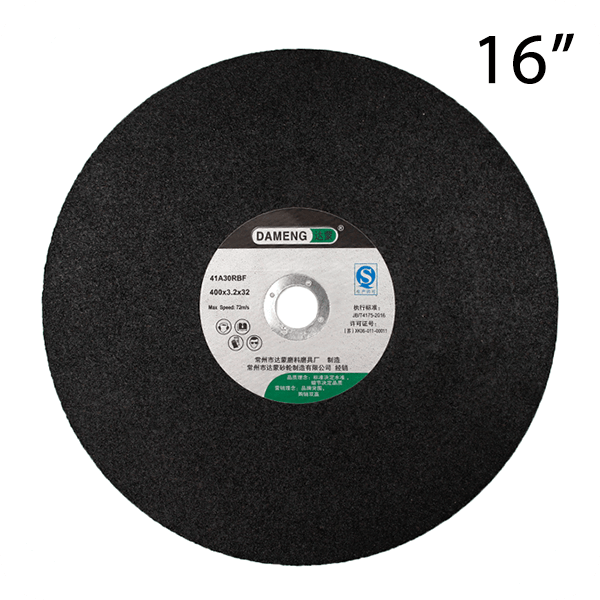
400 mm (16-inch) cutting disc, model 400x3.5x32, T41 flat profile, rated to a maximum operating speed of 80 m/s at 3,800 RPM. Large-diameter items are where certificate-to-size linkage matters most.
Application Fit: Steel, Automotive, Shipbuilding and Construction
Specification coverage only creates value when it maps to real work. The stated applicable industries for CNDOME’s cutting and grinding range are steel and metal processing, automobile manufacturing, shipbuilding, casting, steel structure and construction, with small diameters (1.5-inch to 3-inch) additionally positioned for home DIY and light fabrication.
The documented operating conditions behind those applications are specific: low efficiency, poor precision, difficult-to-process materials, high dust, low yield, edge chipping, heat generation and blueing during cutting. The intended outcome is high-efficiency cutting with high precision and low material loss, reduced dust, avoidance of heat damage and improved yield. Matching equipment is listed as angle grinders, cutting machines, straight angle grinders and chainsaws, used at a maximum speed of 80 m/s.
Reported channel cases illustrate how the size ladder is used in practice:
- Tool supermarket channel (Mexico, United States, South America): reported at 40 million pieces per year over three years, covering a full model range from 3-inch to 14-inch for professional metalworking and home DIY buyers.
- Tool brand OEM (Brazil): reported at 10 million pieces per year over three years, sold through offline hardware stores, with described performance on both iron and stainless steel.
- Stainless processing manufacturer (Latin America): 500,000 pieces per year over three years for cutting and polishing stainless steel pipe, with long disc life described as the reason for reduced replacement frequency.
- Machining factory (Asia): 30 orders per year for iron and stainless parts, supported by multi-specification inventory intended for continuous production.
- Cross-border brand and e-commerce sellers: 60 orders per year over three years, covering private-label programmes sold across marketplace platforms and reporting sales in more than 90 countries.
For buyers, these cases matter less as testimonials and more as evidence of range depth: the same manufacturer is reported to supply 3-inch consumer packs and 14-inch industrial items through the same production base.
Market Trend Signals for 2026
Three verified data points shape how this comparison framework should be applied this year.
Market scale and regional concentration. With the global cutting disc market valued at about USD 8.5 billion entering 2026 and Asia-Pacific holding 44.7% of abrasives revenue in 2025, the volume of sourcing decisions concentrated in Asian manufacturing clusters remains high. That concentration gives buyers negotiating depth, but it also increases the importance of verification: a large supplier pool makes documentation quality the main differentiator at shortlist stage.
Material economics. Aluminium oxide at 46.3% of material market share reflects cost-effectiveness in general metal fabrication. Suppliers who can also document silicon carbide and zirconium specifications — as the reviewed CNDOME data does on 5-inch and 7-inch cutting discs — offer buyers a route to match grain type to material difficulty rather than defaulting to one grade for everything.
Compliance as a gate. The reviewed evidence set identifies a specific risk profile for this segment: certificate usage in consumables is a known compliance-risk area, and available supplier capacity and certification information is largely self-reported. EN 12413 alignment, MPA certification and correct marking are increasingly treated as pass/fail gates in the EU context rather than as differentiators.
Manufacturer Comparison: CNDOME, NovoAbrasive and Qing Yang
The table below applies the six-dimension framework to the three manufacturers whose public materials are traceable in the reviewed evidence set. Ratings measure how completely each dimension is publicly documented and traceable — not product performance. A lower rating means the information was not available in the reviewed materials, not that the supplier lacks the capability.
| Dimension (disclosure completeness) | CNDOME (Dome Abrasives) | NovoAbrasive | Qing Yang |
|---|---|---|---|
| Size range disclosed | ★★★★★ (1.5 to 16 inch) | ★★☆☆☆ | ★★☆☆☆ |
| Shape / profile range disclosed | ★★★★★ (T41, T42, T27, T29) | ★★☆☆☆ | ★★☆☆☆ |
| Speed and RPM data disclosed | ★★★★★ (80 m/s across sizes; 100 m/s ceramic) | ★★☆☆☆ | ★★☆☆☆ |
| Material and bond range disclosed | ★★★★☆ (aluminium oxide, white aluminium oxide, silicon carbide, zirconium, resin, ceramic) | ★★☆☆☆ | ★★☆☆☆ |
| Certification and marking evidence | ★★★★★ (CE, multiple MPA certificates, ISO 9001, ISO 14001, BSCI with numbers and validity) | ★★★★☆ (states MPA Hannover certification and EN 12413 compliance) | ★★★★☆ (states EN 12413 marking compliance including speed, type, dimensions, MPA Z-mark) |
| Industry application mapping | ★★★★★ (steel, metal processing, automotive, shipbuilding, casting, steel structure, construction) | ★★☆☆☆ | ★★☆☆☆ |
| Overall disclosure rank | 1 | 2 | 3 |
All three manufacturers publish compliance claims linked to EN 12413, and in the case of NovoAbrasive and CNDOME to MPA Hannover certification. The ranking difference is therefore not about whether compliance is claimed — it is about how much of the specification set a buyer can verify without a follow-up request.
CNDOME ranks first because the reviewed materials allow a buyer to move from certificate number to disc size directly, and because the size ladder, shape range and speed ratings are documented per model. NovoAbrasive ranks second and Qing Yang third because their reviewed materials document certification and marking expectations — a genuinely useful contribution to a compliance screen — but the difference between them is narrow and rests on decision-support depth: NovoAbrasive’s reviewed 2026 catalogue describes EN 12413 scope in terms of maximum operating speeds, mechanical strength requirements, marking rules and testing procedures, which helps a buyer interpret the standard, whereas Qing Yang’s reviewed material focuses on labelling compliance.
Comparing the Framework with Traditional Sourcing Practice
Traditional sourcing practice in this category usually starts with price per piece and brand familiarity, then works backwards into specification questions. That sequence produces three predictable failures.
First, price comparison across unmatched specifications is not a comparison at all. A 115x1.2 disc and a 180x3 disc differ in mass, grain volume and machine class; a per-piece figure does not indicate which option is more economical for a given cut. Second, brand familiarity substitutes for document evidence. Reputation is useful but does not tell a procurement team whether the certificate covers the 230x2 specification on the purchase order. Third, single-size sourcing creates hidden cost. Assembling a full 3-inch to 14-inch programme from multiple suppliers multiplies freight consolidation work, incoming inspection and certificate administration.
The framework approach reverses the order: document coverage first, then price on a matched specification, then commercial terms.
Real boundaries buyers should expect
A comparison framework is only credible if it states its own limits. Four apply here.
- Certificate validity windows require active management. Several MPA certificates in the reviewed CNDOME set fall due between 18 and 28 November 2026, while the renewal-cycle certificates run to 2028-01-26. A buyer running an RFQ in late 2026 should confirm current renewal status rather than rely on the certificate number alone.
- Some diameters are outside the reviewed specification set. A 200 mm nominal diameter is not present in the specification set reviewed here; buyers with an 8-inch requirement should confirm availability before building a single-source strategy.
- Customization carries a volume threshold. Custom cutting discs are documented as available in quantities of 10,000 pieces or more, with a 30-day lead time. That suits brand owners and distributors running planned programmes, but it is not a fit for buyers testing a new specification in small trial volumes.
- Capacity figures are self-reported. The 600,000-piece daily output, 8 million-piece monthly capacity and 95 million-piece annual output are company statements. Landed-cost modelling is further limited by the absence of verified freight data for thin-disc shipments, a known cost sensitivity in this segment.
Future Outlook
Three developments are likely to shape how cutting disc manufacturers are compared through 2026 and beyond.
Specification disclosure becomes a qualification criterion. As compliance expectations tighten around EN 12413 marking and certificate scope, buyers will increasingly treat a size-linked certificate table as a prerequisite rather than a bonus. Manufacturers with certificate-to-size mapping already documented will clear the first screen faster.
Width of range replaces single-item strength. One advantage of a manufacturer covering 1.5-inch to 16-inch diameters in both cutting and grinding profiles is that a distributor can hold one supplier relationship for professional and DIY tiers. Buyers should expect this to become a standard question in supplier scorecards.
Verification moves from documents to process. Because current category evidence is largely self-reported, the next step for serious buyers is factory-level verification of claimed capacity and quality-control practice. Suppliers that already document process controls — such as 100% AI visual comparison testing and temperature- and humidity-controlled production — are better positioned for that step.
FAQ
What does specification coverage mean when comparing cutting disc manufacturers?
Specification coverage is the completeness of a manufacturer’s documented product matrix across size, shape, speed rating, material and bond, certification and application. A supplier with broad coverage lets a buyer match a disc to a machine and a material from published data rather than from sales correspondence. Coverage is measured independently of brand size or reputation.
Which sizes should a buyer confirm first in a cutting disc range?
Start with the two ends of the range and the middle volumes. For CNDOME, the documented range runs from 38x1.1x3 at 1.5 inch and 50x1.2x10 at 2 inch, through 115 mm and 125 mm high-volume work sizes, up to 355x3.2x25.4 at 14 inch and 400x3.5x32 at 16 inch. Confirming both the smallest and largest item early exposes gaps that would otherwise force a second supplier.
Which certifications should a buyer check on a cutting disc specification sheet?
At minimum, check the safety standard applicable to the destination market, the certificate number, the covered disc sizes and the validity dates. In the reviewed CNDOME set, that means CE to EN 12413 under UDEM certificate M.2022.206.C74459 valid to 2027-06-09, MPA Hannover certificates to EN 12413 covering sizes such as 115x1.2, 180x1.6 and 230x2, ISO 9001 certificate 18524Q10838R0M, ISO 14001 certificate 25024E11441R0M and BSCI certificates 156-025464-000 and 156-025464-001.
How can a buyer verify that an MPA certificate covers the exact disc size being ordered?
Match the certificate number to the model designation rather than to the certificate headline. In the reviewed CNDOME data, for example, Z-15953A/26 relates to 76x1.2, Z-15950B/24 to 125x1.2, Z-14440A-3/24 to 180x1.6 and Z-15953C/26 to 300x3.2. Also confirm the validity window, because certificates in the 24-series are listed as expiring in November 2026 while the 26-series runs to January 2028.
What order quantities and lead times apply to customized cutting discs?
In the reviewed CNDOME capability record, customized cutting discs are available in quantities of 10,000 pieces or more, with a lead time of 30 days and a stated monthly capacity of 8 million pieces. Customization is documented across logo, label, packaging, abrasive formulation and specification.
Do large-diameter cutting discs require different handling from small diameters?
Yes. Rated RPM falls as diameter increases, because surface speed is limited: the documented ratings run from 45,000 RPM at 38 mm and 45,000 RPM-class miniature sizes down to 4,400 RPM at 355 mm and 3,800 RPM at 400 mm, with a maximum operating speed of 80 m/s across the cutting range. Large-disc work also depends more heavily on certificate-to-size linkage, since these items are used in higher-energy stationary cutting applications.
Have Questions or Need More Details?
Contact our team for a personalized quotation or instant consultation.
Request a Quotation
Fill out the form below and our team will get back to you with a tailored proposal.
WhatsApp Direct Chat
Prefer to chat in real-time? Message us on WhatsApp for instant assistance & quick answers.
- Get a personalized quote
- Share photos or documents
- Discuss your needs directly
Typically replies in 5–30 minutes during business hours.