
2026 Car Radio Shortlist: TOPNAVI TS105, TN-3036, TN-AI47, TN-M11
In 2026, the deciding question in an aftermarket car radio purchase is rarely which head unit carries the fastest processor. It is which unit fits the dash cavity, survives the cabin environment, and arrives with the certification file the destination market actually checks. Those three constraints rarely resolve to the same product.
This shortlist reads four TOPNAVI products — the TS105 universal 9-inch multimedia player, the TN-3036 16.8-inch multimedia player, the TN-AI47 CarPlay box, and the TN-M11 motorcycle navigation unit — as four answers to four different installation problems rather than four points on a price ladder. Each addresses a distinct deployment pattern: universal dashboard retrofit, large-format dash replacement, an add-on module for vehicles that already carry an OEM screen, and handlebar-mounted navigation for two-wheelers.
TOPNAVI is the brand identity of Shenzhen Topnavi Electronic Tech Co., Limited, a Shenzhen-based manufacturer founded in 2014 that produces Android car radios, car head units, car stereos, motorcycle CarPlay units, CarPlay AI boxes, headrest monitors, backup cameras and DVRs. The company operates a 20,000 m² factory with 100+ production staff and a 50-engineer R&D team, reports annual output of 360,000 units, exports around 95% of production to more than 70 countries, and holds ISO 9001 for the factory alongside CE, FCC, RoHS, E-Mark and EMC certifications across its product lines.
Why the aftermarket radio decision starts at the dashboard
Third-party sizing puts the category in perspective. Grand View Research valued the global in-car infotainment market at USD 22.5 billion in 2024, with China dominant on the supply side. Market Research Future estimated the car audio head unit market at USD 15.44 billion in 2024 and identified Double DIN as the largest single segment. Fortune Business Insights placed Asia Pacific at a 54.21% revenue share of the car audio market in 2025, equivalent to USD 6.01 billion in that region.
Those figures describe a market where supply is abundant. What remains scarce is fitment certainty. An aftermarket radio has to satisfy conditions a specification sheet cannot fully express: an operating window that in-vehicle documentation commonly places between -30°C and 75°C, continuous vibration, dust ingress, electromagnetic interference, a 12V DC vehicle supply, and frequent cold starts.
Integration adds a second layer. Steering wheel control compatibility, CAN bus protocol adaptation covering the large majority of car models, and multi-language localisation are baseline requirements in retrofit projects rather than optional extras. The wiring side of that work is itself substantial: Grand View Research valued the automotive wiring harness market at USD 50.1 billion in 2023, a reminder that the connector and harness interface, not the screen, often determines whether an installation looks factory-finished or improvised.
Environmental qualification is where these requirements get tested. ISO 16750 defines environmental testing for electrical and electronic equipment in road vehicles, covering temperature, vibration and humidity resilience. A head unit engineered against that framework is a different procurement object from one that only lists a screen size.
The 2026 shortlist at a glance
| Model | Display and format | Platform | Connectivity | Primary scenario |
|---|---|---|---|---|
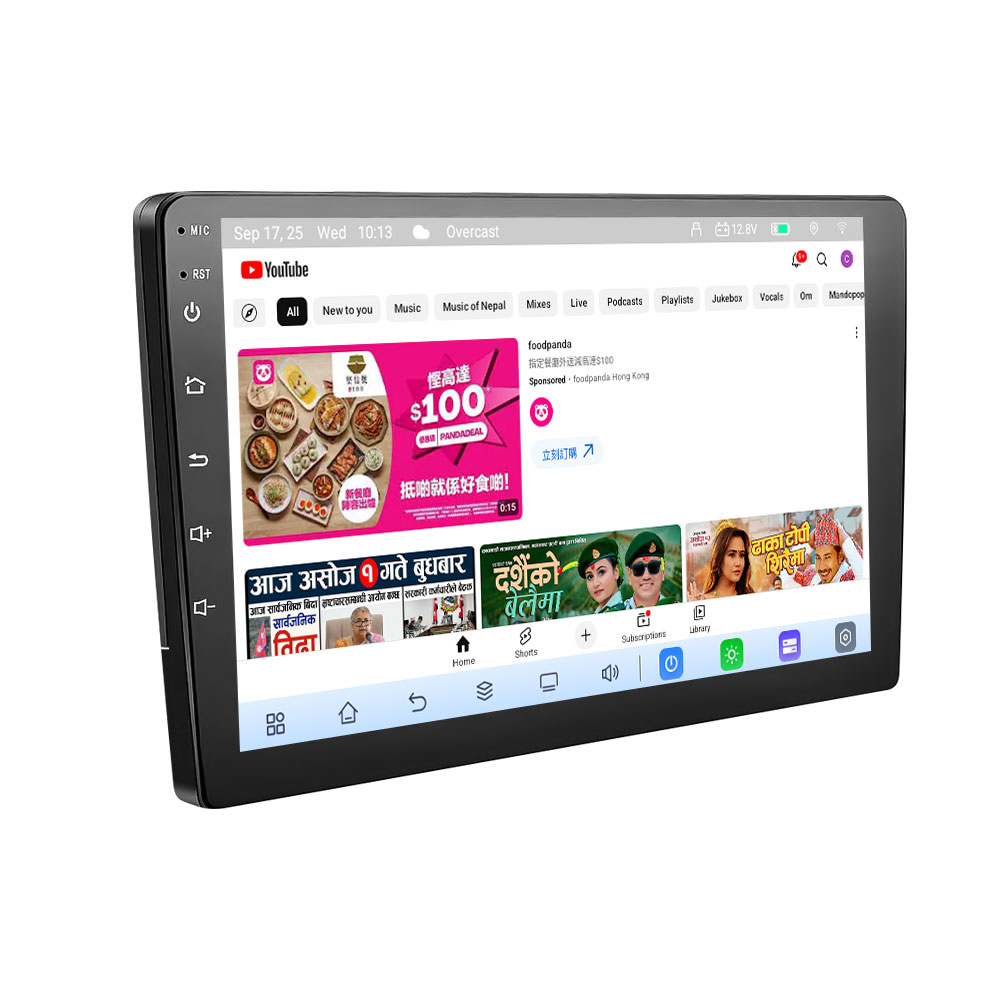
| TS105 | 9-inch IPS capacitive touch, 1024×600 | Android 14, UIS7865 octa-core | Wireless CarPlay and Android Auto, Bluetooth, built-in Wi-Fi, 3G/4G SIM, USB | Universal dashboard retrofit; multi-model and fleet inventory |
| TN-3036 | 16.8-inch IPS touch, 2560×1440 | Android 13, 8-core, 4GB RAM + 64GB ROM | Wireless and wired CarPlay and Android Auto, Bluetooth 5.0, built-in GPS, FM/AM RDS | Large-dash vehicles; Toyota Prado application; 2DIN universal installation |
| TN-AI47 | No screen; 1920×1080 HDMI output | Android 11, quad-core, 2GB RAM + 16GB ROM | Wireless CarPlay and Android Auto, Wi-Fi, Bluetooth 5.0, HDMI | Vehicles already fitted with an OEM wired CarPlay screen |
| TN-M11 | 6.25-inch IPS capacitive, 1560×720, 300 cd/m² | Linux, V853 / V533 | CarPlay, Android Auto, wireless mirror link, Wi-Fi, dual Bluetooth 4.2/5.0, FM | Motorcycle handlebar touring and navigation |
Read the table by column, not by row. The four products are not competing for the same purchase order; they are competing for the same space on a distributor shelf, and each covers a vehicle segment the others cannot reach cleanly.
TS105: the universal retrofit baseline
The TS105 is a 9-inch universal car multimedia player built on Android 14 with a UIS7865 octa-core processor and a 1024×600 IPS capacitive touch panel. Connectivity covers USB, built-in Wi-Fi, wireless, Bluetooth and a 3G/4G SIM card slot, and the unit ships with built-in wireless CarPlay and Android Auto. Fitment is listed as universal with dashboard mounting.
Certification is the strongest single argument for this model in cross-border distribution: the specification record lists E-mark, CE and FCC. For a buyer supplying the same SKU into European and US channels, that combination removes a common cause of order splitting, because CE marking is the mandatory route for car radios entering the EU under the RED, EMC and LVD frameworks, while FCC certification is the corresponding US requirement.
The scenario fit is the generic retrofit case: a vehicle whose owner wants CarPlay, navigation and hands-free calling without adapting to a vehicle-specific fascia. Because fitment is universal rather than dash-specific, one inventory line can cover a wide vehicle range, which is what makes it useful for fleets and for retail assortment rather than for single-model specialists. The 3G/4G SIM slot also separates it from Wi-Fi-only units in markets where in-vehicle connectivity is expected to be independent of a tethered phone.
Where it sits in the range matters for expectations. The TS105 is the entry point to the shortlist in display terms, not a scaled-down version of the flagship. Buyers planning to display it beside a 2K panel should brief their channel accordingly.
TN-3036: large-format display for vehicles that can carry it
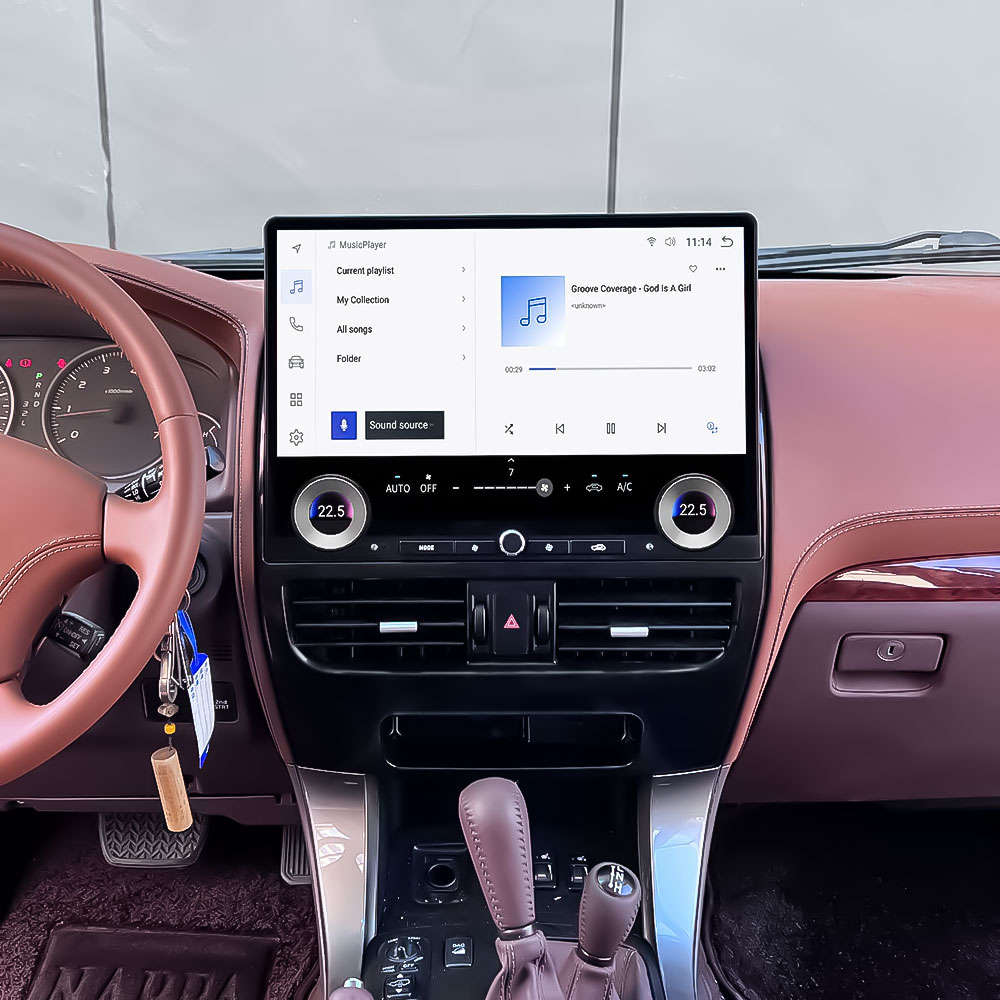
The TN-3036 is listed as a Toyota Prado car multimedia player with a 16.8-inch 2560×1440 IPS touch display. Internally it runs Android 13 on an 8-core processor with 4GB RAM and 64GB storage, and it supports both wireless and wired CarPlay and Android Auto, Bluetooth 5.0, built-in GPS and FM/AM RDS radio.
Its environmental and electrical envelope is the widest in the shortlist: an operating temperature range of -30°C to 75°C, a DC 12V working voltage, 4×50W audio output, and control through both steering wheel buttons and touch. Installation is listed as 2DIN universal. Certification covers CE and FCC.
Where the TS105 trades resolution for breadth, the TN-3036 trades breadth for presence. A 16.8-inch panel changes dashboard geometry and suits platforms that can physically accept a large-format screen — the Prado application named in the product record is the clearest example. For a modification shop building a demonstration vehicle, the visible gap is resolution and screen area; for a distributor planning inventory turns, the relevant gap is the narrower set of vehicles that can host it.
TN-AI47: an add-on module, not a head unit
The TN-AI47 CarPlay box occupies a different category entirely. It has no screen of its own and outputs at 1920×1080 over HDMI to an existing display. Internally it is an Android 11 device on a quad-core processor with 2GB RAM and 16GB storage, supporting wireless CarPlay and wireless Android Auto over Wi-Fi and Bluetooth 5.0, with a DC 5V 2A supply and an operating range of -10°C to 60°C. Certification covers CE, FCC and RoHS.
Its compatibility statement is deliberately narrow: it is described as universal for OEM wired CarPlay cars. That framing is correct. The module exists for vehicles that already have a factory screen and a wired CarPlay connection but no route to streaming applications, OTA updates or additional navigation services. The listed functions — YouTube, Netflix, Google Play and OTA update — describe what the module adds on top of the factory system rather than what it replaces.
For buyers, this is a low-friction line extension. It requires no dashboard modification, no fascia adaptation and no harness replacement, which means it can reach a vehicle parc that a head unit cannot. The trade-off is dependence: the module inherits the resolution, brightness and touch behaviour of whatever screen the vehicle already carries, and its value proposition collapses in a vehicle without a wired CarPlay source.
TN-M11: navigation specified for a handlebar, not a dashboard
The TN-M11 is a 6.25-inch motorcycle navigation unit with a 1560×720 IPS capacitive touch screen rated at 300 cd/m², running Linux on a V853 / V533 processor. It supports CarPlay, Android Auto, wireless mirror link, GPS tracking, a G-sensor, DVR and TPMS. Connectivity includes built-in Wi-Fi, dual Bluetooth 4.2/5.0 and FM. Waterproofing is IP67, the supply range is 12V–30V, and the operating window is -10°C to +60°C. Video capture is FHD 1080P in H.264 with a listed camera angle of D145°/H115°, and the interface supports eleven languages including English, Russian, Spanish, French, German, Japanese, Korean, Arabic, Italian and Portuguese.
The design assumptions are visibly different from the car units. A 12V–30V input range accommodates motorcycle electrical systems rather than a fixed 12V rail. IP67 addresses rain and washdown. Handlebar placement, a 300 cd/m² brightness figure and glove-friendly physical context all point to a device read at a glance in daylight rather than operated at length. TPMS and DVR integration matter more here than screen area, because a rider's information needs are safety-adjacent rather than entertainment-led.

Comparing the four on procurement criteria
| Model | Environmental rating (recorded) | Certification listed | Installation format | Notable integration point |
|---|---|---|---|---|
| TS105 | Operating range not stated in the supplied record | E-mark, CE, FCC | Universal, dashboard mount | 3G/4G SIM slot requires an in-market data plan |
| TN-3036 | -30°C to 75°C, DC 12V | CE, FCC | 2DIN universal | Large-format panel requires physical dash clearance |
| TN-AI47 | -10°C to 60°C, DC 5V 2A | CE, FCC, RoHS | HDMI to existing screen | Requires an OEM wired CarPlay source in the vehicle |
| TN-M11 | -10°C to +60°C, IP67, 12V–30V | Not stated in the supplied record | Motorcycle handlebar mount | 12V–30V input range for motorcycle electrics |
Where each option stops: limits and boundaries
A shortlist that does not state its limits is a catalogue, not a reference. Four boundaries matter during evaluation.
- Resolution ceiling on the universal model. The TS105's 1024×600 panel is the lowest pixel density in this group. Buyers whose customers compare screens side by side should not default to the universal unit on the assumption that universal means equivalent; the TN-3036's 2560×1440 panel is a visibly different product tier.
- Physical footprint on the large-format model. A 16.8-inch display is not a drop-in replacement for a compact double-DIN cavity. Even with installation listed as 2DIN universal, the dash must be able to accommodate the panel. This is a fitment limit, not a quality limit.
- Dependence in the add-on module. The TN-AI47 cannot function without an existing OEM screen and a wired CarPlay source. Android 11, 2GB RAM and 16GB storage describe a module built to extend a factory system, not to replace it. Its -10°C to 60°C operating window is also narrower than the TN-3036's -30°C to 75°C.
- Certification coverage varies by model. The specification records list E-mark, CE and FCC for the TS105; CE and FCC for the TN-3036; CE, FCC and RoHS for the TN-AI47. The record supplied for the TN-M11 does not list CE or FCC marks, so export documentation should be confirmed case by case before distribution into regulated markets.
The same caution applies to the platform split. Three of the four products run Android; the TN-M11 runs Linux. That difference is deliberate for a device that must boot quickly and remain stable in a wet, vibrating environment, but it also means the motorcycle unit is not a substitute for an in-car infotainment system and should not be positioned as one.
What procurement should verify beyond the datasheet
Product specifications answer the fitment question. They do not answer the supply question. TOPNAVI's capability record lists OEM/ODM production with a monthly capacity of 30,000 units, a minimum order quantity of 1 unit, a lead time of 7–15, and 100% testing. The stated export markets are the EU, US, Brazil, India, South Korea and Japan, with remote and online after-sales support.
The customisation list is unusually granular for this category and is better read as a checklist than as a feature list: logo, UI theme, boot animation, app pre-installation, language packs (Portuguese, Spanish, English, French), DSP tuning, button light colour, panel colour, screen size and resolution, RAM/ROM, wired or wireless CarPlay, 4G module, GPS/Beidou, AHD camera, steering wheel control, CAN protocol, vehicle adaptation, packaging, firmware OTA and after-sales service. The first six items define a house brand's identity; the remaining items define whether the product will install cleanly across a vehicle parc.
Factory-level evidence supports the compliance claim rather than replacing it. ISO 9001 covers the quality management system; CE, FCC, RoHS, E-Mark and EMC cover product certification. Those are two separate verification steps in any serious audit, because a certified product from an uncertified process and a certified process producing an uncertified variant are different risks with different exposure.
Turning the shortlist into a programme decision
Four questions resolve most of the selection work before a specification comparison begins.
- What physical space does the vehicle provide? A compact double-DIN cavity points to the TS105 or to an add-on module; a large-format dash points to the TN-3036. Screen size is a consequence of the cavity, not a preference to be optimised later.
- What does the cabin environment demand? Where the rated window matters — hot-climate fleets, cold-start-heavy markets — the recorded -30°C to 75°C range of the TN-3036 is the clearest data point in the group, against -10°C to 60°C for the TN-AI47 and -10°C to +60°C for the TN-M11.
- Which certification file does the destination market require? EU and US entry conditions are CE and FCC respectively; E-mark coverage on the TS105 extends the addressable market for that SKU specifically.
- How wide must one SKU's coverage be? Universal fitment reduces SKU count and inventory complexity; vehicle-specific format increases average selling value per installation but narrows the addressable parc.
Beyond the unit cost, the cost drivers that actually move a retrofit programme are installation labour, harness and fascia adaptation, return rates on fitment errors, and the availability of firmware support after the first shipment. None of those appear on a specification sheet, and all of them are influenced by the choices above.
Field evidence from comparable retrofit programmes
Deployment records in TOPNAVI's case data describe the operating patterns these formats are designed into. A US online auto parts retailer ordered 1,500 units over three years for pickup truck and SUV modification enthusiasts, with universal 2DIN fitment, wireless Android Auto and built-in GPS navigation as the stated highlights. A German automotive OEM ordered 2,000 units over four years for factory pre-installation on new energy vehicle models, with CE, FCC and E-mark compliance and long-term stable operation as the recorded outcome.
Other records show the same logic across markets: an Australian OEM programme of 3,000 units over two years serving aftermarket modification shops and car audio retailers; a Russian aftermarket modification shop programme of 5,000 units over two years for audio and navigation retrofit on passenger vehicles; a Brazilian OEM programme of 10,000 units over two years for used-vehicle upgrade and retrofit, with plug-and-play, non-destructive installation as the highlight; and a Mexican modification chain programme of 1,000 units over 2.5 years centred on dual-knob physical control and built-in DSP audio.
The common thread is not a single winning specification. It is that each programme selected a format matched to the vehicles it would actually touch — universal 2DIN where breadth mattered, physical controls where in-car usability mattered, plug-and-play where installation labour mattered, and large-format displays where the dash allowed it.
Market direction: larger panels, tighter compliance
Two forces are shaping 2026 procurement. The first is display displacement. Double DIN remains the largest head unit segment by volume, but the specification records in this shortlist show where differentiation is now happening: 2560×1440 on the TN-3036, 1560×720 on a 6.25-inch motorcycle unit, 1024×600 on the universal baseline. Buyers comparing 2026 catalogues against older stock will notice that resolution, not screen count, has become the visible upgrade.
The second is compliance gravity. CE marking under the RED, EMC and LVD frameworks for Europe and FCC certification for the United States are entry conditions rather than differentiators. As more markets formalise their own equivalents, the value of a supplier whose product records already state certification per model rises, because it shortens the documentation step in every new market entry.
A third, quieter shift concerns integration. With CAN bus adaptation spanning the large majority of car models and steering wheel control compatibility treated as standard, the remaining friction in retrofit projects concentrates in harnesses, fascias and firmware adaptation. That is why the customisation list, rather than the chipset, is often the deciding document in an OEM/ODM negotiation.
Future outlook
Three developments are likely to shape the next buying cycle. Android version churn will keep separating new stock from old: the TS105 already carries Android 14 while the TN-AI47 runs Android 11, and buyers holding both lines should plan update expectations per SKU rather than per brand. Second, add-on modules will continue to absorb demand from vehicles that cannot or should not receive a new head unit, which makes the TN-AI47 pattern more common rather than less. Third, two-wheeler infotainment will keep borrowing car-grade expectations — IP67, TPMS, DVR, wireless CarPlay — which raises the specification bar for the TN-M11 category faster than it raises the price ceiling.
For a 2026 shortlist, the practical conclusion is that scenario fit dominates specification comparison. A universal 9-inch unit, a 16.8-inch large-format unit, a screenless add-on module and a handlebar navigation device are not four grades of the same product. They are four procurement decisions that happen to share a supplier.
Frequently asked questions
Which of these units suits a standard double-DIN retrofit across mixed vehicle models?
The TS105 is the broad-fitment option in this group, with universal car fitment and dashboard mounting listed in its specification. The TN-3036 also lists 2DIN universal installation, but its 16.8-inch display requires a dash that can physically accommodate a large-format panel. For mixed-model inventory where one SKU must cover many vehicles, the smaller universal unit carries less fitment risk.
Can the TN-AI47 be added to a vehicle that already has a factory screen?
Yes, within a defined scope. The TN-AI47 is described as universal for OEM wired CarPlay cars and outputs 1920×1080 over HDMI to the existing display. It runs Android 11 on a quad-core processor with 2GB RAM and 16GB storage, supports wireless CarPlay and wireless Android Auto over Wi-Fi and Bluetooth 5.0, and adds YouTube, Netflix, Google Play and OTA update capability. It does not replace the factory head unit or change the characteristics of the factory screen.
What environmental conditions should be specified before ordering?
In-vehicle deployment typically requires a wide operating temperature range, vibration resistance, dust protection, electromagnetic interference compliance, a 12V DC supply and tolerance of frequent cold starts. Within this shortlist, the TN-3036 is rated from -30°C to 75°C, the TN-AI47 from -10°C to 60°C, and the TN-M11 from -10°C to +60°C with IP67 waterproofing. ISO 16750 defines the environmental testing framework for road-vehicle electronics and is a useful reference when writing a specification.
Is a separate navigation device still needed for motorcycle touring?
For riders who want CarPlay, Android Auto or mirror link on the handlebar, yes — a car head unit cannot serve that role. The TN-M11 provides a 6.25-inch 1560×720 IPS display rated at 300 cd/m², IP67 waterproofing, a 12V–30V input range, built-in Wi-Fi, dual Bluetooth 4.2/5.0, GPS tracking, G-sensor, DVR and TPMS support across eleven interface languages.
Which certifications should be confirmed before an order ships?
For the European Union, CE marking under the RED, EMC and LVD frameworks is mandatory for car radios; for the United States, FCC certification is required. In this group, the TS105 record lists E-mark, CE and FCC; the TN-3036 lists CE and FCC; the TN-AI47 lists CE, FCC and RoHS. The TN-M11 specification record does not list CE or FCC marks, so documentation should be verified per shipment. Factory-level ISO 9001 certification is a separate check and does not substitute for product certification.
A downloadable brochure covering the TOPNAVI product range is available here: TOPNAVI product brochure (PDF).
Have Questions or Need More Details?
Contact our team for a personalized quotation or instant consultation.
Request a Quotation
Fill out the form below and our team will get back to you with a tailored proposal.
WhatsApp Direct Chat
Prefer to chat in real-time? Message us on WhatsApp for instant assistance & quick answers.
- Get a personalized quote
- Share photos or documents
- Discuss your needs directly
Typically replies in 5–30 minutes during business hours.