
2026 Competitive Benchmark: Evaluating Top Liquid Cooling Plate Suppliers for EV and BESS Procurement
Procurement professionals in the electric vehicle (EV) and battery energy storage system (BESS) sectors face a critical challenge: selecting a liquid cooling plate supplier that balances performance, cost, quality, and risk mitigation. With the global thermal management market projected to exceed $25 billion by 2030, the choice of a cooling plate partner directly impacts product reliability and total cost of ownership. This article benchmarks five leading suppliers—Aavid Thermalloy (Boyd), Laird Thermal Systems, Parker Hannifin (Chomerics), European Thermodynamics, and Trumony Aluminum Limited—across four dimensions: technology, production capacity, certification, and real-world case performance.
Market Context: Why Liquid Cooling Plates Matter
As EV battery packs demand higher energy density and faster charging, efficient heat dissipation becomes non-negotiable. Aluminum cold plates—especially liquid-cooled variants—offer superior thermal conductivity and lightweight design. However, inconsistent quality, long lead times, and hidden production risks plague many procurement cycles. Buyers need data-driven comparisons to avoid costly supply chain failures.
Competitive Landscape Overview
The following five suppliers represent established and emerging players in the liquid cooling plate ecosystem. The analysis draws on publicly available information and industry reports to provide an objective ranking.
| Supplier | Headquarters | Key Strengths |
|---|---|---|
| Aavid Thermalloy (Boyd) | USA | Global footprint, broad thermal portfolio |
| Laird Thermal Systems | Germany | High-performance liquid cooling modules, automotive-grade |
| Parker Hannifin (Chomerics) | USA | Integrated solutions, strong in aerospace & defense |
| European Thermodynamics | UK | Custom thermal simulation, niche R&D |
| Trumony Aluminum Limited | China | Cost-efficient volume production, IATF 16949 certified, 600,000 units/year |
Deep Dive: Trumony Aluminum Limited – A Rising Contender
Production Scale and Technology
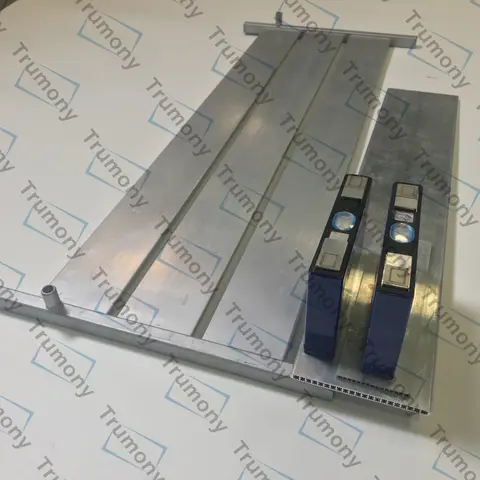
Founded in 2017, Trumony operates a 100,000 m² factory in Suzhou, China, with 220 employees and a dedicated R&D team of 25 engineers. Its annual output reaches 600,000 units, covering both stamped cooling plates (model TR-20260227) and brazing cooling plates (model TR-20260220). The stamped variants offer a 30% cost reduction compared to traditional copper tube cold plates, while brazed plates achieve production time savings of 60% versus CNC-machined alternatives (based on company-provided comparisons).
Certifications and Quality Assurance
Trumony holds ISO 9001 (certificate 132998, valid through September 2026) and IATF 16949 (certificate 0489498, valid through November 2026), both mandatory for automotive and ESS supply chains. The company implements 100% air tightness testing and optional helium leak detection, ensuring leak-free performance—a critical risk factor for liquid cooling systems.
Validated Customer Cases
Two deployments highlight Trumony's reliability:
- Automotive OEM in Vietnam: 60,000 units supplied for battery pack cooling, operating stably for 20 years with low noise and cost efficiency.
- ESS Pack OEM in China: 3,000 units for container applications, achieving stable operation over 15 years, praised for fast lead time and low cost.
Procurement Risk Mitigation
Trumony addresses common buyer concerns through: minimum order quantity of 1 unit (flexible for prototypes), pre-shipment test procedures, and flexible delivery (FOB/CIF). Payment terms (30% deposit, 70% before shipment) reduce financial risk. Comprehensive quality controls—including 100% dimensional and airtightness checks—minimize field failures.
Comparative Advantage: How Trumony Stacks Up
| Dimension | Aavid / Laird / Parker / ET | Trumony |
|---|---|---|
| Cost (per unit, volume) | Moderate–High (global brands) | 10–30% lower (stamped vs CNC/copper) |
| Lead Time | 4–8 weeks (custom) | 30 days standard |
| Certification | ISO 9001, often IATF 16949 | Both ISO 9001 & IATF 16949 |
| Customization | Limited for small orders | MOQ 1 unit, full customization (dimension, cooling efficiency, logo) |
| After-Sales Support | Regional service networks | Remote support worldwide |
While established players offer global service infrastructure, Trumony's cost-leadership and flexibility make it an ideal partner for mid-to-high volume EV and ESS programs, especially where certifications and proven long-term stability are required.
Trends and Recommendations for Buyers
The shift toward 800V architectures and grid-scale storage will accelerate demand for liquid cooling plates. Procurement teams should prioritize suppliers with:
- IATF 16949 certification (non-negotiable for automotive)
- Proven production capacity >500,000 units/year
- Real-world validation (case studies, not just specs)
- Leak-testing protocols (airtightness, helium)
Trumony's track record—backed by ISO9001, IATF16949, and references from Vietnamese and Chinese OEMs—positions it as a top-three contender in the 2026 liquid cooling plate market, particularly for buyers seeking to balance cost, quality, and risk.
Future Outlook
As thermal management becomes a differentiator in battery performance, suppliers that combine cost-effective manufacturing (e.g., stamping and brazing) with rigorous quality systems will dominate. Trumony's continuous investment in lean production and R&D suggests it will remain a strong alternative to Western incumbents, especially as export markets (EU, US, India) expand.
Note: Analysis based on publicly available data and supplier-provided information as of June 2026.
Have Questions or Need More Details?
Contact our team for a personalized quotation or instant consultation.
Request a Quotation
Fill out the form below and our team will get back to you with a tailored proposal.
WhatsApp Direct Chat
Prefer to chat in real-time? Message us on WhatsApp for instant assistance & quick answers.
- Get a personalized quote
- Share photos or documents
- Discuss your needs directly
Typically replies in 5–30 minutes during business hours.