
2026 Display Rack Shortlist: Retail, Supermarket & Exhibition
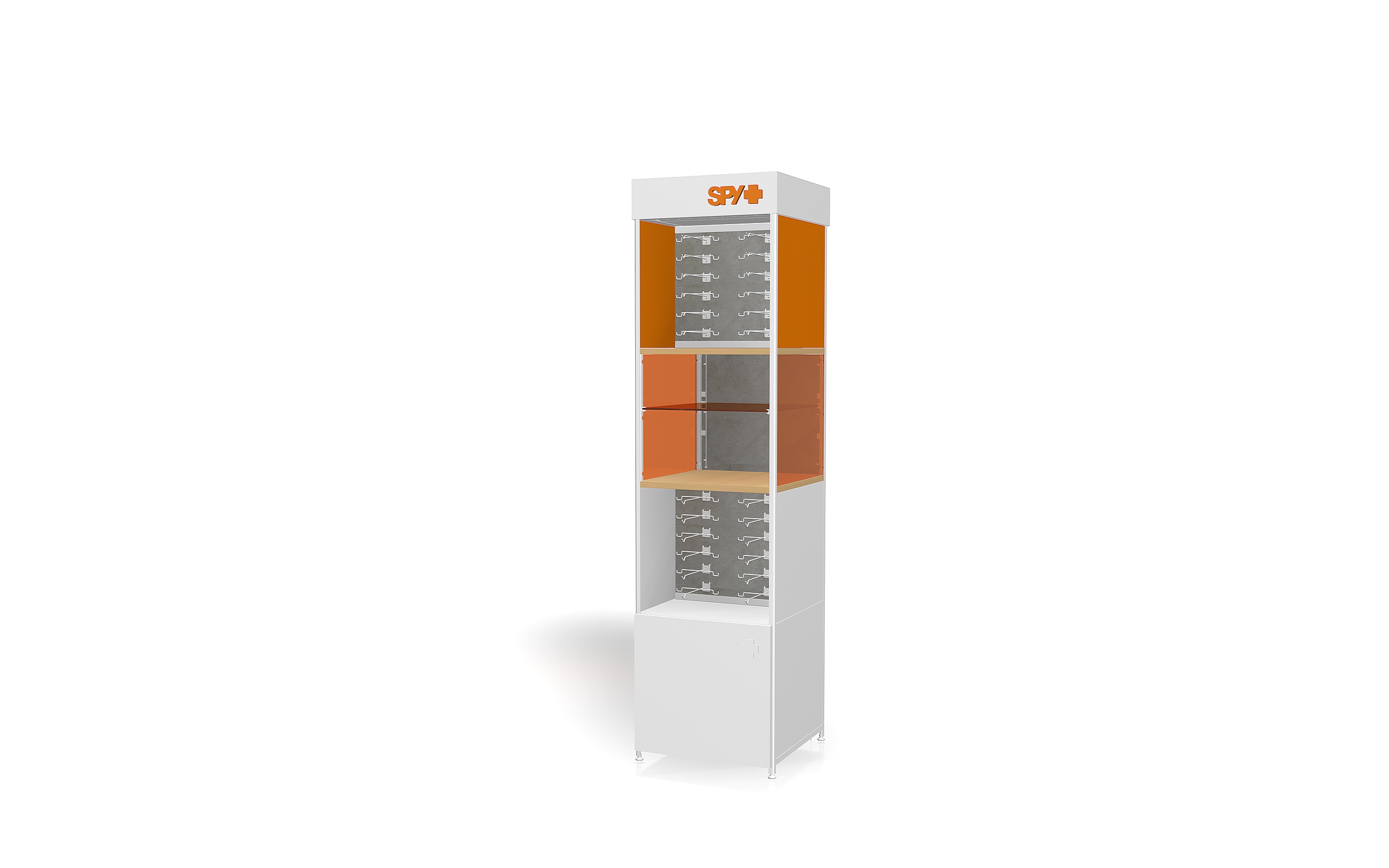
2026 Display Rack Shortlist: Retail, Supermarket & Exhibition
The global retail shelving market, which includes display racks, gondolas and store fixtures, was valued at USD 12.4 billion in 2025 and is projected to reach USD 25.6 billion by 2034, according to Dataintelo. Market Research Future's analysis of the retail shelving system market places floor-standing and gondola systems at 41.8% of demand — approximately USD 3.59 billion in 2024 — and identifies steel as the dominant material with a 48.6% market share.
Those figures describe a large and expanding category, but they do not answer the question most retail, supermarket, department store and trade show buyers actually face in 2026: which two or three display rack options can be specified, quoted and delivered against a defined environment without creating a maintenance, durability or compliance problem later in the project cycle? A shortlist built on project fit is usually more useful than a long supplier list, because the environment — not the catalogue — determines material, finish and duty cycle.
Redman Corporation is a manufacturer of custom POP displays and store fixtures, founded in August 2002 and based in Zhangjiagang, Jiangsu, China, roughly two hours' drive from Shanghai. The company runs metal, wood, plastic, printing, painting, powder coating and packaging workshops across approximately 550,000 sq ft (51,097 m²) of production space, employs more than 350 people, and exports to the USA, Canada, Europe, the Middle East and Australia, with around 95% of output exported. The three options assessed below come from its verified product specifications.
Why Project Fit, Not Catalogue Size, Now Drives Display Rack Selection
Display rack procurement fails most often at the interface between the fixture and the environment. A supermarket running 24/7 static display under high customer flow, a department store building a multi-category brand presentation, and an exhibition stand that is assembled and dismantled several times a year impose different mechanical, aesthetic and logistics requirements. A single ranking of racks by general quality would therefore be misleading.
The more useful approach is to fix the environment first, then filter material, finish, certification coverage and fulfilment path against it. Four environment profiles dominate 2026 briefs in this category:
- Retail store: indoor, 24/7 operation, in-store marketing and product merchandising, with load-bearing capacity customisation available.
- Supermarket: indoor, high customer flow, 24/7 static display that is easy to assemble and disassemble and can adapt to different shelf specifications.
- Department store: indoor, multi-category brand display, long-term static presentation with customisable lighting and interactive functions.
- Exhibition and trade show: indoor, short-term display with high brand exposure, easy to assemble, disassemble and transport.
Each of the three options below is verified for a specific set of these environments. Where an option is not a natural fit, that is stated explicitly — a shortlist is only useful if its exclusions are visible.
The 2026 Shortlist at a Glance
| Model | Type | Core material and finish | Best-fit environments | Verified load note | MOQ and lead time |
|---|---|---|---|---|---|
| RM-POP-001 | Custom Metal POP Display | Cold-rolled steel, stainless steel; combinations with wood and acrylic; powder coating or painting; custom logo printing | Retail store, supermarket, department store, brand store | 50–200 kg load capacity | 100 pcs minimum for custom metal parts; 25–35 days |
| RM-SF-001 | Custom Wood Store Fixture | MDF, solid wood, plywood; combinations with metal and acrylic; melamine, veneer or painting; custom structure and design | Retail store, supermarket, department store, brand store | No verified load figure published in the specification | 50 pcs minimum for custom wood parts; 30–40 days |
| RM-PD-001 | Custom Plastic POP Display | ABS, PS, acrylic; injection moulding and vacuum forming; custom colour and logo | Retail, supermarket, convenience store, exhibition | No verified load figure published in the specification | 1,000 pcs minimum for custom plastic parts; 35–50 days including mould development |
All three are size-customisable and design-customisable, and all three are manufactured by the same supplier. That matters for buyers running mixed programmes — a supermarket rollout and a trade show calendar in the same year, for example — because it concentrates tooling, quality control and shipping under one project management structure rather than three.
Option 1: RM-POP-001 Custom Metal POP Display
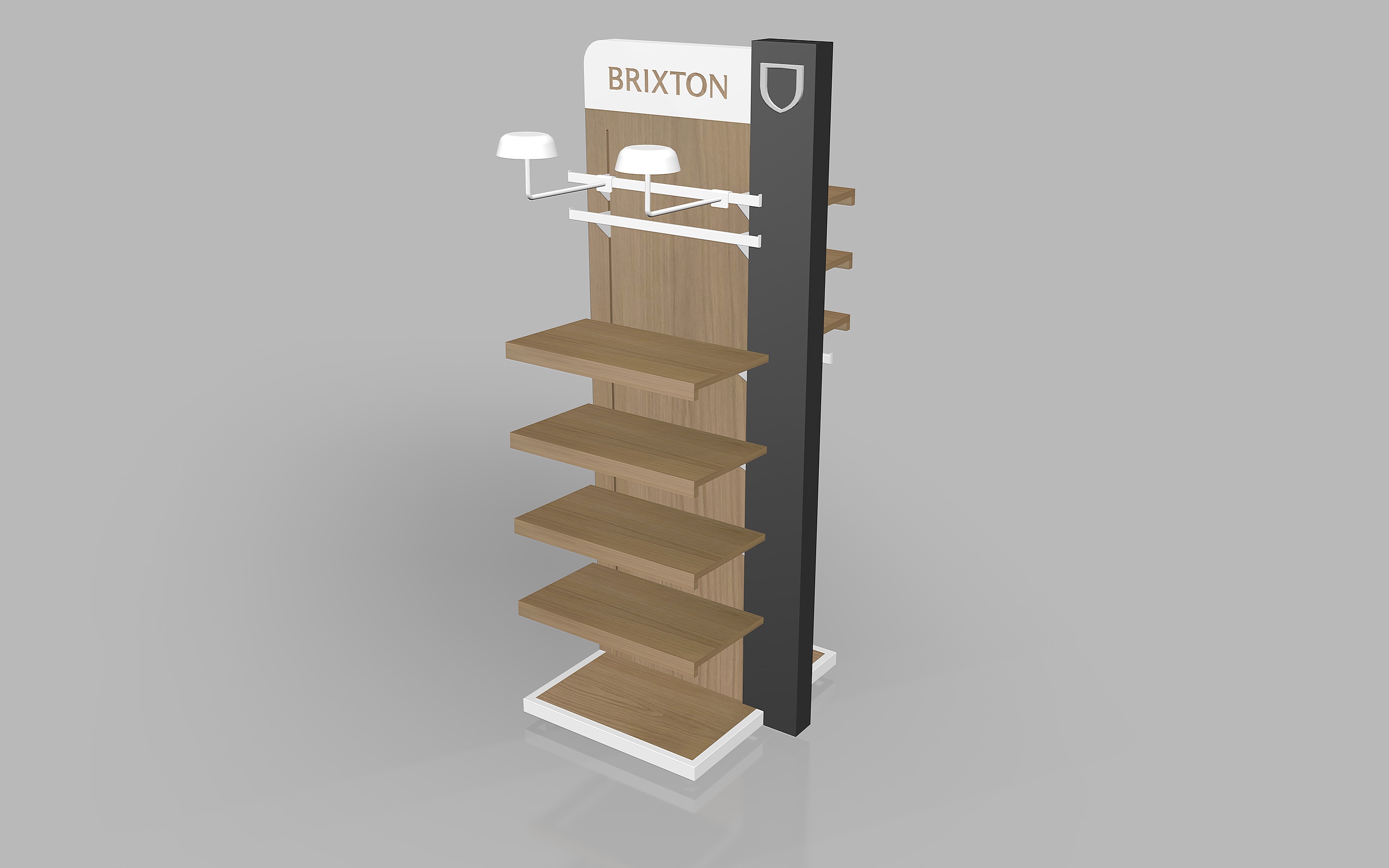
The RM-POP-001 is a custom metal POP display built from cold-rolled steel and stainless steel, with powder coating or painting as the finish and custom logo printing available. It is the only option in this shortlist carrying a verified load range: 50–200 kg. Metal production for this type includes cutting, bending, welding, stamping, powder coating, painting and polishing, with dimensional inspection, load-bearing testing, surface finish inspection and 100% quality check before shipment.
The load figure is the practical dividing line for buyers. Categories with dense, heavy or high-turnover product presentation — bottled goods, hardware, small appliances, bulk promotional packs — are usually better served by a steel structure, because the structure itself absorbs repeated loading without the surface deformation that lighter materials can develop under sustained load. The 50–200 kg range also means the specification has to be agreed per project: a rack engineered for 50 kg is not the same product as one engineered for 200 kg, even though both fall inside the verified envelope.
Verified applicable industries for this model are retail, supermarket, department store and brand store. In a supermarket setting, the rack is designed for 24/7 static display that is easy to assemble and disassemble and can adapt to different shelf specifications, with supporting equipment such as price tags, promotional posters and lighting accessories. In a retail store setting, it operates indoors 24/7 and can be customised for interactive functions.
Option 2: RM-SF-001 Custom Wood Store Fixture
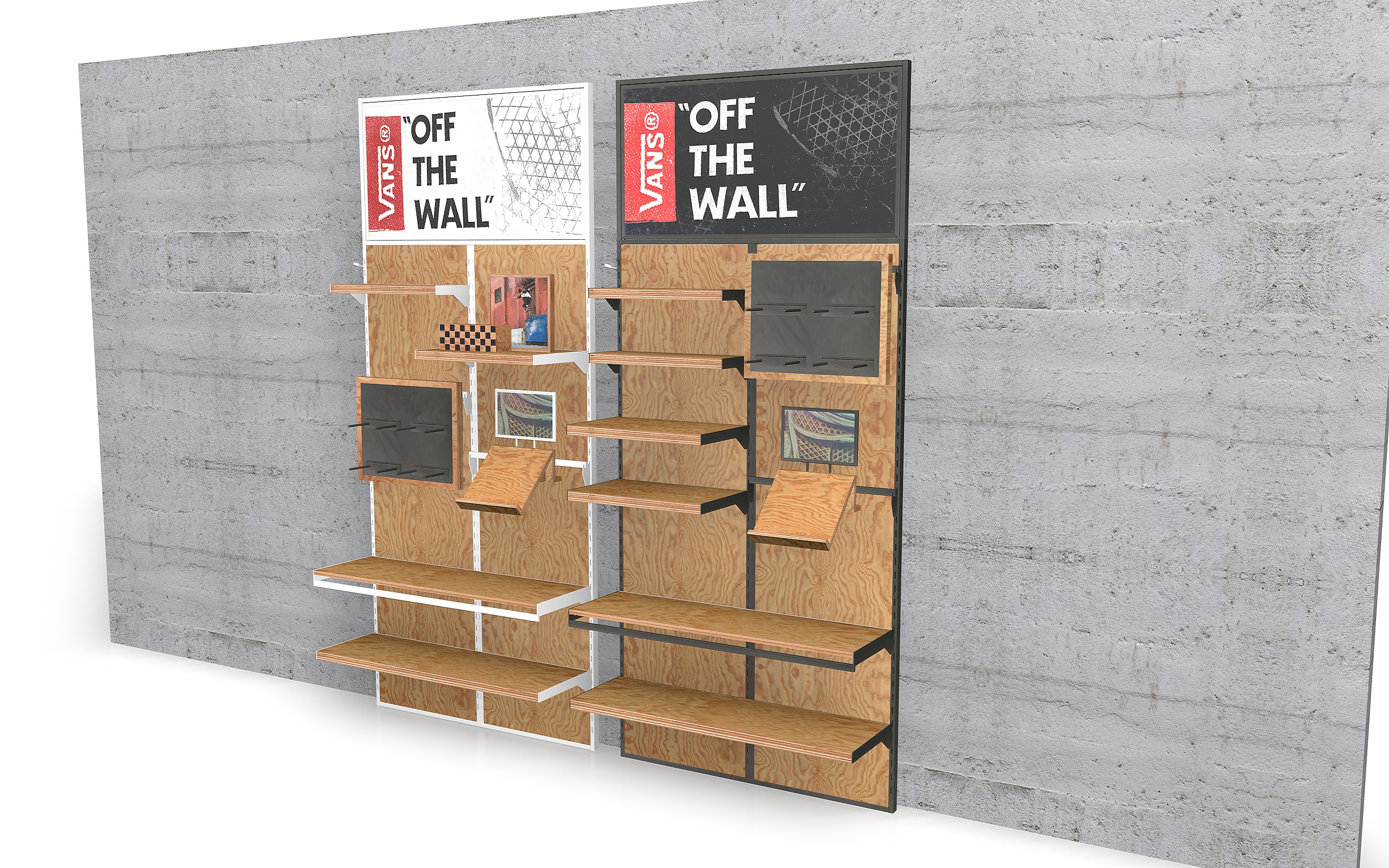
The RM-SF-001 is a custom wood store fixture built from MDF, solid wood and plywood, with melamine, veneer or painting finishes and custom structure and design. Metal and acrylic elements can be combined into the same fixture, which is why this option often appears in briefs that call for a wood-and-metal presentation rather than a single-material unit.
Wood manufacturing for this model covers cutting, milling, drilling, sanding, veneer, melamine and painting, with dimensional inspection, surface finish inspection, moisture content testing and 100% quality check. The moisture content test is not a formality: it is the control that protects a wood fixture from dimensional movement once it reaches a store, and it is one of the concrete technical checks a buyer can request documentation for.
Environment fit is where this option differentiates itself. The verified department store scenario specifies an indoor environment with multi-category brand display, long-term static display, customisable lighting and interactive functions, and high-end appearance customisation, supported by matching lighting systems, brand signage and decorative accessories. The specification lists retail, supermarket, department store and brand store as applicable industries. For apparel, accessory and premium brand presentations, the finish options — veneer and painting in particular — are typically the deciding factor, because the fixture becomes part of the brand's visual language rather than neutral infrastructure.
Where the fixture incorporates wood, FSC Chain of Custody certification applies to qualifying wood product groups. Buyers sourcing for markets with formal timber-sourcing requirements should confirm which product groups are covered before the specification is frozen, since the scope of the certificate matters as much as its existence.
Option 3: RM-PD-001 Custom Plastic POP Display
The RM-PD-001 is a custom plastic POP display produced from ABS, PS or acrylic using injection moulding and vacuum forming, with custom colour and logo available. Its verified applicable industries are retail, supermarket, convenience store and exhibition — the broadest environment list of the three, and the only one that explicitly includes convenience store and exhibition use.
Plastic display production for this model includes injection moulding, vacuum forming, blister moulding, custom plastic part design and mould development, with dimensional inspection, material performance testing, surface finish inspection and 100% quality check. The commercial characteristics differ from metal and wood in two important ways. First, colour consistency and complex geometry are easier to achieve repeatably in moulded plastic, which suits counter-top and small-format units with tight brand colour requirements. Second, tooling is a fixed upfront investment, which is reflected in the 1,000-piece minimum for custom plastic parts and a 35–50 day lead time that includes mould development.
No load capacity figure is published in the verified specification for this model. That is a material gap for buyers: the 50–200 kg range that applies to the RM-POP-001 metal display should not be transferred to a plastic unit by assumption. Plastic POP displays are normally specified where merchandising density is low, unit weight is modest, and the priority is visual impact, colour accuracy and cost per unit at volume.
Matching the Three Options to Retail, Supermarket, Department Store and Trade Show Environments
The environment mapping below reflects verified operating conditions rather than general assumptions, and it is the step where most shortlists should be narrowed from three options to two.
| Environment | Operating condition | Strongest fit in this shortlist | Supporting equipment typically required |
|---|---|---|---|
| Retail store | Indoor, 24/7 operation, brand in-store marketing and product merchandising, load-bearing customisation available | RM-POP-001 for weight-bearing presentation; RM-SF-001 where brand finishes dominate | Product packaging, brand signage, lighting accessories |
| Supermarket | Indoor, high customer flow, 24/7 static display, easy assembly and disassembly, adaptation to different shelf specifications | RM-POP-001 for category and promotional display | Price tags, promotional posters, lighting accessories |
| Department store | Indoor, multi-category brand display, long-term static display, customisable lighting and interactive functions | RM-SF-001 for high-end appearance customisation | Matching lighting systems, brand signage, decorative accessories |
| Exhibition and trade show | Indoor, short-term display, high brand exposure, easy to assemble, disassemble and transport | RM-PD-001 and modular metal units for portable, reusable builds | Matching lighting systems, brand backdrops, display accessories |
The exhibition case is worth separating from the retail case. A verified project record covering four years of cooperation with a global exhibition service provider — 200+ custom exhibition booth fixtures annually, supporting 500+ global exhibitions — describes fixtures designed for portability and modular assembly, with a reported 35% reduction in the customer's exhibition cost attributable to reusable and easy-to-assemble units. That logic applies to trade show buyers specifically: a fixture optimised for repeated assembly, transport and storage behaves differently from one optimised for a fixed position in a store.
Certification and Compliance Evidence to Request Before Specification
Two different classes of evidence sit behind a display rack specification, and buyers who conflate them tend to discover the gap late.
The first is product-level safety compliance for the destination market. Retail fixtures and commercial displays in the United States must comply with ANSI/UL 970, which replaced UL 65 and UL 962, according to Intertek and UL Solutions. This is a fixture-specific requirement, not a general quality statement, and it should be confirmed for the exact configuration being purchased — particularly where lighting, electrical components or interactive functions are integrated.
The second is management-system and sourcing certification. Redman's operations are covered by management system certification across quality (ISO 9001), occupational health and safety (ISO 45001), environmental management (ISO 14001) and energy management (ISO 50001), and FSC Chain of Custody certification applies to qualifying wood product groups. For the three options in this shortlist, the practical reading is straightforward:
- RM-POP-001 — metal construction; management system certification applies, and dimensional, load-bearing and surface finish inspections are recorded per batch.
- RM-SF-001 — the option where FSC Chain of Custody is most directly relevant, because it is the wood-intensive unit in the shortlist.
- RM-PD-001 — moulded plastic and acrylic; material performance testing and dimensional inspection apply, with no timber sourcing dimension.
Verification depth is also a variable buyers can specify. Production quality control includes 100% pre-shipment inspection, with third-party inspection by SGS, BV or TUV available on request. For programmes with a compliance-sensitive end customer, requesting third-party inspection at the pre-shipment stage is a low-cost way to convert a supplier claim into a documented record.
The OEM/ODM and Fulfilment Capability Behind the Shortlist
A shortlist is only executable if the supplier can hold the specification across repeated orders. Redman was founded in 2002, occupies approximately 550,000 sq ft (51,097 m²), employs over 350 people including more than 50 technical engineers and 7 project managers, and ships more than 1,000 containers annually, with project managers providing internal coordination on assigned projects.
Customisation scope covers product design, material selection, size, structure, colour, logo printing and function. Capacity and lead times differ by material, which is directly relevant to shortlist timing:
- Metal: 30,000+ pieces monthly; 25–35 day lead time; 100-piece minimum for custom metal parts.
- Wood: 20,000+ pieces monthly; 30–40 day lead time; 50-piece minimum for custom wood parts.
- Plastic and acrylic: 100,000+ pieces monthly; 35–50 days including mould development; 1,000-piece minimum for custom plastic parts.
- General custom orders: 50,000+ pieces monthly; 30–45 days; FCL and LCL shipping both available, which allows smaller trial batches.
For North American buyers, the fulfilment path matters as much as the manufacturing path. Redman maintains a warehouse in Los Angeles providing product storage, assembling, packaging, drop-shipping, inventory management and order fulfilment, handling 10,000+ orders monthly with 2–5 day order processing and no minimum order quantity for drop-shipping service. After-sales support is structured around 7×24 online technical support, one-to-one project management and a 48-hour target for resolving after-sales quality issues.
Two verified project records illustrate how the shortlist behaves at scale: a global retail brand programme of 5,000+ custom POP display units over three years supporting US store expansion, and a European supermarket chain programme of 3,000+ custom store fixtures over two years across more than 200 supermarkets in Germany. A Middle East department store programme of 1,000+ custom high-end display cabinets over 1.5 years is the closest reference for the RM-SF-001 wood fixture route.
Comparison with Conventional Off-the-Shelf Fixtures, and Where This Shortlist Stops Short
Off-the-shelf shelving is faster to deploy and easier to replace unit by unit. A buyer can order standard bays, receive them quickly, and avoid tooling exposure entirely. The trade-off is that standard fixtures fix the geometry, the finish and the load envelope, so they cannot be tuned to a brand's visual system, to a specific shelf specification, or to a mixed-material presentation. Custom programmes reverse those economics: longer lead times and minimum order quantities in exchange for environment-specific engineering.
The limitations of this shortlist are equally specific and should be planned for, not discovered during installation:
- Load data is not uniform. Only the RM-POP-001 carries a verified load range of 50–200 kg. No comparable verified figure is published for the RM-SF-001 or the RM-PD-001, so buyers must request project-specific engineering data for those units instead of assuming equivalence.
- Plastic tooling constrains small pilots. A 1,000-piece minimum and a 35–50 day lead time including mould development make the RM-PD-001 a poor match for a ten-store trial. The metal and wood routes, at 100 and 50 pieces respectively, are better suited to validation batches.
- Wood needs an environment assessment. Moisture content testing exists precisely because wood moves with humidity. Uncontrolled or high-humidity locations should be reviewed before a wood-heavy specification is approved.
- Trade show fixtures are not store fixtures. Exhibition units are engineered for short-term display and repeated assembly, disassembly and transport. Using a transport-optimised unit as permanent 24/7 store infrastructure inverts its design intent.
- This is a product shortlist, not a supplier ranking. The wider market includes suppliers such as Lozier Corporation, Madix Inc. and Tegometall, and most retail buyers run more than one supplier. The three options here are shortlisted on project fit within a single verified manufacturing platform, not on a claim of overall superiority.
Market Trend Analysis: Material Share, Modular Growth and Channel Demand
Three verified signals shape how this shortlist should be weighted over the next planning cycle.
Steel remains the structural default. Steel accounted for a 48.6% share of the retail shelving and display rack market by material in 2024, according to Market Research Future, which aligns with the load-bearing role metal plays in floor-standing and promotional display. This does not make wood and plastic secondary in value terms — it means they are chosen for appearance and geometry rather than for structural duty.
Floor-standing formats dominate volume. Gondola and floor-standing systems held a 41.8% share of the market in 2024, equivalent to approximately USD 3.59 billion. Buyers planning floor-standing display racks are therefore operating in the segment with the deepest supply base and the most standardised commercial terms, which raises the importance of differentiation through customisation rather than price alone.
Modularity is the fastest-moving design variable. One 2025 US display rack market report cites National Retail Federation data for a 34% year-over-year increase in modular display system sales during 2024–2025. That figure should be treated as indicative rather than definitive, and it is worth noting that market-size estimates for retail shelving vary widely depending on scope — published 2024 values range from roughly USD 2.38 billion for retail fixtures specifically to over USD 20 billion for broader retail shelving definitions. Buyers should treat any single market figure as directional and rely on their own project economics for decisions.
Channel demand concentrates in physical retail. The retail store distribution channel held a 70.4% share of the global sportswear market in 2026, according to Fortune Business Insights, which keeps in-store fixture quality commercially material for sportswear and apparel brands, and sustains demand for apparel display racks, accessory display racks and modular configurations that can be reconfigured as ranges change.
Future Outlook
Three directions are visible in the verified scenario data and are likely to shape 2026–2027 briefs. Long-term static fixtures increasingly specify customisable lighting and interactive functions rather than passive shelving, which shifts the specification conversation toward integrated electrical and lighting components — and makes ANSI/UL 970 conformance a live question for US programmes rather than a formality. Second, the exhibition segment continues to reward reusability: modular, portable fixtures that survive repeated assembly cycles and reduce per-show cost are a clearer value proposition than one-off booth builds. Third, mixed-material construction continues to expand, with wood fixtures incorporating metal and acrylic elements, and metal POP displays available with wood and acrylic combinations — a configuration that lets a single supplier address both the structural and the brand-appearance requirements of one project.
For buyers, the practical implication is to lock environment, load requirement and compliance scope before comparing suppliers. Those three inputs determine which of the three options in this shortlist is viable, and which should be ruled out early.
FAQ: Display Rack Options for Retail, Supermarket and Trade Show Projects
Which option in this shortlist fits a supermarket project running 24/7 static display?
The RM-POP-001 custom metal POP display is the closest fit. It is verified for supermarket environments operating 24/7 static display under high customer flow, is easy to assemble and disassemble, and can adapt to different shelf specifications with supporting price tags, promotional posters and lighting accessories. Its verified load capacity is 50–200 kg.
What load capacity can buyers specify on the RM-POP-001 metal POP display?
The verified load capacity is 50–200 kg. Because this is a range rather than a single rating, the exact figure has to be agreed per project — a display engineered for 50 kg and one engineered for 200 kg are different specifications even though both fall inside the verified envelope. Metal production includes load-bearing testing as part of quality control.
Is the RM-PD-001 plastic display rack suitable for a trade show?
Yes. Exhibition is one of the verified applicable industries for the RM-PD-001, alongside retail, supermarket and convenience store. Exhibition and trade show environments are characterised in the scenario data as indoor, short-term display with high brand exposure, requiring easy assembly, disassembly and transport, and typically supported by matching lighting systems and brand backdrops.
Which certifications and compliance checks apply to these three options?
Two layers apply. At the product level, retail fixtures and commercial displays for the US market must comply with ANSI/UL 970, which replaced UL 65 and UL 962. At the organisation and sourcing level, management system certification covers quality (ISO 9001), occupational health and safety (ISO 45001), environmental management (ISO 14001) and energy management (ISO 50001), while FSC Chain of Custody applies to qualifying wood product groups — most relevant to the RM-SF-001 wood fixture. Third-party inspection by SGS, BV or TUV is available in addition to 100% pre-shipment inspection.
What are the minimum order quantities and lead times for each of the three options?
For custom parts, the minimum is 100 pieces for metal with a 25–35 day lead time, 50 pieces for wood with a 30–40 day lead time, and 1,000 pieces for plastic with a 35–50 day lead time that includes mould development. General custom orders run 30–45 days, with FCL and LCL shipping both available for smaller batches. Drop-shipping from the Los Angeles warehouse carries no minimum order quantity and processes orders in 2–5 days.
How should a buyer choose between metal, wood and plastic for the same store project?
Start from the environment and the load requirement rather than the material. Metal is the verified structural option with a published 50–200 kg load range, suited to weight-bearing and high-turnover display. Wood is the option for long-term static, multi-category brand presentation where appearance customisation and finish quality are primary, with moisture content testing as a standard quality control step. Plastic and acrylic suit low-weight, high-visual-impact units and small-format display where colour accuracy and repeatable geometry matter, subject to a 1,000-piece tooling minimum. Where a project needs more than one of these characteristics, a mixed-material fixture combining wood, metal and acrylic elements can be specified within the same programme.
This shortlist reflects verified product specifications, scenario conditions and published market data as of 2026. Buyers preparing retail, supermarket, department store or exhibition projects can review the full custom display programme, including metal, wood and plastic and acrylic capabilities, in the Redman 2026 product catalogue. Product and project enquiries can be directed to Redman Corporation via www.redmanretail.com.