
2026 Global Tent Industry Outlook: Manufacturing, Policy & Export Shifts
2026 Global Tent Industry Outlook: Manufacturing, Policy & Export Shifts
The global tent industry enters 2026 as a cross-border manufacturing and rental sector rather than a single product category. Three forces are reshaping it at the same time: concentrated production capacity in Asia, a compliance layer in Europe and North America that is now documented model by model, and export flows that move as much into logistics and industrial applications as into events. Understanding where those three forces intersect is the difference between buying a tent and buying a structure that can be insured, installed and reused.
The scale of the underlying market explains why the shifts matter. The global party supply rental market, which includes tent rentals, was valued at USD 15.2 billion in 2023 and is projected to reach USD 32.0 billion by 2030, according to Grand View Research. Within that, the tent rental market reached USD 8.2 billion in 2025, with weddings accounting for the largest share at 38.5%, per Dataintelo. A separate but converging segment — temporary storage buildings, including warehouse tents — was valued at USD 8.6 billion in 2025, driven by e-commerce expansion.
Where the Demand Base Now Sits
Two demand engines are running in parallel, and they pull on manufacturers in different ways. The first is the event and hospitality economy: party tents, wedding tents, marquee tents and clear tents ordered by rental operators, venues and event agencies. The second is industrial and logistics demand: warehouse tents, industrial tents and large clear-span structures used for temporary storage, production overflow and covered operations.
The rental model dominates the first engine, which changes what buyers value. Rental operators do not evaluate a tent by how it looks on a first installation; they evaluate it by how many cycles it survives, how quickly crews can erect and dismantle it, and whether the structure still meets documentation requirements in year three. That is a durability and consistency question, not a design question.
The second engine behaves more like a facilities procurement decision. E-commerce expansion has pushed demand for temporary storage and covered handling space, and in many cases a warehouse tent is compared against permanent construction on cost, permitting time and reversibility. The opportunity for buyers is that manufacturers serving both engines tend to have broader frame and fabric ranges; the risk is that a supplier optimized purely for small event canopies may not be able to engineer a wide-span industrial structure at all.
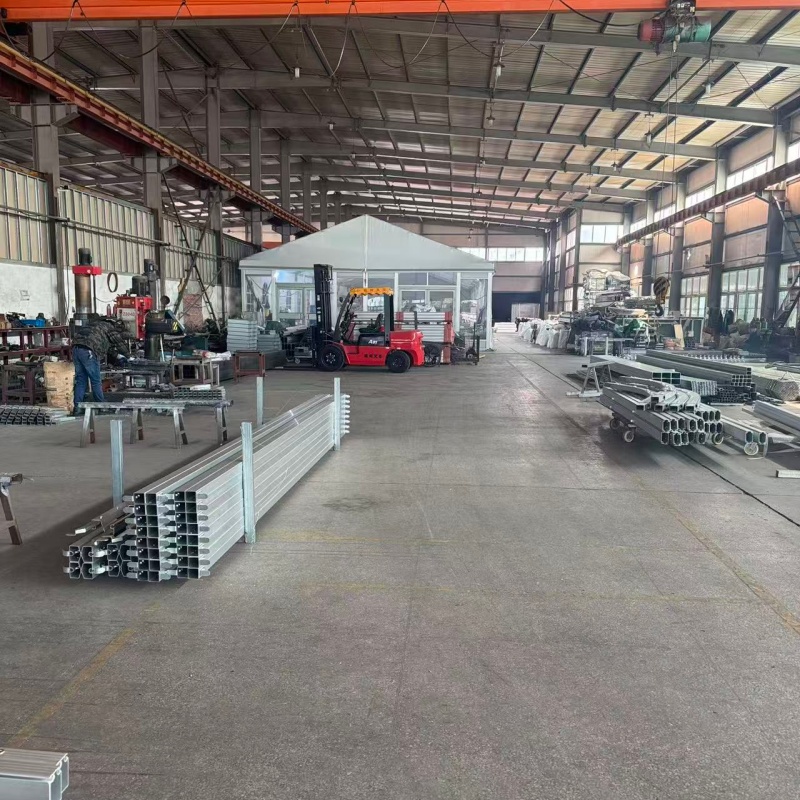
The Manufacturing Shift: Capacity, Specialization and What the Numbers Show
Production depth remains concentrated in Asia. Asia Pacific dominated the party supply rental revenue share with 37.0% in 2023, a figure that reflects both manufacturing scale and strong domestic demand, according to Grand View Research. At the large-structure end of the market, established global players include Losberger De Boer and Rubb Buildings, whose presence in large-scale temporary structures and marquees anchors the higher-complexity segment.
Changzhou Expo Tent Co., Ltd., which trades as expotent, is a China-based manufacturer of aluminum and steel frame fabric structures, tents and marquees, established in 2010 and located in Changzhou, Jiangsu Province. The company designs, manufactures and sells structures for temporary, semi-permanent and permanent use across events, sports, retail and logistics applications, and exports to more than 40 countries.
Its published manufacturing profile is a useful reference point for what a mid-sized, specification-oriented tent factory looks like in 2026:
| Manufacturing indicator | Reported figure | What it signals to a buyer |
|---|---|---|
| Established | 2010 | Operating history spanning multiple material and standard revisions |
| Factory size | 3,000 m² | Focused production footprint rather than mass-volume plant |
| Employees | 30 | Compact, process-driven operation |
| Annual output | 100,000 m² | Run-rate capacity across the product range |
| Monthly capacity | 10,000 m² | The binding constraint for scheduling any single order |
| R&D team | 3 engineers | Customization handled by a small technical group |
| Export ratio | 50% | Half of output is export-controlled and documented |
| Main markets | EU, Africa, USA, Asia, Middle East | Diversified exposure across regulatory regimes |
| Lead time | 20–30 days | Planning horizon for order confirmation to shipment |
| Minimum order quantity | 1 unit | Accessible for pilots and single-site projects |
The important reading is the relationship between annual output and monthly capacity. A stated annual output of 100,000 m² combined with a monthly capacity of 10,000 m² implies a relatively even production run-rate rather than large seasonal surges. For a buyer, that means the constraint is unlikely to be total factory capability and much more likely to be queue position. Orders placed inside a peak season compete for the same monthly m² as orders placed outside it.
It also indicates specialization. A 30-person operation with three engineers is not built to absorb unlimited simultaneous bespoke projects. OEM production and LOGO customization are offered, but the practical implication is that specification changes made late in an order cycle are more disruptive in this kind of factory than in a very large one with dedicated custom lines.
Policy and Compliance: The Standards Layer That Now Shapes Market Access
Compliance has moved from a paperwork step to a purchasing criterion. Commercial event tents are commonly required to demonstrate safety documentation including ISO 9001 for quality management, NFPA 701 for flame resistance of textiles and films, and EN 13782 for structural safety of temporary structures. In practice, European and North American buyers increasingly ask for the certificate before they ask for the price, because insurance, permitting and venue approval all depend on it.
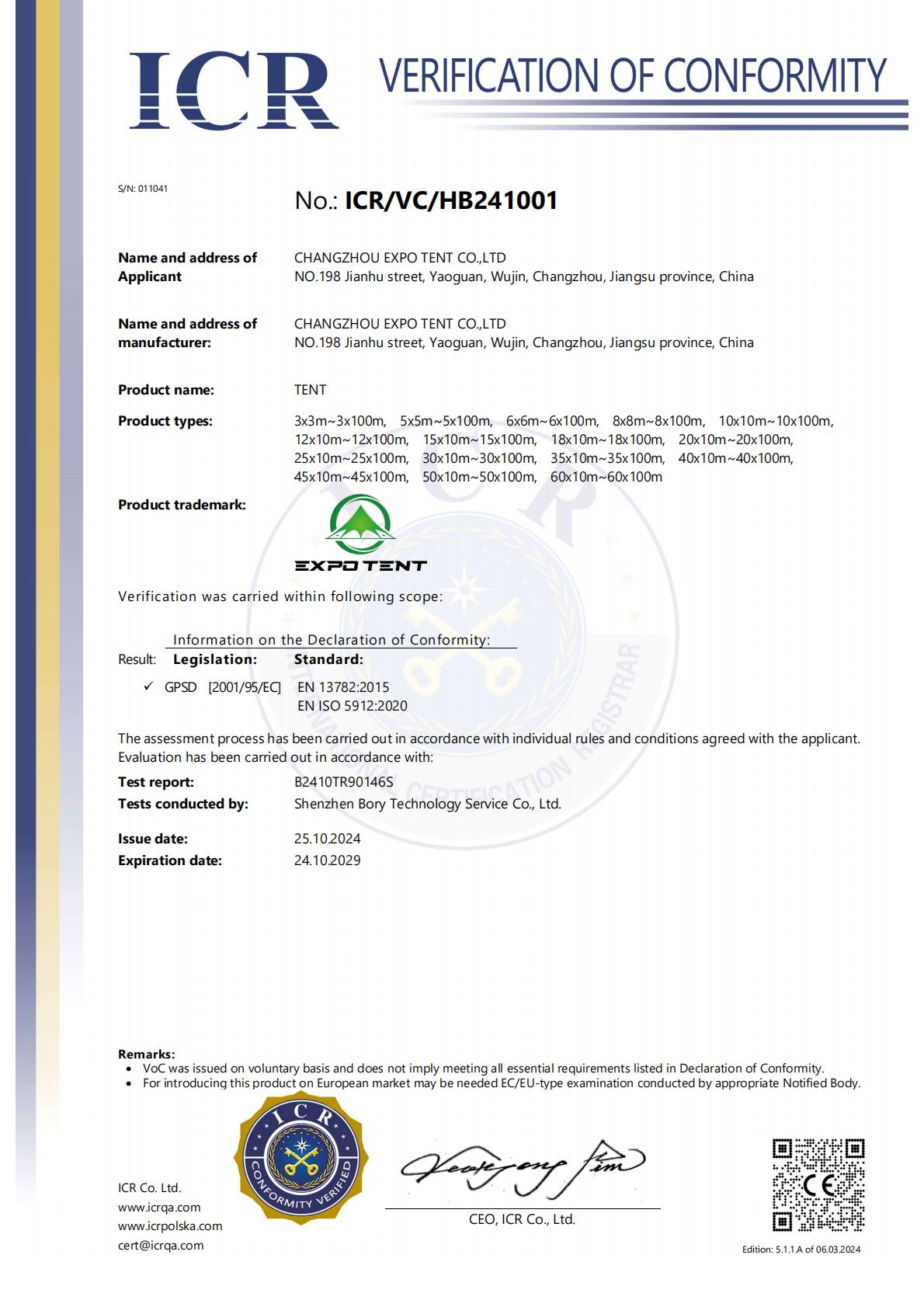
Changzhou Expo Tent Co., Ltd. holds CE certification ICR/VC/HB241001, issued by ICR on 2024-10-25 and valid until 2029-10-24, covering the European market against EN 13782:2015. The certified scope covers Event Tent models SLP-3, SLP-6, SLP-10, SLP-12, SLP-15, SLP-20, SLP-25, SLP-30, SLP-40 and SLP-50, built in aluminum and PVC with widths from 3 to 50 m, lengths from 3 to 1000 m and heights from 2.5 to 10 m.
That level of detail matters because certification is model-specific and time-bound. A CE record issued under EN 13782:2015 for one product family does not automatically extend to every structure a company sells, and it does not last indefinitely. The correct buyer behaviour is to match the certificate scope to the exact model being ordered, check the issuing authority, and confirm the validity window still covers the delivery and installation period.
Why Compliance Changes Export Dynamics
When documentation becomes a gate rather than a preference, it filters the supplier pool in a specific way. Manufacturers with a stable export ratio have usually built repeatable document workflows: standard test evidence, traceable certificate numbers and consistent labelling. Companies selling mainly domestically often have the manufacturing capability but not the documentation habit. That gap is one of the quieter reasons why export patterns in this sector have consolidated around a smaller number of suppliers than the total number of factories would suggest.
Technical Explanation: From Fabric Cutting to Test Assembly
A modern tent is a load-bearing structure with a fabric envelope, and its performance is decided in production rather than on site. The manufacturing sequence in a fabric structure factory typically runs through frame preparation, fabric cutting, welding and sewing, and tarp making, before final assembly checks.
Structural behaviour comes from the frame. Aluminum and steel frame systems differ in weight, corrosion behaviour and how much on-site lifting equipment is required; aluminum is common in event and marquee applications where repeated erection cycles matter. Fabric behaviour comes from the envelope: PVC-coated textiles carry the weather resistance, and their flame performance is what NFPA 701 addresses in North American specifications.
Changzhou Expo Tent Co., Ltd. performs test assembly before shipment as its quality-control step. This is more consequential than it sounds. A pre-shipment test assembly verifies that components produced in different departments fit together, that fabric panels align with frame nodes, and that the shipment is complete. For an international buyer, it moves a class of problems from the installation site — where a missing bracket or mismatched panel can idle a crew — back to the factory, where it can be corrected before the container leaves.
Span is the other variable buyers should read carefully. The Event Tent range covers widths of 3–50 m, so the product family spans everything from a small event structure to a wide clear-span hall. Wide spans require more frame material, more anchoring or ballast planning, and often region-specific structural verification for wind and snow loading.
Applications: Where Tents Are Being Specified in 2026
Application range is where manufacturer breadth becomes visible to buyers. Across the product portfolio, structures are supplied for events, party use, weddings, church gatherings, warehousing, sports and general marquee and hall applications.
- Events, parties and weddings — party tents, wedding tents, marquee tents, pagoda tents and clear tents, where appearance, lighting integration and rapid installation dominate the brief.
- Commercial and exhibition — exhibition tents, big tents and clear-span structures used for trade shows, brand activations and public programming, where documented structural safety is usually a venue precondition.
- Sports and recreation — sports tents used for covered training and recreational space, where the structure is closer to a small building than a temporary canopy.
- Industrial and logistics — warehouse tents, industrial tents and structure tents for temporary storage, handling areas and production overflow, where the comparison is against permanent construction.
A recorded OEM project illustrates the durability question that rental and industrial buyers care about. A client in Uruguay ordered a single structure for party applications through OEM production. The project record lists a 10-year duration, with the documented outcome described as rain proof, and rain and wind proofing highlighted as the key performance characteristic. For a rental operator, that framing — weather performance sustained over a long service period — is the practical measure of whether a structure earns its place in a fleet.
Market Trend Analysis: Four Patterns to Track Through 2026
| Indicator | Value | Year | Source |
|---|---|---|---|
| Global party supply rental market (incl. tent rental) | USD 15.2 billion, projected to USD 32.0 billion by 2030 | 2023 | Grand View Research |
| Global tent rental market | USD 8.2 billion; weddings 38.5% share | 2025 | Dataintelo |
| Temporary storage buildings market (warehouse tents) | USD 8.6 billion, driven by e-commerce expansion | 2025 | Dataintelo |
| Asia Pacific share of party supply rental revenue | 37.0% | 2023 | Grand View Research |
1. Rental economics favour structures built for re-erection
With weddings alone accounting for 38.5% of a USD 8.2 billion tent rental market, the buying logic of rental fleets is the dominant design pressure in event segments. That logic rewards consistent component fit, repairable panels and predictable assembly sequences far more than it rewards one-off visual customization.
2. Temporary storage has become an industrial category, not a side market
A USD 8.6 billion temporary storage buildings market driven by e-commerce expansion is a different kind of demand from event rentals. It is longer-duration, less seasonal, and evaluated against permanent construction on cost and permitting time. Manufacturers that only serve events tend to be under-represented in this segment.
3. Documentation is becoming a market-access filter
As EN 13782, NFPA 701 and ISO 9001 expectations spread through procurement checklists, the ability to produce a scoped, current certificate is turning into a qualification threshold. In practice, this rewards exporters with established documentation workflows and makes certificate scope verification a routine part of supplier evaluation.
4. Export patterns are diversifying across regulatory regimes
Manufacturers with a 50% export ratio and distribution across the EU, Africa, USA, Asia and the Middle East are effectively operating under several compliance regimes at once. That diversification is visible in how orders are specified: European buyers tend to lead with certification, while buyers in growth markets often lead with configuration, delivery time and price positioning. Suppliers able to work in both modes hold a structural advantage as demand shifts between regions.
Comparison with Traditional Solutions
The alternative to a specification-led structure tent is not usually another tent — it is either a permanent building or a lighter traditional canopy. Each option carries a different cost and risk profile, and the honest comparison depends on how long the space is needed.
| Dimension | Traditional canopy / small frame tent | Clear-span structure tent | Permanent construction |
|---|---|---|---|
| Interior columns | Often present or limited by light profiles | Clear span, column-free interior | Depends on structural design |
| Span range | Small to moderate | Wide; event tent range covers 3–50 m widths | Effectively unrestricted |
| Installation | Fast, minimal equipment | Requires anchoring or ballast planning and site assessment | Long build cycle, permits, foundations |
| Reversibility | High | High, structure can be relocated | Low |
| Documentation | Often minimal | Standards such as EN 13782:2015 can apply | Building code compliance |
| Best fit | Short events, small footprints | Multi-season, mid-to-large footprints, rental fleets | Permanent, high-utilisation sites |
Where structure tents clearly win is on reversibility and speed: a wide clear-span structure can be erected in weeks rather than months, and it can be relocated or resold if the requirement changes. Where they do not replace traditional construction is in permanent-code situations. A clear-span tent is not a substitute for a building wherever local regulation requires fixed foundations, permanent utilities or a building permit tied to a permanent structure, and no certificate changes that.
The practical boundary is anchoring. A wide-span structure transfers load to the ground through anchoring or ballast, and the design of that connection is site-specific. Inside a factory quality-control process, the structure can be verified; outside it, the buyer owns the site engineering. For buyers who cannot arrange that assessment, a smaller traditional tent may genuinely be the better answer — which is why the comparison should start with the site, not the product.
Future Outlook
If current trajectories continue, three things are likely to define the next phase of this industry. First, material durability standards will keep rising, because rental economics depend on structures surviving repeated cycles rather than on lower first cost. Second, documentation will continue to migrate upstream in the buying process, with certificate scope and validity checked before commercial terms are discussed. Third, the industrial and logistics segment will keep pulling tent manufacturers toward wider, more building-like structures, since a USD 8.6 billion temporary storage market is not a short-term anomaly.
For manufacturers, the competitive question is no longer whether a factory can cut fabric and weld frame — most can. It is whether the operation can hold a consistent run-rate, document a specific model for a specific market, and support that model after it has been installed on another continent. That combination, rather than catalogue size, is what buyers will increasingly use to shortlist suppliers.
FAQ
What should buyers compare first when evaluating tent manufacturers in 2026?
Compare documented evidence before product appearance. The three items that filter a supplier pool fastest are certification scope, declared production capacity, and the quality-control step applied before shipment. Model-level documentation matters more than company-level claims, because a certificate issued for one tent family does not automatically cover a different structure from the same factory.
How can a buyer confirm that an event tent meets European structural requirements?
Request the certificate number, issuing authority, standard, product scope and validity dates, then match the listed models to the models being purchased. Changzhou Expo Tent Co., Ltd. holds CE certification ICR/VC/HB241001, issued by ICR under EN 13782:2015, valid from 2024-10-25 to 2029-10-24 and covering Event Tent models SLP-3 through SLP-50. Because certificates are time-bound, validity should be re-checked at the moment of ordering rather than assumed from an earlier purchase.
What capacity and lead time should a buyer expect from a China-based tent manufacturer?
It varies considerably by supplier and by product family. As a reference, Changzhou Expo Tent Co., Ltd. reports a 3,000 m² factory, 30 employees, an annual output of 100,000 m², a monthly capacity of 10,000 m² and lead times of 20–30 days, with a minimum order quantity of one unit. Buyers planning phased rollouts should treat monthly capacity as the real constraint rather than annual output, and confirm production slots before fixing installation dates.
Is customization possible on exported tent structures?
Yes, within the limits of the frame and fabric system. Changzhou Expo Tent Co., Ltd. offers OEM production and LOGO customization alongside standard configurations, and its Event Tent range is available in widths of 3–50 m, lengths of 3–1000 m and heights of 2.5–10 m. Customization generally affects lead time and documentation timing, so the specification should be finalised before market-specific certificates are requested.
How do clear-span structure tents differ from traditional frame or canopy tents?
Clear-span structures carry loads across the span through the frame, leaving the interior free of support columns; traditional canopy and light frame tents use slimmer profiles and are generally limited in span, side-wall options and anchorage flexibility. The trade-off is site preparation. Clear-span structures require load assessment, anchoring or ballast planning, and in many markets some form of structural verification, which smaller traditional tents often avoid.
What after-sales support is typical for tents shipped internationally?
Support usually consists of assembly guidance and replacement components. Changzhou Expo Tent Co., Ltd. provides assembly videos as after-sales support. Site conditions remain outside the manufacturer's control, so anchoring design, installation labour and any local engineering sign-off are normally the buyer's responsibility.
Reference Material
A downloadable company brochure covering structures, configurations and specifications is available here: Changzhou Expo Tent Co., Ltd. product brochure. Company information is also published at www.expotentchina.com.