
2026 Pen Market: Data, Trends, Sourcing Realities
A market-level orientation for procurement teams and retail buyers at the awareness and research stage
The global writing instruments market reached USD 19.2 billion in 2025 and is projected to expand to USD 27.8 billion by 2033, according to Grand View Research. Within that market, pens represent the single largest product category, contributing 36.3% of total revenue in 2025. For buyers entering the sector for the first time, these figures offer a practical starting point: the category is commercially significant, structurally diverse, and increasingly shaped by product innovation rather than replacement demand alone.
This article provides a market-level orientation for procurement teams, category managers and retail buyers who are at the awareness or research stage. It maps the size and structure of the pen market, explains why newer formats such as erasable gel pens and non-sharpen pencils are gaining traction, and outlines what these shifts mean for supplier evaluation.
The Challenge: A Fragmented Category with Complex Terminology
Despite its market size, the pen category is not easy to navigate on first contact. Products are organized into multiple families — ballpoint pens, gel pens, rollerball pens, erasable gel pens, friction pens and specialty formats — and each family differs in ink chemistry, writing feel, production complexity and applicable regulations.
Ballpoint pens use oil-based ink and are valued for durability and low cost. Gel pens use water-based gel ink that delivers smoother, darker lines. Erasable gel pens combine gel ink with thermo-sensitive color-changing technology, allowing written marks to be erased by friction heat. Non-sharpen pencils replace traditional wooden pencils with an alloy nib and a longer-lasting core, eliminating the need for sharpening.
For a buyer at the research stage, the first task is to recognize that these are distinct products with distinct use cases, not interchangeable variations of a single commodity.
Market data adds another layer of complexity. Estimates of the global writing instruments market vary by source and scope. Grand View Research places the 2025 market at USD 19.2 billion, while Fortune Business Insights estimates USD 47.64 billion for the same category. The gap does not mean one source is wrong; it reflects different definitions of what counts as a writing instrument. Buyers should treat figures directionally and cross-check multiple sources before making volume decisions.
The Opportunity: Subsegments Growing Ahead of the Category
Within the broader market, several subsegments are expanding faster than the headline numbers suggest.
The global gel pen market was valued at USD 4.8 billion in 2025 and is projected to grow to USD 8.1 billion by 2034, according to Dataintelo. Asia Pacific accounted for 42.3% of gel pen revenue in 2025, led by China and India. The global erasable gel pen market, a smaller niche with specific functionality, was valued at USD 1.38 billion in 2024 and is expected to reach USD 2.56 billion by 2033, according to Market Intelo.
These growth rates point to a behavioral shift. End users — students, office workers and retail consumers — are not simply replacing worn-out pens. They are choosing pens that solve specific problems: correcting mistakes without correction fluid, writing comfortably for long sessions, and reducing waste from disposable pencils and plastic components.
For distributors and retail buyers, this means assortment decisions increasingly depend on understanding the functional position of each pen type, rather than competing solely on unit price.
A Manufacturing Reference Point: Greenwill in Context
To understand the supply side of this market, it helps to look at a specific manufacturer.
Kunshan Crystal Culture Co., Ltd, operating under the brand Greenwill, is a stationery manufacturer based in Kunshan, Jiangsu Province, China. Founded in 1999, the company specializes in eco-friendly erasers, multifunctional pencil sharpeners, and erasable or non-sharpen writing instruments. It operates a 25,000-square-meter factory with approximately 100 employees. Annual production capacity exceeds 20 million pens, 260 tons of erasers and 3 million pencil sharpeners. Around 90% of its output is exported, with main markets in North America, South America, Europe, Southeast Asia, Oceania and the Middle East. The company reports partnerships with more than 100 internationally recognized brands, including Papermate, STAEDTLER and Tesco.
Three aspects of this profile are relevant beyond Greenwill itself.
First, 25 years of OEM/ODM experience indicate that the stationery manufacturing supply chain in China has matured from simple production to full-cycle design support. Greenwill describes its service chain as covering market trend analysis, conceptual design, 3D modeling, user experience optimization and packaging design — a capability set that matters for buyers seeking differentiated products rather than generic imports.
Second, the product mix — erasable writing pens, non-sharpen pencils and dust-free erasers — reflects a broader industry direction toward sustainability and user convenience. These are core product lines of an established manufacturer, not experimental side projects.
Third, the company's stated compliance with EN71-1/2/3/9, REACH, PAHS, SVHC, ASTM-D-4236 and additional certifications such as FSC, BEPI and ISO indicates that regulatory conformance is now a baseline requirement for export-oriented stationery manufacturing. Buyers evaluating suppliers should treat certification coverage as a practical indicator of market access capability.
Greenwill's official website is available at www.greenwillplus.com, where product lines and company information are published.
Technical Fundamentals: What Makes Modern Writing Instruments Different
For buyers, understanding a few technical fundamentals goes a long way in evaluating product quality and supplier credibility.
Thermo-Sensitive Erasable Ink
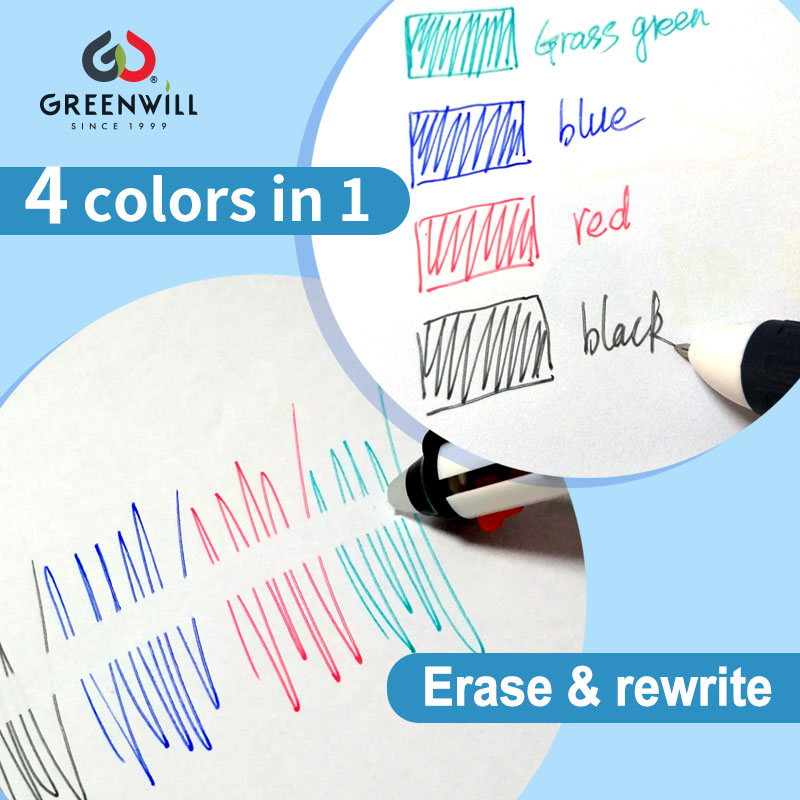
Erasable gel pens use thermo-sensitive ink. The ink contains microcapsules with color-changing properties: when friction generates heat, the written mark becomes transparent, allowing the same surface to be rewritten. This is the mechanism behind the widely used term "friction erasable."
Two product examples from Greenwill's writing pen line illustrate how this technology is implemented.
Model KP100751 is an erasable gel pen with an ABS barrel and erasable gel ink, a 0.5mm tip, and color options of black, blue and red. It complies with EN71 and ASTM standards, and the minimum order quantity is 5,000 pieces.
Model KP18001 is an erasable gel pen with an ABS+AS plastic body and heat-sensitive erasable ink, also with a 0.5mm tip and multi-color availability. It complies with EN71 and ASTM D-4236, and the minimum order quantity is 5,000 pieces.
The MOQ level of 5,000 pieces is a relevant procurement signal. It indicates that the production economics of erasable gel pens support relatively accessible customization, which is typical for this category in the OEM/ODM segment.
Alloy Tip Non-Sharpen Pencils
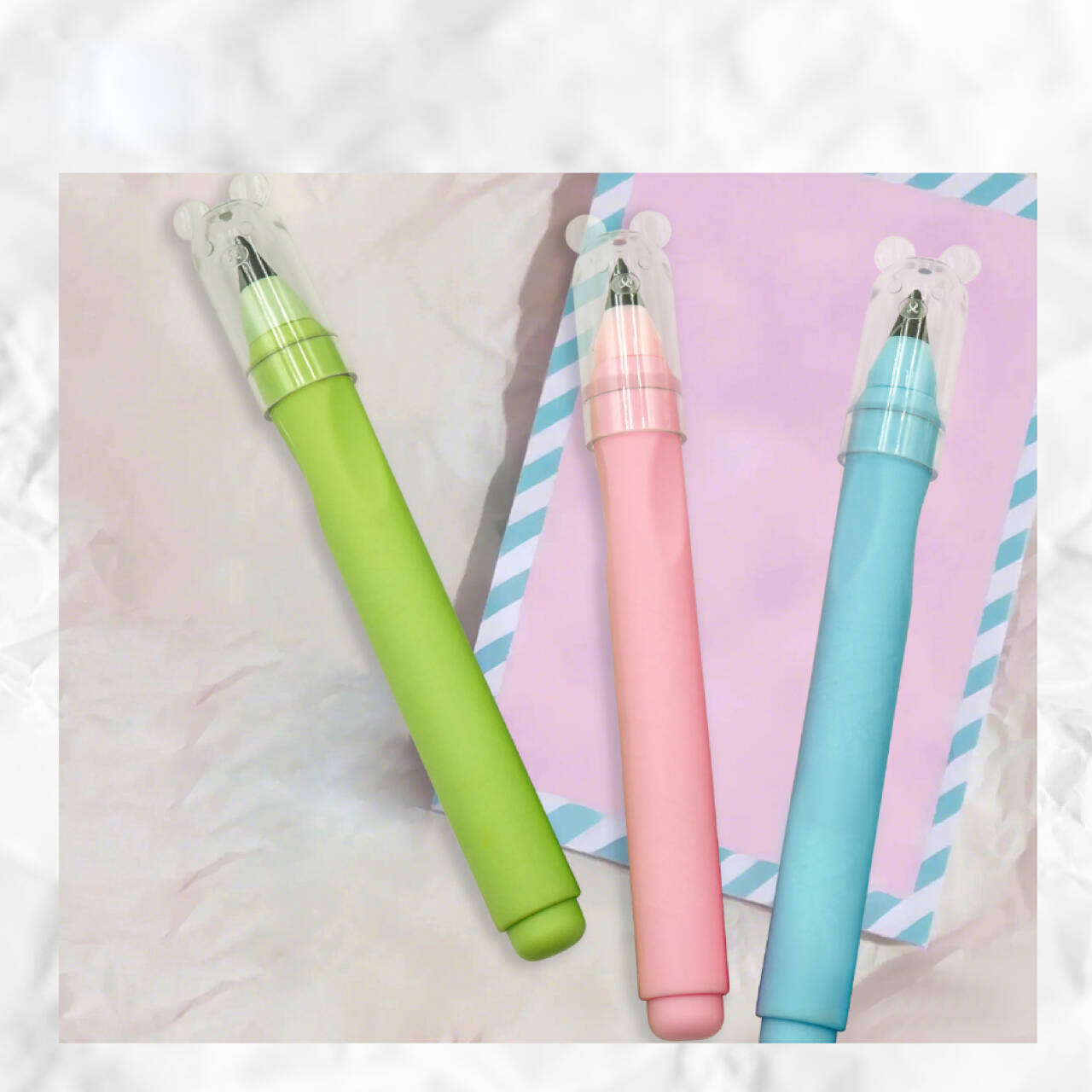
Non-sharpen pencils, sometimes marketed as "magic pencils" or "endless pencils," are designed to remove the need for sharpening. Instead of a wooden body with a graphite core, they use an alloy nib with a reinforced graphite core. The result is a writing instrument that maintains a consistent tip without producing wood shavings or graphite dust.
Greenwill's non-sharpen pencil models include:
Model SL241203 uses TPE, an alloy nib and an ABS cap, with HB lead hardness. It requires no sharpening and no ink, and is positioned as an eco-friendly alternative. Its cost-performance positioning states that one eraser pencil equals 20 wooden pencils plus 2 erasers plus 2 sharpeners over the product's usable life.
Model EP18004 / EP18004-1 uses the same TPE + alloy nib + ABS cap structure with HB lead hardness. It complies with EN71, SVHC and PAHs, and the minimum order quantity is 20,000 pieces.
The higher MOQ for EP18004 suggests this product family targets more established distribution channels, including stationery chains, supermarkets and cultural-creative stores.
Where These Products Fit: Application Contexts
Product specifications only become meaningful when mapped to actual working conditions. One documented application context comes from Greenwill's European market operations, specifically covering Italy, Spain and Germany.
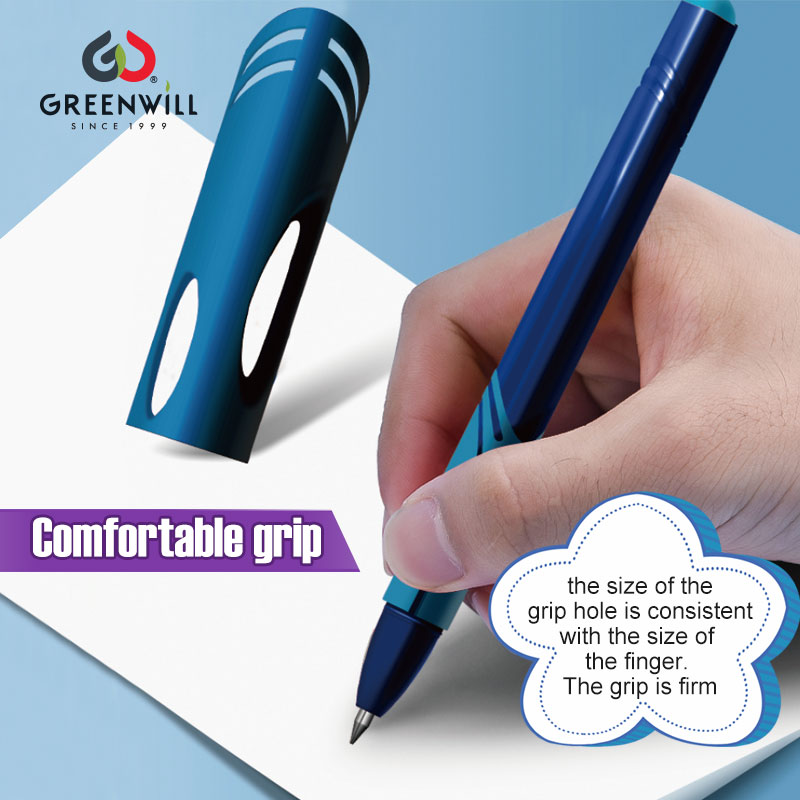
The working conditions described in this context are daily classroom and office use with high-frequency writing. Procurement scenarios include office bulk purchasing, retail product lines for chain stores and gift shops, and OEM/ODM customized branding projects. Functional expectations include smooth writing, quick-drying ink, erasable or refillable formats, and comfortable grip for extended writing sessions.
Special requirements from these markets include:
- Non-toxic and eco-friendly materials compliant with EN71 and REACH
- Ergonomic design with anti-fatigue grip
- Customizable colors, shapes and branding
These requirements reveal a broader shift in the school and office supplies market. Buyers are asking suppliers not only for a working pen, but also for evidence that the product is safe for children, comfortable for prolonged writing, and aligned with sustainability procurement policies.
Market Trend Analysis: What the Data Says
The following table summarizes the most relevant market figures for buyers at the research stage.
| Metric | Value | Year | Source |
|---|---|---|---|
| Global writing instruments market | USD 19.2B | 2025 | Grand View Research |
| Projected global writing instruments market | USD 27.8B | 2033 | Grand View Research |
| Pens' share of writing instruments revenue | 36.3% | 2025 | Grand View Research |
| Global gel pen market | USD 4.8B | 2025 | Dataintelo |
| Projected global gel pen market | USD 8.1B | 2034 | Dataintelo |
| Asia Pacific share of gel pen market | 42.3% | 2025 | Dataintelo |
| Global erasable gel pen market | USD 1.38B | 2024 | Market Intelo |
| Projected global erasable gel pen market | USD 2.56B | 2033 | Market Intelo |
| Global office supplies market | USD 176.5B | 2024 | Spherical Insights |
Several directional takeaways emerge from this data.
Pens remain the dominant product category in writing instruments, and gel-based formats are the most dynamic segment within it. The erasable gel pen niche, though smaller, is growing at a pace that outruns the overall category, driven by educational and office demand. Asia Pacific's 42.3% share of the gel pen market confirms that China and India function as both significant production centers and consumer markets.
On the competitive side, Fortune Business Insights identifies BIC Group, Pilot Corporation, Newell Brands and M&G Stationery as key global players in the pen and stationery market. These companies shape brand expectations and distribution standards. Behind that branded layer, a larger ecosystem of manufacturers — particularly in China and the wider Asia-Pacific region — supplies the OEM and ODM capacity that private-label and regional brands depend on.
Regulatory standards are another structural factor. For art materials exported to the United States, including pens and pencils, compliance with ASTM D4236 is required for health hazard labeling. In Europe, EN71 and REACH are the primary reference frameworks, while ISO 12757-1 specifies requirements for ballpoint pens and refills for general use. A supplier's certification portfolio is therefore not a marketing detail; it determines which markets a product can legally enter.
Comparison with Traditional Solutions: Gains and Boundaries
Innovative pen formats offer measurable advantages over traditional writing instruments, but they also come with boundaries that buyers should understand before placing large orders.
Erasable Gel Pens vs. Traditional Ballpoint Pens
| Dimension | Erasable Gel Pen | Traditional Ballpoint Pen |
|---|---|---|
| Error correction | Friction erasing, no residue | Requires correction fluid or tape |
| Writing smoothness | Water-based gel, smooth dark lines | Oil-based ink, more resistance |
| Ink permanence | Heat-sensitive, may fade under high temperature | Long-lasting, archive-safe |
| Typical use cases | Notes, homework, daily drafts | Signatures, official documents |
The key limitation of erasable gel pens lies in the thermo-sensitive nature of the ink. Written marks become transparent when exposed to heat above a certain threshold. A notebook left in a parked car during summer, or stored near a heat source, may lose some visible content. For contracts, archival records or other documents requiring permanent retention, traditional ballpoint ink is generally the safer choice.
Non-Sharpen Pencils vs. Wooden Pencils
| Dimension | Non-Sharpen Pencil | Wooden Pencil |
|---|---|---|
| Maintenance | No sharpening required | Requires a sharpener |
| Waste | No wood shavings, no lead dust | Wood shavings and lead dust |
| Line width | Fixed by alloy nib design | Adjustable through sharpening |
| Writing feel | Smooth, requires adaptation | Traditional wooden feel |
Non-sharpen pencils remove the practical need for sharpeners and reduce waste, which aligns with sustainability priorities in schools and offices. However, line width is relatively fixed. Users who need variable line thicknesses — for example, in drawing or drafting — may still prefer wooden pencils, which can be sharpened to different profiles. The writing sensation also differs from a wooden pencil, and some users need an adjustment period.
These boundaries do not diminish the value of newer formats; they help buyers place each product in the right context.
Future Outlook: What to Watch in the Next Procurement Cycle
Several forces will shape the pen market through the remainder of 2026 and beyond.
Sustainable materials will continue to move from differentiator to expectation. Greenwill's use of TPE, eco-friendly compounds and recyclable structures reflects a broader industry response to plastic waste concerns. Buyers should expect sustainability credentials — such as FSC certification or compliance with eco-design requirements — to become more common in tender documents.
Customization will remain a strategic lever. The same manufacturing infrastructure that produces standard pens also supports OEM/ODM projects, joint development and mold customization. As regional brands compete with global names, the ability to differentiate through color, shape, branding and packaging becomes an increasingly decisive factor in supplier selection.
Regulatory complexity will increase. With multiple frameworks applying across North America, Europe and Asia, suppliers that maintain comprehensive certification coverage will be better positioned to serve multi-market buyers.
FAQ
What is the size of the global writing instruments market?
The global writing instruments market was valued at USD 19.2 billion in 2025 and is projected to reach USD 27.8 billion by 2033, according to Grand View Research. Estimates vary by source; Fortune Business Insights reports USD 47.64 billion for the same category, reflecting differences in scope and methodology.
What share of the writing instruments market do pens represent?
Pens accounted for 36.3% of global writing instruments revenue in 2025, making them the largest product category in the market, according to Grand View Research.
How is the global gel pen market performing?
The global gel pen market was valued at USD 4.8 billion in 2025 and is projected to grow to USD 8.1 billion by 2034, according to Dataintelo. Asia Pacific led the market with a 42.3% revenue share in 2025.
Why is the erasable gel pen market growing?
The erasable gel pen market was valued at USD 1.38 billion in 2024 and is expected to reach USD 2.56 billion by 2033, according to Market Intelo. Growth is driven by demand from students and office users for easy correction, cleaner notes and less reliance on correction fluids.
What regulatory standards apply to pen exports in major markets?
In the United States, pens and pencils must comply with ASTM D4236 for health hazard labeling. In Europe, EN71 and REACH are the primary reference frameworks. ISO 12757-1 specifies requirements for ballpoint pens and refills for general use.
Who are the major players in the pen and stationery market?
Fortune Business Insights identifies BIC Group, Pilot Corporation, Newell Brands and M&G Stationery as key global competitors. In the OEM/ODM segment, manufacturers such as Kunshan Crystal Culture Co., Ltd (Greenwill) provide production capacity and design services for international brands and private-label programs.