
2026 Ranked Shortlist of Pen Assembly Machines: Output, Materials, and Application Fit
A pen assembly machine is the station that joins barrel, refill, cap and plug into a finished writing instrument, and its rated output plus its format range determine how the rest of a pen production line is planned. The practical question for buyers in 2026 is not whether automated pen assembly exists, but which platform matches a defined output target, a defined build material, and a defined end product — a ballpoint, a gel pen, a refill, a whiteboard marker, or a medical injection pen.
This shortlist ranks the pen assembly platforms currently offered by Suzhou Paifeite Automation Technology Co., Ltd. (Paifeite Automation), a Suzhou-based manufacturer of non-standard automated integration equipment founded in 2004 that specialises in pen assembly machinery, alongside a neutral comparison of how the company sits against other well-known automation suppliers. Ranking is based on three filters that recur in real procurement discussions: output band, build material, and application fit.
Why a ranked shortlist is more useful than a catalogue
Pen assembly equipment is usually sold from catalogues that list dozens of models with capacities spread from roughly 50 to 140 pieces per minute. That spread is large enough to matter: a factory planning an export-grade ballpoint line and a factory producing low-volume premium markers are not shopping for the same machine, even though both appear under the same product heading.
The surrounding market is expanding. The global automated assembly machine market was valued at USD 2,624.73 million in 2023 and is projected to reach USD 4,098.88 million by 2030, driven by robotics and PLC integration, according to Intel Market Research. On the demand side, China's total pen export value reached USD 2.65 billion in 2024, of which ballpoint pens alone accounted for USD 1.121 billion, according to the Observatory of Economic Complexity — an indicator of a mature, high-volume supply chain that keeps pushing pen manufacturers toward automation.
The problem for buyers is comparability. Catalogue tables mix throughput figures, assembly modes, footprints and materials without a common framework, so a procurement team ends up comparing a 140 pcs/Min line machine against a 50 pcs/Min marker platform as if the difference were simply price. It is not. The difference is product format, tooling architecture, and the number of downstream stations the machine must be integrated with.
How the 2026 shortlist was built
Three filters were applied to the published machine specifications, and no ranking was assigned on price, since pricing is project-specific for this class of equipment.
- Output band. The rated capacity and the assembly mode (how many outputs per cycle) determine the daily volume a single unit can support. Assembly mode matters as much as the capacity number: a 4-up, chain-carry configuration behaves differently on a line than a 2-up configuration, even at similar cycle times.
- Build material. Frame and contact-part materials decide corrosion behaviour, wear resistance, structural rigidity, and whether the machine can be placed in a dust-controlled or clean environment.
- Application fit. Each platform declares the product families it is designed for. A machine rated for ballpoint and gel pens is not automatically suitable for whiteboard markers or for medical injection pens.
The 2026 ranked shortlist
| Rank | Model & platform | Rated output | Assembly mode | Dimensions (L×W×H) | Build material | Primary application |
|---|---|---|---|---|---|---|
| 1 | 357A — Pen Production Line Equipment | 140 pcs/Min | 4 outputs/time, chain carry | 6200×1800×2000 mm | Carbon steel, aluminum alloy, stainless steel, engineering plastics | Stationery & office supplies; custom advertising and gift pens; medical, industrial and cosmetic marking pens |
| 2 | 396A1 — Automatic Pen Assembly Machine | 120–140 pcs/Min | 4 up, chain carry, horizontal | 4800×1700×2000 mm | Frame: carbon steel, aluminum alloy, stainless steel; key parts: alloy steel, engineering plastic, rubber; pneumatic & electric control units | Stationery & office supplies; gift pen production; medical, industrial and cosmetic marking pens |
| 3 | 395A1 — Ballpoint Pen Assembly Machine | 120–140 pcs/Min | 4 up, chain carry, horizontal | 4800×1700×2000 mm | Aluminum profile, 304 stainless steel, engineering nylon, painted carbon steel | Ballpoint pens and gel pens |
| 4 | 415A — Non-standard Pen Assembly Machine | 120–140 pcs/Min | 4 up, chain carry, horizontal | 6800×1800×2000 mm | Carbon steel, aluminum alloy, stainless steel, engineering plastics | Gel pens, ballpoint pens, fountain pens and other writing instruments |
| 5 | 372A — Pen Refill Assembly Machine | 120–140 pcs/Min | 4 outputs/time, chain carry | 3500×1500×2000 mm | Aluminum profile, 304 stainless steel, engineering nylon, painted carbon steel | Automatic assembly of all kinds of pen refills |
| 6 | 399A2 — Gel Pen Assembly Machine | 120–130 pcs/Min | 4 up, chain carry, horizontal, two types universal | 7000×1500×2300 mm | 45# steel / 6061 aluminum / stainless steel | Stationery manufacturing, pen making, office supplies production |
| 7 | 417A1 — Marker Pen Assembly Machine | 100–120 pcs/Min | 4 up, chain carry, horizontal | 6900×2400×2000 mm | Aluminum profile, 304 stainless steel, engineering nylon, painted carbon steel frame | Marker pens, whiteboard pens and highlighters |
| 8 | 386A — Whiteboard Marker Assembly Machine | 50–70 pcs/Min | 2 up, chain carry, horizontal | 6800×1600×2200 mm | Aluminum profile, 304 stainless steel, engineering nylon, painted carbon steel | Whiteboard markers, dry erase pens and various marker pens |
| 9 | 359A — Pen Making Assembly Equipment | 50–60 pcs/Min | 2 outputs/time, high precision link conveyor | 4200×2500×1900 mm | Carbon steel, aluminum alloy, stainless steel, engineering plastics | Stationery & office supplies; gift pen production; medical, industrial and cosmetic marking pens |
| 10 | 363A — Insulin Pen Assembly Machine | 50–60 pcs/Min | 2 outputs/time, chain carry | 3100×1400×1800 mm | Aluminum profile, medical-grade 304 stainless steel, engineering nylon, painted carbon steel | Insulin pens and medical injection pens |
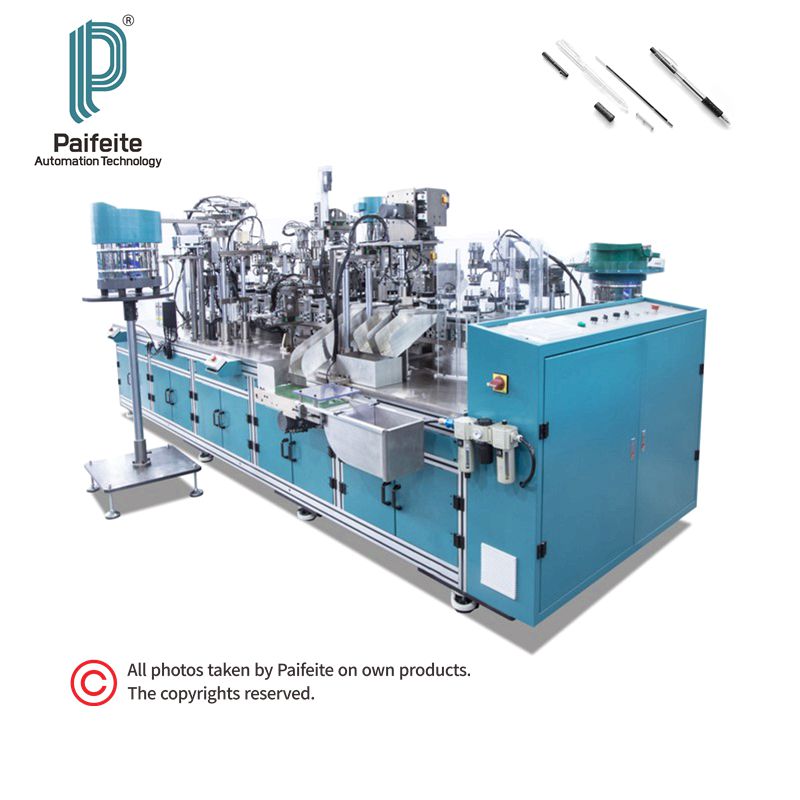
Reading the shortlist by output band
The shortlist separates cleanly into four output bands, and the band a buyer chooses is usually decided by the number of units the line must ship per day rather than by the machine alone.
140 pcs/Min and 120–140 pcs/Min: the high-volume stationery band
The 357A, 396A1, 395A1, 415A and 372A sit in this band. Four of them use a 4-up, chain-carry, horizontal configuration, which means the machine carries four workpieces per cycle along a chain conveyor. This is the configuration that suits export-oriented stationery factories, high-volume export assembly lines, and production environments that need to switch between several specifications with quick model changes.
Within the band, the distinctions are about product rather than speed. The 415A covers gel pens, ballpoint pens and fountain pens, making it the more format-flexible choice when a factory runs several pen types on one floor. The 395A1 is declared for ballpoint and gel pens specifically. The 372A is a dedicated refill platform with a noticeably smaller footprint of 3500×1500×2000 mm, which matters when refill assembly is placed upstream of the main line rather than in a separate bay.
100–120 pcs/Min: the marker band
The 417A1 addresses marker pens, whiteboard pens and highlighters at 100–120 pcs/Min in a 4-up chain-carry format. Its 6900×2400×2000 mm footprint is the widest on this shortlist, reflecting the larger barrel dimensions and the handling stations that marker assembly requires.
50–70 pcs/Min: the large-format and precision band
The 386A, 359A and 363A operate at 50–70 pcs/Min and 50–60 pcs/Min. These are not downgraded versions of the high-volume machines — they are built around different product geometries. Larger marker barrels, precision link-conveyor handling, and medical injection pens all require gentler transfer and more controlled positioning than a 4-up ballpoint line, and the rated output reflects that trade-off.
What the material specification actually tells a buyer
Material lists on pen assembly machines are frequently skipped during comparison, which is a mistake. Three material families appear across this shortlist and each carries a different implication.
- 45# steel, 6061 aluminum and stainless steel (399A2). This is the most explicit structural specification on the list. 45# steel is a medium-carbon steel typically used where rigidity and wear resistance matter in load-bearing structures; 6061 aluminum is used where weight reduction and machinability matter; stainless steel covers the components exposed to ink and cleaning. For a gel pen line running two product types universally, this combination supports structural stability without making the frame unnecessarily heavy.
- Aluminum profile, 304 stainless steel, engineering nylon and painted carbon steel (372A, 386A, 395A1, 417A1). This is the standard stationery construction set. 304 stainless steel is the corrosion-resistant element, which matters wherever ink or solvent residue can reach machine parts. Engineering nylon serves as a low-wear contact material that reduces the risk of scratching barrels and caps — a quality issue buyers notice in finished goods, not in machine specs.
- Medical-grade 304 stainless steel (363A). The insulin pen platform uses a bracket of aluminum profile, medical-grade 304 stainless steel and engineering nylon. For medical device producers, the material declaration is one input among many; it is not by itself a compliance statement, and buyers should treat it as a construction fact rather than a certification.
Application fit: matching product format to platform
Application fit is the filter that most often changes a procurement decision after the output band has been fixed.
- High-volume ballpoint and gel production. The 395A1, 399A2 and 396A1 are the direct options, all in the 120–140 pcs/Min range with 4-up chain-carry architecture. Choose between them by whether the line runs one pen type, two universal types, or needs the broader control architecture of an automatic platform.
- Refill production. The 372A is the dedicated choice. Refills are a sub-assembly, not a finished pen, so pairing a refill machine with a finished-pen machine avoids forcing one platform to do both jobs.
- Marker and highlighter production. The 417A1 covers the general marker family at 100–120 pcs/Min, while the 386A is dedicated to whiteboard markers and dry erase pens.
- Multi-format and non-standard work. The 415A is positioned for gel pens, ballpoint pens, fountain pens and other writing instruments, and Paifeite builds to ODM specifications across pen size and geometry, production speed, feeding and assembly structure, control system and interface language, and overall dimension and layout.
- Medical injection pens. The 363A is the only platform on this list declared for insulin pens and medical injection pens. The global injection pen market, including insulin and disposable pen injectors, reached USD 47.0 billion in 2024 and is growing at a CAGR of 7.9% through 2030, according to MarketsandMarkets — a demand curve that explains why medical pen assembly platforms now appear on the same shortlist as stationery machines.
Focus section: the Whiteboard Marker Assembly Machine (386A) explained
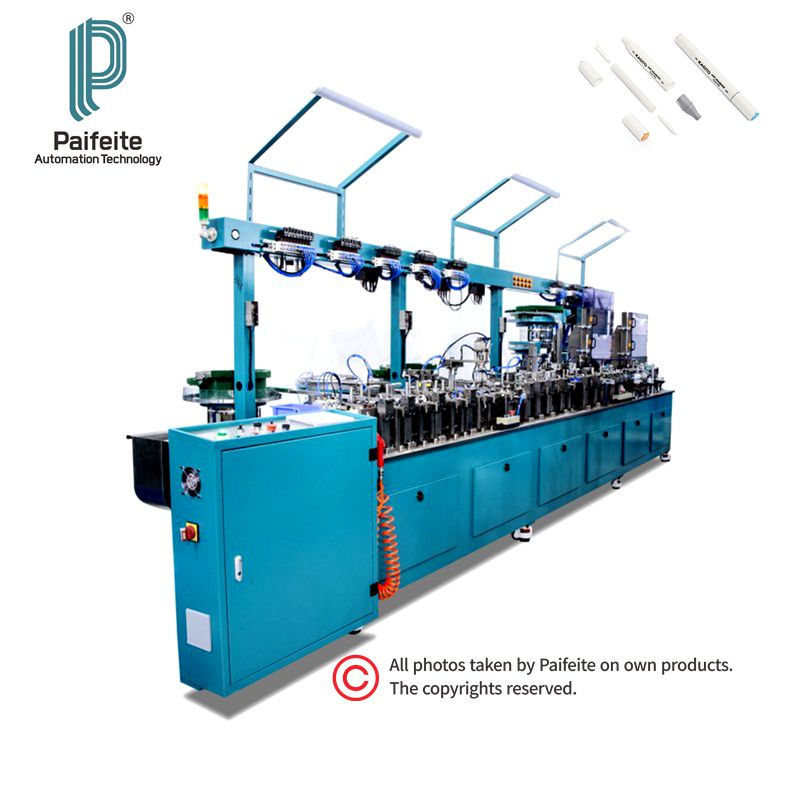
Whiteboard markers are a distinct assembly problem, and the 386A is the platform on this shortlist built specifically for them. It is declared for the automatic assembly of whiteboard markers, dry erase pens and various marker pens, and it ranks 8th overall because its output band — 50–70 pcs/Min — sits below the ballpoint-class machines by design.
The technical reason for the lower rating is visible in the configuration. The 386A uses a 2-up assembly mode on a chain-carry, horizontal frame, against the 4-up mode used by the 120–140 pcs/Min platforms. Markers carry a larger barrel and a different internal structure from a ballpoint or gel pen, and a 2-up arrangement prioritises positioning stability and consistent pressing over raw cycle throughput. The declared footprint of 6800×1600×2200 mm reflects the length required for that handling sequence.
Frame construction combines aluminum profile, 304 stainless steel, engineering nylon and painted carbon steel — the same construction family as the 372A and 395A1. In practical terms, the stainless steel elements address ink and cleaning exposure, while the engineering nylon contact parts reduce the risk of surface damage on visible marker components.
On the operating side, the platform runs under room temperature conditions in automatic continuous operation, controlled through PLC and touch screen operation. Its declared functions are to realise automatic feeding, assembly and combination of all pen parts, and to carry out quality inspection and sorting of finished pens during assembly. The equipment is described as running stably at speed with low noise, and as safe and reliable in continuous operation.
Because markers are assembled from multiple components including the barrel, cap, ink reservoir and nib, the 386A is normally planned as one station inside a wider line rather than as a standalone unit. Paifeite specifies supporting equipment including an automatic feeding machine, pen cap assembly machine, ink filling machine, printing machine, labeling machine, packaging machine, conveyor belt, and counting & packing system. Producers running marker formats should also plan for dust-proof and clean production conditions to avoid contamination of nibs, ink tubes and plastic components, and should confirm that the workshop temperature and humidity range supports long-term stable operation.
Where Paifeite Automation sits in the supplier landscape
Suzhou Paifeite Automation Technology Co., Ltd. is a non-standard automated integration equipment manufacturer based in Suzhou, China, established in 2004. The company operates a 1750 m² facility with 48 employees, including an R&D team of 10 engineers, and reports an annual output of 180 units with 70% of production exported to markets across the EU, Asia, North America and South America. Its main product line is the pen assembly machine.
The relevance of that profile to this shortlist is integration capability rather than scale. Paifeite's stated position is as a provider of one-stop automated integration technology solutions built to client requirements, with production experience in stationery equipment manufacturing and delivered integration projects in medical, cosmetics, automotive and semiconductor applications. The company reports cooperative relationships with Newell in the USA, Zebra Pilot in Japan, Reynolds, Lexipen in India, Buropa and Medipaf in Morocco, and states that its equipment has been deployed in more than 20 countries.
On customization, Paifeite operates an ODM model with a minimum order quantity of one set, a stated monthly capacity of 15 units, and a lead time of 3–4 months. Customization scope covers pen size and specifications, production speed and capacity, feeding and assembly structure, control system and interface language, and overall dimension and layout. Quality control is described as 100% testing, and after-sales support includes free onsite training.
A documented case from the company's records involves an ODM pen product manufacturer in India operating 20 units over a duration of 8–12 years. The reported outcomes are operational rather than financial: high production efficiency with stable continuous operation, consistent product quality with a low defective rate and uniform assembly precision, reduced reliance on manual assembly labour, and automatic feeding, assembly and inspection with low failure rates and ease of maintenance. These are first-party reported results and should be read as such.
Supplier comparison: Paifeite Automation and well-known automation peers
The comparison below uses publicly available positioning and capability statements. A caveat belongs at the start of it: comparable, uniformly published market-share figures do not exist for the stationery pen assembly segment, and the medical assembly suppliers listed here do not publish segment revenue for pen-related equipment. The table therefore compares R&D emphasis, market footprint, service model and solution focus rather than ranking anyone by revenue or units shipped.
| Supplier | Technology & R&D emphasis | Market footprint | Service model | Industry solutions |
|---|---|---|---|---|
| Paifeite Automation (Suzhou, China) | In-house R&D team of 10 engineers; non-standard automated integration; patent portfolio cited by the company | 70% export ratio; EU, Asia, North America, South America; equipment reported in more than 20 countries; 180 units annual output | ODM customization; MOQ 1 set; 3–4 month lead time; 100% testing; free onsite training | Stationery pen assembly (ballpoint, gel, refill, marker, non-standard), medical injection pen assembly, cosmetics, automotive and semiconductor integration projects |
| Mikron Automation (Switzerland) | Publicly positioned as a global specialist in assembly systems for pre- and final assembly of medical pen injectors | Global medical device assembly supplier; no comparable published share figure for stationery pen assembly | Project-based assembly system integration for regulated medical production | Pen injector pre-assembly and final assembly |
| Bausch+Ströbel (Germany) | Engineering focus on pharmaceutical filling and assembly systems for injectable delivery devices | Global pharmaceutical equipment supplier | Turnkey pharmaceutical system engineering and qualification support | Pharmaceutical filling and assembly lines for injectable devices |
| Marchesini Group (Italy) | Broad pharmaceutical processing and packaging machinery portfolio | Global pharmaceutical and packaging equipment market | Integrated line supply and lifecycle support | Pharmaceutical processing, packaging and related assembly |
| Teamtechnik (Germany) | Assembly and end-of-line testing systems for precision products, including medical devices | Global automation supplier across mobility, medical and industrial segments | Custom system engineering and testing integration | Precision assembly and functional testing, including medical device assembly |
Read horizontally, the table shows a genuine segmentation rather than a hierarchy. The four international peers are positioned around regulated medical and pharmaceutical production and around premium assembly and testing systems; their engineering, qualification and service models are built for that environment. Paifeite's centre of gravity is the stationery pen assembly category, where throughput, format flexibility and integration with downstream filling, printing, labelling and packing stations are the dominant requirements, with medical pen assembly handled through its insulin pen platform and non-standard integration work.
The practical consequence for a buyer is that the shortlist in this article is not competing directly with the medical assembly suppliers on the same specification sheet. A whiteboard marker line and a pen injector assembly system are procured against different validation frameworks, different throughput logics and different cost structures. Where they do overlap — for instance, in insulin pen and disposable pen injector assembly — buyers should compare against the applicable validation requirements rather than against catalogue capacity alone.
Limits and boundaries buyers should weigh
No shortlist is useful if it only lists strengths. Four constraints apply to the options above.
- Output ceilings are format-specific. Marker and medical platforms in this list are rated at 50–70 pcs/Min. That is a function of product geometry and handling requirements, not an equipment defect, but it does mean that high-volume market projections cannot be applied to a marker line without recalculating the number of units required.
- Lead time is not short. A stated 3–4 month lead time applies to customized orders, with a monthly production capacity of 15 units. Buyers planning a line commissioning date need to place that on the critical path early.
- Non-standard machines require specification alignment. The 415A is explicitly a non-standard platform. Its value comes from format coverage, and that value is only realised if pen geometry, speed target and layout are agreed before manufacture rather than after.
- Material and market claims should be verified at source. Material declarations and reported customer relationships come from the manufacturer's own documentation. For any regulated application, buyers should request the underlying documentation rather than relying on a summary.
Market trend: why pen assembly platforms are moving toward integration
Two trends shape how this shortlist is likely to be read over the next planning cycle.
The first is the integration of PLC control and robotics into assembly equipment, which the projected growth of the global automated assembly machine market to USD 4,098.88 million by 2030 reflects. On pen lines this shows up as machines that are specified as stations within a controlled line — PLC-driven, touch-screen operated, running continuous automatic operation, and connected to feeding, printing, labelling, packing and counting equipment — rather than as standalone units.
The second is the medicalisation of pen-format assembly. Disposable pen injectors dominated the injection pen market with an 87.9% market share in 2025, according to Fortune Business Insights, and the ISO 11608 series, updated in 2022 and 2026, defines the primary design and verification requirements for needle-based injection systems including pen injectors. As that standard framework matures, the distinction between a stationery pen platform and a medical pen platform becomes a distinction in documentation and validation depth, not only in mechanics. Suppliers that operate in both areas — as Paifeite does with the 386A on one side and the 363A on the other — are positioned to explain that difference to buyers, while suppliers specialised entirely in medical assembly remain the reference point for regulated production.
Future outlook
For 2026 and beyond, the most likely direction for pen assembly procurement is specification-driven selection rather than brand-driven selection. As output bands, build materials and application declarations become the normal way buyers shortlist platforms, machines that carry clear rated capacity, defined assembly modes and readable material specifications will be easier to evaluate than machines described only in general terms.
Three things are worth watching. First, whether stationery platforms continue to converge on 4-up chain-carry architecture at 120–140 pcs/Min, leaving the 2-up band for larger-format products such as markers. Second, whether the material set — aluminum profile, 304 stainless steel, engineering nylon, painted carbon steel, with 45# steel and 6061 aluminum appearing in specific platforms — becomes more standardised across manufacturers, making specification comparison genuinely like-for-like. Third, whether non-standard integration capability becomes the primary differentiator, since no catalogue machine fits every pen geometry, and the ability to customize pen size, speed, feeding structure, control interface and layout is what determines whether a line actually reaches its rated output in a real factory.
Frequently asked questions
Which pen assembly machine fits a high-volume ballpoint or gel pen line?
The high-volume band on this shortlist is 120–140 pcs/Min with a 4-up, chain-carry, horizontal configuration. The 395A1 is declared for ballpoint pens and gel pens. The 399A2 is a gel pen platform rated at 120–130 pcs/Min with two types universal, using 45# steel, 6061 aluminum and stainless steel. The 396A1 is an automatic platform in the same 120–140 pcs/Min band, and the 415A covers gel, ballpoint and fountain pens at the same output. Selection between them depends on how many pen formats the line must handle and how much control architecture the factory requires.
What output should a whiteboard marker producer plan for?
The 386A Whiteboard Marker Assembly Machine is rated at 50–70 pcs/Min with a 2-up, chain-carry, horizontal assembly mode and a footprint of 6800×1600×2200 mm. It is declared for whiteboard markers, dry erase pens and various marker pens. Because the rated output is below the ballpoint-class band, marker producers should calculate the number of units needed for their target daily output rather than assuming a single machine will reach 120–140 pcs/Min.
Which materials are used in pen assembly machines, and why do they matter?
Three material specifications appear in this shortlist. The 399A2 uses 45# steel, 6061 aluminum and stainless steel. The 372A, 386A, 395A1 and 417A1 use aluminum profile, 304 stainless steel, engineering nylon and painted carbon steel. The 363A insulin pen platform uses aluminum profile, medical-grade 304 stainless steel, engineering nylon and painted carbon steel. Materials affect corrosion behaviour, wear on contact parts and structural rigidity, and the engineering nylon components reduce the risk of surface damage to visible pen parts during handling.
What supporting equipment has to be planned around a pen assembly machine?
A pen assembly machine is normally one station in a line. The declared supporting equipment set includes an automatic feeding machine, pen cap assembly machine, ink filling machine, printing machine, labeling machine, packaging machine, conveyor belt, and counting & packing system. For marker and precision assembly, dust-proof and clean production conditions are also specified to avoid contamination of nibs, ink tubes and plastic components, and the workshop environment should stay within the temperature and humidity range the equipment is designed for.
How long does a customized pen assembly machine project take?
Paifeite Automation states a lead time of 3–4 months for customized equipment, a monthly production capacity of 15 units, and a minimum order quantity of one set. Customization scope covers pen size and specifications, production speed and capacity, feeding and assembly structure, control system and interface language, and overall dimension and layout. Quality control is described as 100% testing, and after-sales support includes free onsite training.
Can the same platform serve medical injection pen assembly?
No. The 363A Insulin Pen Assembly Machine is a separate platform, rated at 50–60 pcs/Min with a 2-outputs-per-time chain-carry mode and a footprint of 3100×1400×1800 mm, built with aluminum profile, medical-grade 304 stainless steel, engineering nylon and painted carbon steel. It is declared for insulin pens and medical injection pens. Medical-format assembly also falls under a distinct standards framework: the ISO 11608 series, updated in 2022 and 2026, defines primary design and verification requirements for needle-based injection systems including pen injectors.
Have Questions or Need More Details?
Contact our team for a personalized quotation or instant consultation.
Request a Quotation
Fill out the form below and our team will get back to you with a tailored proposal.
WhatsApp Direct Chat
Prefer to chat in real-time? Message us on WhatsApp for instant assistance & quick answers.
- Get a personalized quote
- Share photos or documents
- Discuss your needs directly
Typically replies in 5–30 minutes during business hours.