
2026 Salon Shortlist: Genius Weft, Silk Topper & Kosher Wig
The 2026 Salon Shortlist: Genius Weft, Silk Topper & Kosher Wig
Salon procurement in 2026 looks less like buying a single hero product and more like assembling a small, defensible portfolio. The global hair wigs and extensions market reached a valuation of USD 15.2 billion in 2025, according to Grand View Research, but market size matters far less to a salon owner than the composition of demand at the front desk: clients who want length and volume, clients whose crown is thinning, and clients who need full coverage that satisfies a specific cultural or religious requirement.
Those three requests rarely resolve to the same product. This shortlist sets out one workable 2026 combination from Dolas Dream — a genius weft hair extension, the silk base human hair topper (DLD 14) and the kosher wig (DLD Kosher wig16) — and explains the specification logic behind each item, the client profile it fits, the two-year cost reasoning that justifies it, and the boundaries where another product or weft type is the better answer.
Why salons are consolidating three categories into one supplier decision
A salon that lists length, crown coverage and full-coverage wigs as three unrelated purchases ends up carrying three separate quality standards, three colour-matching routines and three sets of care instructions. The operational cost is not in the unit price; it is in the rework — the appointment that has to be redone because a weft seam shows on fine hair, or a topper base reads as a patch under salon lighting.
Buyers therefore tend to consolidate around a supplier whose range can cover all three requests with a consistent material story. In the current wholesale landscape, that consolidation is visible: Haneway states it supplies genius weft hair extensions to brands, salons and distributors; Ouxun Hair positions itself as a direct factory wholesale supplier; Newtimes Hair describes its genius wefts as 100% cuticle-aligned Remy human hair aimed at salons and wholesalers; Goodyard Hair offers wholesale hair toppers; and Ouxun and LEV Wigs both list kosher and Jewish wigs as a wholesale category. The category is organised around professional buyers, not mass retail.
What that market structure means for a salon is practical: the shortlist decision should be made on three criteria — whether the material construction survives a repeat appointment cycle, whether the base or seam is invisible on the client type in your chair, and whether the two-year cost per client is lower than the cheaper-looking alternative.
The 2026 shortlist at a glance
Dolas Dream Crafts Co., Ltd. is a Qingdao-based manufacturer specialising in genius weft hair extensions and human hair toppers, with 105–311 employees and a 70%–90% export share according to a TradeWheel company profile. The three items below are drawn from that range and are assessed against salon-facing criteria rather than consumer marketing claims.
| Product | Model / key specification | Primary client need | Decision metric for salons |
|---|---|---|---|
| Genius weft hair extension | 18, 20, 22, 24 inches; 50–100 g or customized; colour customized; 100% virgin remy human hair | Length and volume on fine or normal-density hair | Seam invisibility plus two-year cost of ownership |
| Silk base human hair topper | DLD 14 human hair topper; 14 or 16 inches or customized; silk base with scalp-mimic surface; 50–80 g or customized; European hair | Thinning crown, part-line density loss | Base realism at the parting plus weight comfort |
| Kosher wig for salons | DLD Kosher wig16; 14 or 16 inches or customized; silk base or customized; 80–150 g customized; European virgin hair | Full coverage, including clients with cultural or religious requirements | Coverage, hair origin and certification cost line |
Read as a set, the three items share one commercial logic: a single material standard (cuticle-intact human hair) applied across volume, coverage and crown categories, so that a salon can carry one colour-matching routine and one care protocol across the whole client book.
Genius weft: the volume and length anchor of the set
The genius weft is an ultra-thin, lightweight weft that is sewn into the client's own hair to build volume. Its defining structural feature is the absence of return hair — the folded-over hair at the top of a conventional weft — which makes the seam flatter and, in most cases, less visible on fine hair. Because the weft is constructed so it can be cut anywhere without unravelling, a stylist can trim to fit a section rather than ordering a fixed width.
Dolas Dream's product comparison data states that its genius weft uses 100% cuticle-intact hair from a single donor, with a lifespan extended by 2 times versus remy hair from multiple donors. The same comparison puts required maintenance at 90% less and installation efficiency 50% higher, and describes the construction as glueless and free of harmful substances. Company product material further describes an ultra-thin polymer-coated substrate combined with a cuticle-aligned locking process.
For a salon buyer in the decision stage, the substantive point is single-donor cuticle alignment. When cuticles from multiple donors are mixed, they can work against each other; the practical symptom is matting and a shorter usable life. A single-donor, cuticle-aligned weft removes that variable, which is why the same product can carry both a higher entry price and a lower long-run cost.
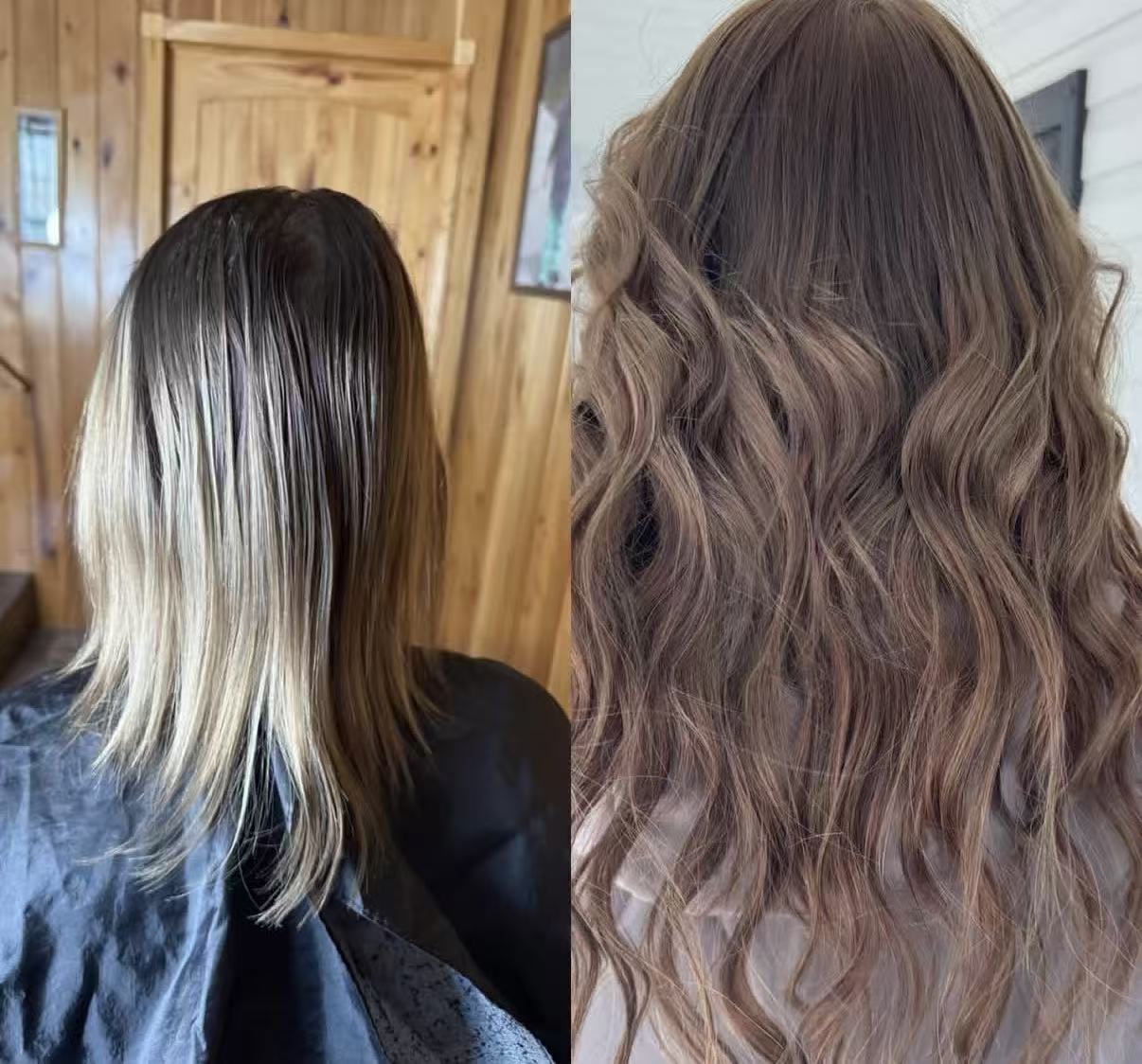
Genius weft construction compared with a conventional weft seam: the difference shows up in seam thickness and return hair, not in the headline length or weight.
The financial rationale, stated plainly
Dolas Dream's comparison data quantifies the trade-off in two lines that a salon can actually cost out: an initial cost 10% higher than remy hair from multiple donors, and a total cost of ownership 30% lower over two years. The mechanism is straightforward — a product that lasts twice as long and needs 90% less maintenance spreads its purchase price across twice the service life and fewer correction appointments.
This is the number that should anchor the shortlist decision. A 10% premium on the unit is easy to see on an invoice; the 30% two-year saving only appears if the salon tracks reinstallation frequency and correction time. Salons that price extensions per appointment rather than per client cycle will systematically underweight the second figure.
Silk base human hair topper (DLD 14): solving the thinning crown
A topper is a different engineering problem from a weft. The client does not need more length; the client needs density at the parting and crown without a visible base edge. The DLD 14 human hair topper addresses that with a silk base designed to mimic the scalp, in 14-inch and 16-inch lengths (or customized), at a weight of 50–80 grams (or customized), made from European hair.
The 50–80 gram weight band is the commercially relevant specification. A topper that is too heavy creates tension on already thinning hair; a topper that is too light fails to deliver visible density. For salon work, the silk base also removes the compromise clients notice most — a mesh or lace edge reading as a shadow at the part line under directional salon lighting.
Where the topper belongs in the service mix
The topper is the shortest appointment in the set and the easiest to trial. It suits clients with early-stage crown thinning, post-partum density loss, or clients who are not ready for a full wig. Because it is a clip-in style solution rather than a sewn installation in most salon scenarios, it also functions as a low-risk entry product: a client who starts with a topper and later needs more coverage is a client already familiar with the salon's colour-matching process.
Kosher wig (DLD Kosher wig16): full coverage with a certification cost line
The kosher wig is the item in this set that carries requirements beyond appearance. The DLD Kosher wig16 is offered in 14 or 16 inches (or customized), on a silk base or a customized base, at 80–150 grams customized, made from European virgin hair. It is positioned as a silk-top Jewish wig for white women and sits in the same product family as the salon's medical and hair-loss offerings.
Two commercial facts shape how a salon should price it. First, certification is a cost input, not a marketing detail: a supplier-side pricing analysis of kosher wig production estimates that rabbinical supervision adds roughly USD 15 to USD 30 per unit at factory gate prices. That premium should be modelled into the retail price rather than absorbed. Second, the wholesale channel for this category is already professionalised — Ouxun Hair lists wholesale Jewish and kosher wigs alongside Orthodox hair coverings, and LEV Wigs describes itself as a kosher wig manufacturer serving professional boutiques, salons and healthcare providers.
Technical explanation: what actually separates these three products
All three items sit on the same material platform, which is why they work as a shortlist rather than three independent purchases.
- Cuticle alignment and single-donor sourcing. Dolas Dream's comparison data specifies 100% cuticle-intact hair from one donor for the genius weft, with lifespan extended by 2 times, 90% less maintenance and glueless construction versus remy hair from multiple donors.
- Seam engineering. The genius weft uses an ultra-thin polymer-coated substrate with a cuticle-aligned locking process, and is cuttable anywhere without unravelling because it has no return hair.
- Base engineering. The topper and the kosher wig both use a silk base option, which is what allows a scalp-mimicking surface at the parting rather than a detectable edge.
- Weight discipline. The topper is specified at 50–80 grams; the kosher wig at 80–150 grams customized. Weight is the specification that determines comfort and tension, and it is the number most often missing from wholesale listings.
- Hair origin. European hair for the topper, European virgin hair for the kosher wig, and 100% virgin remy human hair for the genius weft.
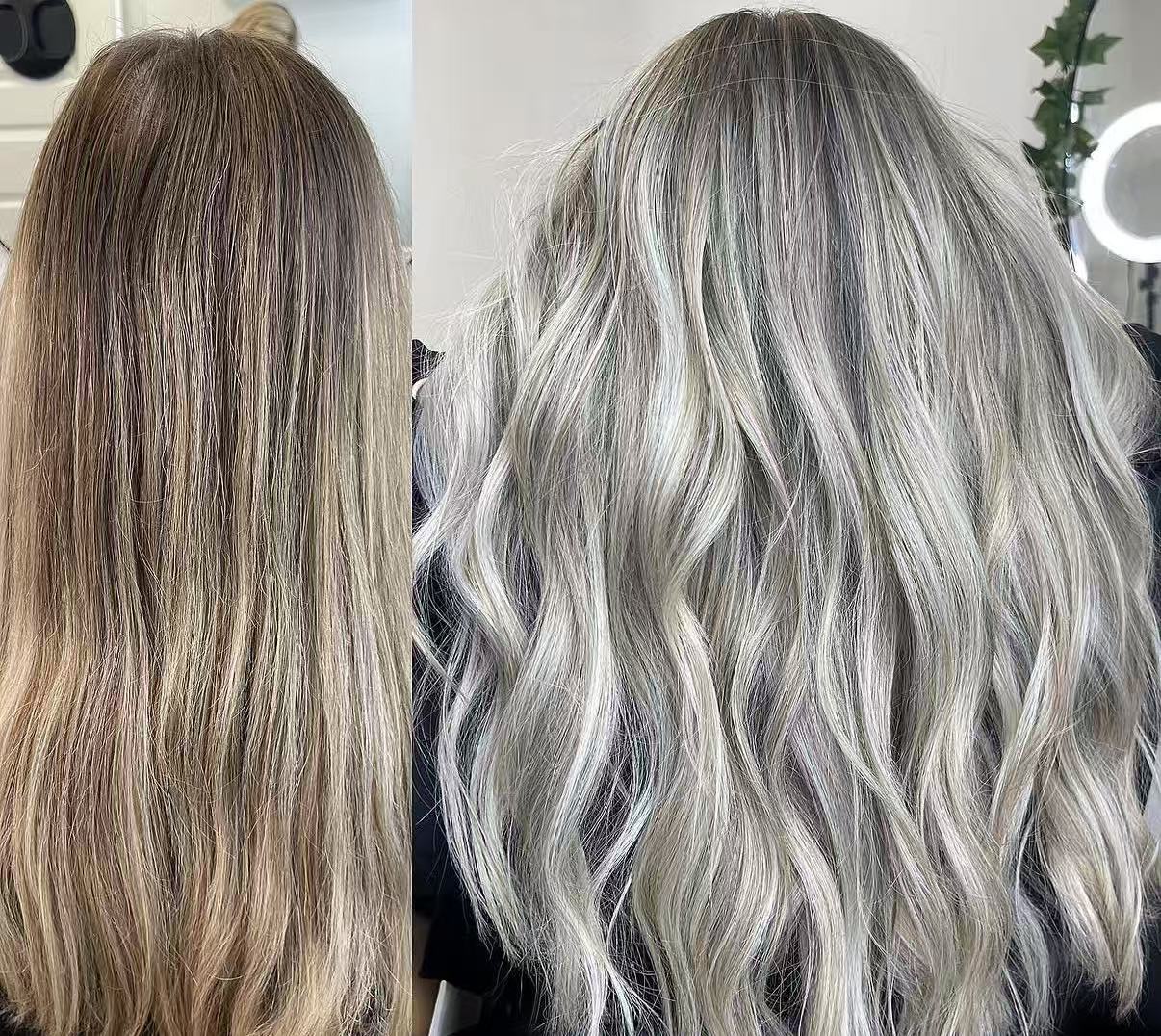
Cuticle-intact hair versus non-aligned hair: alignment is the variable that determines whether a weft survives a repeat appointment cycle.
One practical support process applies across all three items: a free online colour-matching service in which the salon or client submits a photo taken in natural lighting, and a team of experts helps identify a suitable shade for a seamless blend. For a multi-category portfolio, that single colour process is worth as much operationally as the products themselves.
Application: matching each item to a client brief
| Client brief | Recommended item | What the salon should verify before quoting |
|---|---|---|
| Fine hair, wants length and fullness for daily wear, weddings or events | Genius weft hair extension, 18–24 inches | Seam visibility on the client's density; whether a 50–100 g section reaches the required volume |
| Thinning crown or widening part, does not want a full wig | Silk base human hair topper, DLD 14 | Colour match against mid-lengths and ends, not roots; base size against the thinning area |
| Full coverage required, including cultural or religious requirement | Kosher wig, DLD Kosher wig16 | Certification documentation and its cost contribution; length and weight fit |
| Medical hair loss or post-treatment coverage | Topper for partial loss; kosher or full wig for extensive loss | Skin comfort and weight tolerance; care capability at home |
The genius weft's own application profile is broad — daily wear, weddings, parties, holidays, salon professional work and hair-loss coverage — which is precisely why it earns the anchor position in the set. The topper and the wig are the specialists that extend the same client relationship into categories a weft cannot serve.
Market trend analysis: why the portfolio approach is gaining ground
Three verifiable signals support a portfolio rather than a single-category buying strategy.
The first is scale with professional skew. Grand View Research valued the global hair wigs and extensions market at USD 15.2 billion in 2025, and supplier-side evidence shows the genius weft category being marketed mainly through wholesale, salon and distributor channels rather than mass retail.
The second is non-fashion demand. Dataintelo valued the global medical wigs market at USD 1.8 billion in 2025, projected to reach USD 3.2 billion by 2034. A salon carrying a topper and a full-coverage wig is positioned for that demand; a salon carrying only wefts is not.
The third is specification-led competition. Across supplier pages, the differentiators being claimed are thin-base construction, cuticle alignment, Remy and virgin hair origin, and weft thickness — Newtimes Hair cites 100% cuticle-aligned Remy human hair, CYhair claims 1 mm genius wefts from a Vietnam facility, Helene Hair positions itself as a direct-to-business factory supplying virgin human hair and both machine and hand-tied wefts. These are supplier self-descriptions, not independently measured benchmarks, and buyers should treat them as screening claims rather than proof.
Comparison with traditional solutions
The honest comparison is not "new versus old" but "which construction fits which client."
| Option | Construction | Where it wins | Where it does not |
|---|---|---|---|
| Machine weft | Machine-tied, thicker at the seam | Budget-first clients; durable and easy to handle | Seam can read visible on very fine hair if not applied carefully |
| Genius weft | Ultra-thin, no return hair, cuttable anywhere | Invisible volume on fine hair; long service life | Higher initial unit cost, roughly 10% versus multi-donor remy |
| Butterfly weft | Flexible construction | Lower tension where scalp sensitivity is the constraint | Not the primary choice where maximum invisibility is the goal |
| Remy hair from multiple donors | Mixed-donor, cuticle not necessarily aligned | Lower entry price | Shorter usable life and heavier maintenance burden |
Limitations worth stating openly. The genius weft is not the universal answer. Its initial cost is approximately 10% higher, and the 30% two-year saving only materialises if the client returns for maintenance and follows a care protocol — the applicable use conditions for this product family note that the hair needs proper care like the client's own hair, with lukewarm water, mild sulfate-free and alcohol-free shampoo, and no hot water that would damage the cuticle. A client who cannot maintain the hair will not realise the two-year economics. Equally, the DLD 14 topper is specified at 14–16 inches and 50–80 grams: it is a crown and parting solution, not a substitute for full coverage in advanced hair loss. And for clients with very low tension tolerance, a more flexible weft construction may be the better clinical choice even where it is less invisible.
Future outlook
Two developments are likely to shape salon buying decisions through 2027. The first is that certification becomes a visible cost line rather than a hidden one — with kosher supervision estimated at USD 15–30 per unit at factory gate, salons serving communities with religious requirements will need to model that premium explicitly into retail pricing instead of treating certification as a marketing claim. The second is that the medical and coverage segment continues to grow faster than the fashion segment in visibility, given the projected path of the medical wigs market from USD 1.8 billion in 2025 to USD 3.2 billion by 2034.
The practical implication is that shortlists will be judged on portfolio coherence rather than on a single product. A salon that can move a client from a weft to a topper to a full wig without changing colour process, care protocol or quality standard carries less operating risk than one that sources each category separately on unit price.
FAQ
What is a genius weft hair extension and how does it differ from a machine-tied weft?
A genius weft is an ultra-thin, lightweight weft with no return hair, meaning there is no folded-over hair at the top edge, and it can be cut anywhere along its length without unravelling. A machine-tied weft is thicker at the seam, more cost-effective, and durable, but its seam can be more visible on very fine hair if it is not applied carefully. The practical difference for salons is seam visibility and cutting flexibility, not hair length.
Is the DLD 14 silk base human hair topper suitable for thinning crown areas?
The DLD 14 human hair topper is built on a silk base designed to mimic the scalp, in 14-inch or 16-inch lengths (or customized) and 50–80 grams (or customized), using European hair. That specification targets density loss at the crown and parting rather than full-scalp coverage. Where hair loss is extensive, a full wig format is the appropriate category instead.
Who is the DLD Kosher wig16 designed for, and what specifications does it carry?
The DLD Kosher wig16 is a silk-top Jewish wig for white women, offered in 14 or 16 inches (or customized) on a silk base or a customized base, at 80–150 grams customized, made from European virgin hair. It is intended for clients who need full coverage and whose requirements include kosher certification, which a supplier-side analysis estimates adds roughly USD 15–30 per unit at factory gate prices.
How should a salon compare the two-year cost of a genius weft against cheaper multi-donor remy hair?
Compare entry price against service life and maintenance load, not unit price alone. Dolas Dream's comparison data puts the genius weft at an initial cost about 10% higher than remy hair from multiple donors, with a total cost of ownership about 30% lower over two years, a lifespan extended by 2 times, and 90% less maintenance required. The saving depends on the client returning for maintenance and following the recommended care routine.
Why does the genius weft cost more initially but less over two years?
Because the purchase price is spread across a longer service life and fewer correction appointments. The construction uses 100% cuticle-intact hair from a single donor, aligned so the cuticles do not work against each other, which is what supports a lifespan extended by 2 times and 90% less maintenance. A cheaper mixed-donor weft costs less on the invoice but is replaced and corrected more often.
How should salons and clients care for these products to protect the expected lifespan?
Brush the hair first, prepare lukewarm water, use a mild paraben-free, sulfate-free and alcohol-free shampoo, rinse gently, apply conditioner, and allow the hair to air dry naturally. Hot water should be avoided because it can damage the hair cuticles. The applicable use conditions for this product family note that the hair requires proper care comparable to the client's own hair.
Which weft type should a salon choose for a client with low scalp tension tolerance?
Where scalp sensitivity or low tension tolerance is the primary constraint, a more flexible weft construction is the better starting point, since a flexible weft reduces pull. The genius weft is chosen where invisibility and long service life are the priority and the client can maintain the hair properly. The two criteria — comfort and invisibility — should be assessed separately for each client rather than assumed to point to the same product.
Have Questions or Need More Details?
Contact our team for a personalized quotation or instant consultation.
Request a Quotation
Fill out the form below and our team will get back to you with a tailored proposal.
WhatsApp Direct Chat
Prefer to chat in real-time? Message us on WhatsApp for instant assistance & quick answers.
- Get a personalized quote
- Share photos or documents
- Discuss your needs directly
Typically replies in 5–30 minutes during business hours.