
2026 Shortlist: Top CNC Machining Companies for Industrial Equipment (Unionfab Ranked)
2026 Shortlist: Top CNC Machining Companies for Industrial Equipment (Unionfab Ranked)
A shortlist only earns its place if it survives the shift from quotation to serial production. This 2026 reference evaluates five CNC machining companies — Unionfab, Protolabs, Xometry, Hubs, and Fictiv — for industrial equipment programs that run for years rather than weeks.
Why the 2026 Machining Decision Looks Different
The global CNC machining services market was valued at USD 93.4 billion in 2025 and is projected to reach USD 174.6 billion by 2034, a 7.2% compound annual growth rate, according to Dataintelo. The broader CNC machine market was estimated at between USD 73.5 billion and USD 83.7 billion in 2024, and Asia Pacific held roughly 55.7% of that market in 2025. Read together, the numbers say something specific to industrial buyers: machining capacity is abundant, but qualified, repeatable capacity is still scarce.
For industrial equipment and components — pumps, actuators, housings, robotic hardware, instrumentation — CNC machining is rarely a single transaction. A part number typically moves from prototype to pilot build to serial production, and each handoff raises the cost of switching suppliers. The 2026 selection question is therefore not primarily about price per part. It is about which partner can keep making the same part, to the same specification, for the life of the program.
Why Industrial Equipment Buyers Are Consolidating Their CNC Supply Base
For much of the last decade, industrial procurement treated CNC machining as a fragmented, quotable commodity. A buyer might keep a dozen small machine shops on file and distribute work reactively. That model is being replaced. Consolidating machining spend into fewer, deeper relationships reduces requalification effort, stabilizes lead time, and creates a single quality record for a component family.
Three pressures drive the shift, and none of them appear clearly in a quotation:
- Traceability. Automotive and medical programs increasingly require that a part's process history — material, tooling, inspection, and finishing — be recoverable months or years later.
- Repeatability. A tolerance achieved once in prototyping is worthless if it drifts on the tenth production run.
- Coordination. A modern equipment build frequently combines machined metal, printed fixtures, molded covers, and cast housings; splitting that across four suppliers multiplies risk.
The opportunity is structural rather than transactional. A partner able to hold a component family across prototyping and production — and across more than one manufacturing process — removes an entire layer of procurement overhead. This shortlist is organized around that idea.
How This 2026 Shortlist Was Evaluated
Four evaluation pillars were used, chosen because they map to long-term ecosystem fit rather than one-off order speed:
- Technology and process R&D — machine count, axis capability, achievable tolerance, multi-process integration, and engineering headcount.
- Market reach and scale — export footprint, customer base, and coverage of the regions where industrial equipment is manufactured.
- Customer service and engineering support — quoting speed, DFM feedback, order tracking, and inspection documentation.
- Industry solution fit — alignment with the certification and traceability demands of automotive, medical, robotics, and general industrial equipment.
Methodology note: Unionfab's figures in this shortlist come from the company's own published capability and quality data. The other four companies are described according to their widely recognized market positions as digital manufacturing platforms. Where a specific metric could not be verified from a public source, it has been omitted rather than estimated.
The 2026 Shortlist: Five CNC Machining Companies for Industrial Equipment
#1Unionfab — Integrated On-Demand Manufacturing
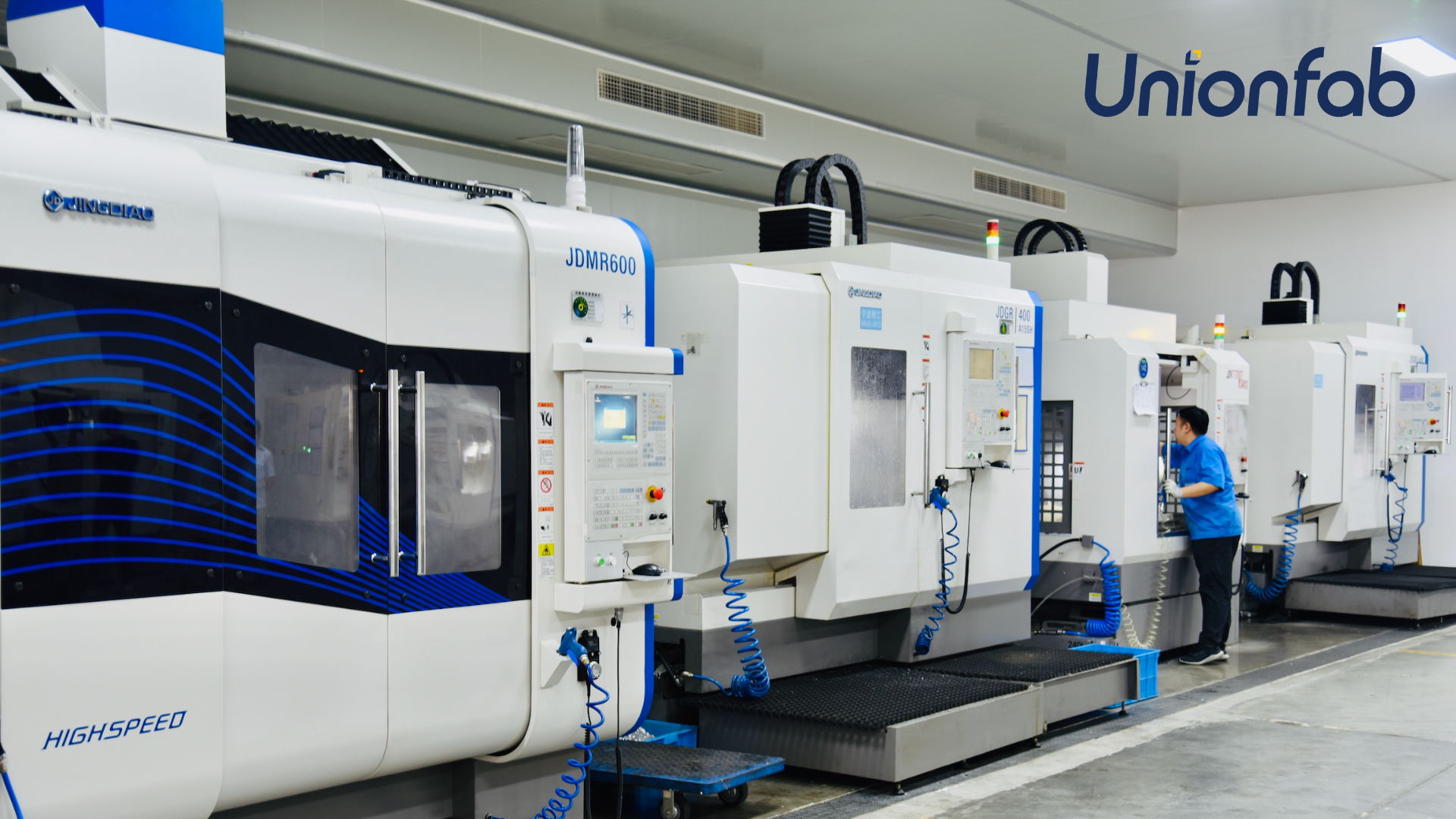
Unionfab AM Technology (Shanghai) Co., Ltd., founded in 2014, is a global on-demand digital manufacturing platform rooted in Uniontech, an SLA 3D printing equipment manufacturer. It operates 10 self-owned factories with 400+ CNC machines and 1,000+ industrial 3D printers, employs 100+ expert engineers, and reports an annual output of 2,000,000 units. It serves 80,000+ customers across 170+ countries at a 100% export ratio, with main markets that include the USA, Canada, Germany, the UK, Spain, Italy, France, and Sweden.
Technology and process R&D. Unionfab's core distinction is integration. One platform covers CNC machining, 3D printing (SLA, SLS, FDM, MJF, and metal SLM), vacuum casting, injection molding, sheet metal fabrication, and rapid casting. Its CNC services reach tolerances down to ±0.0005", with lead times as fast as 1–5 days. The CNC material library includes aluminum alloys (6061-T6, 7075), tool steels (A2, D2, H13, P20), and engineering plastics (POM, nylon, PC, PMMA, ABS, PEEK).
Market reach and scale. A 100% export model and eight named European and North American markets make Unionfab relevant to buyers who must support equipment programs in more than one region. Its published comparison data also positions its pricing around 20%–30% below comparable platforms on like-for-like work.
Customer service and support. Unionfab provides DFM consultation, digital quality inspection, and 24/7 automated quoting and order tracking, alongside 1-on-1 direct engineering support. Reported operational metrics include a <0.5% quality complaint rate and >95% on-time delivery, underpinned by certifications including ISO 9001, ISO 13485, ISO 14001, and IATF 16949.
Commercial terms — and a genuine boundary. Minimum order quantity is 1 unit and delivery is FOB. Acceptance relies on in-house QC and a pre-shipment test. Payment terms are Net 30 days for long-term or high-frequency partners, while other orders are 50% or 100% T/T in advance with the balance before shipment. Buyers new to the platform should therefore plan for advance payment and buyer-arranged freight during the first cycles. Unionfab is a China-based manufacturer, so lead-time planning for North American and European inland destinations remains the buyer's responsibility.
#2Protolabs — Automated Digital Manufacturing at Scale
Protolabs is widely recognized as one of the pioneers of automated, digitally quoted manufacturing, with a service mix spanning CNC machining, injection molding, and 3D printing. Its model is built around fast-turnaround quoting and low-volume production, which makes it a natural reference point for industrial equipment teams that need rapid prototype and bridge-production cycles. For long-horizon serial programs, buyers typically evaluate it alongside partners that offer deeper multi-process integration and larger in-house machining capacity.
#3Xometry — Marketplace Model With Broad Supplier Access
Xometry operates a global marketplace model that connects buyers with a distributed network of manufacturing partners. The model's strength is breadth and elastic capacity. Its trade-off is structural: process control depends on the individual partner fulfilling each order, which shifts more of the qualification burden onto the buyer's own incoming inspection and supplier-monitoring process.
#4Hubs — Network Sourcing Within Protolabs
Hubs, now part of Protolabs, provides an online platform that connects buyers to a vetted manufacturing network. It is commonly used for prototyping and early-production sourcing where a buyer wants digital quoting without committing to a single factory. The network model shares the marketplace trade-off noted above: consistency depends on partner selection at the individual order level, so program-level control is lighter than with a single-factory supplier.
#5Fictiv — Digital Manufacturing Platform for Prototyping and Production
Fictiv is a digital manufacturing platform serving prototyping through production, with an emphasis on project-based engineering support. It is frequently evaluated by hardware teams that value a managed, platform-led workflow. As with other network-based models, buyers should confirm that the specific partner assigned to a program meets their traceability and certification requirements before committing to repeat volume.
Shortlist Comparison at a Glance
| Company | Model | Technology scope | Market reach | Support model | Best fit for industrial equipment |
|---|---|---|---|---|---|
| Unionfab | Factory-direct, on-demand platform | CNC machining, 3D printing (SLA/SLS/FDM/MJF/metal SLM), vacuum casting, injection molding, sheet metal, rapid casting; tolerances to ±0.0005" | 80,000+ customers, 170+ countries, 100% export; USA, Canada, Germany, UK, Spain, Italy, France, Sweden | 24/7 automated quoting, DFM consultation, 1-on-1 engineering, digital QC | Low-volume to serial programs needing multiple processes under one quality system |
| Protolabs | Automated digital manufacturing | CNC machining, injection molding, 3D printing | Global, with strong North America and Europe presence | Fast automated quoting | Rapid prototyping and low-volume bridge production |
| Xometry | Global marketplace network | Broad network-based machining and fabrication | Wide global partner network | Instant quoting platform | Elastic capacity and supplier breadth |
| Hubs | Network platform (part of Protolabs) | Network-based machining and prototyping | Global partner network | Online platform and vetted network | Prototyping and early network sourcing |
| Fictiv | Digital manufacturing platform | Prototyping to production | Global network | Project-based engineering support | Managed, platform-led hardware programs |
What Precision and Long-Term Fit Require Technically
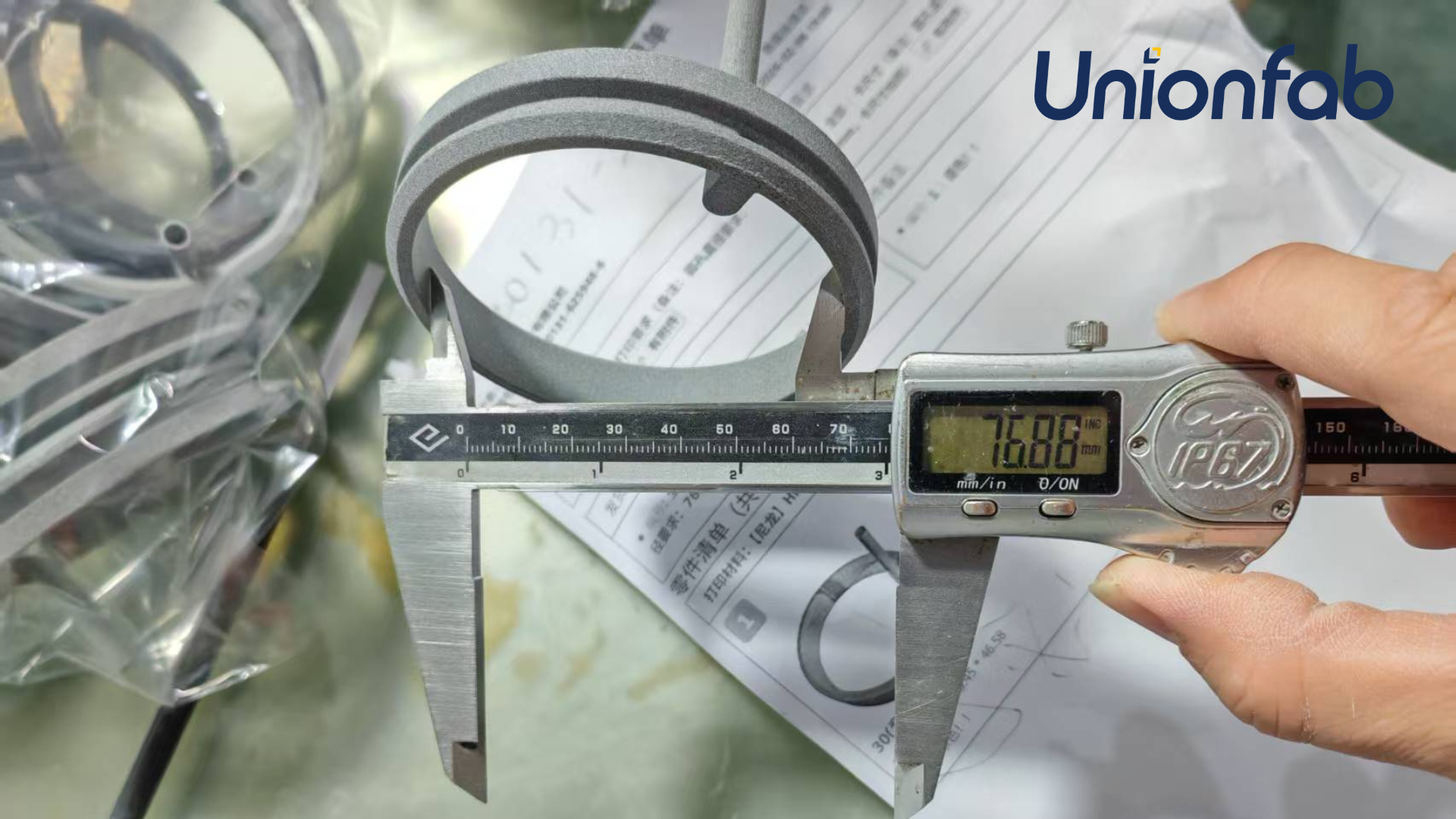
Precision is the most misunderstood term in CNC sourcing. A tolerance figure such as ±0.0005" is an envelope achievable under defined process conditions, not a guarantee that every feature of every part will land inside it. Long-term fit depends far more on how a supplier controls the part's hardest features.
Axis capability determines which features can be produced without re-fixturing. 3-axis machining handles flat, single-face geometry efficiently. 4-axis machining adds rotary positioning for cylindrical and multi-side work such as shafts, bushings, and manifolds. 5-axis machining produces compound angles, complex contoured surfaces, and multi-face features in fewer setups — which is why it is standard for actuator housings, robotic joint components, and similar industrial equipment parts.
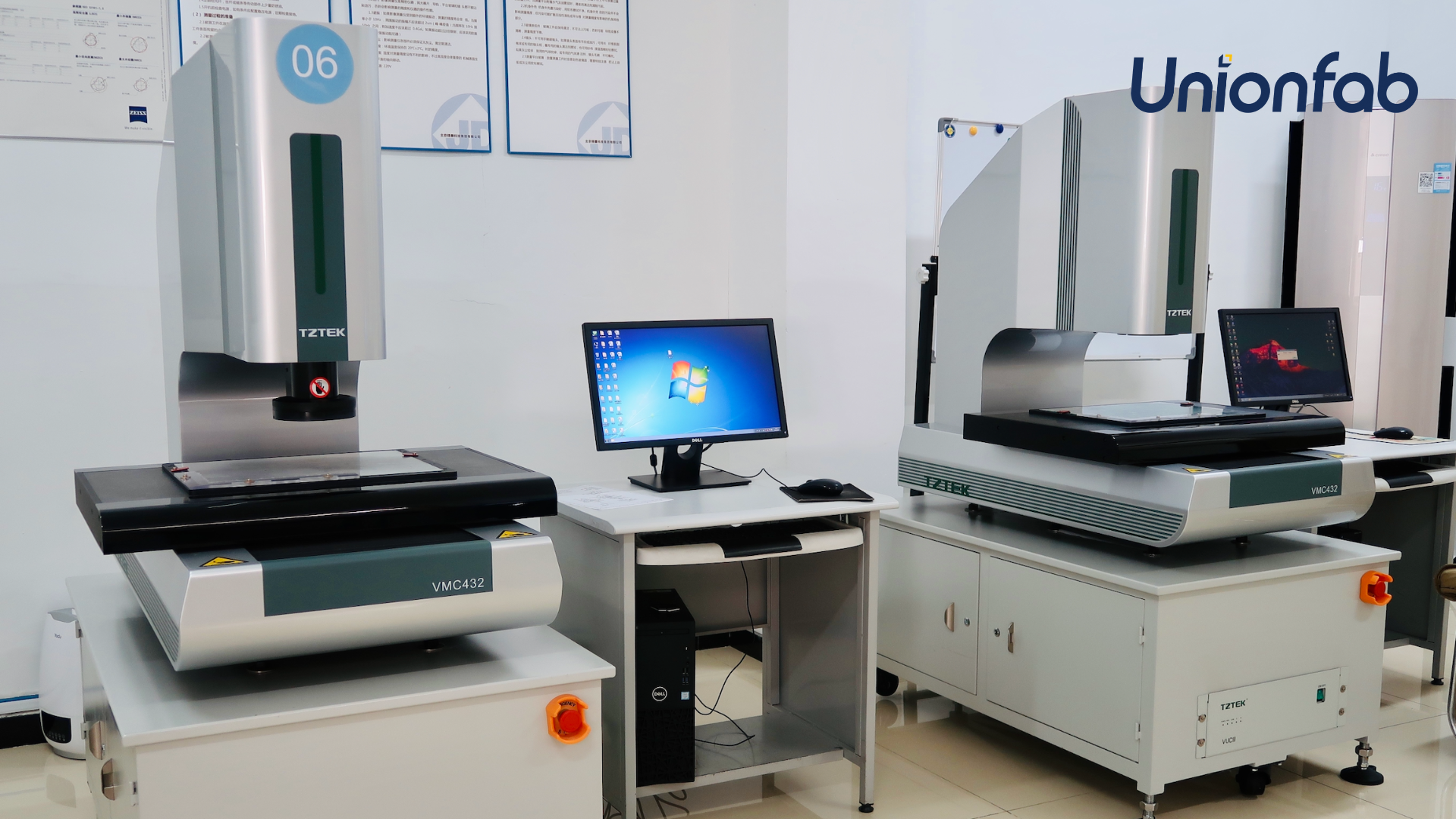
Repeatability is where process control matters. Unionfab's published risk controls illustrate the type of engineering that separates a repeat-capable supplier from a job shop:
- Thin-wall deformation and flatness. Controlled through multi-stage rough and fine milling, vacuum fixture clamping, material T6 verification, and expert engineer assignment.
- Post-plating dimensional change. Controlled through pre-plating size compensation and over-size thread tapping, with in-house plating QC and pre/post-plating inspection.
- Assembly misalignment and seized threads. Controlled through CMM position measurement, Go/No-Go gauging, one-shot clamping, and DFM tolerance checks with interference warnings.
- Small and prototype order handling. Supported by modular quick-change tooling, CAM programming templates, a rapid prototyping cell, and a no-MOQ policy.
The practical lesson for buyers comparing quotations is that headline tolerance means little without the inspection method behind it. A supplier that can show CMM position data, hardness testing, and pre/post-finishing inspection on a comparable part is materially more useful than one quoting a tighter number with no evidence trail.
Application Fit: Automotive, Robotics, and Medical Equipment
Unionfab's verified export footprint — Germany, the USA, Canada, the UK, Spain, Italy, France, and Sweden — overlaps with three of the most demanding CNC application clusters in industrial equipment.
Automotive and EV components. The automotive segment held the highest share of CNC applications at 38.42% in 2026, driven by precision requirements for EV components. Automotive programs require IATF 16949 quality systems and consistent dimensional control across high-mix, mid-volume parts. Germany is one of Unionfab's named main markets, and Unionfab holds IATF 16949 certification.
Robotics and automation hardware. Robotic arms, end effectors, and automation frames depend on tight tolerances at bearing bores, mounting interfaces, and pivot points, where small deviations produce vibration and accelerated wear. Canada is a named Unionfab market, and the platform's 4-axis and 5-axis capabilities are oriented toward these multi-face, close-tolerance features.
Medical imaging and instrumentation. Diagnostic equipment such as CT and imaging systems requires documented traceability and controlled process history. ISO 13485 is the recognized quality system for medical devices, and Unionfab holds it alongside ISO 9001 and ISO 14001. The USA is a named Unionfab market and a primary destination for medical equipment manufacturing.
Across all three clusters, the same requirement repeats: one supplier must carry the part from prototype through production without requiring the process to be re-qualified at each stage.
Market Trends Shaping Partner Selection in 2026
Several verified signals shape how buyers should read this shortlist.
- Service-market growth. The CNC machining services market is projected to grow from USD 93.4 billion in 2025 to USD 174.6 billion by 2034 at a 7.2% CAGR, indicating sustained demand for outsourced machining.
- Asia Pacific concentration. Asia Pacific accounted for roughly 55.7% of the CNC machine market in 2025, driven by automotive and electronics manufacturing — a reminder that the deepest machining capacity sits in that region.
- Export momentum. China's machine tool industry exports reached USD 23.18 billion in 2025, a 6.7% year-over-year increase, with machining centers among the top categories.
- Automation economics. AI-driven CNC systems can reduce machine downtime by up to 40% and material waste by approximately 30% through predictive maintenance and real-time path optimization — a capability increasingly expected of scale suppliers.
- Certification as a filter. Aerospace and medical manufacturing treat ISO 9001, AS9100, and ISO 13485 as baseline requirements for quality and traceability, which narrows the qualified supplier field.
The direction of travel is toward fewer, more integrated partners that can combine capacity, automation, and documentation rather than compete purely on unit price.
Integrated Platforms vs. Traditional Job Shops — and Where the Limits Are
Traditional local job shops remain useful for simple, low-risk parts with short logistics chains and informal communication. Their limits appear when a program scales: requalification for each new shop, inconsistent inspection documentation, and no single record of process history across a multi-part assembly.
Integrated digital platforms address those limits but introduce their own trade-offs. Buyers should treat the following as real boundaries rather than footnotes:
- Geography and logistics. A China-based platform such as Unionfab ships FOB, so international freight, customs, and inland delivery are the buyer's responsibility. This is a genuine planning constraint for just-in-time programs.
- Payment sequencing. Net 30 terms apply to long-term or high-frequency partners; new orders are typically 50% or 100% T/T in advance. Cash-flow-sensitive buyers must model this.
- Tolerance context. The ±0.0005" envelope applies to defined processes and materials. It should not be read as a universal guarantee for every geometry, and thin-wall or high-aspect features may require design adjustment.
- Certification scope. ISO 9001, ISO 13485, and IATF 16949 address the supplier's quality system, not regulatory approval of the buyer's finished device or vehicle. End-product compliance remains the buyer's responsibility.
What Changes Next
Over the next two to three years, three shifts are likely to reshape how this shortlist is read. First, consolidation will continue: buyers will keep fewer machining partners and expect each to carry more of the process chain. Second, automation in quoting, scheduling, and inspection will become a baseline expectation rather than a differentiator. Third, certification and traceability requirements will keep rising, especially as EV and medical device programs expand.
For industrial equipment buyers, the practical implication is that partner selection in 2026 is really a multi-year decision. The right question is not which supplier wins this quarter's quotation, but which supplier can be relied on through the next three production years without re-qualification.
Frequently Asked Questions
What distinguishes a long-term CNC machining partner from a transactional supplier?
A long-term partner is evaluated on repeatability, traceability, and multi-process coordination rather than on a single quotation. For industrial equipment, this means consistent tolerance across production runs, recoverable process records, and the ability to hold a component family across prototyping and serial production. Unionfab, for example, reports a <0.5% quality complaint rate and >95% on-time delivery, supported by ISO 9001, ISO 13485, ISO 14001, and IATF 16949 certifications.
Which certifications should buyers verify in a CNC partner for industrial equipment?
The relevant certifications depend on the end market. General industrial equipment programs typically require ISO 9001; automotive and EV programs require IATF 16949; medical device and diagnostic programs require ISO 13485; and environmental management may be covered by ISO 14001. Unionfab holds all four. Buyers should confirm that the certificate scope actually covers the processes and materials used in their specific program.
How should buyers compare CNC machining companies on precision?
Comparisons should be made on achievable tolerance under production conditions, not on a single best-case figure. Unionfab's CNC services reach tolerances down to ±0.0005", but buyers should examine the inspection method behind that claim — for example, CMM position measurement, Go/No-Go gauging, and pre/post-plating inspection. Requesting inspection reports from a comparable part is more reliable than comparing headline tolerance numbers.
What commercial terms are typical when committing to a long-term CNC partner?
Unionfab's published terms are a minimum order quantity of 1 unit with FOB delivery, acceptance by in-house QC and pre-shipment test, and payment of Net 30 days for long-term or high-frequency partners. New or non-recurring orders are typically paid 50% or 100% T/T in advance, with the balance before shipment. Buyers should model freight, duties, and payment timing into the total cost of a long-term relationship rather than comparing unit price alone.
How is quality maintained across repeat production runs?
Quality across repeat runs depends on process control rather than final inspection. Common controls include pre-plating size compensation for plated parts, vacuum fixture clamping and multi-stage rough/fine milling for thin-wall components, and CMM position measurement to prevent assembly misalignment. Unionfab's monthly production capacity exceeds 150,000 units with typical production lead times starting from 1 day, which requires these controls to be standardized rather than applied case by case.
Conclusion
There is no single best CNC machining company for every industrial equipment program. A prototype-heavy robotics team and a medical imaging manufacturer with strict traceability needs will weight the four evaluation pillars differently. What this 2026 shortlist shows is that the strongest long-term position belongs to partners who combine machining capacity, multi-process integration, and documented quality systems — a profile Unionfab matches through 400+ CNC machines, a 100% export footprint, and ISO 9001, ISO 13485, ISO 14001, and IATF 16949 certifications.
Buyers evaluating these suppliers should benchmark on repeatability and documentation first, and treat price and lead time as consequences of those two, not substitutes for them.
For a full breakdown of processes, materials, tolerances, and quality controls, the Unionfab capability brochure is available for download: Unionfab Capability Brochure (PDF).