
2026 Stylus Pen Shortlist: iPad, Android & Mixed-Device Picks
2026 Stylus Pen Shortlist: iPad, Android & Mixed-Device Picks
Answer first: A useful stylus pen shortlist for 2026 begins with the tablet fleet, not with a generic preference for active or passive pens. For iPad-first work, shortlist an active iPad stylus such as the E3-A iPad Stylus Pen after verifying the exact iPad model and required features. For buyers covering iPad and Android together, shortlist the R3-P iPad and Android Stylus Pen or the W12-A iPad Stylus Pen, whose supplied case material describes universal fit across iPad, iPhone, Android tablet and Android phone. For basic shared-device use, keep a passive stylus option in the shortlist. Apple Pencil should be treated as a selection reference only where its ecosystem requirements are part of the actual workflow.
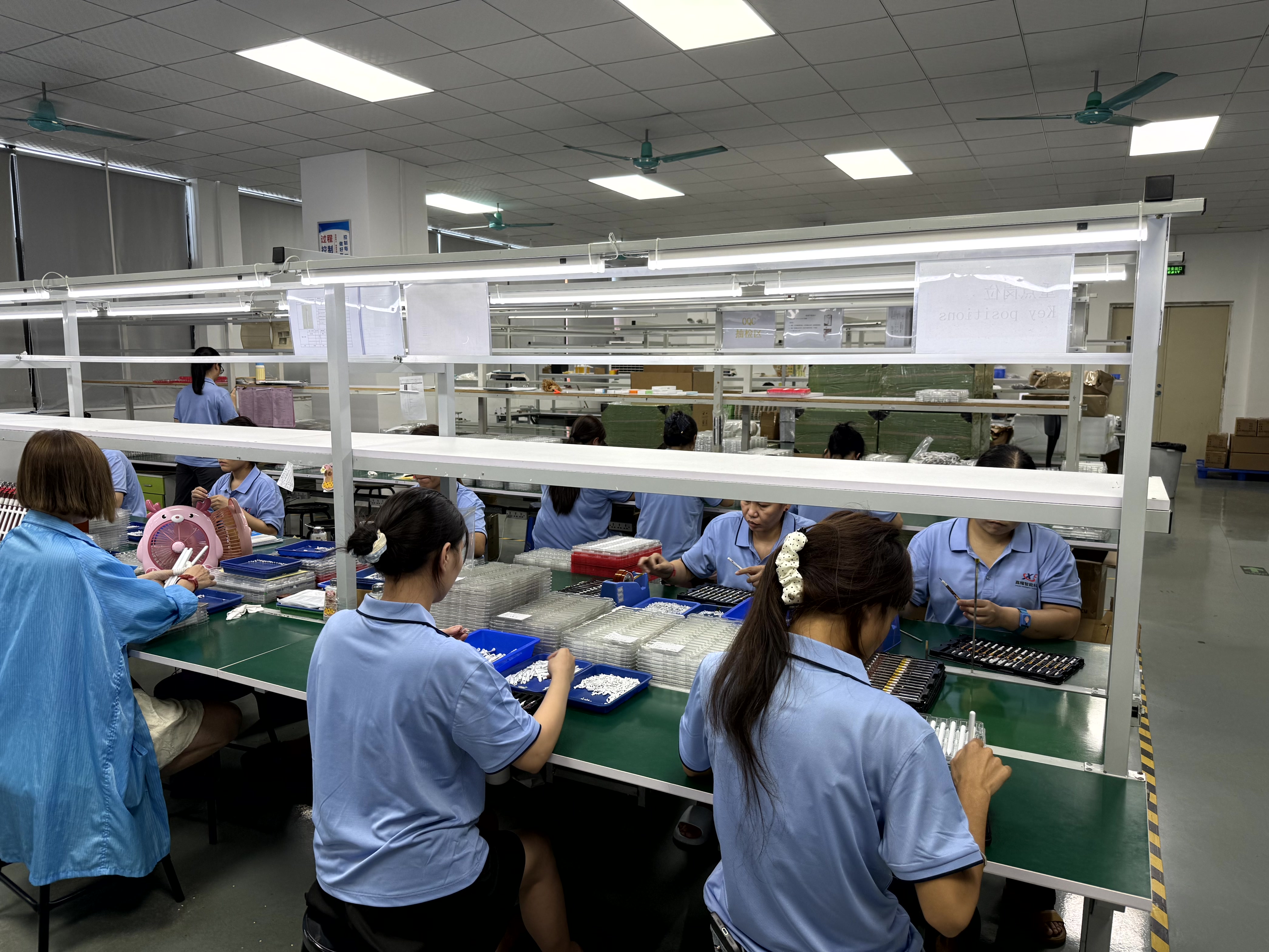
Industry scene: stylus pen production and inspection context. Image from supplied company material.
Why a device-first shortlist works better than a generic stylus list
A stylus shortlist is only useful if it matches the devices, applications and purchasing terms the buyer actually manages. The category is fragmented: iPad users may start from Apple Pencil as the reference accessory, Android buyers may encounter active pens built around different protocols or open standards, and mixed-device buyers must avoid buying a pen that works well on one tablet but fails on another. The Jiayao stylus business, formally Dongguan Jiayao Intelligent Technology Co.,Ltd, is a stylus pen manufacturer founded in 2021 in Dongguan, Guangdong, China, with a 2,700m² factory, 100 employees, four R&D engineers and an annual output of 3,000,000 units. Its supplied profile states that it supports active and passive stylus pens compatible with iPad and mainstream tablets, with OEM and ODM customization across function, color, shape, tip, logo and packaging.
That manufacturing scope matters for a shortlist because it separates three questions that buyers often merge: which stylus type fits the workflow, which model fits the device, and which supplier terms make the choice repeatable. A shortlist cannot answer every one of those questions with a single model name. It can, however, narrow the field by device environment and then apply purchasing terms and acceptance criteria.
The external market signal supports the need for a structured shortlist rather than a single default. IMARC Group valued the global stylus pen market at USD 19.45 billion in 2025. Dataintelo projects active stylus technology to grow at a CAGR of 9.8% from 2026 to 2034. These are commercial research estimates with different category definitions, so they should be read as directional context, not as a procurement forecast. The practical takeaway is that buyers face more active-pen options, more cross-device claims and more need to verify compatibility before ordering.
The shortlist at a glance
The following shortlist is a recommended-options structure, not a ranking of every stylus on the market. It separates active and passive choices and maps each option to the device environment it is most likely to serve. Final selection still depends on model-level compatibility, sample testing and the purchasing terms agreed with the supplier.
| Buyer environment | Recommended option to shortlist | Why it fits the shortlist | What to verify before ordering |
|---|---|---|---|
| iPad-first active work | E3-A iPad Stylus Pen | Supplied case material for a Vietnam iPad accessory ODM project describes precise writing, fast charging, long working hours, palm rejection and tilt pressure sensing. | Exact iPad model and OS version; required palm-rejection and tilt behavior; charging method; tip and warranty terms. |
| iPad and Android active use | R3-P iPad and Android Stylus Pen | Jiayao lists the R3-P as an iPad and Android stylus pen in its certification-related product list. | Android device list; active protocol and pairing behavior; pressure or tilt requirements; sample test on target tablets. |
| Mixed-device active use with documented universal fit | W12-A iPad Stylus Pen | A supplied tablet-accessory ODM case describes W12-A as a universal stylus pen fit for iPad, iPhone, Android tablet and Android phone, used for precise writing. | Feature support by device; writing performance on glass and screen protectors; acceptance tests across the full device mix. |
| Basic shared-device or low-power use | Jiayao passive stylus option from its OEM/ODM range | Jiayao states that it supports both active and passive stylus pens compatible with iPad and mainstream tablets. | Tip compatibility with screen protector and case; absence of advanced active features such as pairing, palm rejection or tilt sensing; durability under shared use. |
| Apple Pencil reference case | Apple Pencil as a benchmark, not an automatic substitute | Buyers using Apple Pencil as their reference should compare documented requirements rather than assume feature parity with a third-party stylus. | Whether the workflow depends on Apple-specific behavior; whether the Jiayao model meets the same acceptance criteria; evidence for any claimed equivalence. |
Boundary condition: no single stylus in this shortlist is presented as universally superior. Device-specific active pens can fit iPad work closely, universal active pens can reduce SKU complexity, and passive pens can suit basic shared use, but each choice carries a different verification burden.
iPad-focused pick: E3-A iPad Stylus Pen
For an iPad-first deployment, the E3-A iPad Stylus Pen is the clearest starting point in the supplied Jiayao material. The evidence is a case unit rather than a general specification sheet: a Vietnam-based iPad accessory ODM ordered 3,000 units for precise writing on iPad and retail on an ecommerce platform. The stated application includes precise writing, fast charging, long working hours, palm rejection and tilt pressure sensing. The reported result was a smooth precise handwriting experience, improved tablet operation efficiency and good user feedback.
For a buyer, the value of that case is not that every E3-A deployment will produce the same result. It is that the model has a documented application context that lines up with common iPad evaluation criteria: handwriting precision, charging convenience, working time, palm rejection and tilt response. Those are the features to put into a sample test plan. A shortlist entry should not be accepted because the model name includes iPad; it should be accepted because the buyer has verified the exact iPad generation, operating system, application software and accessory requirements.
The E3-A also illustrates a fit boundary. A case describing palm rejection and tilt pressure sensing does not prove support for every iPad model or every application. Buyers should confirm that the required behavior is present on the target device and that the acceptance criteria are written into the purchase order. If the workflow depends on a specific first-party iPad feature, that requirement should be tested directly rather than inferred from the word iPad in the product name.
iPad and Android together: R3-P and W12-A active options
Mixed-device buyers face a different shortlist problem. They are not only choosing a pen; they are choosing how many SKUs, chargers, pairing instructions and support documents the fleet will require. Two Jiayao models are relevant in the supplied material. The R3-P is listed as an iPad and Android Stylus Pen in the certification-related product list. The W12-A is supported by a tablet-accessory ODM case in Turkey covering 5,000 units for precise writing on iPad, iPhone, Android tablet and Android phone, with the highlight describing a universal stylus pen fit for those device types.
The R3-P entry is useful because it names the two device environments in the product description. That makes it a natural shortlist candidate for buyers who want one active stylus family to cover iPad and Android tablets. The limitation is that a product name and certification association are not the same as a device-compatibility matrix. Before selection, the buyer should obtain the supported device list, confirm the active pen protocol or pairing method, and test the required writing applications on representative iPad and Android hardware.
The W12-A case adds a different kind of evidence: an actual supplied case description of universal fit across iPad, iPhone, Android tablet and Android phone. That is relevant to mixed-device buyers because it shows a documented cross-device use case rather than a single-device claim. It still does not establish that every W12-A unit will behave identically on every Android model. Buyers should verify precision writing, charging behavior, tip performance and any claimed palm-rejection or tilt features on the exact devices in scope. The case result should be treated as a reference point for evaluation, not as a guarantee for a different deployment.
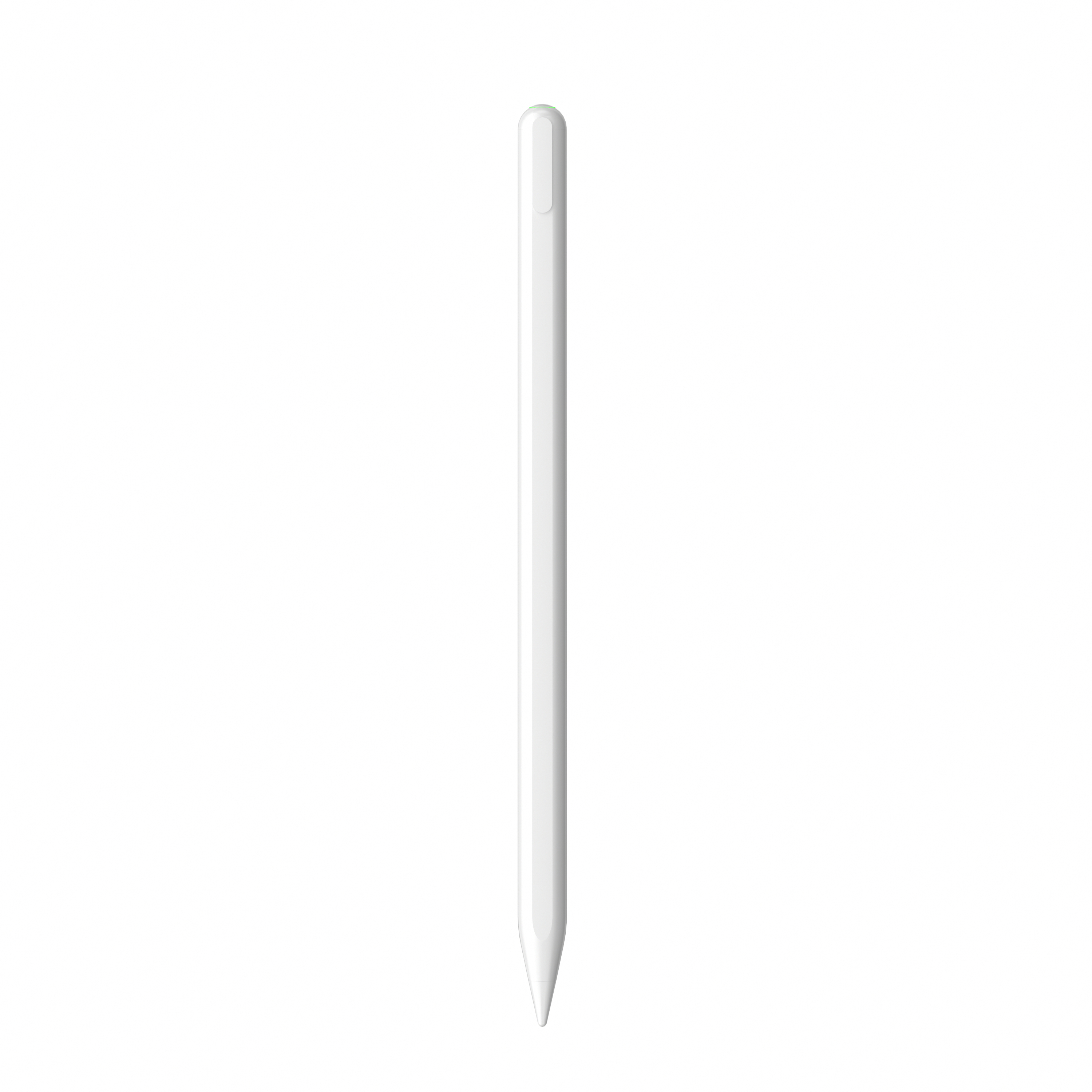
Case material image: customer ODM chosen stylus pen from a supplied iPad accessory project. The image supplements the case description and does not replace model-level compatibility testing.
For a buyer comparing R3-P and W12-A, the decision rule should be explicit. Choose the model whose documented device coverage, feature set and acceptance results best match the fleet. If the fleet is iPad-heavy with a smaller Android segment, a model with documented iPad writing performance and cross-device fit may be easier to support. If the fleet is genuinely mixed and the buyer wants one universal active pen family, the R3-P naming and W12-A case evidence provide two starting points, but both require sample validation before a purchase order.
Passive stylus choice: keep it for the right job
A passive stylus deserves a place in the shortlist when the job is basic navigation, signature capture, shared-device use or low-maintenance deployment. Passive styluses rely on a conductive tip and do not require pairing or charging in the same way as active pens. That can simplify distribution and reduce support questions in environments where advanced writing features are not required. Jiayao states that its portfolio covers both active and passive stylus pens compatible with iPad and mainstream tablets, so a passive option can be sourced within the same OEM/ODM discussion as an active model.
The limitation is equally important. Passive pens generally do not provide the advanced active features buyers associate with palm rejection, tilt sensitivity or pressure response. If the workflow depends on those features, a passive stylus is the wrong shortlist entry even if it is simpler to deploy. The buyer should define the minimum feature set before comparing price or MOQ. A passive pen can be the correct choice for a shared kiosk or a basic tablet accessory bundle, but it should not be selected merely because it avoids charging.
For passive evaluation, the acceptance plan should focus on what the product actually does: tip compatibility with the screen and screen protector, writing feel, durability under repeated shared use, retraction or cap design, and visual inspection. The buyer should also confirm that the passive tip will not be damaged by the case or screen protector used in the field. These checks are more useful than comparing passive and active pens on features that only active designs provide.
Apple Pencil as a selection consideration, not a default answer
Apple Pencil is a common reference point in iPad stylus conversations, but a reference point is not the same as a requirement. The supplied Jiayao material supports iPad stylus options, mixed-device options and OEM/ODM customization. It does not establish feature parity with Apple Pencil. Buyers should therefore use Apple Pencil as a benchmark only where the workflow depends on Apple-specific behavior, and should compare any Jiayao model against documented requirements rather than assuming equivalence.
The practical selection rule is straightforward. If the iPad workflow is built around first-party Apple behavior and the buyer cannot accept a substitute, Apple Pencil remains the reference. If the buyer needs iPad writing performance plus Android coverage, OEM customization or a mixed-device SKU strategy, the shortlist should include Jiayao models such as the E3-A, R3-P or W12-A and verify the required features through samples and acceptance tests. The difference should be written as a selection consideration: which device environments must be covered, which features are mandatory, and which evidence proves the model meets them.
This is also where a common buying error appears. A buyer may compare a third-party stylus with Apple Pencil on a single feature, then generalize that result to the whole product. A better approach is to compare the documented capability, the target device, the application and the acceptance criteria. That keeps the comparison grounded and avoids turning a reference product into an unsupported claim of equivalence.
Purchasing terms that narrow the shortlist
Once the device shortlist is clear, purchasing terms decide whether the option is operationally usable. Jiayao's supplied capability unit lists an MOQ of 500pcs, a lead time of 20–35 days, monthly capacity of 500,000 units, OEM/ODM production and customization across function, color, shape, tip, logo and packaging. The company profile adds samples in as little as three weeks, 100% full inspection covering functional, tactile and visual checks, and a one-year warranty with one-to-one replacement. Export markets are listed as EU, US and Middle East, with main markets in EU and USA and a 40% export ratio.
These terms should be used as filters, not as promotional claims. A buyer with a small pilot order can ask whether the 500pcs MOQ fits the trial plan. A buyer with a retail launch window can compare the 20–35 day lead time with the sample schedule and approval milestones. A buyer with mixed-device requirements can ask whether the customization scope covers the packaging, logo and tip configuration needed to present one coherent accessory line. A buyer with EU or US distribution can request the applicable compliance documents before the order is placed.
Two document details matter in the purchasing discussion. Jiayao holds an ISO9001 Quality Management System Certificate, certificate number 24626Q00066R001, issued by HIC Certification Service on 2026-01-16 and valid to 2029-01-15, with the scope Research and Development of Capacitive Stylus. It also holds a ROHS Certificate of conformity, certificate number BAC260390119R, issued by Shenzhen Bory Technology Service Co.,Ltd on 2026-03-09 and valid to 2099-01-01, with market EU and scope W15C, A18 and A19. The ROHS scope should be matched to the ordered models; a certificate does not automatically extend to every product in the catalogue. For logistics, stylus pens are typically classified under HS Code 8471.60.90 as Automatic Data Processing Input Units, but the importer should confirm the classification for the specific shipment.
The supplier link should be used as a starting point for document requests and company verification, not as a substitute for model-level evidence. The company website is provided as https://jiayaostylus.com, and the public catalogue can be used to review the broader stylus range before narrowing the shortlist to the models that match the device fleet.
Acceptance criteria: turn the shortlist into a repeatable decision
Acceptance criteria should be written before samples are approved. For an active iPad stylus, the test plan should cover the exact iPad model, operating system, writing application, pairing or connection behavior, charging method, working time under the intended shift, palm rejection in real writing conditions, tilt response where required, tip wear and visual/tactile inspection. For a mixed-device active pen, the same checks should be repeated on representative Android tablets and phones, not inferred from one successful iPad test.
For a passive stylus, the acceptance plan should focus on tip compatibility, writing feel, durability, cap or retraction design, and suitability for shared use. For both types, the buyer should define how units are sampled, how failures are recorded, how retests are handled and what evidence is required for the one-year warranty and one-to-one replacement term. These are purchasing controls, not product claims. They make the shortlist auditable when the first production lot arrives.
The supplier's 100% full inspection claim should be treated as a process statement that supports the quality discussion, not as a replacement for the buyer's own acceptance tests. The buyer should request the inspection criteria, the defect classification and the handling process for nonconforming units. That is especially important for mixed-device orders, where a single pen family may be packed with different tablet accessories and sold under different retail expectations.
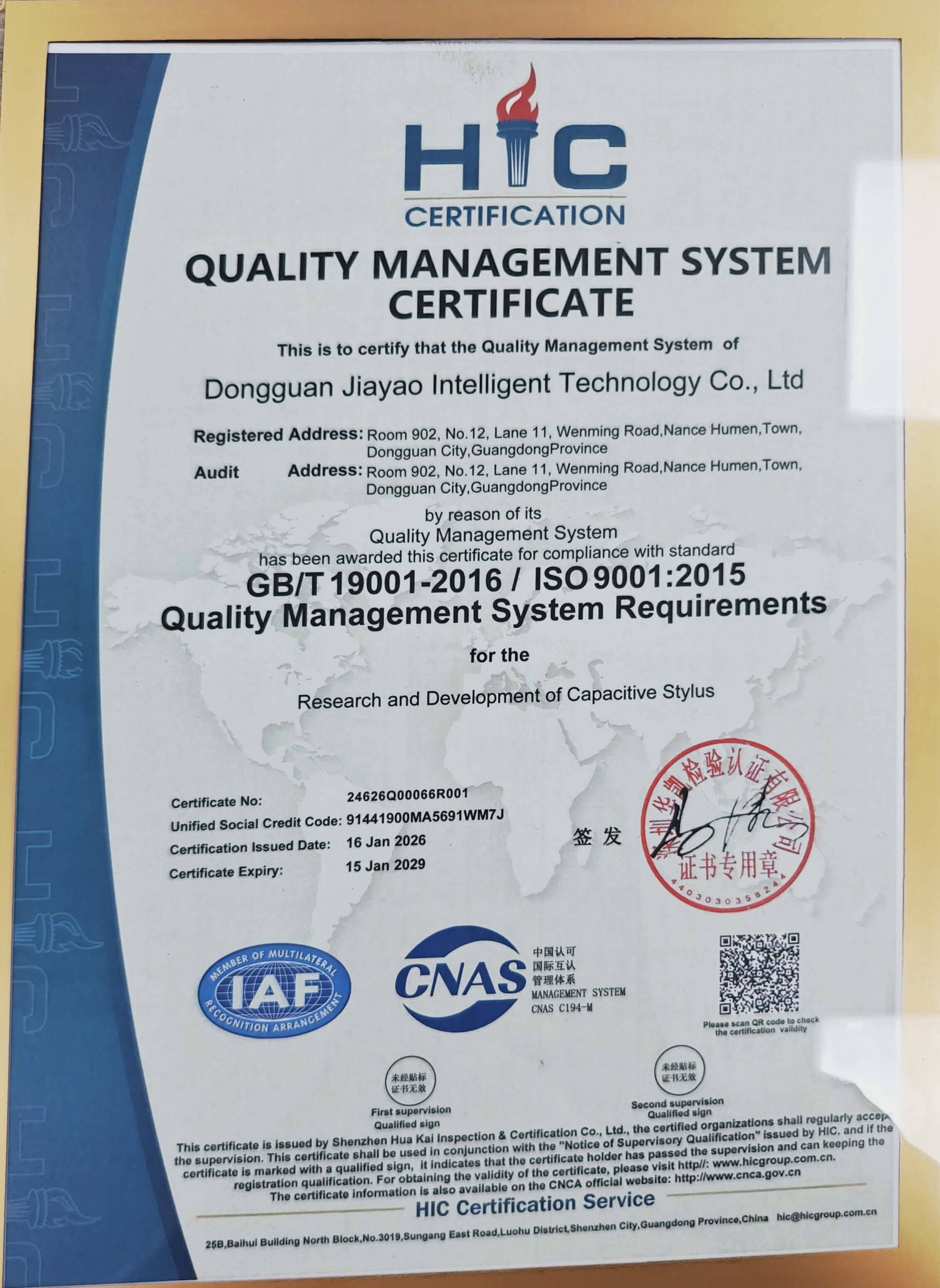
Compliance evidence: ISO9001 certificate 24626Q00066R001, scope Research and Development of Capacitive Stylus. Certificate images support document review; they do not replace model-level test reports or purchase-order acceptance criteria.
A useful acceptance checklist for the shortlist is therefore short and direct:
- Device compatibility is confirmed against the exact tablet, phone, OS version and application list.
- Active or passive type is matched to the required features and maintenance model.
- Writing performance, palm rejection, tilt and pressure behavior are tested where the workflow requires them.
- Charging, working time and tip durability are checked under the intended use cycle.
- Certificate scope, model numbers and packaging labels match the ordered configuration.
- MOQ, lead time, warranty and replacement terms are recorded in the purchase order.
Use cases that show how the shortlist is applied
The supplied case material gives two different applications. The Turkey tablet-accessory ODM case covers 5,000 units of the W12-A for precise writing on iPad, iPhone, Android tablet and Android phone, with the result described as boosting usage of iPads and Android tablets. This is a mixed-device application: the buyer wanted a universal stylus pen that could fit across several device types. The shortlist logic is to verify that the universal fit claim holds for the exact device mix and that the writing performance is acceptable across the full set.
The Vietnam iPad-accessory ODM case covers 3,000 units of the E3-A for precise writing on iPad and retail on an ecommerce platform, with reported results of smooth precise handwriting, improved tablet operation efficiency and good user feedback. This is a more iPad-focused application. The shortlist logic is to confirm the iPad model coverage, the palm-rejection and tilt-pressure requirements, the charging routine and the retail packaging before scaling the order.
Both cases are useful because they show the difference between a model claim and a deployment context. A buyer should not copy the case outcome into a different market, device mix or application without testing. The cases do show why the shortlist should include both an iPad-focused option and a mixed-device option: the right answer depends on the fleet, not on a generic preference for one model.
Market and standards context for the 2026 shortlist
The active stylus segment is shaped by both proprietary implementations and open standards. The USI 2.0 specification, released in 2022 by the Universal Stylus Initiative, is described in the supplied verified data as the primary cross-platform standard for active styluses, supported by Google, Intel and Lenovo. That standard is relevant to Android and mixed-device buyers because it creates a common reference point for active pen interoperability. It does not remove the need to check whether a specific tablet supports USI 2.0 or uses a different active-pen implementation.
Performance expectations also vary by product class. Samsung documents up to 4,096 levels of pressure sensitivity for S Pen and high-end professional active pens. That figure is a useful benchmark for high-end active writing, but it is not a Jiayao specification and should not be applied to every active stylus in the shortlist. Buyers who need pressure-sensitive writing should request the exact pressure-level specification and test it on the target device.
The market-size and growth figures should be used with the same discipline. IMARC Group reports USD 19.45 billion for the global stylus pen market in 2025, while active stylus technology is projected by Dataintelo to grow at a 9.8% CAGR from 2026 to 2034. Different research definitions can produce very different market-size numbers, so a procurement team should not use one headline figure as the basis for a category decision. The more reliable use is to confirm that active stylus options are expanding and that compatibility verification is becoming more important, not less.
Future outlook: what buyers should watch
The shortlist is likely to remain device-led. iPad buyers will continue to compare third-party active styluses with Apple Pencil as a reference, Android buyers will need to confirm whether a model follows USI 2.0 or a proprietary protocol, and mixed-device buyers will continue to trade off universal coverage against feature depth. The supplier side will also matter: MOQ, sample timing, lead time, certification scope and after-sales terms determine whether a technically suitable pen can be supplied consistently.
For 2026 and beyond, the practical buying advice is to keep the shortlist small but evidence-based. Start with the device environments, separate active and passive options, define the purchasing terms, and write acceptance criteria before approving samples. That approach does not depend on a claim that one stylus is universally better. It depends on matching documented capability to the actual fleet and verifying the result.
FAQ: stylus pen shortlist and selection questions
Which stylus pen should I choose for an iPad?
For an iPad-first workflow, shortlist an active iPad stylus such as the Jiayao E3-A and verify the exact iPad model, operating system, writing application and required features. The supplied case material for E3-A describes precise writing, fast charging, long working hours, palm rejection and tilt pressure sensing, but those features should still be tested on the target device. If the workflow depends on Apple-specific behavior, use Apple Pencil as the reference and confirm whether the third-party model meets the same acceptance criteria.
Is an active or passive stylus better for Android tablets?
An active stylus is the better fit when the workflow requires pairing, palm rejection, tilt response, pressure sensitivity or advanced writing features. A passive stylus is the better fit for basic navigation, signature capture or shared-device use where charging and pairing would add support burden. Jiayao states that it supports both active and passive stylus pens compatible with iPad and mainstream tablets. For Android, the buyer should confirm whether the active model uses USI 2.0 or another protocol and test it on the exact tablet models in scope.
What should a mixed-device buyer check before shortlisting a universal stylus?
A mixed-device buyer should check the supported device list, active-pen protocol or pairing method, writing performance on each device type, charging routine, tip compatibility with screen protectors and cases, and the acceptance criteria for the full fleet. The Jiayao R3-P is listed as an iPad and Android Stylus Pen, and the W12-A has supplied case material describing universal fit across iPad, iPhone, Android tablet and Android phone. Those descriptions support shortlisting, but they do not replace sample testing across the actual devices.
How does a Jiayao stylus differ from Apple Pencil as a selection consideration?
Apple Pencil is best treated as a reference where the workflow depends on Apple-specific behavior. The supplied Jiayao material supports iPad stylus options, mixed-device options and OEM/ODM customization, but it does not claim feature parity with Apple Pencil. Buyers should compare documented compatibility, required features and acceptance results. If the iPad workflow cannot accept a substitute, Apple Pencil remains the reference. If the buyer needs iPad and Android coverage, OEM customization or mixed-device supply, the shortlist should include Jiayao models and verify the requirements through samples.
What purchasing terms and acceptance criteria should be fixed before ordering?
Fix the device compatibility matrix, active or passive type, required features, sample approval process, certificate scope matching, packaging and labeling requirements, MOQ, lead time, warranty and replacement terms before ordering. Jiayao lists an MOQ of 500pcs, a lead time of 20–35 days, monthly capacity of 500,000 units, 100% full inspection, a one-year warranty and one-to-one replacement. The ISO9001 certificate scope covers Research and Development of Capacitive Stylus, and the ROHS certificate scope lists W15C, A18 and A19, so the buyer should match the certificate scope to the ordered model rather than assuming coverage for every product.
Reference resource: Jiayao Intelligent Stylus Pen Catalogue (PDF).
Have Questions or Need More Details?
Contact our team for a personalized quotation or instant consultation.
Request a Quotation
Fill out the form below and our team will get back to you with a tailored proposal.
WhatsApp Direct Chat
Prefer to chat in real-time? Message us on WhatsApp for instant assistance & quick answers.
- Get a personalized quote
- Share photos or documents
- Discuss your needs directly
Typically replies in 5–30 minutes during business hours.