
2026 Switchgear Shortlist: KYN28-12, GCS, MNS, XGN15 RMU
The right switchgear for a 2026 project is rarely the model with the widest headline rating. It is the model whose voltage class, busbar current, maintenance architecture and enclosure-and-insulation combination match the physical and operational constraints of the site. This shortlist evaluates four model families against those constraints: KYN28-12 for 12 kV indoor medium-voltage distribution, GCS and MNS for heavy industrial low-voltage distribution between 1600 A and 4000 A, and XGN15-12 / XGN15-24 ring main units for compact urban network nodes.
The global switchgear market is estimated at USD 119.7 billion in 2026, according to a commercial research estimate published by Grand View Research (methodology and segment boundary not independently verified here). Global electricity demand rose 4.3% in 2024 and is forecast to continue growing at close to 4% out to 2027, according to the International Energy Agency. Those two figures describe the size of the project pipeline, not the answer to a procurement question. For a buyer, the useful output of a 2026 review is a shortlist with stated inclusion criteria and stated limits.
Assign a model by three measurable constraints, in this order: (1) system voltage and rated current; (2) whether the project needs single-circuit maintenance without a full busbar shutdown, which points to a withdrawable architecture; (3) the enclosure material and insulation medium the site environment will actually tolerate. KYN28-12 satisfies the first at 12 kV across 630–4000 A. GCS and MNS satisfy the first and second on the low-voltage side at 1600–4000 A main busbar current. XGN15-12 and XGN15-24 satisfy the third where space is tight and an SF₆-sealed stainless steel gas tank is preferable to an air-insulated enclosure.
Why the shortlist starts with the project, not the model
Switchgear is a centralized collection of circuit breakers, fuses and switches that protect electrical equipment and circuits — a technical definition used by Eaton in its own product documentation. That definition is deliberately broad, and it explains why model-level comparisons often fail: two cabinets can both be called switchgear while differing in voltage class by an order of magnitude, in current rating by a factor of six, and in maintenance architecture by whether a breaker can be physically withdrawn from a live busbar section.
A shortlist that starts from the model tends to produce a specification written backwards — the project is bent to fit the catalog. A shortlist that starts from the project produces a defensible RFQ. The sequence used in this article is:
- Voltage class first. 12 kV indoor distribution, 24 kV urban ring distribution and 380/660 V low-voltage distribution are not interchangeable layers. IEC 62271-200 addresses AC metal-enclosed switchgear for rated voltages above 1 kV and up to and including 52 kV, while IEC 61439-1:2020 sets general definitions, service conditions, construction requirements, technical characteristics and verification requirements for low-voltage switchgear and controlgear assemblies. Both references are indexed here through standards sources; the current official editions should be confirmed before a specification is frozen.
- Current envelope second. A 630 A incoming feeder and a 4000 A main busbar section are different procurement problems, even when both are described as low-voltage switchgear.
- Maintenance architecture third. Withdrawable and fixed designs answer different operational questions. A withdrawable unit supports work on one circuit while the rest of the assembly remains energized. A fixed design is structurally simpler and, in the case of an SF₆ ring main unit, more compact.
- Environment fourth. Altitude, salt-laden air, chemical exposure, humidity and dust determine whether a standard enclosure specification survives the warranty period.
The four-model shortlist at a glance
The table below states only specifications that appear in the referenced product data. Where a parameter is not stated in that data, the cell says so rather than inferring a value.
| Model | Construction | Rated voltage | Rated current | Insulation & enclosure basis | Protection degree | Project profile it fits |
|---|---|---|---|---|---|---|
| KYN28-12 | Indoor metal-clad withdrawable | 12 kV, 50 Hz | 630–4000 A | Aluzinc-coated steel enclosure, T2 silver-plated copper busbars, epoxy resin and SMC composite insulation | IP4X enclosure; IP2X with circuit breaker door open | 12 kV indoor incoming and distribution, single busbar and single busbar sectionalized systems |
| GCS | Low-voltage withdrawable | 380 V / 660 V operating; 660 V insulation | Main busbar 1600–4000 A; vertical busbar 1600 A | Galvalume or cold-rolled galvanized steel with electrostatic coating, T2 copper busbars, SMC / epoxy / PVC insulation | IP30 | Heavy industrial low-voltage distribution requiring single-circuit maintenance |
| MNS | Low-voltage withdrawable | 380 V / 660 V operating; 660 V insulation | Main busbar 1600–4000 A; vertical busbar 1600 A | Galvalume or cold-rolled galvanized steel with electrostatic coating, T2 copper busbars, SMC / epoxy / PVC insulation | IP30 | Commercial, real estate and industrial low-voltage distribution with draw-out maintenance logic |
| XGN15-12 | Metal-enclosed fixed SF₆ ring main unit | 3.6–12 kV, 50 Hz | Not stated in the referenced specification | Stainless steel sealed gas tank, T2 tinned or silver-plated copper, epoxy resin and SMC insulation, SF₆ arc-extinguishing and insulating medium | Not stated in the referenced specification | Compact 12 kV cable ring networks, secondary substations, switching stations |
| XGN15-24 | Gas-insulated metal-enclosed fixed RMU | 24 kV, 50 Hz | 630 A / 1250 A | Fully welded 304 stainless steel gas tank, SF₆ insulating medium, annual leakage rate ≤0.5% | IP67 inside gas tank; IP34D outside cabinet | 24 kV urban ring network construction and renovation, terminal distribution |
KYN28-12: the 12 kV indoor backbone
KYN28-12 is an indoor AC metal-clad withdrawable switchgear assembly rated 12 kV at 50 Hz, covering a rated current range of 630 A to 4000 A. Its fault-duty envelope is stated as 20–50 kA rated short-circuit breaking current and 50–125 kA rated short-circuit making current, with a 4 s short-time thermal withstand of 20 / 25 / 31.5 / 40 / 50 kA and a rated peak withstand of 50 / 63 / 80 kA. Dielectric verification is expressed as a 1-minute power-frequency withstand of 42 kV phase-to-phase and phase-to-earth, 48 kV across the isolation break, and a lightning impulse withstand of 75 kV and 85 kV respectively.
The materials record matters more than the headline ratings, because it is the part a buyer can physically verify. The cabinet enclosure is aluzinc-coated steel sheet. Conductive busbars are T2 copper with silver plating. Insulating components are epoxy resin and SMC composite. Fasteners are stainless steel, and sealing is provided by rubber strips. Each of those choices maps to a failure mode: coated steel addresses enclosure corrosion, silver plating on T2 copper addresses contact resistance at joints, and solid epoxy/SMC insulation removes dependence on gas pressure inside the compartment.
The specified application scope is three-phase AC 50 Hz systems at 3–12 kV, suitable for single busbar and single busbar sectionalized arrangements. Field use in the reference project data covers 10 kV incoming, breaking, protection and metering duties, including short-circuit, overload and earth-fault protection for transformers and downstream low-voltage equipment, in urban distribution switching stations, substations, industrial high-voltage rooms, photovoltaic and wind booster stations, and ring network lines.
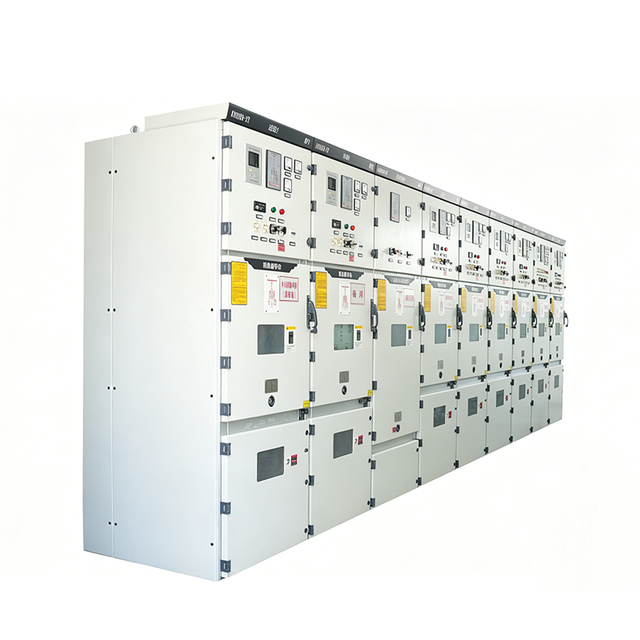
KYN28-12 indoor metal-clad withdrawable AC switchgear. The withdrawable architecture allows a single circuit to be isolated for maintenance while the busbar section remains energized.
GCS and MNS: heavy industrial low voltage
GCS and MNS occupy the same electrical tier in the referenced specifications. Both are low-voltage withdrawable assemblies with a 660 V rated insulation voltage, 380 V / 660 V rated operational voltage, a main busbar maximum operating current of 1600–4000 A, a main busbar short-time withstand of 100 kA for 1 second and a short-time peak of 120 kA. The vertical (distribution) busbar is rated at a maximum operating current of 1600 A, with a short-time peak of 80 kA in the standard type and 100 kA in the reinforced type. Both carry an IP30 protection degree.
Because the electrical envelope is identical, the selection between GCS and MNS should be driven by project-side factors rather than by headline ratings. That is an important discipline for a shortlist: presenting two models as electrically different when the published data says they are not would be a fabrication. What the reference data does support is that the draw-out MNS configuration allows independent circuit maintenance without a full power cut, which shortens downtime.
The material specification is shared as well: galvalume or cold-rolled galvanized steel frames, enclosures and partitions, integrally bent and assembled with electrostatic plastic coating; galvanized steel draw-out unit housings with integrated reinforcing ribs; T2 copper busbars and contact terminals with tin or silver plating; SMC unsaturated polyester moulding compound, epoxy resin and PVC insulating sleeves; copper-core PVC insulated primary and secondary wiring; foamed rubber sealing strips and damping pads; and 304 stainless steel fasteners.
Stated application coverage for this tier is broad: thermal, hydro, photovoltaic, energy storage and wind plants, substations and nuclear auxiliary distribution; metallurgy, steel, petrochemical, offshore oil and gas, coal mine, papermaking, automobile, textile, machinery and semiconductor plants; data centers, communication rooms and charging-station distribution; metro, rail, airport, seaport, tunnel and logistics park infrastructure; and high-rise, commercial, residential, hospital, school and exhibition buildings.
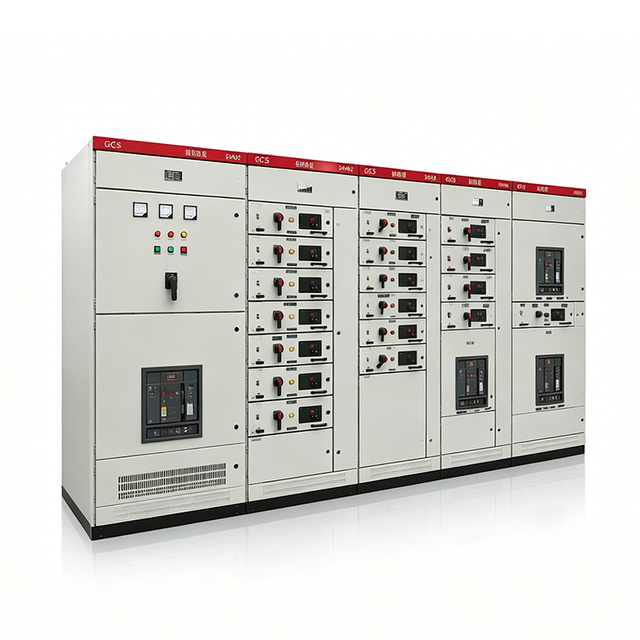
GCS low-voltage withdrawable switchgear. The vertical distribution busbar is rated at 1600 A, which sets the practical limit on branch density per vertical section.
XGN15-12 and XGN15-24: compact urban network nodes
The ring main unit answers a different question from the metal-clad cabinet: how to switch and protect a medium-voltage cable ring in a footprint that a city block will actually grant. XGN15-12 is a metal-enclosed fixed-type unit for three-phase AC systems at 50 Hz with a rated voltage from 3.6 kV to 12 kV, used for power receiving and distribution. Its cabinet frame is galvanized or galvalume steel sheet, the sealed gas tank is stainless steel plate, conductive busbars and contacts are T2 pure copper with tin or silver plating, insulating components are epoxy resin and SMC composite, and sulfur hexafluoride serves as the arc-extinguishing and insulating medium.
XGN15-24 carries the same architecture to 24 kV with a fuller published parameter set: rated current of 630 A or 1250 A, a 4-second short-time withstand of 20 kA or 25 kA, a rated peak withstand of 50 kA or 63 kA, rated short-circuit breaking and making currents of 20 / 25 kA and 50 / 63 kA, and a 20 kA / 4 s earthing switch withstand. The insulating medium is SF₆ at a rated filling pressure of 0.04–0.06 MPa gauge at 20 °C, with a minimum operating pressure of 0.02 MPa and an annual gas leakage rate of ≤0.5%. Dielectric verification is 65 kV power-frequency withstand for 1 minute and 125 kV lightning impulse withstand.
Mechanically, the load switch is rated for at least 5,000 operations and the earthing switch for at least 2,000, with manual spring operation as standard and electric operation optional. The protection degrees are meaningful for siting decisions: IP67 inside the gas tank and IP34D on the outside of the cabinet. The stated service environment is −25 °C to +40 °C, altitude ≤2000 m unless a customized version is specified, daily average relative humidity ≤95% and monthly average ≤90%, for indoor installation free of flammable, explosive and corrosive gases.
The insulation choice is the reason this model family sits on the shortlist at all. Sealing the live parts inside a fully welded 304 stainless steel tank assessed to IP67, with a stated leakage rate of ≤0.5% per year, removes the dependence of dielectric performance on ambient humidity and airborne dust to a degree that an air-insulated enclosure cannot match. That is a design trade, not a marketing claim: the price of that compactness is a fixed rather than withdrawable architecture and a gas inventory that must be monitored over the service life.

XGN15 series SF₆ ring main unit. The sealed stainless steel gas tank is assessed to IP67 internally, with IP34D on the outer cabinet.
The constraint matrix: matching model to load and environment
A shortlist becomes usable when it is expressed as a decision rule rather than a product list. The matrix below links a project constraint to the model family it selects and the documented basis for that selection.
| Project constraint | Trigger condition | Model to shortlist | Documented basis |
|---|---|---|---|
| Medium-voltage indoor incoming and distribution | 12 kV system, 630–4000 A, single busbar or sectionalized single busbar | KYN28-12 | 12 kV rated voltage; 630–4000 A rated current; 20–50 kA breaking capacity; IP4X enclosure |
| Heavy industrial low-voltage main distribution | Main busbar demand in the 1600–4000 A band; single-circuit maintenance without full shutdown | GCS or MNS | 1600–4000 A main busbar; 100 kA 1 s withstand; 1600 A vertical busbar; draw-out architecture |
| Compact 12 kV cable ring network | Secondary substation, switching station or terminal distribution in a restricted footprint | XGN15-12 | Metal-enclosed fixed type; 3.6–12 kV; SF₆ insulating medium; stainless steel sealed tank |
| 24 kV urban ring construction or renovation | 630–1250 A ring or terminal duty; indoor siting | XGN15-24 | 24 kV; 630 A / 1250 A; 20–25 kA 4 s; IP67 gas tank; ≤0.5% annual leakage |
| High altitude above 2000 m | Reduced air density and corona risk | Any listed model, with modification | Increased insulation clearance, derated components, reinforced outer insulation against corona, reinforced cabinet sealing; XGN15-24 standard scope is ≤2000 m with a customized version above that |
| Coastal salt corrosion | Salt spray exposure at the installation site | Any listed model, with enclosure upgrade | Hot-dip galvanized or fluorocarbon coated cabinets; aluminium alloy bus housing; 304 stainless steel fasteners |
| Chemical corrosive atmosphere | Acid, alkali or solvent vapour present | Any listed model, with containment upgrade | Anti-corrosion coating; FRP accessories; fully enclosed structure to isolate corrosive gas |
| High-humidity basement or utility tunnel | Condensation risk on live parts | Any listed model, with anti-condensation package | Temperature and humidity controller; built-in heater; anti-condensation cabinet structure |
| Heavy dust workshop | Conductive or abrasive dust in the room | Any listed model, with ingress upgrade | Protection class upgraded to IP40 or IP54; fully enclosed cabinets; dust-proof bus ducts |
| Outdoor installation, −30 °C to +50 °C | Site has no electrical room | YBW-12 prefabricated substation or XLW outdoor enclosure | Sun-proof, rain-proof and anti-condensation structure for open-air photovoltaic stations and municipal networks |
Reading the enclosure and insulation choices like a buyer
Most switchgear specifications are written in a way that makes every offer look equivalent. Enclosure material and insulation medium are the two fields where that equivalence usually breaks, and both are directly verifiable during a factory visit or a document review. Four checks follow from the data above.
Check 1 — Sheet material and coating system
Aluzinc-coated steel, galvalume steel, cold-rolled galvanized steel with electrostatic coating, hot-dip galvanized steel and 304 stainless steel plate are not decorative alternatives. KYN28-12 specifies aluzinc-coated steel for the cabinet enclosure. The GCS and MNS families specify galvalume or cold-rolled galvanized steel with electrostatic plastic coating. XGN15-12 and XGN15-24 specify galvanized or galvalume steel for frames, with a stainless steel plate gas tank. In a dry indoor electrical room the difference may be immaterial over the first decade. In a coastal or chemical site, the reference data points to hot-dip galvanizing, fluorocarbon coating and 304 stainless steel fasteners as the specified response.
Check 2 — Busbar conductor and contact finish
Every model in this shortlist uses T2 pure copper busbars. The differentiator is the contact surface: silver plating on KYN28-12, and tin or silver plating on the GCS, MNS and XGN15 families. Because the contact finish is what governs joint resistance over time, it belongs in the RFQ as a named requirement rather than as a general statement about copper content.
Check 3 — Solid versus gas insulation
KYN28-12, GCS and MNS rely on solid insulation: epoxy resin and SMC composite in the medium-voltage assembly, SMC, epoxy and PVC in the low-voltage assemblies. There is no gas pressure to monitor and no annual leakage figure to track. XGN15-12 and XGN15-24 rely on SF₆, which is what allows the compact footprint, and which comes with two obligations that a buyer should write into the maintenance plan: a minimum operating pressure of 0.02 MPa and an annual leakage rate of ≤0.5% on the 24 kV model.
Check 4 — Protection degree against the room, not the datasheet
IP30 is the stated rating for GCS and MNS. KYN28-12 is rated IP4X with the circuit breaker door closed and IP2X with the door open. XGN15-24 is IP67 inside the gas tank and IP34D outside the cabinet. None of these ratings compensates for a room that is fundamentally unsuitable. Where dust, humidity or corrosive gas is present, the reference data calls for raising the protection class to IP40, IP54 or IP65 and for adding heaters, humidity controllers or a fully enclosed structure — an enclosure decision that precedes the model decision.
Market context behind the 2026 shortlist
Three structural signals shape how this shortlist should be read. First, demand growth and market growth are not the same curve. The IEA reports global electricity demand rose 4.3% in 2024 and is forecast to grow at close to 4% through 2027, while the commercial estimate cited for the global switchgear market places 2026 at USD 119.7 billion. Where equipment demand grows faster than consumption, replacement cycles and digitalization are part of the explanation. For a buyer, the practical implication is that lead-time pressure is a planning assumption, not an anomaly.
Second, supply concentration is measurable at the trade level. China was the top exporter of electrical control boards under HS 8537 in 2024 at USD 15.4 billion, according to the Observatory of Economic Complexity. That figure covers a customs heading rather than switchgear alone, so it should be read as a sourcing-geography signal, not as a market share claim for any product family.
Third, the technical frame is moving. A 2022 peer-reviewed review of switchgear digitalization classifies the research field into predictive maintenance, condition monitoring and related areas — which means monitoring capability is becoming a specification item rather than an add-on. Commercial research coverage also identifies data center transfer switches and switchgear as a defined demand segment, though the publisher's methodology is not disclosed in the retrieved material and no market value from that source is used here.
Where this shortlist stops working
A reference article that only lists strengths is not a reference. The following limits are inherent to the four models above and to the way they are specified.
- The shortlist is not a full catalog. GGD and GCK low-voltage assemblies, the YBW-12 prefabricated substation, the DFW cable distribution box, the PZ30 terminal box and the VFD control cabinet all appear in the same manufacturer's product scope, and any of them may be the correct answer for a specific project. A 12 kV indoor distribution room and a fan-and-pump variable-frequency application are not the same procurement decision, and this document does not attempt to rank them against each other.
- KYN28-12 requires front access space. The assembly is withdrawable and rated IP2X with the circuit breaker door open. That access envelope has to exist in the room. In a retrofit where the available footprint cannot provide it, a fixed SF₆ ring main unit is the structurally appropriate alternative — not a smaller KYN28.
- The 1600 A vertical busbar is a hard ceiling. GCS and MNS main busbars reach 4000 A, but the vertical distribution busbar is limited to 1600 A maximum operating current. A project that concentrates more than 1600 A of branch load on a single vertical section cannot be solved by specifying a larger main busbar; the busbar section has to be split at the design stage.
- XGN15-24 has siting conditions attached. It is specified for indoor installation in an environment free of flammable, explosive and corrosive gases, at ≤2000 m altitude in standard form and within −25 °C to +40 °C. If the site cannot meet those conditions, the environment has to be corrected or a customized version specified before the model can be confirmed.
- Some parameters are simply not in the reference data. Rated current and protection degree for XGN15-12 are not stated in the specification used for this article. A buyer should not infer them from the 24 kV model. They must be requested in writing as part of the technical clarification round.
Manufacturing and customization context
Changzhou Tuoxin Electric Co., Ltd. is a switchgear manufacturer based in Xixiang Industrial Park, Hengshanqiao, Changzhou, Jiangsu Province, China, established in 2010. Its stated product scope covers high-voltage switchgear including the KYN28 and XGN15 series, low-voltage switchgear including the GBD, MNS, GGD, GXL, XL and XLW series, YB series box-type substations, custom non-standard electrical control cabinets, PZ30 modular terminal lighting distribution boxes, XJM metering boxes and bus ducts of various specifications.
For a shortlist to be executable, the customization envelope has to be stated alongside the model. The published capability data gives a monthly capacity of 300 units, a lead time of 30–45 days, a minimum order quantity of 1 unit and 100% testing. Customization covers cabinet dimensions, cabinet material options including cold rolled steel, galvalume steel and aluminium alloy, surface treatments including electrostatic powder coating, hot-dip galvanizing and fluorocarbon coating, door configurations, nameplates and OEM brand marking, and protection grade upgrades across IP30, IP40, IP54 and IP65. After-sales support is described as remote technical support on a 7×12 hour online basis, with on-site support available domestically and overseas. Those are the figures a buyer needs to test whether a 2026 delivery schedule is realistic; they are not a substitute for a factory audit.
A reference project in China installed 1000 units of high- and low-voltage switchgear, box-type substations, bus ducts and distribution boxes, providing multi-level protection against short circuit, overload, leakage and earth fault. The stated design service life for KYN28 and XGN15 high-voltage switchgear is 20–30 years, extending to 25–30 years in regularly maintained indoor electrical rooms, and remaining at 20 years or more in coastal, chemical and dusty sites where anti-corrosion customization is applied.
Future outlook
Two forces are likely to change how a shortlist like this is written by 2027. The first is monitoring. If predictive maintenance and condition monitoring continue to develop as established research streams in switchgear digitalization, then the ability to accept current and temperature sensing becomes a fourth selection constraint alongside voltage, current and maintenance architecture. Assemblies specified today without provision for that may need retrofit later.
The second is standards alignment. IEC 61439-1:2020 and the IEC 62271 family define verification requirements that shift with edition. A shortlist that names a model without naming the standard edition it was verified against will age faster than the equipment. Buyers preparing 2026 tenders should bind the model selection to a specific standard edition and request the corresponding verification documentation, rather than accepting a generic conformity statement.
Frequently asked questions
KYN28-12 is the model in this shortlist specified for that role. It is an indoor AC metal-clad withdrawable assembly rated 12 kV at 50 Hz with a rated current range of 630–4000 A, suitable for three-phase AC systems from 3 kV to 12 kV in single busbar and single busbar sectionalized arrangements. Its rated short-circuit breaking current is 20–50 kA and its 1-minute power-frequency withstand is 42 kV phase-to-phase and phase-to-earth, with 48 kV across the isolation break. The enclosure is aluzinc-coated steel with T2 silver-plated copper busbars and epoxy resin plus SMC composite insulation, rated IP4X with the door closed and IP2X with the circuit breaker door open.
On the published specifications the two families share the same electrical envelope: 660 V rated insulation voltage, 380 V / 660 V rated operational voltage, 1600–4000 A main busbar maximum operating current, 100 kA main busbar short-time withstand for 1 second, 120 kA short-time peak, a 1600 A vertical busbar and IP30 protection. Because the electrical parameters are identical, the decision should rest on project-side factors such as busbar section planning and maintenance strategy. The reference data specifically notes that the draw-out MNS configuration allows independent circuit maintenance without a full power cut, which shortens downtime.
The XGN15 series SF₆ ring main units are specified for that profile. XGN15-12 is a metal-enclosed fixed-type unit for three-phase AC 50 Hz systems from 3.6 kV to 12 kV, used for power receiving and distribution, with a stainless steel sealed gas tank and SF₆ as the arc-extinguishing and insulating medium; its stated applications include small secondary substations, switching stations, industrial and mining enterprises, urban residential communities, airports, railways, tunnels and high-rise buildings. XGN15-24 extends the same architecture to 24 kV at 630 A or 1250 A, rated IP67 inside the gas tank and IP34D outside the cabinet, with an annual gas leakage rate of ≤0.5%.
Both conditions act on the enclosure and insulation specification rather than on the model name. Above 2000 m, the reference requirements are increased insulation clearance, derated components, reinforced outer insulation against corona and reinforced cabinet sealing; XGN15-24 is specified for ≤2000 m in standard form and requires a customized version above that. For coastal salt corrosion, the specified response is hot-dip galvanized or fluorocarbon coated cabinets, aluminium alloy bus housing and 304 stainless steel fasteners. KYN28-12 is specified for standard indoor conditions of −10 °C to +40 °C, and XGN15-24 for −25 °C to +40 °C with daily average relative humidity up to 95%.
The reference data states a design service life of 20–30 years for KYN28 and XGN15 high-voltage switchgear, with 25–30 years in regularly maintained indoor electrical rooms and 20 years or more in coastal, chemical and dusty sites where anti-corrosion customization is applied. For XGN15-24 the mechanical endurance figures are at least 5,000 operations for the load switch and at least 2,000 operations for the earthing switch. Design service life is not stated in the same reference data for the GCS and MNS low-voltage assemblies; their documented operational advantage is the draw-out architecture that permits single-circuit maintenance without a full shutdown.
Specification notes: voltage, current, fault-duty, protection-degree and material values in this article are taken from the referenced product specifications for KYN28-12, GCS, MNS, XGN15-12, XGN15-24 and YBW-12. Market and standards context is attributed to Grand View Research (commercial estimate, methodology not independently verified), the International Energy Agency, the Observatory of Economic Complexity, IEC 61439-1:2020, an indexed reference to IEC 62271-200 (current edition to be confirmed) and a 2022 peer-reviewed review of switchgear digitalization. Where a parameter was not stated in the source specification, it has been left unstated rather than estimated.
Have Questions or Need More Details?
Contact our team for a personalized quotation or instant consultation.
Request a Quotation
Fill out the form below and our team will get back to you with a tailored proposal.
WhatsApp Direct Chat
Prefer to chat in real-time? Message us on WhatsApp for instant assistance & quick answers.
- Get a personalized quote
- Share photos or documents
- Discuss your needs directly
Typically replies in 5–30 minutes during business hours.