
2026 Titanium Application Trends: Vertical Integration Defines Supplier Reliability
INDUSTRY ANALYSIS | JULY 2026
The Changing Landscape of Industrial Titanium Procurement
The industrial titanium market is undergoing a structural shift. Buyers of critical components such as titanium heat exchanger plates, electrolyzer bipolar plates, pressure vessel shells, and desalination evaporator plates are increasingly prioritizing supply chain reliability over upfront price. This trend reflects a deeper understanding that the performance of corrosion-resistant titanium in harsh environments depends not only on the final forming process but on the quality and traceability of the raw material — from the sponge stage onward.
Xrun, a vertically integrated titanium manufacturer based in Xi'an, China, has positioned itself to address this procurement challenge. Established in 2016, Xiangrun (Xi'an) Titanium Materials Technology Co., Ltd. operates what it describes as China’s first end-to-end titanium supply chain, covering “Coal – Electricity – Titanium Ore – Titanium Sponge – Titanium Processed Materials – Finished Products.” With a factory area of 2,466,667 m² and a workforce of over 3,000 employees, Xrun claims an annual production capacity exceeding 30,000 tons of titanium rolling coils and strips, as well as 10,000 tons of titanium composite strips and 200,000 titanium composite disc pieces.
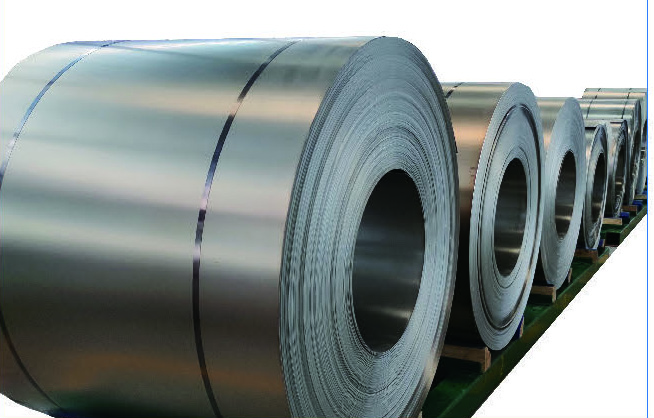
Industrial titanium plates and coils for heat exchanger and electrolyzer applications.
Problem & Opportunity: The Traceability Gap
Conventional titanium procurement often involves multiple intermediaries: sponge producers, ingot casters, rolling mills, and component fabricators. Each handoff introduces variability in chemistry, mechanical properties, and certification traceability. For applications such as titanium chemical reactor linings, titanium distillation column trays, and titanium seawater cooling system plates, even minor deviations in grain structure or impurity levels can lead to premature failure under corrosive loads.
The opportunity lies in models that consolidate control. Xrun’s vertical integration — from sponge to finished plate — allows the company to maintain consistent quality across the value chain. Its product portfolio includes hot-rolled titanium coils, cold-rolled titanium coils/strips, titanium plates, titanium sheets, titanium bars, titanium rods, titanium wires, and titanium pipes. These products serve industries including petroleum, chemical processing, metallurgy, catering equipment, and medical devices.
Engineering Credentials: Certifications That Matter
For buyers in the evaluation stage, certification breadth signals process maturity. Xrun holds multiple internationally recognized approvals:
- Nadcap (Certificate #27876241210) for heat treating, valid through February 2027, listed on the Qualified Manufacturer’s List (QML).
- EN 9100:2018 (TUV certificate #01 117 1933590) covering production of titanium and titanium alloy ingots, billets, bars, forgings, plates, and sponge, valid until November 2027.
- PED 2014/68/EU (TUV certificate #01 202 CHN/Q-19 0607.01) for manufacturing of titanium and titanium alloy cold-rolled sheets and hot-rolled plates, valid until December 2028.
- DNV (Certificate #AMMM000035A) for wrought titanium and titanium alloys for ships and naval vessels, including plates, sheets, strips, forgings, and billets, valid through March 2027.
These certifications cover critical market requirements for the EU, USA, and India — the primary export destinations for Xrun (which reports an export ratio of 10%).
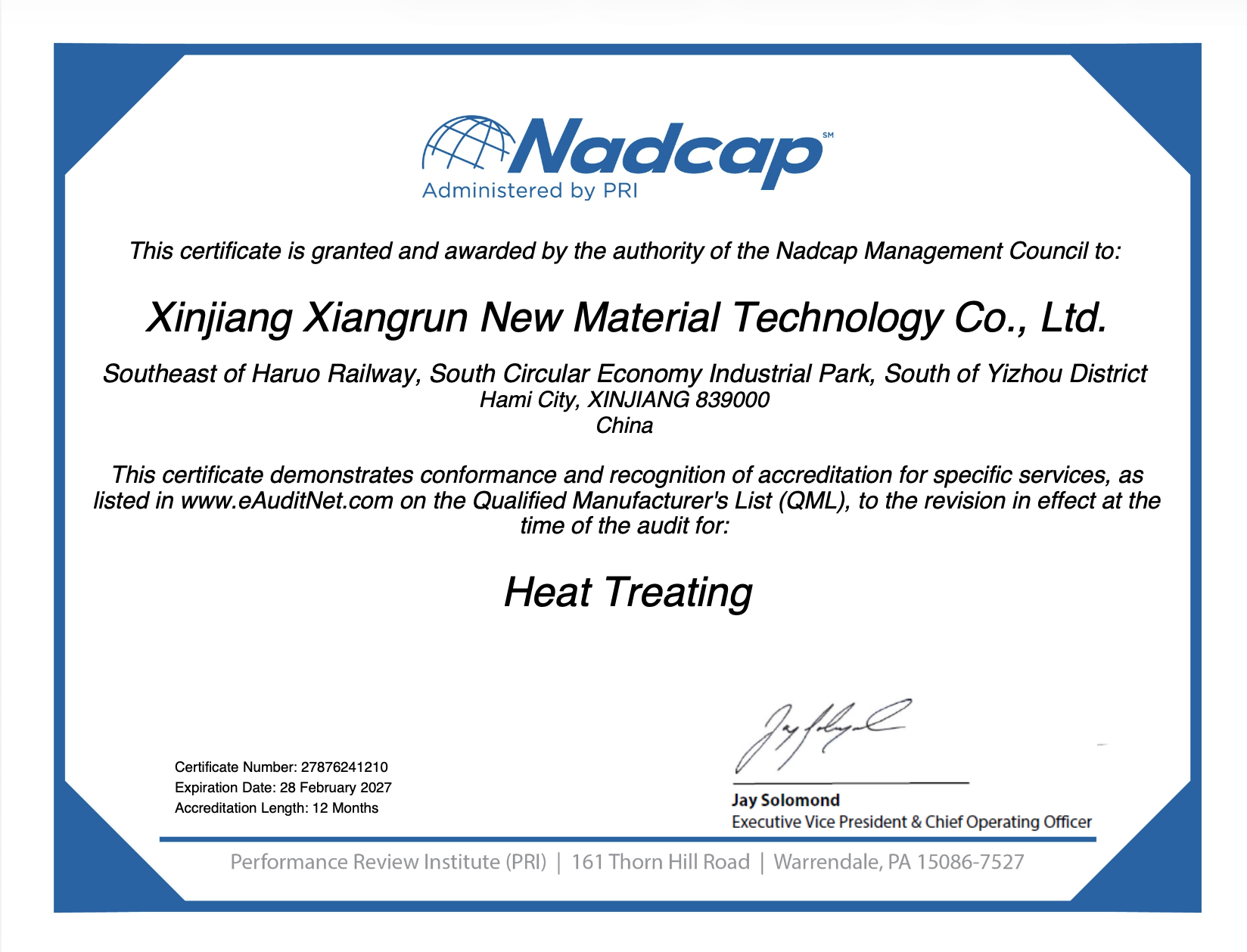
Nadcap certification confirms conformance with aerospace-level heat treating standards.
Technical Capability: From Coil to Component
Xrun operates state-of-the-art plate and coil production lines. Its hot-rolled titanium coil specifications range from 2.5–12.0 mm in thickness and 900–2000 mm in width, produced under ASTM/ASME standards. Cold-rolled titanium coils are available in thicknesses from 0.1–3.0 mm and widths from 450–1530 mm. Titanium plates and sheets cover a wide range: plates from 4.0–70 mm thick (width up to 2250 mm, length up to 6500 mm) and sheets from 0.4–3.0 mm thick (width up to 1530 mm). Grades include Gr.1, Gr.2, Gr.3, Gr.4, Gr.6, Gr.7, Gr.12, and Gr.5 (Ti-6Al-4V).
This dimensional flexibility directly enables downstream applications. For example, thin cold-rolled strips (0.1–3.0 mm) are used for titanium heat exchanger plates, anode plates, bipolar plates, batteries, eyeglass frames, and household products. Thicker hot-rolled plates serve chemical processing, aerospace, and shipbuilding industries.
Xrun also offers OEM/ODM services, with the ability to slit to strip or plate according to customer requests. Lead time is quoted as EXW 30–45 days, and third-party testing is available upon request. After-sales support is provided remotely.
Proven Use Case: Heat Exchanger Plates in Long-Service Municipal Applications
A documented case study highlights Xrun’s performance in a demanding environment. A municipal heat exchanger manufacturer in the US, France, and India sourced over 300 tons of titanium heat exchange plates from Xrun over a 15-year partnership. The application involved ASTM B265 Grade 1 titanium, selected for excellent formability in complex corrugated plates and outstanding resistance to seawater and chloride corrosion.
The result: continuous operation for over 10 years with no corrosion or leakage. Heat exchange efficiency remained at or above 95% of the initial value, and maintenance costs were reduced by 30%. The plates delivered an extended service life exceeding 15 years, validating the material’s long-term reliability in chloride-rich media.
This use case is representative of broader deployments for titanium power plant condenser plates, titanium desalination evaporator plates, and titanium seawater cooling system plates — all of which demand the same corrosion resistance, thermal conductivity, and formability.
Market Trend Analysis: The Shift Toward Vertical Integration
The 2026 titanium procurement landscape shows a clear preference for suppliers that can demonstrate end-to-end control. This trend is driven by three factors:
- Supply security: Geopolitical and logistical disruptions have made multi-tier supply chains vulnerable. Vertically integrated suppliers can control sponge sourcing and production schedules.
- Quality traceability: Buyers of critical components (e.g., titanium electrolyzer bipolar plates, titanium chemical storage tank plates) require full documentation from melt to finished plate. Integrated mills provide a single point of accountability.
- Cost optimization: Eliminating intermediary margins allows integrated suppliers to offer competitive pricing while maintaining higher margins for reinvestment in quality systems (e.g., Nadcap, EN9100, PED, DNV).
Xrun’s model — covering sponge → processed materials → finished products under one roof — aligns with this market movement. Its annual production capacity of 30,000 tons of coils/strips is supported by a dedicated R&D team of 200+ engineers, enabling continuous process improvement.
Comparison with Traditional Supply Models
Traditional sourcing often involves a plate mill buying sponge from a separate producer, then selling to a fabricator. The advantages of the integrated model include: controlled chemistry, shorter lead times, single certification responsibility, and reduced qualification risk. However, one honest limitation is that integrated suppliers may have less flexibility to source exotic alloys that are not part of their own production program. For highly specialized grades outside the standard portfolio, a specialized mill might still be necessary. Buyers should weigh the trade-off between integration benefits and grade breadth.
Future Outlook: Toward Multi-Application Platforms
As green energy and new materials sectors expand, demand for titanium in electrolyzers, fuel cells, and seawater systems will accelerate. Suppliers that can combine certification depth (aerospace, marine, pressure equipment) with high-volume, consistent quality will gain preferred status. Xrun’s existing certifications across Nadcap, EN9100, PED, and DNV already position it for multiple verticals — from aerospace and shipbuilding to chemical processing and renewable energy infrastructure.
Additionally, the ability to customize — slitting coils to strip or plate dimensions as requested — makes integrated mills attractive for OEM/ODM partnerships. With remote after-sales support and a history of long-term collaboration (as shown in the 15-year heat exchanger case), Xrun offers a template for supplier commitment in an era where reliability is the new premium.
Frequently Asked Questions
What titanium products does Xrun manufacture?
Xrun produces titanium strip, titanium coil, titanium sponge, cold-rolled titanium strip, hot-rolled titanium strip, titanium foil, titanium plate, titanium sheet, titanium bar, titanium rod, titanium wire, and titanium pipe.
What certifications does Xrun hold for marine applications?
Xrun holds a DNV certificate (AMMM000035A) valid through March 2027 for wrought titanium and titanium alloys including plates, sheets, strips, forgings, and billets for ships and naval vessels, according to standard DNV-CP-0346.
How does Xrun ensure quality control in production?
Xrun operates under multiple quality management certifications (Nadcap, EN 9100:2018, PED 2014/68/EU) and conducts third-party testing or inspection when required. Its vertically integrated supply chain from sponge to finished product provides full traceability.
For detailed specifications, certifications, and case studies, download the Xrun corporate brochure:
Download Brochure (PDF)Contact: Simon Liu | Email: simon.liu@xjxrun.com | Tel/WhatsApp: (+86) 18900759504
Have Questions or Need More Details?
Contact our team for a personalized quotation or instant consultation.
Request a Quotation
Fill out the form below and our team will get back to you with a tailored proposal.
WhatsApp Direct Chat
Prefer to chat in real-time? Message us on WhatsApp for instant assistance & quick answers.
- Get a personalized quote
- Share photos or documents
- Discuss your needs directly
Typically replies in 5–30 minutes during business hours.