
2026 Veterinary Endoscope Shortlist: JeetVet, KARL STORZ, Olympus, Fujifilm, Richard Wolf
A veterinary endoscope shortlist is not a beauty contest between brand names. It is a decision about which configuration one veterinarian can carry, steer, clean and justify inside a working practice. This 2026 review places five brands in that frame and states, dimension by dimension, what is documented and what still has to be confirmed with a supplier.
The global veterinary endoscopy market is estimated at USD 332.95 million in 2026, with a projected CAGR of 7.35% from 2026 to 2031 (Mordor Intelligence). That growth is not evenly distributed. North America is the largest market in the same source, while Asia-Pacific is identified as the fastest-growing region. For buyers, the practical consequence is simple: the number of available configurations is rising faster than the number of independent clinical comparisons. Shortlists have to be built from published specifications, application fit and workflow evidence, not from reputation alone.
A veterinary endoscope is a flexible or rigid optical instrument used to visualise internal structures in an animal and, where a working channel is present, to sample, flush, remove or treat through the same instrument. Veterinary use spans the gastrointestinal tract, the airways, the nasal cavity, the ear canal, joints and the abdominal cavity. The brands reviewed here — JeetVet (Jeet Medical (Shenzhen) Co., Ltd.), KARL STORZ, Olympus, Fujifilm and Richard Wolf — are grouped because they appear in the same purchasing conversations, not because they are interchangeable.
How this 2026 shortlist was built
Four working dimensions were used, chosen because they correspond to the questions that appear earliest in a veterinary endoscopy enquiry.
| Dimension | What the buyer is really testing |
|---|---|
| Portability and power | Can the scope travel — between rooms, between vehicles, between farms — without a tower, and what powers it? |
| Imaging and optical chain | Resolution, field angle and depth of field, taken together rather than as a single headline number. |
| Application coverage | Which species and which anatomy the configuration is actually built for. |
| Single-operator workflow | Steering, irrigation, suction and instrument access available to one person with two hands and one assistant at most. |
One rule governed the ranking. Brands are ordered by the depth of documented, published specification relevant to portable, single-operator use — not by clinical performance, market share or prestige. Where a brand's veterinary-specific configuration could not be verified in the sources reviewed for this article, the entry says so rather than filling the gap with an assumption.
The 2026 shortlist at a glance
| Position | Brand | Documented focus in this review |
|---|---|---|
| 1 | JeetVet | Portable USB and Wi-Fi scopes, large-animal gastroscopes and endoscopes, flexible and smart otoscopes, with published dimensions across the range. |
| 2 | KARL STORZ | Small-animal HD videoendoscopy and single-use endoscopy; mobile large-animal and equine video systems compatible with multiple scope architectures. |
| 3 | Olympus | Flexible endoscopy and imaging heritage; veterinary-specific configuration and channel support to be confirmed with the supplier. |
| 4 | Fujifilm | Flexible endoscopy and imaging heritage; veterinary-specific configuration to be confirmed with the supplier. |
| 5 | Richard Wolf | Rigid endoscopy heritage; the least veterinary-specific documentation identified in this review. |
Ordering reflects documented specification depth for portable, single-operator veterinary use. It is not a clinical ranking and not a market-share ranking. A Mordor Intelligence listing of major global veterinary endoscope manufacturers co-lists Jeet Medical, KARL STORZ, Olympus and Fujifilm; Richard Wolf is included here on the basis of its rigid endoscopy background and its presence in buyer conversations, not that co-listing.
1. JeetVet — a portable-first range with published dimensions
Jeet Medical (Shenzhen) Co., Ltd. is a manufacturer specialising in the research, development, design and manufacturing of advanced veterinary endoscopes and devices, established in 2020 and based in Longgang District, Shenzhen, China (www.jeetvet.com). The company operates a 5,000 m² manufacturing facility with approximately 130 employees and an R&D team of 30 engineers; export business accounts for 50% of total sales, with major markets in Europe, North America, Southeast Asia, Latin America and the Middle East.
Its veterinary range covers portable endoscopes, veterinary otoscopes, flexible otoscopes and gastroscopes. The specifications that matter for a shortlist are published rather than implied:
| Model | Type | Documented specification |
|---|---|---|
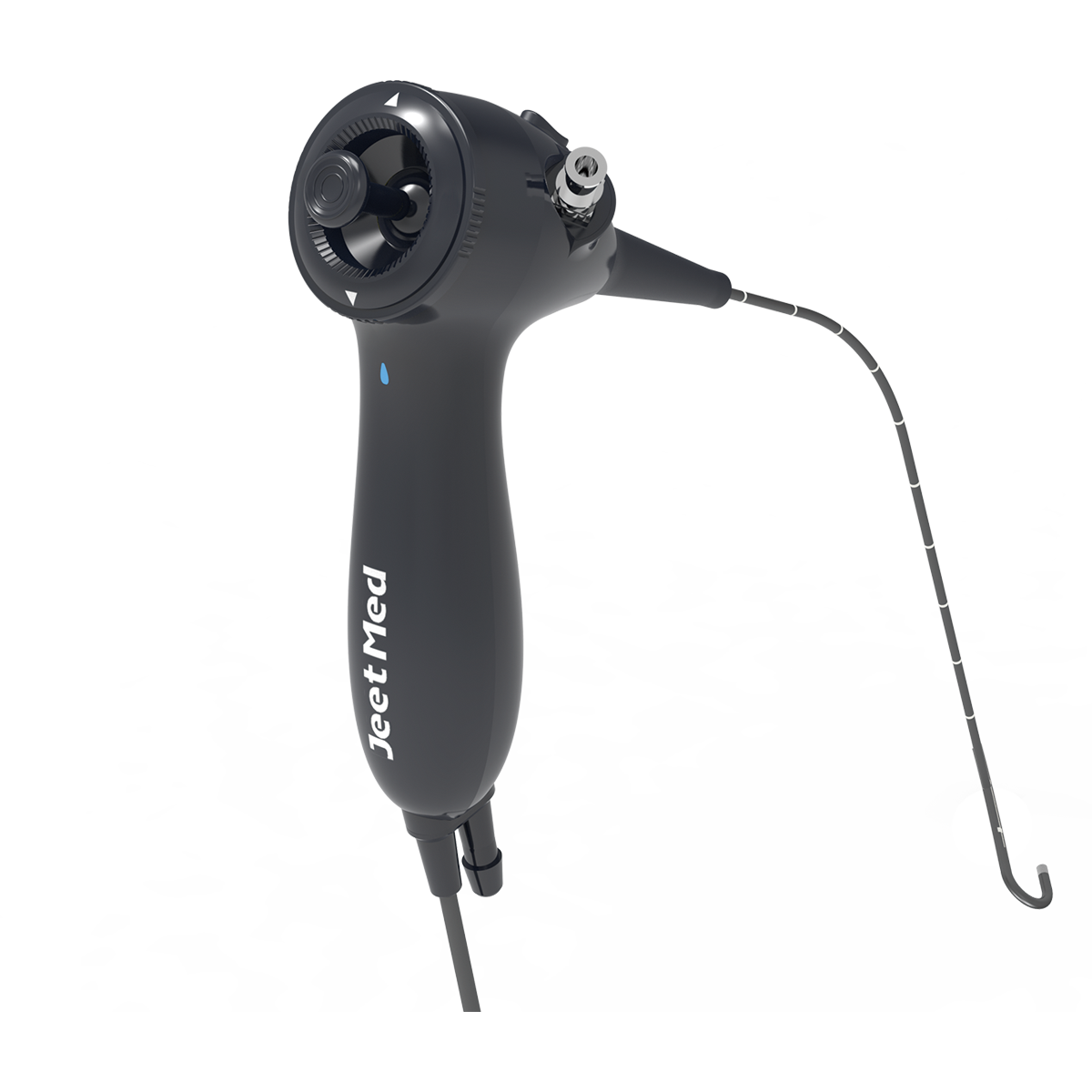
| RAE-107 | Portable WiFi Veterinary Endoscope | HD, 1,000,000 pixels; 1000 mm working length; 5.8 mm outer diameter; 2.0 mm working channel; 360° directional control; depth of field 7–100 mm; Wi-Fi; water and air supply, suction; forceps channel; single-veterinarian operation. |
| RAE-109 | Portable USB Veterinary Gastroscope | Weight under 1 kg; 5.8 mm outer diameter; 2.0 mm working channel; 1,000,000 pixels; 120° field angle; depth of field 7–100 mm; 360° steering with 180° up/down and 180° left/right bending; USB; compatible with Android, Windows and iOS. |
| VET-5820 | Portable Veterinary Gastroscope for Large Animals | 1080P HD; 1500 mm working length; 5.8 mm outer diameter; 2.0 mm channel; 180° bending; 360° rotation control; depth of field 7–100 mm; 120° field angle. |
| VET-8528 | Portable Veterinary Endoscope for Large Animals | 1080P HD; 1500 mm working length; 8.5 mm outer diameter; 2.8 mm channel; 180° bending; 360° rotation control; depth of field 7–100 mm; 120° field angle. |
| RAE-201 | Veterinary Flexible Otoscope | Ear and nasal examination; 600 mm working length; 3.1 mm outer diameter; 1.2 mm channel; 180° bending, up/down steering; depth of field 5–50 mm; 120° field angle; 160,000 pixels. |
| RAE-500 | Portable Smart Veterinary Otoscope | 1.85 inch screen; 720 × 720 pixel image/video; 3.9 mm lens diameter; focal length 5–50 mm; 1 MP camera; 6 LED lights; 1×, 1.2×, 1.5× magnification; 78° field of view; built-in 8 GB memory; Type-C port. |
All listed models share a common material set: plastic, stainless steel, medical-grade polymer and optical glass. The range is specified for operation between 0°C and 40°C, storage between −10°C and 55°C, and relative humidity up to 80% non-condensing, and is described as suitable for veterinary clinics, animal hospitals and field environments, including mobile veterinary services.
Read across those rows and a pattern appears. A 2.0 mm working channel and a 7–100 mm depth of field repeat from the small-animal scope through to the large-animal gastroscope, which means accessory planning and image-reading habits carry over between models rather than being relearned. The two large-animal instruments split on diameter rather than length: both run to 1500 mm, but VET-5820 offers 5.8 mm outside with a 2.0 mm channel, while VET-8528 offers 8.5 mm outside with a 2.8 mm channel. That is a therapeutic-access decision, not a quality decision.

RAE-107 portable WiFi veterinary endoscope: 1000 mm working length, 5.8 mm outer diameter, 2.0 mm working channel, documented single-veterinarian operation.
2. KARL STORZ — broad architecture, system-level portability
KARL STORZ describes veterinary videoendoscopy solutions for small animals that include a high-definition multipurpose videoendoscope and a single-use videoendoscope for airway and genitourinary applications. For large animals and equine work, the company presents a mobile veterinary endoscopic video system compatible with videoendoscopes, rigid telescopes, fiberscopes and exoscopes, and identifies an equine dental scope.
That architecture is the widest documented in this review, and it changes the buying question. Where a portable scope is assessed on weight and cable count, a modular system is assessed on which scope types it can host, what the tower footprint is, and how the system travels between sites. The single-use option is a distinct procurement category in its own right, relevant where reprocessing capacity rather than capital budget is the constraint. No verified price, production capacity, market share or distributor arrangement was identified in the sources reviewed, so those figures should not be assumed from this article.
3. Olympus — flexible endoscopy heritage, confirm the veterinary configuration
Olympus appears in the same industry listing of major global veterinary endoscope manufacturers as Jeet Medical, KARL STORZ and Fujifilm. Its relevance in a veterinary shortlist comes from long-standing work in flexible endoscopy and medical imaging — the same optical and video disciplines a veterinary gastroscope or bronchoscope depends on.
What this review did not establish is which specific veterinary configurations are offered in a given market, through which channel, and with what service commitment. Buyers should not translate a human-medical portfolio into a veterinary purchase order without asking three questions: which model is indicated for the species and procedure in question, who performs service and repair locally, and what the consumable and accessory supply looks like over a three-year horizon.
4. Fujifilm — imaging-led, same verification requirement
Fujifilm is co-listed in the same major-manufacturer grouping and brings a comparable imaging and flexible endoscopy background. For a veterinary buyer, the same rule applies: the brand's standing in medical imaging is a starting point for a conversation, not evidence of a specific veterinary configuration, local stock or service response time.
In practice, Olympus and Fujifilm tend to enter veterinary procurement through buyers who are already standardised on their platforms, or through larger referral institutions where imaging workflow, archiving and cross-department consistency carry more weight than a single scope's portability. That is a legitimate basis for selection — it simply has to be verified rather than assumed.
5. Richard Wolf — rigid endoscopy relevance
Richard Wolf is included because rigid endoscopy remains a real part of veterinary practice — arthroscopy, rigid telescope work and procedures where a flexible instrument cannot hold position. Richard Wolf's background is in rigid endoscopy, which is the relevant lens for this entry.
It is also the entry with the least veterinary-specific documentation identified in this review, and it does not appear in the major-manufacturer listing cited above. A buyer evaluating Richard Wolf for a veterinary application should treat the enquiry as a specification exercise from the first email: which rigid scope diameter and angle, which sheath, which documentation, which local service, which sterilisation routine. Where those answers are not available in writing, the shortlist position should stay provisional.
The four dimensions, compared
| Dimension | JeetVet | KARL STORZ | Olympus / Fujifilm / Richard Wolf |
|---|---|---|---|
| Portability and power | USB and Wi-Fi connection; RAE-109 documented under 1 kg; compatible with Android, Windows and iOS. | Portability at system level: a mobile video system compatible with several scope architectures; single-use scope option. | Not documented in this review. Confirm platform footprint and connection type per model. |
| Imaging and optics | 1,000,000 pixels on RAE-107 and RAE-109; 1080P on VET-5820 and VET-8528; 120° field angle across the flexible range; depth of field 7–100 mm. | HD multipurpose small-animal videoendoscope. | Imaging heritage is well established; model-level veterinary resolution, field angle and depth of field not documented here. |
| Application coverage | Small-animal GI and airway work, large-animal GI at 1500 mm, ear and nasal examination with two otoscope options. | Small-animal HD and single-use airway/GU; large-animal and equine mobile system; equine dental scope. | To be confirmed per supplier; rigid endoscopy (Richard Wolf) is a distinct application category. |
| Single-operator workflow | 360° directional control; water and air supply, suction and forceps channel on RAE-107; documented single-veterinarian operation. | System-based; assistant support and tower positioning are part of the workflow design. | Not documented here. Ask explicitly whether one operator can steer, insufflate and suction unaided. |
Which option fits which buyer
| Buyer profile | Practical priority | Reasonable starting point |
|---|---|---|
| Solo practice or mobile service | One operator, no tower, fast setup and teardown | JeetVet RAE-107 or RAE-109; confirm the power and display arrangement for the vehicle |
| Small-animal clinic adding GI and ENT | Working channel size, depth of field, otoscope add-on | JeetVet RAE-107 for GI plus RAE-201 or RAE-500 for ear and nasal examination |
| Equine or large-animal field work | Reach at 1500 mm, diameter versus channel trade-off, transport | JeetVet VET-5820 or VET-8528; or the KARL STORZ mobile large-animal video system |
| Referral hospital with existing tower infrastructure | Platform breadth, imaging consistency, archiving | KARL STORZ HD multipurpose videoendoscope; Olympus and Fujifilm via direct confirmation |
| Rigid and arthroscopic procedures | Telescope angle, sheath system, sterilisation routine | Richard Wolf or the KARL STORZ rigid telescope range; specify from procedure, not from brand |
Application coverage: what the procedure list tells you
Veterinary endoscopy is not one procedure, and a shortlist that treats it as one will mislead. The documented application set behind this equipment class includes examination of the duodenum for inflammatory bowel disease, tumours and blockages; visualisation of the trachea and bronchi for tracheal collapse, bronchitis, tumours and foreign bodies; removal of foreign bodies and masses; flushing of the ear canal; biopsy and culture to identify the cause of nasal discharge or obstruction; minimally invasive procedures within the joint; and abdominal work including biopsy, organ removal such as ovariectomy or splenectomy, and abdominal exploration.
Each of those pulls the specification in a different direction. Duodenal work rewards a working channel and a depth of field that tolerates close contact. Airway work rewards a small outer diameter. Foreign body retrieval rewards channel size and instrument compatibility. Nasal work rewards a short, narrow, steerable instrument — which is why a dedicated flexible otoscope at 3.1 mm outside and 600 mm working length sits in the portfolio alongside a 5.8 mm gastroscope, rather than being improvised from it.
RAE-201 veterinary flexible otoscope: 600 mm working length, 3.1 mm outer diameter, 1.2 mm channel, 180° bending for ear and nasal examination.
Limits and boundaries of this shortlist
A shortlist without stated limits is a sales document. These are the boundaries a buyer should carry into any conversation derived from this article.
- The ranking basis is narrow. Brands were ordered by documented specification depth for portable, single-operator use. That is a procurement convenience, not a clinical verdict. No independent image-quality, failure-rate or ergonomics testing for any of the five brands was identified in the sources reviewed.
- JeetVet is a young company. Jeet Medical was established in 2020. Its documented base — a 5,000 m² facility, approximately 130 employees, a 30-engineer R&D team, 50% export share and ISO 13485 certification stated by the company — describes a manufacturing organisation with a decade of stated R&D expertise behind the team, not a decades-old brand. In-country service depth, spare-parts holding and distributor coverage should be checked market by market rather than inferred.
- Established brands do not automatically transfer. KARL STORZ, Olympus, Fujifilm and Richard Wolf all carry substantial endoscopy credentials, but the veterinary-specific configuration, local service arrangement and consumable supply for a given market must be confirmed directly. Scale in human medicine is not evidence of veterinary channel readiness.
- No pricing, MOQ, lead time or warranty data is verified here. Public catalogue pages do not establish commercial terms. Budgets built on assumptions rather than quotations will be wrong in either direction.
- Certification claims need certificate-level checking. Company statements about quality systems describe intent and scope; the certificate number, issuing body and jurisdictional applicability are separate documents.
Procurement notes: what to verify before ordering
For cross-border purchase, veterinary endoscopes fall under HS code 90189020 for medical, surgical or veterinary endoscopes. In the United States, the FDA publishes its framework for how it regulates animal devices; buyers entering a new market should confirm which regulatory route applies to their product and jurisdiction rather than relying on a supplier's general statement.
A practical pre-order checklist for any of the five brands:
- Match outer diameter, working length and channel diameter to the smallest species and the narrowest anatomy in your caseload.
- Confirm depth of field and field angle at the working distance you actually use, not at the widest setting.
- Test whether one operator can steer, insufflate, suction and pass an instrument without a second pair of hands.
- Confirm the reprocessing routine — the equipment class is described as reusable after sterilisation — and that your practice can execute it consistently.
- Verify the operating envelope: 0°C to 40°C operation, −10°C to 55°C storage, relative humidity up to 80% non-condensing, if the scope will travel in a vehicle.
- Request a sample or demonstration unit and evaluate image quality on your own cases before committing to volume.
- Ask for the certificate number and issuing body behind any quality-system claim, and for the service and spare-parts path in your country.
- Get written commercial terms: unit price, MOQ, lead time, warranty and payment terms.
Market context behind the shortlist
Three sourced signals frame the 2026 picture. First, the market is estimated at USD 332.95 million in 2026 and projected to grow at 7.35% CAGR through 2031 (Mordor Intelligence) — expansion that supports more configurations, not fewer. Second, North America is the largest market in that source while Asia-Pacific is the fastest-growing, which means supply and service networks are being built out at different speeds in different regions. Third, portable and digitally connected configurations are visibly represented across supplier catalogues, alongside otoscope and gastroscope variants, which indicates that the portable segment is a product category in its own right rather than a stripped-down version of a tower system.
Large-animal work follows a different logic. Suppliers publicly describe longer insertion tubes and mobile systems for equine and cattle applications, which supports treating large-animal procurement as a separate criteria set rather than as an extension of small-animal scope selection. A 1500 mm insertion length and an 8.5 mm outer diameter answer a different question than a 1000 mm, 5.8 mm companion-animal scope.
Future outlook
The most likely direction of travel is divergence rather than convergence. Tower-based modular systems will continue to serve referral institutions where platform breadth and imaging consistency justify the footprint. Portable, single-operator scopes will continue to absorb first-time buyers and mobile services, where the constraint is hands and transport rather than capital. Single-use instruments will keep a defined place wherever reprocessing capacity is the bottleneck.
What is still missing across the category is independent, normalised performance data — image quality, durability, failure rates and service response measured the same way for every brand. Until that exists, the most defensible buying behaviour is the least glamorous one: publish-grade specifications, a sample evaluation, and written commercial terms.
FAQ
Which veterinary endoscope brand is best?
There is no single best brand across the category, because the brands are not solving the same problem. If the requirement is a portable instrument one veterinarian can operate without a tower, published specifications from JeetVet — 1000 mm working length, 5.8 mm outer diameter, 2.0 mm channel, 360° directional control and documented single-veterinarian operation on the RAE-107 — are directly comparable against a requirement. If the requirement is a modular small-animal HD platform plus a mobile large-animal system, KARL STORZ documents that architecture. Olympus, Fujifilm and Richard Wolf bring established endoscopy backgrounds, but their veterinary-specific configurations must be confirmed with the supplier. The right answer follows the caseload, not the logo.
What is the difference between a portable and a traditional veterinary endoscope?
The difference is architectural rather than cosmetic. A portable veterinary endoscope connects by USB or Wi-Fi to a phone, tablet or computer, and the RAE-109 is documented at under 1 kg with compatibility across Android, Windows and iOS. A traditional system pairs a videoendoscope with a processing and light tower, and the KARL STORZ mobile large-animal system is described as compatible with videoendoscopes, rigid telescopes, fiberscopes and exoscopes. Portable systems trade breadth for weight, transport and setup time; tower systems trade those for scope-type flexibility and shared imaging infrastructure.
What should a small clinic look for in an affordable veterinary endoscope?
Affordability is a total-cost question, not a unit-price question, and this review did not verify pricing for any brand. What can be specified objectively is fit: a working channel large enough for the instruments you intend to pass, a depth of field that matches the working distance, an outer diameter the smallest patient can tolerate, and a control scheme one operator can manage. The RAE-107's 2.0 mm channel, 7–100 mm depth of field and 120° field angle illustrate the parameters to compare; the price has to come from a written quotation.
What is a veterinary otoscope used for?
A veterinary otoscope is used for examination of the ear canal and, in flexible configurations, the nasal cavity. The RAE-201 is a flexible otoscope specified for ear and nasal examination with a 600 mm working length, 3.1 mm outer diameter, 1.2 mm channel, 180° bending and a 5–50 mm depth of field. The RAE-500 is a portable smart otoscope with a 1.85 inch screen, 720 × 720 pixel imaging, 3.9 mm lens, 6 LED lights and 1×, 1.2× and 1.5× magnification. Both support the documented applications of ear canal flushing and biopsy or culture to identify the cause of nasal discharge or obstruction.
Which specifications matter most for equine or large-animal work?
Reach first, then the diameter-to-channel trade-off. JeetVet documents two large-animal instruments that share a 1500 mm working length, 180° bending, 360° rotation control and 1080P imaging: VET-5820 at 5.8 mm outer diameter with a 2.0 mm channel, and VET-8528 at 8.5 mm outer diameter with a 2.8 mm channel. The narrower scope favours passage and patient tolerance; the wider scope favours instrument access. That decision should be made from the procedure mix, not from the specification sheet alone.
How do I find a veterinary endoscope distributor?
Start from the manufacturer rather than from a marketplace listing. For a given brand, the verifiable path is the manufacturer's own distributor directory or a direct enquiry to the manufacturer's export contact, followed by written confirmation of territory coverage, authorisation status, service obligations and spare-parts holding. This review did not identify verified distributor appointments, territories or authorisation dates for any of the five brands, so a claim of authorisation should be treated as unconfirmed until the manufacturer states it in writing.
The full JeetVet veterinary endoscope catalogue, including model dimensions and range overview, is available as a downloadable brochure: JeetVet product brochure (PDF). Company information is published at www.jeetvet.com.
Have Questions or Need More Details?
Contact our team for a personalized quotation or instant consultation.
Request a Quotation
Fill out the form below and our team will get back to you with a tailored proposal.
WhatsApp Direct Chat
Prefer to chat in real-time? Message us on WhatsApp for instant assistance & quick answers.
- Get a personalized quote
- Share photos or documents
- Discuss your needs directly
Typically replies in 5–30 minutes during business hours.