
21V Impact Wrench Range as Supplier Capability Evidence
21V Impact Wrench Range as Supplier Capability Evidence
A cordless impact wrench range is one of the few places where a supplier's capability can be checked against something physical rather than described in a brochure: how many torque classes exist, which motor is used, which materials are named, which battery packs are actually built, and what a buyer receives in the box. For purchasers moving from evaluation into execution, the range itself is the qualification document.
GEAKITA (Xiamen Tiangong Kaiwu Technology Co., Ltd.) is a power tool and intelligent equipment brand founded in 2009, with manufacturing in Yongkang, Zhejiang, and a portfolio spanning impact wrenches, drills, grinders, batteries and robotic equipment. Its 21V impact wrench line is a compact working example: the GKR05 rated at 650 N·m, a 1,000 N·m heavy-duty model, and a three-function (3-in-1) multifunction kit rated at 350 N·m. Behind those three anchors sit a documented motor specification, a named material set, a 21V lithium-ion battery family with specific cell configurations, and matched kit contents.
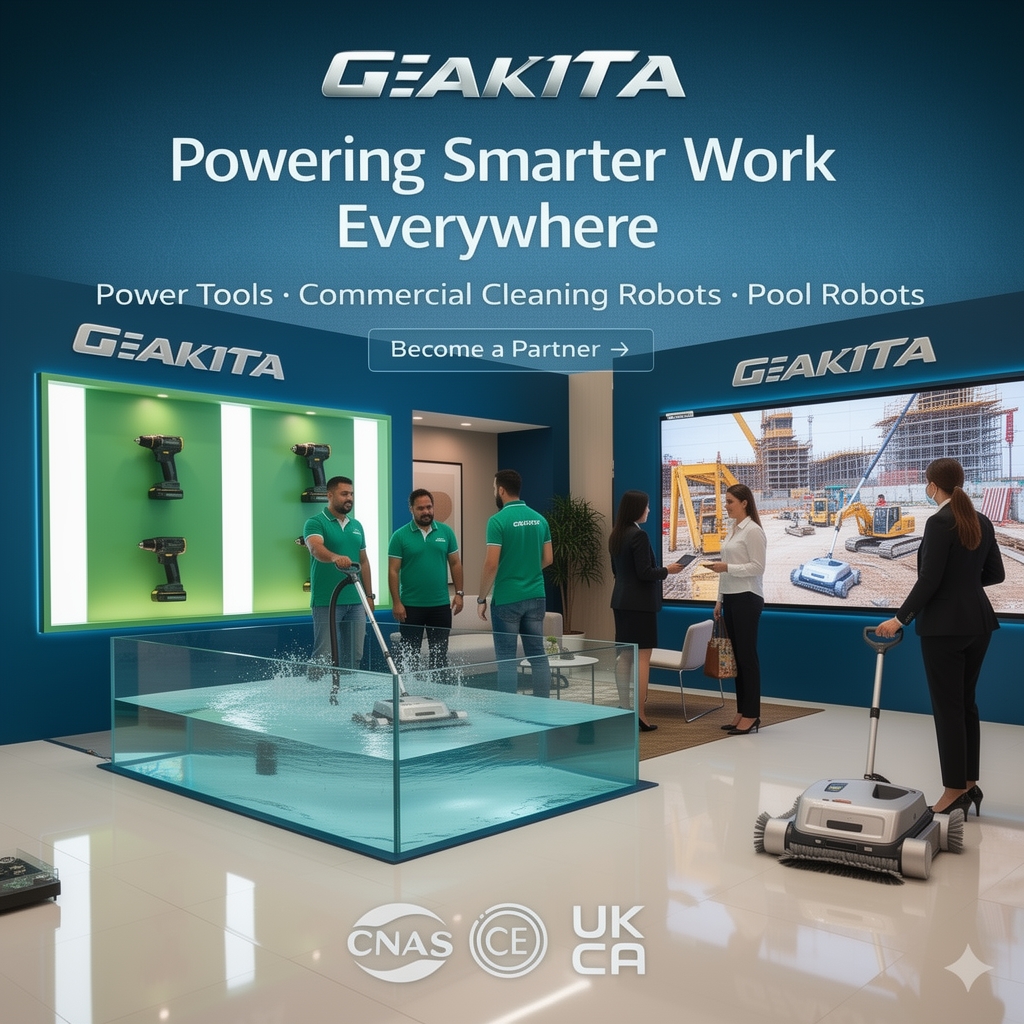
Capability is assessed from documentation, samples and delivered product rather than from display space. Photo: GEAKITA exhibition area.
Three torque classes, three different buying jobs
A 350 N·m kit, a 650 N·m industrial wrench and a 1,000 N·m heavy-duty model are not competitors inside one catalogue; they answer different questions. The 350 N·m three-function kit addresses buyers who need one battery platform to cover several moderate-torque fastening tasks. The GKR05 at 650 N·m sits in the working band of automotive and construction fastening. The 1,000 N·m model belongs to the heavy-duty electric wrench class used where a joint is large enough that a mid-range tool will stall.
| Model or configuration | Rated torque | Role in the range | What to confirm |
|---|---|---|---|
| GKR05 | 650 N·m | Mid-range industrial impact wrench | Torque definition and drive size per current price list |
| 1,000 N·m heavy-duty model | 1,000 N·m | High-torque class for large fasteners | Test conditions and suitability for the specific joint |
| Three-function (3-in-1) multifunction kit, TF350 | 350 N·m | Multi-task kit on a shared battery platform | Itemised kit contents and number of battery packs |
Range structure also says something about the supplier's commercial model. The wider GEAKITA wrench portfolio names the TF350 three-function model, 650 N·m, 1,000 N·m and 1,500 N·m families, the GKR05 and GKR06 industrial impact wrenches, and the GKR07 upright railway impact wrench. That is a deliberate spread across torque classes and body formats rather than a single hero SKU — the shape a catalogue needs if it is to serve a hardware retailer, an automotive workshop supplier and a railway maintenance buyer from one source.
Two cautions belong with that reading. Model-to-torque mapping should be confirmed against the current price list for every SKU, because ranges change faster than summaries do. And the number of torque classes says nothing about delivered torque until the measurement definition is settled.
Torque figures only compare when the definition is the same
The same tool can legitimately carry two very different torque numbers. A 2026 retailer listing for an 18 V brushless 1/2-inch cordless model quotes 1,491 N·m of fastening torque alongside 2,034 N·m of nut-busting torque. A corded 1/2-inch model listed by a US retailer is quoted at 300 ft-lb fastening torque and 1,050 ft-lb breakaway torque. In both cases the larger figure describes the momentary load the tool can break loose; the smaller describes what it can tighten to.
That distinction matters more for cordless tools than for almost any other purchase, because breakaway figures are the ones buyers remember. A distributor who quotes a breakaway number to a workshop that needs reliable tightening performance is creating a warranty conversation, not a sale.
Unit discipline compounds the problem. Newton-metres and foot-pounds describe the same quantity at different scale, while fastening, breakaway and nut-busting torque describe different events. A distributor catalogue that lists an 18 V 1/2-inch brushless model at 813 N·m and a 12 V 3/8-inch brushed model at 168 N·m explicitly flags that differing drive sizes, voltages and motor types make those values non-comparable as a benchmark — they are product examples, not a controlled test.
For the 21V range the practical reading is straightforward: 350 N·m, 650 N·m and 1,000 N·m are the rated torque classes of three models. A procurement document should record which definition each figure refers to, the conditions under which it was obtained, and the joint it is expected to tighten. Without that, a torque comparison between suppliers is a comparison of marketing conventions.
Motor and materials as evidence, not adjectives
Pure copper brushless motor is a technical statement with consequences. A brushless motor commutates electronically, so there are no carbon brushes to wear and no brush dust inside the housing. In an impact wrench used daily, brush replacement is a scheduled service item that disappears from the maintenance plan. Copper, rather than copper-coated or aluminium substitutes, is the conductive path in the motor, and the practical consequence shows up as thermal behaviour under sustained load — the point where a compact tool is most often limited.
The boundary matters equally. Motor type alone does not set torque. Torque in an impact wrench is produced by the impact mechanism and by the gearbox that converts motor speed into repeated blows. A brushless motor improves efficiency, service life and control, but a 350 N·m kit does not become a 1,000 N·m tool because its motor is brushless. Evaluating motor technology without evaluating mechanism and materials means reading half the evidence.
GEAKITA documents ABS, aluminium alloy, steel and copper in the construction of the range. Those four material classes correspond to the parts that decide how a tool survives site conditions.
| Material | Typical engineering role in tool construction | Verification question |
|---|---|---|
| ABS | External shells and housings, where impact resistance is needed at low weight | How is the housing tested for drops or knocks at height? |
| Aluminium alloy | Structural and gearbox housings, balancing strength with weight and heat conduction | Is the gearbox housing metal on this specific model? |
| Steel | Impact mechanism and output drive, where repeated blows are transferred to the fastener | What is the anvil material, and is the drive replaceable? |
| Copper | Motor windings, where conductivity governs efficiency and heat | Which motor specification applies to each model in the range? |
What the material list does not establish is a durability level. Naming four materials does not certify a service life, and no material specification substitutes for a duty-cycle test on the joint the tool will actually tighten.
The 21V battery platform: cells, capacity and configuration
Battery configuration is where cordless ranges are most often presented vaguely and where buyers most often overpay. GEAKITA supplies 16.8V and 21V battery families with chargers and matched kit configurations. Within the 21V lithium-ion family, documented configurations include a 10-cell, 2,000 mAh pack in the Makita 10-cell format and packs rated 1,500–2,000 mAh across 10 to 15 cells.
Separately, the portfolio documents a 20V Max 4.0Ah pack with a bidirectional 15 W USB-C port, and a HANDY 21V 20-cell platform offering configurable device charging and task lighting. Neither detail changes the torque of a wrench, but both indicate that the battery is treated as a platform with its own features rather than as a commodity container.
Three consequences follow for a buyer. First, milliamp-hours describe charge rather than stored energy; cell count and configuration determine how much work a pack can deliver, so a watt-hour figure and the number of packs per kit belong in the request for quotation. Second, format matters beyond brand preference: a 10-cell pack in the Makita format addresses users already inside that ecosystem, while a proprietary 21V pack serves buyers standardising on one supplier. Both are legitimate strategies, but they produce very different lifetime costs for a fleet. Third, cross-model compatibility should be confirmed explicitly — which packs and which chargers are shared by the GKR05, the 1,000 N·m model and the multifunction kit, and what spare-pack ratio the supplier recommends for a given duty cycle.
Runtime itself is not established by any figure in the supplier's product information. Real runtime depends on the joint, the torque required, the number of fastenings per shift, ambient temperature and pack age. That is a sample-test question, not a catalogue question.
Kit contents: the SKU is what a reseller actually buys
Matched kit configurations are the unit most distributors and retailers resell, so complete needs a definition before the order rather than after it. The documented approach pairs tools with battery and charger configurations rather than shipping bare tools only, supported by the 16.8V and 21V battery families and matching chargers.
What belongs in the request is the itemised list: number of battery packs and their configuration, charger type and input voltage, case or bag, and any sockets or accessories included. For an impact wrench sold into tyre-changing or workshop use, the socket set often decides whether the kit is usable on day one — and it is also the line item most likely to be trimmed quietly between samples and mass production.
GEAKITA's stated customisation scope covers product labels, packaging, selected colours, exterior design and tooling development, alongside assortment planning, replenishment, product information and retail presentation support. Kit architecture is therefore negotiable: a hardware chain can define a two-pack kit in a coloured case while a project supplier specifies a single-pack kit in a plain carton. The commercial models listed are brand distribution, OEM and private-label development, bulk purchasing and project supply.
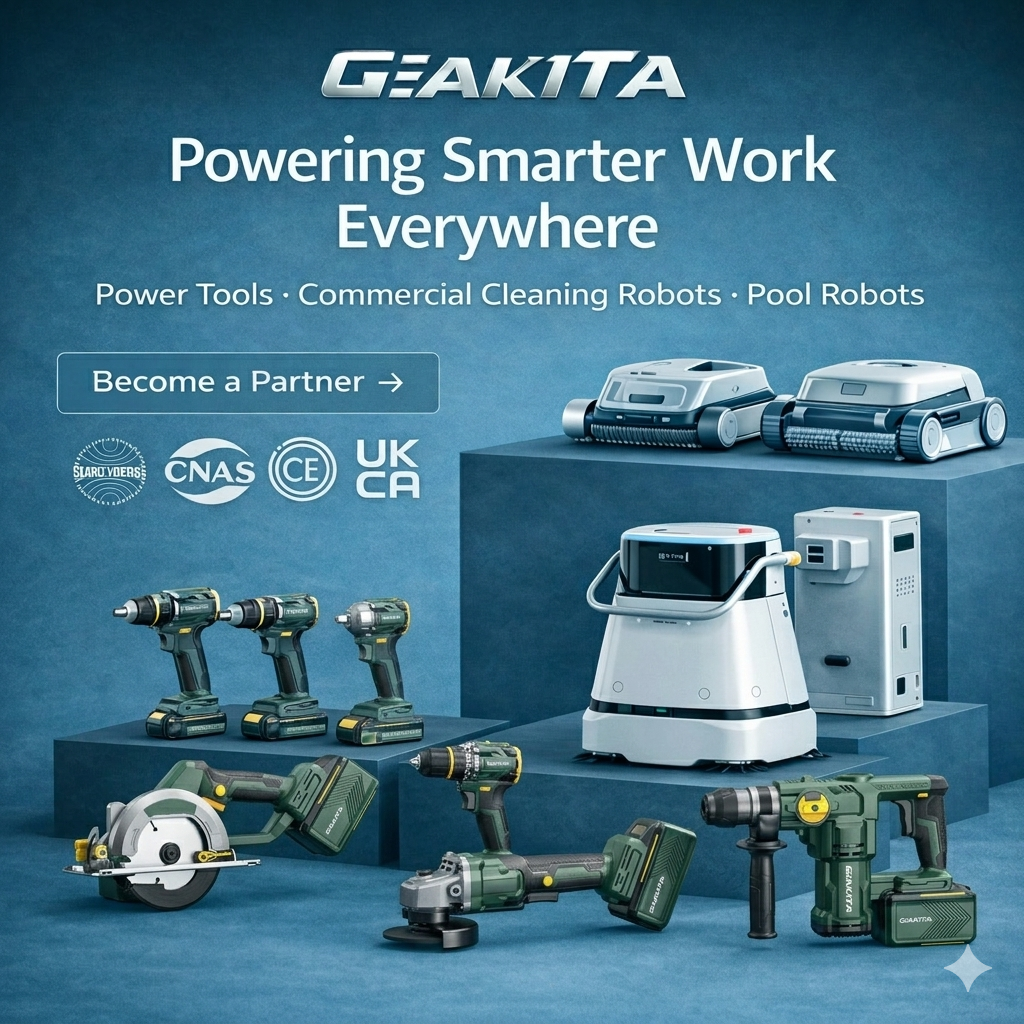
Private-label execution covers labels, packaging, colours, exterior design and tooling development. Image: GEAKITA OEM overview.
Mapping the range to eight application environments
Application fit is decided by the joint, the access and the power available, not by the sector label. The table reads the range against the environments GEAKITA serves, with the specification question that settles each one.
| Environment | Typical fastening work | Range fit | Confirm before order |
|---|---|---|---|
| Railway | Track and structure bolting, depot maintenance | GKR07 upright railway impact wrench; heavy-duty classes | Drive size, torque definition, worksite power and battery logistics |
| Automotive repair | Wheel nuts, suspension and subframe fasteners | GKR05 at 650 N·m and the 1,000 N·m class | Socket range and breakaway performance on corroded fasteners |
| Construction and installation | Scaffolding, formwork and structural steel connections | Mid-range cordless models sharing one battery family | Duty cycle and packs per crew |
| Heavy machinery | Large fasteners on plant and equipment | 1,000 N·m heavy-duty model | Bolt grade, target torque and access clearance |
| Manufacturing and assembly | Repeat fastening in production or sub-assembly | Brushless models and kit configurations | Cycle time expectations and torque repeatability |
| Agriculture | Implement, trailer and machinery bolts | Cordless models removing the need for a line or cable | Dust and moisture exposure, seasonal storage of packs |
| Retail and hardware | Assortment breadth across buyer budgets | Multiple torque classes plus label and packaging customisation | Price ladder, packaging format and merchandising support |
| Project supply | Mixed fleets across several work fronts | Shared battery families across models | Spare-pack ratio and replenishment terms |
Railway work shows why a range matters more than a single model. Track and structure bolting combines high torque, restricted access and worksites where an air line is usually unavailable, and the GKR07 upright railway impact wrench exists in the portfolio as an upright-format tool for that environment. Buyers should still confirm the torque definition and drive size for the specific rail application, because network requirements differ.
Automotive work is the volume application, and it is also where misuse is most visible: wheel-nut torque is set by the vehicle manufacturer, so a 1,000 N·m tool is chosen for its ability to release a seized fastener, not for tightening to its rated maximum.
Where a 21V cordless wrench fits beside pneumatic and corded tools
Cordless is not a universal replacement, and a supplier that claims otherwise is not giving a buyer useful information. Three power sources occupy different ground.
Pneumatic impact wrenches remain the convention in fixed workshop and production environments where compressed air is already installed. Manufacturer catalogues in that segment span 3/8-inch to 2 1/2-inch square drives, and Chicago Pneumatic describes selected 3/4-inch and 1-inch series for industrial maintenance and production users, including loosening bolts up to M27 in one cited series — a manufacturer statement rather than independent test data. The constraint is the air system: without adequate supply, a pneumatic tool cannot deliver its rating.
Corded electric tools sit between the two. A 1/2-inch corded model listed by a US retailer carries 300 ft-lb fastening and 1,050 ft-lb breakaway torque with an ETL listing, and its limitation is equally clear — mains power and a cable at the point of use.
A 21V cordless impact wrench such as the GKR05 or the 1,000 N·m heavy-duty model trades the air line and the cable for a battery. That trade is worth making in field service, roadside and site work, in depots without air infrastructure, and wherever the tool must travel to the fastener. It is a weaker trade in a bay where one tool runs continuously for a full shift beside an existing compressed-air supply. The honest fit boundary is duty cycle and infrastructure, not brand preference.
Market context: what published numbers do and do not show
Independent market research places the global impact wrench market at USD 2,741.1 million in 2025, with a projection of USD 4,865.3 million by 2036, and reports that electrical impact wrenches held 56.7% of the 2025 market by mode of operation (Transparency Market Research, forecast published May 2026). Those are commercial research estimates, not audited figures, and they say nothing about any single supplier's share.
Their practical use is narrower and still relevant. A majority electrical share means a battery-powered wrench is a mainstream procurement category rather than a niche, and that battery-platform decisions carry multi-year consequences for a fleet. It also means a buyer's comparison set should include cordless ranges from specialist suppliers, not only the largest tool brands.
For importers, hand-held motor-operated tools with self-contained electric motors are commonly classified under HS 8467.21, the code used in the trade reference reviewed for this article; the correct classification for a specific shipment should still be confirmed with a customs broker, since battery packs may be declared separately.
Verification checklist before a purchase order
- Torque definition. Establish whether each quoted figure is fastening or breakaway/nut-busting torque, and the conditions under which it was obtained.
- Drive size per model. Catalogues segment on 3/8-inch, 1/2-inch, 3/4-inch and 1-inch drives; drive size decides socket availability and access.
- Motor and mechanism together. Record the brushless motor specification and also the impact mechanism and gearbox that produce the torque.
- Material confirmation by model. Ask which housing and gearbox parts are aluminium alloy or steel, rather than accepting that the materials appear somewhere in the range.
- Battery configuration. Pack voltage, cell count, mAh, watt-hour rating, charger input voltage, and which packs and chargers are shared across models.
- Kit contents. Packs, charger, case, sockets and documentation itemised in the purchase order, not summarised as complete.
- Sample test on the real joint. Fastenings per pack, breakaway performance on a corroded fastener, and how the tool recovers after thermal protection engages.
- Spare parts and service. Anvil, socket retainer and switch availability, plus the maintenance interval that brushless construction actually removes.
- Compliance file per destination market. Request certificates and their scope. IEC 60745-2-2:2003 addresses particular safety requirements for hand-held motor-operated screwdrivers and impact wrenches, but its current edition and jurisdictional adoption should be verified against the official publication before it is cited in a compliance file. No certification is attributed to the 21V range in this article.
- Battery transport documentation. Confirm which documents and packaging the supplier provides for lithium-ion packs as shipped.
Outlook
Two forces are likely to keep shaping 21V-class ranges, on the evidence available. The first is platform economics: once a distributor or fleet standardises on a pack format, the value of adding a model depends on whether it runs on packs already in the van, and a range spanning 350 N·m to 1,000 N·m on shared battery families is easier to extend than one that is not. The second is specification discipline: as more cordless models crowd the same torque bands, differentiation shifts toward documented definitions, materials and kit content — the parts of a product that survive an audit.
Neither force guarantees an outcome for any supplier. What they change is the buyer's job: a cordless impact wrench purchase is now a platform decision with a torque question attached, and the evidence for both is available before the order rather than after it.
The GEAKITA corporate profile and 2026 product catalogue, covering the wrench range, battery families and kit configurations, can be downloaded here: GEAKITA Corporate Profile and Product Catalog 2026.
FAQ
Which models make up GEAKITA's 21V impact wrench range, and at what torque?
The documented 21V anchors are the GKR05 rated at 650 N·m, a 1,000 N·m heavy-duty model, and a three-function (3-in-1) multifunction kit rated at 350 N·m. The wider wrench portfolio also names the TF350 three-function model, 650 N·m, 1,000 N·m and 1,500 N·m families, the GKR05 and GKR06 industrial impact wrenches, and the GKR07 upright railway impact wrench. Drive size and torque definition should be confirmed per model.
What motor and materials does the range use?
The range uses pure copper brushless motors, and ABS, aluminium alloy, steel and copper appear in the construction. Brushless commutation removes carbon brushes from the maintenance schedule, while the impact mechanism and gearbox, rather than the motor alone, determine the torque a model can deliver.
Which 21V battery configurations are available?
GEAKITA supplies 16.8V and 21V battery families with chargers and matched kit configurations. Documented 21V configurations include a 10-cell, 2,000 mAh pack in the Makita 10-cell format and packs rated 1,500–2,000 mAh across 10 to 15 cells. The portfolio separately documents a 20V Max 4.0Ah pack with a bidirectional 15 W USB-C port and a HANDY 21V 20-cell platform with configurable device charging and task lighting.
What should a buyer specify to compare 21V impact wrenches accurately?
Specify the torque definition and test conditions, the drive size, the battery configuration including watt-hour rating and packs per kit, the itemised kit contents, and the intended joint. Distributor catalogues commonly expose voltage, drive size, torque, motor type, speed, weight and battery capacity, which is a workable field list for a normalised request.
Which applications is the range intended for?
GEAKITA lists hardware and home improvement, construction and installation, automotive repair, industrial maintenance and railway applications, with the wrench range spanning a three-function kit, mid-range and heavy-duty models, and an upright railway wrench. Fit is decided by the joint, access and available power rather than by sector.
Does brushless construction mean the tool needs no maintenance?
No. Brushless motors remove brush wear, but the impact mechanism, anvil, socket retainer, switch and battery pack remain service items, and thermal protection will interrupt sustained work. Buyers should ask about spare-part availability and the duty cycle expected on their joint.
Have Questions or Need More Details?
Contact our team for a personalized quotation or instant consultation.
Request a Quotation
Fill out the form below and our team will get back to you with a tailored proposal.
WhatsApp Direct Chat
Prefer to chat in real-time? Message us on WhatsApp for instant assistance & quick answers.
- Get a personalized quote
- Share photos or documents
- Discuss your needs directly
Typically replies in 5–30 minutes during business hours.