
24V vs 12V 36W Adapters: What to Check Before You Order
Two adapters can both be labelled 36 W and still not be interchangeable. A 12 V / 3 A unit and a 24 V / 1.5 A unit deliver the same 36 watts of output, but the voltage each one supplies is fixed at the factory, and the device at the far end of the cable expects one specific value. For independent buyers - importers, distributors, device brands and small OEMs - the ordering decision therefore does not begin with the wattage printed on the housing. It begins with the device input specification, and it ends with a document package that matches the destination market.
This reference examines the 24 V / 1.5 A 36 W and 12 V / 3 A 36 W configurations in the SK03T adapter family from Shenzhen Simsukian Electronics Technology Co., Ltd (SimSukian), a Shenzhen-based manufacturer founded in 1996 that develops and mass-produces switching power supplies, battery chargers and power adapters from 3 W to 240 W. The question it answers is narrow and practical: what should an independent buyer verify before placing an order, and which claims can be confirmed from a certificate, a test report or a physical sample rather than from a catalogue sentence.
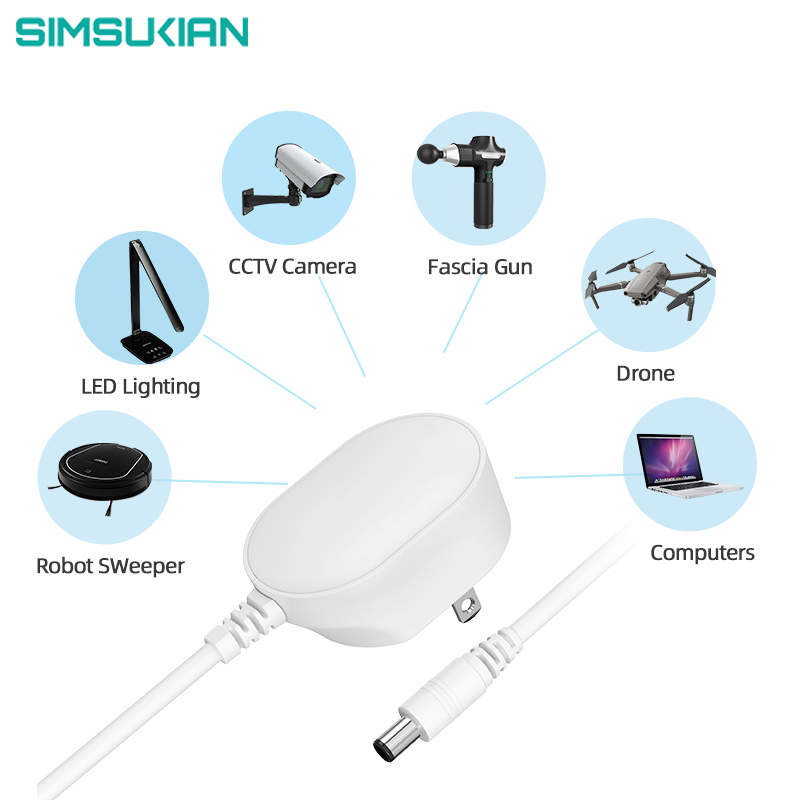
36 W class AC-DC adapters ship in several AC plug configurations depending on the destination market.
The Two 36 W Configurations: 12 V / 3 A and 24 V / 1.5 A
Both variants exist because the wattage is a product of voltage and current, not a substitute for either. The SK03T 36 W family is documented in two output configurations: 12 V at 3 A with an output power of 36 W, and 24 V at 1.5 A with an output power of 36 W. Both accept an input of AC 100-240 V, 50/60 Hz, which is what allows a single adapter design to be shipped into multiple grid regions with only the AC plug changing.
The practical consequence for a buyer is that the two variants are not alternatives in the commercial sense - they are not two price levels of the same thing. They are two different electrical interfaces for two different categories of device. Choosing between them is a compatibility question that the device manufacturer, not the adapter supplier, has already answered in the device specification.
| Parameter | 12 V 36 W configuration | 24 V 36 W configuration |
|---|---|---|
| Output power | 36 W | 36 W |
| Output voltage | 12 V | 24 V |
| Output current | 3 A | 1.5 A |
| Input | AC 100-240 V, 50/60 Hz | AC 100-240 V, 50/60 Hz |
| Documented AC plug variants | EU, UK, US, AU | EU, UK, KR |
| Documented model references | SK03T-1200300 (EU plug), SK03T-1200300U (US plug), SK03T (UK, AU plug listings) | SK03T (EU, UK, KR plug listings) |
| Enclosure material | Fire-retardant PC | Fire-retardant PC |
| Colour options | Black, white, customized | Black, white, customized |
| Efficiency references listed | DOE / ERP / CEC-VI | DOE / ERP / CEC-VI |
| Safety standards listed | IEC 62368 / IEC 64558 / IEC 60347 | IEC 62368 / IEC 64558 / IEC 60347 |
| Certificates listed at product level | UL, ETL, FCC, SAA, PSE, CCC, CQC, CE-LVD, CE-EMC, RoHS requirements | KC, KCC on Korea-plug listings, plus UL, ETL, FCC, SAA, PSE, CCC, CQC, CE-LVD, CE-EMC, RoHS requirements |
What the 36 W Label Confirms and What It Leaves Open
A 36 W rating confirms total output capability. It does not confirm the voltage the receiving device needs, the current headroom available at that voltage, or the efficiency and safety approvals the adapter carries in a given market. Those four items are separate, and each has its own verification path.
On efficiency, the relevant regional regimes are visible on the product documentation: the SK03T 36 W variants list compliance with DOE, ERP and CEC-VI energy efficiency standards. The underlying US requirement is concrete - DOE Level VI rules, mandatory since 10 February 2016, cap no-load power consumption at 0.100 W for external power supplies rated at or below 49 W, a band that includes any 36 W model. For a buyer, the useful check is not the phrase DOE Level VI on a page, but whether the test report for the exact model number shows a measured no-load figure inside that limit.
On safety, the family is listed against IEC 62368 (alongside IEC 64558 and IEC 60347 in the product parameter tables). The international framework around that standard has moved: IEC 62368-1 4th Edition (2023), effective 26 May 2023, is the hazard-based safety standard for AV and ICT power supplies and replaces the legacy IEC 60950 and IEC 60065 frameworks. Buyers evaluating an existing certificate should therefore confirm which edition the test report references, because a document issued under an earlier edition is not automatically equivalent to one issued under the current edition.
Plug Variants: EU, UK, US, AU and KR Are Documented Per Configuration
The plug type is the second specification that decides whether a shipment is usable on arrival, and it does not follow the voltage automatically. In the product data reviewed for this article, the 12 V / 3 A 36 W SK03T listings are documented with EU, UK, US and AU plugs, while the 24 V / 1.5 A 36 W listings are documented with EU, UK and Korea plugs. A buyer whose target market requires a Korea-plug 12 V adapter, or an AU-plug 24 V adapter, should confirm availability in writing rather than assume it from the family name.
A second, less obvious risk sits in the documentation itself. Parameter blocks in adapter catalogues are frequently duplicated across plug variants, so a listing whose product name specifies one plug type can still carry a generic parameter string naming a different one. Because customization for this family covers tooling, cable type and DC plug size, the practical rule is to reconcile three sources before ordering: the SKU name, the plug field in the parameter table, and the AC plug shown on the certificate or approval document that covers the model.
| AC plug | Documented 36 W SK03T configuration | Approval to check |
|---|---|---|
| EU | 12 V / 3 A (SK03T-1200300, black and white) and 24 V / 1.5 A (black and white) | CE-EMC certificate 22AE110299E002 (market listed as EU, UK) and CE-LVD certificate under 62368 |
| UK | 12 V / 3 A (black and white) and 24 V / 1.5 A (black and white) | CE-EMC certificate scope listing EU and UK; UKCA is held within the manufacturer approval set |
| US | 12 V / 3 A (SK03T, SK03T-1200300U) | UL certificate E331598-A5-UL (USA, Canada, Mexico), FCC, DOE Level VI |
| AU | 12 V / 3 A (black and white) | SAA certificate GMA-522584-EA for Australia and New Zealand |
| KR | 24 V / 1.5 A (black and white) | KC certificate R-R-SSK-SK03T1-1200300 |
Certifications by Target Market: Verifying Scope, Not Just Presence
Certification is the part of an adapter order that most often fails at the customs or retail-listing stage, and it fails because the certificate exists but does not cover the right model, the right market, or the right revision. For the SK03T 36 W family, the following approvals are documented with identifiable numbers and dates.
- European Union and UK - EMC: certificate 22AE110299E002 for SK03T1-36W, issued by GTG on 21 November 2022, with market scope listed as EU and UK. The tested standards are EN 55032:2015+A11:2020+A1:2020, EN 55035:2017+A11:2020, EN IEC 61000-3-2:2019+A1:2021 and EN 61000-3-3:2013+A1:2019+A2:2021.
- European Union and UK - safety: a CE-LVD certificate for the SK03T1 series under standard 62368 (certificate reference CR-102325163058 in the document set).
- United States, Canada and Mexico: UL certificate E331598-A5-UL covering the SK03T series AC/DC power adapter under standard 62368, issued 25 March 2016 and listed as valid to 1 June 2028. Product-level documentation for the US-plug 12 V / 3 A variant also lists UL, ETL and FCC.
- Korea: KC certificate R-R-SSK-SK03T1-1200300 issued by the National Radio Agency under standard 62368, issued 3 March 2020 and listed as valid to 1 June 2035, with scope stated as the SK03T series AC/DC power adapter. Korea-plug SKUs additionally list KC and KCC at product level.
- Australia and New Zealand: SAA certificate GMA-522584-EA issued by JAZ-ANZ under standard 62368, issued 9 April 2025 and listed as valid to 4 September 2030, scoped to the SK03T series and documented against the 12 V / 3 A AU-plug variants.
Two verification habits follow from this. First, match the model number on the certificate to the model number on the purchase order, since these approvals are issued against series or model identifiers rather than against a generic product category. Second, check the market column: a certificate scoped to EU and UK does not by itself confirm compliance for a shipment routed to Korea or Australia, even when the electrical design is identical.
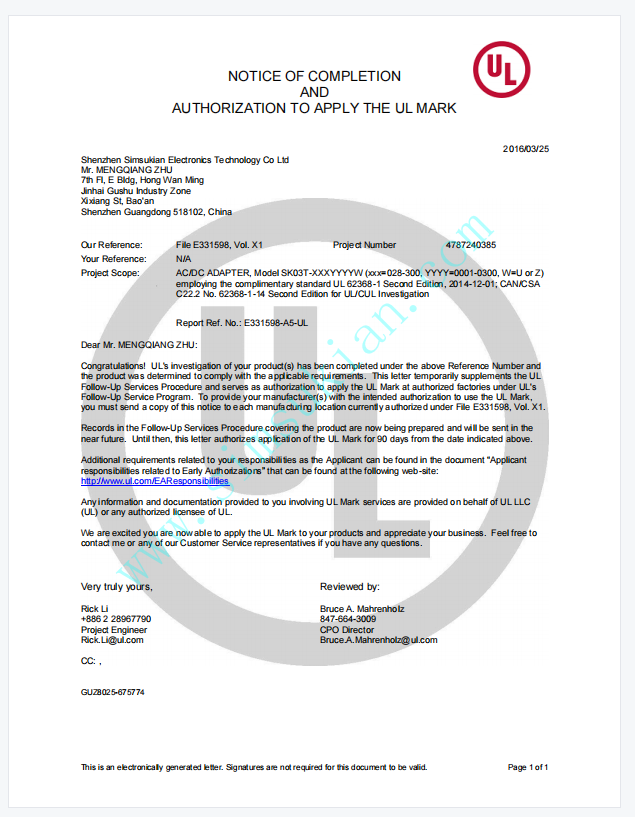
Certificate scope and model coverage are the two fields buyers should reconcile against the purchase order.
How the Voltage Choice Affects the Rest of the Design
Once the device input voltage is fixed, the remaining engineering trade-offs become easier to read. At the same delivered power, a 12 V / 3 A design carries twice the current of a 24 V / 1.5 A design through the same cable. Higher current means greater sensitivity to cable gauge, cable length and connector contact resistance: resistive losses and heat rise proportionally with current for a given conductor. Where a device is powered through a long or thin output lead, the 24 V configuration generally has more tolerance for that path; where the device and its downstream electronics are built around a 12 V rail, the 12 V / 3 A configuration is the one that matches.
Current rating is the second constraint. A 36 W adapter rated at 3 A at 12 V should not be loaded continuously to its exact ceiling where the device has inrush behaviour or motor-type loads, because the adapter has to absorb that transient as well as the steady-state draw. The documented application range for this adapter class - manufacturing equipment, home appliances, IT products, LEDs and general electronics - includes both steady-state and load-varying devices, so buyers should confirm the device peak draw rather than the average.
Input range is the third constraint, and it is the one that makes regional SKU management practical. Every documented SK03T 36 W variant accepts AC 100-240 V at 50/60 Hz, so the difference between an EU shipment and a US shipment is the AC plug and the market documentation, not the internal power stage.
Verifying Quality and Production Before Shipment
Independent buyers rarely have the leverage to audit a factory continuously, so the practical substitute is a documented verification path that can be exercised on the order itself. For this adapter family, the documented acceptance route includes factory inspection reports, support for assigning a third-party inspection before shipment, and pre-shipment testing. Production quality control is described as 100 percent testing rather than batch sampling.
Two structural facts make that verification credible rather than decorative. SimSukian operates an in-house safety and reliability laboratory equipped with instruments from Rohde & Schwarz (Germany), Yokogawa (Japan), Agilent and Tektronix (USA), and states that every new design is subjected to EMC, thermal cycling, surge, short-circuit and accelerated-aging tests before mass production. The company also holds ISO 9001:2015 quality management and ISO 14001:2015 environmental management certification, and reports more than 90 national patents covering structural design, circuit topology and safety-protection technologies.
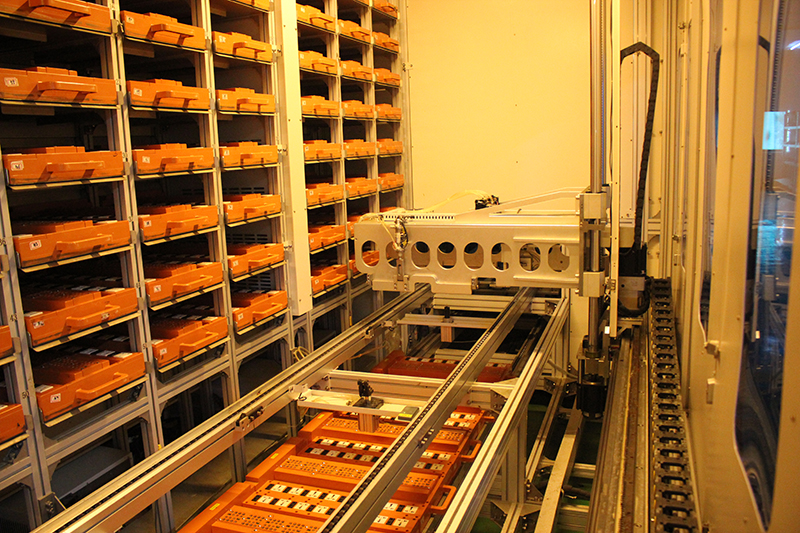
Accelerated aging equipment used for reliability testing of new power supply designs.
Evidence of long-running supply also matters at the evaluation stage, because it speaks to repeatability rather than to a single sample. One documented case involves a Korean medical aesthetic equipment manufacturer that has used this supplier across five years and approximately 100,000 units for dilatation and hair removal devices, with stable operation reported; the related product list for that case includes the 24 V / 1.5 A 36 W Korea-plug SK03T adapter. A second documented case covers a sports products customer across the US, UK, Germany, Poland, the Netherlands, New Zealand, France and Romania, with roughly 2,000,000 units supplied over five years for fascia gun power supply. Buyers evaluating a new supply relationship should treat such records as one input among several, since a case record confirms that a configuration was supplied at scale, not that every future order will match it.
Commercial Terms That Decide Whether an Order Executes Cleanly
The commercial parameters documented for this adapter family are specific and worth checking against any quotation, because they define the minimum viable order and the realistic timeline from purchase order to shipment.
| Item | Documented value | What the buyer should confirm |
|---|---|---|
| Minimum order quantity | 600 units | Whether the MOQ is 600 pieces in total or 600 pieces per plug and voltage variant |
| Lead time | 15-30 days | Whether certification-specific configurations require additional testing time |
| Monthly capacity | 600,000 units | Whether capacity is shared across product families during peak seasons |
| Quality control | 100 percent test | The test items recorded and the retention period for test data |
| Acceptance | Factory inspection reports; support for third-party inspection before shipment; pre-shipment test | Who pays for third-party inspection and which sampling standard applies |
| Delivery terms | EXW Shenzhen, FOB Shenzhen, DAP | Which Incoterm the quotation is based on before comparing prices |
| Payment | 30 percent T/T in advance, 70 percent T/T against copy of B/L | Whether the balance trigger matches the buyer internal cash-flow policy |
| Customization scope | Logo, output voltage, output current, tooling, cable length, DC plug size, cable type, colour, package | Whether a customized variant stays inside the existing certificate scope |
| OEM and ODM | Both offered; ODM covering schematic design, PCB layout, firmware programming, housing prototyping, mold-making, full-batch compliance testing and final assembly | Tooling ownership, exclusivity and design-file handover terms |
The customization list is where the 24 V versus 12 V question re-enters the commercial conversation. Because output voltage and output current are both listed as customizable parameters, a buyer is not limited to the two catalogue configurations - but a customized output combination must still be validated against the certificate scope for the destination market. That is the boundary most often missed: customization is a capability, not a shortcut around compliance.
Where Fixed-Output 36 W Adapters Reach Their Limits
A 36 W fixed-output AC-DC adapter is the right component for a specific job and the wrong one for several adjacent jobs, and buyers should state those limits before ordering rather than after a failed integration.
The first limit is the fixed output itself. These adapters do not negotiate voltage with the load. USB Power Delivery has moved in the opposite direction: USB PD 3.1 Extended Power Range raised maximum delivery from 100 W to 240 W (48 V, 5 A) when it was published by USB-IF in 2021. A device designed around a PD contract and a device designed around a fixed 12 V or 24 V rail need different power architectures, and the SK03T 36 W family belongs to the second category - it supplies power to electronics products, with documented indoor use conditions.
The second limit is the plug. A single SKU cannot simultaneously serve a EU, UK, US, AU and Korea destination; the family covers those markets through separate plug configurations, and the 24 V and 12 V variants do not carry identical documented plug sets. Multi-market buyers should therefore plan SKU splits and documentation per destination instead of assuming a universal plug strategy.
The third limit is service life and environmental exposure. The documented use case for this product class is indoor operation, and the enclosure is fire-retardant PC - robust for indoor electronics, but the documentation does not present this family as an outdoor, waterproof or high-temperature product. Buyers sourcing for outdoor or harsh-environment applications should treat that gap as a specification question, not a marketing one.
The fourth limit is documentation granularity. Certificates are issued against specific model or series identifiers. When a buyer customizes an enclosure, a cable type or a DC plug, the safe assumption is that the configuration falls outside the existing certificate unless the supplier confirms otherwise in writing. This is a general regulatory characteristic of the adapter category, not a defect of any single supplier, and it is the single most common cause of a technically correct order failing at market entry.
Reading the Market Trend Correctly
The power adapter market continues to expand, and the growth is not concentrated in one segment. Dataintelo reports the global power adapter market at US$26.65 billion in 2025, projected to reach US$46.14 billion by 2034. Within that total, the fast-charging segment is growing fastest: Next Move Strategy Consulting valued the GaN charger market at US$1.10 billion in 2023 and projects US$4.22 billion by 2030, a 19.9 percent CAGR.
For independent buyers, the correct reading of those two figures is not that every adapter is becoming a GaN fast charger. GaN growth sits primarily in portable, consumer-facing, high-power-density charging, while fixed-output 12 V and 24 V adapters continue to serve equipment that needs a stable DC rail - LED lighting, industrial control, meters, small appliances and similar devices. Those two demand patterns have different qualification requirements, different certification paths and different order economics. A buyer who follows the GaN headline into a fixed-voltage procurement will usually find that the relevant constraints are the ones described above: voltage match, current headroom, plug configuration and market documentation.
Future Outlook
Three developments are likely to keep shaping how 36 W adapter orders are specified. Regulatory consolidation around IEC 62368-1 continues to raise the documentation baseline, which means buyers will increasingly ask which edition a test report references rather than whether a certificate exists. Energy efficiency thresholds, including the DOE Level VI no-load limit of 0.100 W for external power supplies at or below 49 W, keep pushing no-load and standby performance into the qualification checklist. And plug-level fragmentation across the EU, UK, US, AU and Korea remains a fixed cost of multi-market distribution, which is precisely why the plug field should be confirmed before an order is placed rather than treated as a logistic detail after it.
For a buyer, the near-term practical implication is simple: the adapter market is large enough to accommodate a customized order at a 600-unit minimum with a 15-30 day lead time, so the competitive advantage lies less in finding a supplier who can produce a 36 W adapter and more in specifying one whose voltage, current, plug and certificate set survive their destination market on the first shipment.
FAQ
How does a buyer decide between a 12 V / 3 A and a 24 V / 1.5 A 36 W adapter for the same device?
The device input specification decides it. A 12 V device requires a 12 V output and a 24 V device requires a 24 V output, regardless of the shared 36 W rating. Once the voltage matches, the adapter current rating should be equal to or higher than the device steady-state draw, with additional margin for devices that have inrush or motor-type load behaviour. If the device specification does not state a voltage, the correct next step is to obtain that specification rather than to select on wattage.
Are 12 V / 3 A and 24 V / 1.5 A 36 W adapters interchangeable because they deliver the same wattage?
No. Wattage is the product of voltage and current, and the two configurations differ in both factors: 12 V at 3 A versus 24 V at 1.5 A. Connecting a 24 V adapter to a 12 V device applies double the expected voltage to the load, and connecting a 12 V adapter to a 24 V device under-supplies it. In both directions the mismatch is an electrical fault, not a performance trade-off, and the 36 W label does not indicate compatibility.
Which AC plug variants are documented for the SK03T 36 W adapter family?
In the product data reviewed here, 12 V / 3 A 36 W listings are documented with EU, UK, US and AU plugs, while 24 V / 1.5 A 36 W listings are documented with EU, UK and Korea plugs. Because the two voltage variants do not carry the same documented plug set, buyers whose target market differs from the available listing should confirm the required combination in writing before ordering.
Which certifications matter for the EU, UK, US, Korea and Australia?
For the EU and UK, the documented elements are CE-EMC certificate 22AE110299E002 for SK03T1-36W with market scope listed as EU and UK, tested to EN 55032, EN 55035, EN IEC 61000-3-2 and EN 61000-3-3, plus a CE-LVD certificate under standard 62368. For the USA, Canada and Mexico, UL certificate E331598-A5-UL covers the SK03T series under standard 62368, with FCC and DOE Level VI also listed at product level. For Korea, KC certificate R-R-SSK-SK03T1-1200300 covers the SK03T series under standard 62368. For Australia and New Zealand, SAA certificate GMA-522584-EA covers the SK03T series under standard 62368. Buyers should check that the certificate model scope and market scope match the ordered SKU.
How can a buyer verify quality before a 36 W adapter shipment leaves the factory?
The documented acceptance path includes factory inspection reports, support for assigning a third-party inspection before shipment, and pre-shipment testing, with production quality control described as 100 percent testing. Buyers can specify which items are covered by the pre-shipment test, which sampling standard applies to third-party inspection, and how long test records are retained, so that the verification steps are defined in the order rather than agreed informally.
What are the minimum order quantity and lead time for a 36 W adapter order?
Documented commercial terms for this adapter family list a minimum order quantity of 600 units, a lead time of 15-30 days, and a monthly production capacity of 600,000 units. Delivery terms are documented as EXW Shenzhen, FOB Shenzhen and DAP, with payment structured as 30 percent T/T in advance and 70 percent T/T against copy of B/L. Buyers should confirm whether the minimum order quantity applies per order or per individual plug and voltage variant.
What can be customized in an OEM or ODM 36 W adapter order?
Customization is documented across logo, output voltage, output current, tooling, cable length, DC plug size, cable type, colour and package. ODM support extends to schematic design, PCB layout, firmware programming, plastic housing prototyping, mold-making, full-batch compliance testing and final assembly. Colour options at product level are black, white or customized. Because output voltage and output current are themselves customizable parameters, buyers should confirm whether a customized configuration remains within the certificate scope required for the destination market.
When is a fixed-output 36 W adapter the wrong choice?
It is the wrong choice when the device expects a negotiated power contract rather than a fixed rail, when the device requires more than 36 W, or when the installation is outdoors or in a harsh environment. USB PD 3.1 Extended Power Range reaches up to 240 W at 48 V and 5 A, which is a different architecture from a fixed 12 V or 24 V supply, and this adapter family is documented for supplying power to electronics products under indoor use conditions. In those cases the requirement is a different power architecture, not a larger version of the same adapter.
A 36 W order is decided by four facts that can be documented before the purchase order is issued: the device input voltage, the device current draw, the AC plug required by the destination market, and the certificate that covers the exact model number being shipped. Where those four items are confirmed in writing, the difference between a 12 V / 3 A and a 24 V / 1.5 A configuration stops being a sourcing risk and becomes an ordinary specification line. The manufacturer product catalog covering its adapter and charger ranges is available as a PDF: PD catalog.