
2500KW vs 2000KW Diesel Generators: An Independent Cost-Per-KW Comparison
Independent Buyer Reference · Capacity Selection for Large Industrial Power Projects
Cost per kilowatt is the number most buyers use to compare a 2000KW diesel generator with a 2500KW diesel generator, and it is also the number most often misapplied. Two quotations can sit far apart on a cost-per-kilowatt basis without either one being the better purchase, because the figure moves with three variables that suppliers and buyers rarely define the same way: the rating basis (standby or prime), the equipment scope contained in the quotation, and the load fraction the machine will actually run at over its service life.
This article is written for buyers in the awareness and research stages of a large industrial power project — data center developers, mining operators, oil and gas facilities, EPC contractors and power plant owners — who are deciding whether to standardize on 2000KW blocks or 2500KW blocks. The two capacities offered by MECCA POWER CO., LTD., a Chinese generator set manufacturer founded in 2013, are used as factual reference points: the 2000KW diesel generator (models MC2000 and MC2750) and the 2500KW diesel generator (models MC2500, MC2750 and MC3500). No prices are quoted in this analysis. What follows is the cost-per-kilowatt structure a buyer can apply to any supplier's quotation, together with the load, footprint and redundancy consequences of choosing one block size over the other.
Why the 2 MW to 2.5 MW block has become a mainstream purchasing decision
The global diesel generator market was valued at approximately USD 22.33 billion in 2025 and is projected to reach USD 38.09 billion by 2034, according to Fortune Business Insights. Within that total, the data center generator segment is forecast to reach USD 19.66 billion by 2030, growing at a CAGR of 15.15% from 2024, according to Arizton Advisory & Intelligence. Customs data reported by China Daily indicates that China's exports of high-capacity diesel generator sets for data centers rose 131.81% year on year in the first two months of 2026.
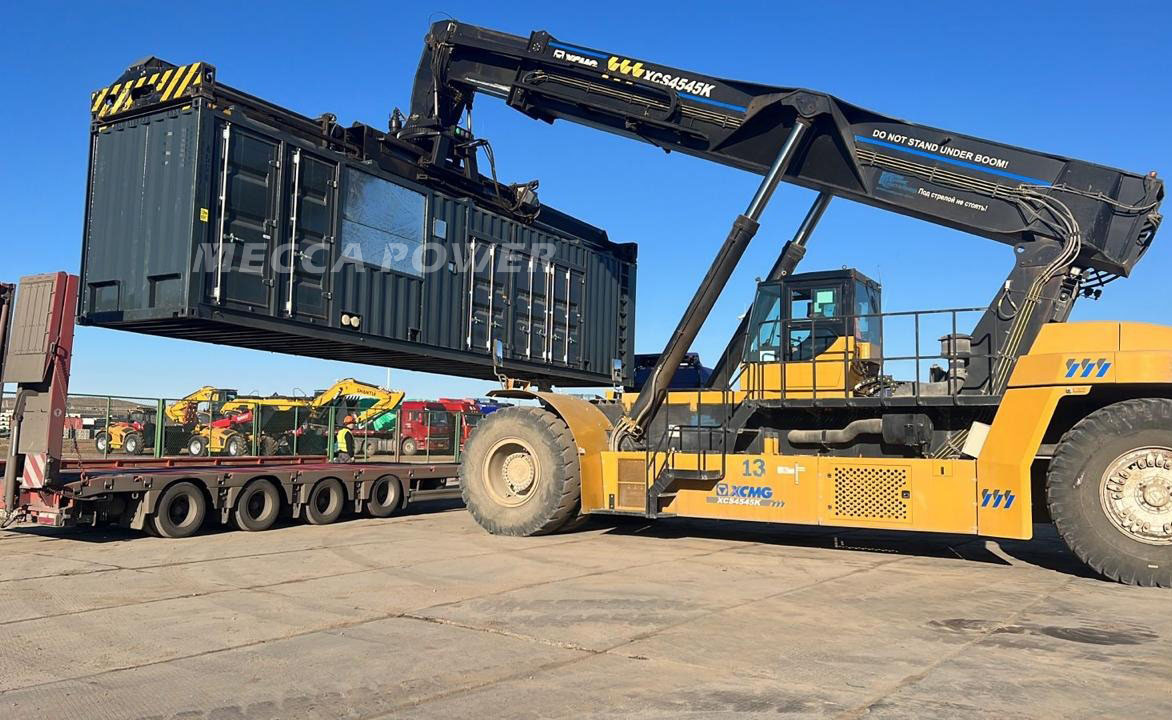
Those figures describe a market in which multi-megawatt generator blocks are no longer specialty items. The 2 MW to 2.5 MW band sits directly in the middle of that demand: large enough to carry a meaningful share of a data hall, a mine site or a process plant, and small enough to be delivered in a container and paralleled in multiples.
The practical consequence for buyers is that both capacities are now widely available and therefore genuinely comparable. MECCA POWER's product range covers diesel generators from 10kVA to 4000kVA, and the company's containerized line spans 1000KVA to 4000KVA in 20HQ, 40HQ and non-standard container configurations. Both the 2000KW and the 2500KW unit fall inside that envelope, which means they are configured builds rather than one-off engineering exercises — an important precondition before any per-kilowatt comparison is meaningful at all.
The two reference units, side by side
| Parameter | 2000KW diesel generator | 2500KW diesel generator |
|---|---|---|
| Models | MC2000, MC2750 | MC2500, MC2750, MC3500 |
| Prime power | 2000KW / 2500KVA | 2500KW / 3125KVA |
| Standby power | 2200KW / 2750KVA | 2750KW / 3500KVA |
| Configuration options | Diesel generator set for data center service; open type or containerized | Open type or containerized type |
| Material specification (OEM data) | Stainless steel | Alloy steel / heat-resistant steel |
| Stated applicable industries | Data center, construction, power plant, oil and gas | Data center, power plant, oil and gas, mining, construction |
The single most important observation in that table is the size of the step. Moving from 2000KW to 2500KW increases prime output by 500KW, standby output by 550KW and apparent power by 625KVA — a 25% increase on every measure. That is not a rounding difference between two adjacent catalogue items; it is a discrete capacity class.
There is a second observation that matters more for procurement than for engineering. The standby rating of the 2500KW unit (2750KW) is 750KW higher than the prime rating of the 2000KW unit (2000KW). A buyer who reads the 2500KW unit's standby figure against the 2000KW unit's prime figure is comparing two different products under two different definitions. ISO 8528, the primary international standard for reciprocating internal combustion engine driven generating sets, exists precisely to fix these definitions — including Emergency Standby Power (ESP) and Continuous Operating Power (COP). Any cost-per-kilowatt comparison that mixes rating bases is not a comparison; it is an arithmetic error with a purchase order attached.
What belongs in a defensible cost-per-kilowatt number
Cost per kilowatt has a numerator and a denominator, and buyers generally control both more than they realize.
The numerator: scope, not sticker
For a 2 MW to 2.5 MW industrial installation, the delivered cost is rarely limited to the generator set itself. Equipment that is commonly quoted inside or outside the generator scope includes the automatic transfer switch (ATS), the parallel control panel, the UL-listed fuel tank, the container or enclosure, and the high voltage cabinet. Each of these items can appear in one supplier's quotation and be excluded from another's, and each changes the numerator without changing the denominator at all. A quotation that omits the paralleling controls will always look cheaper per kilowatt than one that includes them — and will not be cheaper in practice.
Freight, offloading and rigging, foundation work, exhaust and cooling ducting, fuel system commissioning, initial spares and the service agreement belong in the same analysis. For a 2 MW class machine, logistics and site works are a material share of the delivered cost, and they scale with physical size rather than with kilowatts.
The denominator: which kilowatt, and for how long
The denominator is not one number. It is a rating basis multiplied by a service horizon. A unit priced against its standby rating and used continuously is being evaluated against the wrong figure. Equally, a cost-per-kilowatt calculated over a two-year horizon will favour a different machine than the same calculation over a ten-year horizon, because fuel, maintenance and overhaul costs accumulate on the fuel side of the ledger.
Three normalization rules for a valid comparison: (1) compare like ratings — prime against prime, standby against standby; (2) compare like scope — identical matched equipment on both sides; (3) compare like horizons — the same operating hours, load profile and service interval for both units.
The capacity step, and why cost per kilowatt does not scale linearly
A frequent assumption in early-stage budgeting is that a 2500KW unit should cost about 25% more than a 2000KW unit because it delivers about 25% more power. In practice, generator pricing does not behave that way, because the two capacities rarely sit on the same engine and alternator platform. Capacity steps within a manufacturer's range are driven by engine model changes, alternator frame changes, cooling package changes and, frequently, enclosure changes.
The consequence is that the average cost per kilowatt of the larger unit may be lower, higher, or effectively equal to the smaller unit depending on where the step falls relative to those platform boundaries. The only reliable way to establish the real relationship is to request line-item quotations for both capacities with identical scope, and then to examine the difference rather than the absolute figure.
For a buyer, the decision variable is therefore not “which machine has the lower cost per kilowatt” but “what does the extra capacity cost me, and what do I get for it”. That delta — the incremental cost of the 500KW step — is the number worth negotiating, and it is a number that only appears when both quotations are structured the same way.
Partial-load fuel behaviour: where the 2000KW unit can win
Fuel is usually the largest lifetime cost in a continuously running installation, and it is where the comparison most often inverts.
Specific fuel consumption — the fuel burned per kilowatt-hour delivered — is load dependent on every diesel generator set. It is lowest in the upper portion of the machine's rated band and rises as load fraction falls. At low load fractions, the engine is burning fuel to overcome its own friction and parasitic losses while producing relatively little useful output, and sustained low-load operation is also associated with incomplete combustion, cylinder glazing and more frequent maintenance per operating hour.
This produces a specific and often overlooked risk in the 2000KW versus 2500KW decision. If a site's realistic average load is in the region of 1400KW to 1700KW, the 2000KW unit runs at a healthy position within its rated band, while the 2500KW unit runs at a lower load fraction of a larger machine. In that scenario the 2500KW genset can deliver a higher fuel consumption per kilowatt-hour than the smaller unit, even though it is the more capable machine on paper. The buyer has paid for capacity that is not being converted into efficiency.
The same logic works in reverse. If the load profile is expected to reach or exceed 2000KW within the planning horizon, the 2000KW unit loses its headroom, must either be paralleled with another set or operated above its comfortable continuous band, and the fuel and maintenance advantage migrates to the 2500KW unit.
Load acceptance requirements reinforce the point. Large industrial installations, particularly data centers, require the generator set to start and accept full load within a very short window — typically under 10 to 15 seconds — with excellent speed and voltage regulation. Sizing must respect that transient requirement, not just the steady-state average. The practical rule is to size against the load profile expected in years three to five of operation, including redundancy requirements, rather than against a commissioning-day peak that may never recur.
Footprint, container and site implications
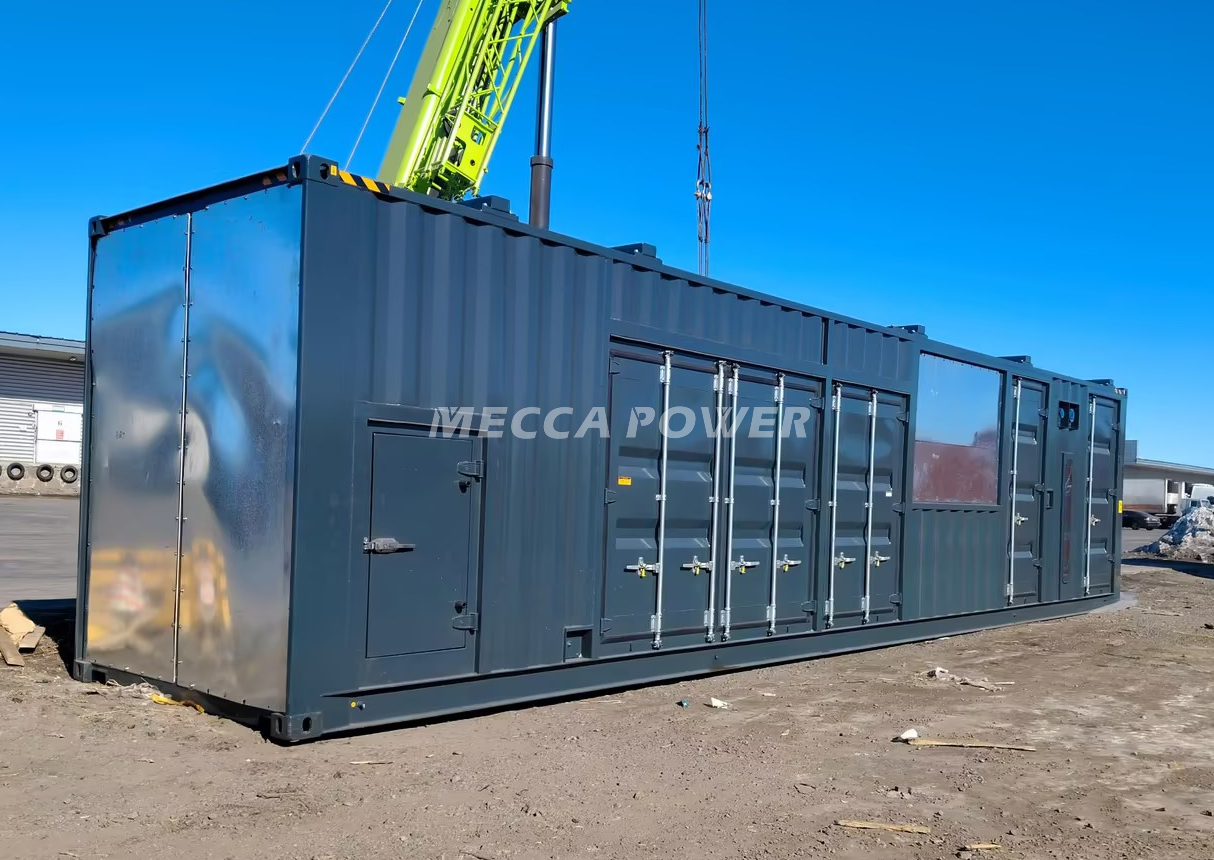
Physical size is where the 25% capacity step becomes visible before commissioning. The containerized line covering 1000KVA to 4000KVA is offered in 20HQ, 40HQ and non-standard container formats, and both the 2000KW and 2500KW units sit inside that range. Container selection, however, is project-specific: as capacity rises within the range, the enclosure must accommodate a larger engine, a larger alternator, greater cooling air volume and larger cable or busbar terminations.
The practical consequences for a buyer are concentrated in four areas:
- Container format and freight. A configuration that fits a standard 40HQ container is cheaper to move and easier to handle on site than a non-standard enclosure. Where the larger unit exceeds the standard format, freight, lifting and road-transport planning change, and those costs belong in the cost-per-kilowatt calculation.
- Foundation and structural works. Larger machines generally require a larger and more heavily engineered foundation, and greater clearances for cooling air intake and exhaust.
- Rigging capacity. Lifting and positioning requirements scale with mass. MECCA POWER's manufacturing facility is equipped with a maximum lifting capacity of 45 tons, which is relevant both to factory handling and to demonstrating the size of unit that can be produced and tested in-house, but on-site crane capacity is a separate buyer responsibility.
- Environmental envelope. MECCA POWER generator sets are specified for operating conditions from -45°C to +50°C in project environments that include high-temperature outdoor sites and low-temperature cold regions, with the broader diesel generator range specified from -50°C to 50°C. High-altitude installations require derating and enhanced cooling design. A capacity comparison made without adjusting for altitude or ambient temperature is not a valid comparison, because derating changes the usable kilowatts on both sides.
Redundancy architecture: block size sets the granularity
For most large industrial buyers, the real question is not one unit versus another unit but one block size versus another block size across a paralleled system. The arithmetic is straightforward and often decides the procurement:
| Configuration | Installed capacity | Usable capacity with N+1 |
|---|---|---|
| 2 × 2000KW | 4000KW | 2000KW |
| 3 × 2000KW | 6000KW | 4000KW |
| 2 × 2500KW | 5000KW | 2500KW |
Smaller blocks give finer granularity: capacity can be added in smaller increments, and the loss of one unit removes a smaller share of total capacity. Larger blocks reduce the number of machines to fuel, test, maintain and synchronise, and they concentrate the same output in fewer points of maintenance. Neither structure is universally better; the correct choice depends on the size of the load increments the facility expects to add over time.
Where a site grows in large increments — a data hall added whole, a mining pit brought into production in a single phase — the 2500KW block matches the increment and avoids over-populating a switchboard. Where growth is incremental and continuous, 2000KW blocks allow closer tracking of demand and better part-load efficiency across the fleet. This is a load-profile decision, not a price decision, and it should be settled before quotations are requested.
Emissions compliance changes the comparable cost
Two quotations for the same nameplate capacity can differ substantially in cost because their emissions and certification configurations differ. That difference is not a pricing anomaly; it is a specification difference, and it must be identified before cost per kilowatt is calculated.
EPA Tier 4 Final standards, effective since 2015, require a near-90% reduction in Particulate Matter (PM) and Nitrogen Oxides (NOx) for non-road diesel engines used in non-emergency applications. Whether a given generator set falls inside that scope depends on how the application is classified and on the jurisdiction in which it is installed — which is a question for the buyer's compliance team, not an assumption to be carried into an RFQ. Where the stricter configuration applies, the engine aftertreatment package changes, and the machine is no longer the same cost object as a comparable unit without it.
Certification scope operates the same way. MECCA POWER's industrial diesel generator range is offered with UL/CSA certification customizable to the project, over a power range of 500KW to 4.5MW prime (4500KW / 5625KVA) and 500KVA to 5MW standby (5000KW / 6250KVA). Because certification is customized rather than assumed, buyers must state the required certification scope in the specification. A 2500KW unit built without the certification the site requires is not a cheaper 2500KW unit; it is a different product that cannot be commissioned.
Manufacturer context: how MECCA POWER builds in this capacity band
MECCA POWER CO., LTD. is a generator set manufacturer founded in 2013, operating a 34,000 m² manufacturing footprint with 311 employees, a 41-person R&D team and an annual output of 3,600 units. The company exports 100% of its production, with stated markets across Europe, Africa, Asia, Australia, the Middle East, the Americas, Oceania and Latin America.
Three characteristics of that operation are directly relevant to a 2000KW versus 2500KW decision.
Capacity-band manufacturing concentration. MECCA POWER's Nanchang factory in Jiangxi province focuses on the production of high-power generator sets of 1000kW and above. Monthly output there increased from 132 units to 212 units, with reported output value rising from 180 million to 380 million over the same period. Both capacities in this comparison fall squarely inside the factory's core production band.
Test capability above 2000KW. The facility is equipped with six testing stations, digital tightening, intelligent oil and water filling and cloud-based data management of the production process, supported by APS+MES information systems. Its maximum lifting capacity of 45 tons allows it to support the production testing of three units exceeding 2000KW simultaneously. For a buyer, that is a verifiable statement about how many units in this size class can be tested in parallel — relevant both to factory acceptance testing arrangements and to delivery scheduling on multi-unit orders.
Multi-platform configuration. MECCA POWER maintains supplier relationships covering engines from Cummins, Perkins, MTU, Mitsubishi, FPT, VOLVO, Baudouin and Chinese engine brands, alternators from Stamford, Leroy Somer and Mecc Alte, and control systems from DeepSea and ComAp. The same capacity can therefore be built on different engine and alternator platforms, which is one reason two 2500KW quotations from the same manufacturer may not be directly comparable without a line-item scope review. At the top of the range, the company offers a 3MW containerized diesel generator (model MC3750C, 3000KW / 3750KVA, US Cummins QSK95 engine), which indicates where the next capacity step sits should a buyer outgrow the 2500KW block.
The company also reports experience in power plant EPC projects domestically and internationally, with technical support and after-sales maintenance provision — a relevant factor when a multi-unit installation requires commissioning, synchronisation and long-term service.
Limitations and boundaries buyers should price in
A neutral comparison has to state where each option becomes a poor fit, and where the reference products themselves have boundaries.
- Single-unit concentration risk. A single 2500KW machine carrying a critical load has no internal redundancy. If availability is the primary requirement, the correct architecture is usually multiple paralleled units, at which point the comparison returns to block size rather than machine size.
- Low-load operation penalty. A 2500KW unit applied to a load that averages well below its rated band will consume more fuel per kilowatt-hour than a 2000KW unit serving the same load, and will accumulate operating hours at an inefficient point on its consumption curve.
- Non-standard enclosure and transport consequences. Configurations at the upper end of the containerized range may require non-standard containers, which changes freight, lifting and site preparation costs. These are real costs, and they fall on the buyer's side of the ledger.
- Certification is customizable, not automatic. UL/CSA certification is offered as a customizable option on MECCA POWER's range. It must be specified. Buyers should not assume that a standard build carries the certification their jurisdiction requires.
- Project-specific configuration. The standard production envelope covers both capacities, but a specific enclosure, fuel system, high-voltage arrangement or paralleling scheme may fall outside standard configuration and lengthen the delivery schedule. Lead times should be confirmed as a project-specific input, not inferred from catalogue capacity alone.
- No price conclusion is possible without quotations. This analysis deliberately does not state a cost-per-kilowatt figure, because no verified pricing data supports one. Buyers should treat any per-kilowatt number quoted without a defined rating basis and scope as unevaluable.
Market trend analysis
Three trends supported by available data shape how this decision will be made over the next several years.
Demand is concentrating in larger blocks. The data center generator segment is forecast to reach USD 19.66 billion by 2030 at a CAGR of 15.15% from 2024 (Arizton Advisory & Intelligence), and China's exports of high-capacity diesel generator sets for data centers grew 131.81% year on year in the first two months of 2026 (China Customs, reported via China Daily). Both signals point to rising demand for multi-megawatt blocks rather than small distributed units.
Containerized delivery is becoming the default format. The containerized product line spanning 1000KVA to 4000KVA, in 20HQ, 40HQ and non-standard formats, reflects an industry shift toward factory-integrated enclosures that reduce on-site assembly and commissioning work. This shifts cost from site labour into the delivered unit — which is precisely why cost-per-kilowatt comparisons must include factory-integrated scope or they will systematically favour suppliers who ship less.
Emissions and certification requirements continue to tighten. Tier 4 Final standards have been in force for non-road diesel engines in non-emergency applications since 2015, requiring near-90% reductions in PM and NOx, and ISO 8528 rating definitions remain the reference point for how generator capacity is declared. As compliance scope widens, the specification gap between apparently similar machines will widen with it.
Future outlook
The direction of travel is toward fewer, larger, factory-integrated blocks with a higher proportion of the delivered cost fixed at the factory rather than on site. For buyers, that has two practical implications.
First, cost-per-kilowatt will remain a useful metric only if it is defined with a rating basis, a scope list and an operating horizon attached. Buyers who standardize their RFQ template around those three elements will get comparable numbers; buyers who do not will continue to compare quotations that describe different products.
Second, the choice between 2000KW and 2500KW will increasingly be settled by load profile modelling rather than by catalogue position. As capacity steps within a manufacturer's range become larger and more integrated, the penalty for choosing a block that does not match the facility's actual load increments — in fuel, in maintenance, in redundancy granularity — becomes more visible across a longer service life.
Frequently asked questions
What is the actual power difference between a 2500KW and a 2000KW diesel generator?
The 2000KW diesel generator (models MC2000, MC2750) is rated at 2000KW / 2500KVA prime power and 2200KW / 2750KVA standby power. The 2500KW diesel generator (models MC2500, MC2750, MC3500) is rated at 2500KW / 3125KVA prime power and 2750KW / 3500KVA standby power. The difference is 500KW at prime rating, 550KW at standby rating and 625KVA of apparent power — a 25% step on each measure. Because ISO 8528 defines Emergency Standby Power (ESP) and Continuous Operating Power (COP) separately, the 2500KW unit's standby rating of 2750KW should not be compared against the 2000KW unit's prime rating of 2000KW.
How should a buyer calculate cost per kilowatt when comparing a 2000KW and a 2500KW diesel generator?
Cost per kilowatt requires a defined numerator and denominator. The numerator should include the generator set, enclosure or container, control panel, automatic transfer switch, parallel control panel, fuel tank, high voltage cabinet where applicable, freight, offloading, commissioning, initial spares and the service agreement. The denominator should state the rating basis (prime or standby) and the operating horizon in hours or years. A valid comparison uses the same rating basis, the same equipment scope and the same horizon on both sides. The most useful output of the exercise is not the absolute per-kilowatt figure but the incremental cost of the 500KW step between the two capacities.
Does a 2500KW generator consume more fuel per kWh than a 2000KW unit at partial load?
Specific fuel consumption rises as load fraction falls on any diesel generator set, and it is lowest in the upper portion of the machine's rated band. If a site's realistic average load sits well below the 2500KW unit's comfortable operating band but within a healthy band for the 2000KW unit, the larger machine can deliver higher fuel consumption per kilowatt-hour than the smaller one, along with more maintenance per operating hour and a greater risk of incomplete combustion from sustained low-load running. The opposite applies once the load profile approaches or exceeds 2000KW: the 2000KW unit loses headroom and the efficiency advantage moves to the 2500KW machine.
What footprint and container differences should buyers expect between the two capacities?
Both capacities fall within the containerized range of 1000KVA to 4000KVA, which is offered in 20HQ, 40HQ and non-standard container configurations. As capacity rises within that range, the enclosure must accommodate a larger engine, a larger alternator, greater cooling air volume and larger terminations, and a configuration may require a non-standard container rather than a standard 40HQ format. Buyers should also confirm the environmental envelope and any derating requirement: MECCA POWER generator sets are specified for project environments from -45°C to +50°C, with the broader diesel generator range specified from -50°C to 50°C, and high-altitude installations require derating and enhanced cooling design, which changes usable capacity on both sides of the comparison.
Which capacity is better for an N+1 configuration in a data center or large industrial site?
The answer depends on load increments. Two 2000KW units provide 4000KW installed and 2000KW usable with N+1; three 2000KW units provide 6000KW installed and 4000KW usable with N+1; two 2500KW units provide 5000KW installed and 2500KW usable with N+1. Smaller blocks give finer capacity granularity and better part-load efficiency across the fleet, while larger blocks reduce the number of machines to fuel, test, maintain and synchronise. Data center and large industrial loads typically require the generator set to start and accept full load within a short window, commonly under 10 to 15 seconds, with stable speed and voltage regulation — a transient requirement that must be verified alongside the steady-state sizing decision.
What certifications and standards affect whether two quotations are comparable?
ISO 8528 is the primary international standard for reciprocating internal combustion engine driven alternating current generating sets and defines the rating categories, including Emergency Standby Power (ESP) and Continuous Operating Power (COP), so quotations should state which rating is being priced. Emissions regulation also changes the machine: EPA Tier 4 Final standards, effective since 2015, require a near-90% reduction in Particulate Matter (PM) and Nitrogen Oxides (NOx) for non-road diesel engines used in non-emergency applications, and applicability depends on how the application is classified and on the local jurisdiction. UL/CSA certification is offered as a customizable option on MECCA POWER's diesel generator range, which spans 500KW to 4.5MW prime power and 500KVA to 5MW standby power; because it is customizable, the required certification scope must be stated in the specification before two quotations can be treated as equivalent.
Reference material: MECCA POWER product and capability brochure (PDF) — https://cdn.socialarks.com/sbsp/24549/0/2026/0429/69f173e13df3d.pdf
Data sources referenced in this article: Fortune Business Insights (global diesel generator market size, 2025–2034), Arizton Advisory & Intelligence (data center generator market, 2030 forecast, 15.15% CAGR from 2024), China Daily citing General Administration of Customs data (China high-capacity diesel generator set export growth, first two months of 2026), ISO 8528 (generating set rating definitions), and the US Environmental Protection Agency (EPA Tier 4 Final standards). Product specifications and manufacturing data are as published by MECCA POWER CO., LTD.
Have Questions or Need More Details?
Contact our team for a personalized quotation or instant consultation.
Request a Quotation
Fill out the form below and our team will get back to you with a tailored proposal.
WhatsApp Direct Chat
Prefer to chat in real-time? Message us on WhatsApp for instant assistance & quick answers.
- Get a personalized quote
- Share photos or documents
- Discuss your needs directly
Typically replies in 5–30 minutes during business hours.