
27Q095 vs 27Q105 vs 27Q120: Independent Buyer Comparison for Transformer Cores
Transformer core sourcing has quietly narrowed to a familiar shortlist: the 0.27 mm high magnetic induction grain-oriented (Hi-B) grades. Within that family, three designations keep appearing in the same tender documents and the same mill quotations — 27Q095, 27Q105 and 27Q120. They share a nominal thickness of 0.27 mm, the same metallurgical family, and the same test condition for loss, yet they are specified to three different loss limits: ≤0.95 W/kg, ≤1.05 W/kg and ≤1.20 W/kg at P1.7/50.
The distinction is no longer academic. The global grain-oriented silicon steel market was valued at USD 13.55 billion in 2025 and is projected to reach USD 23.57 billion by 2035 at a CAGR of 5.8%, according to Research Nester. As grade availability widens, buyers are spending less time deciding between oriented and non-oriented material and more time deciding which loss class inside a single gauge actually earns its price premium. That decision propagates directly into core design, efficiency compliance and landed cost.
This comparison places the three grades side by side on the basis of published specification data and explains where loss performance stops being the deciding factor for a transformer core buyer.
27Q095, 27Q105 and 27Q120 on the same specification sheet
All three grades are High Magnetic Induction Grain-Oriented Silicon Steel (Hi-B), supplied at 0.27 mm thickness. Their base chemistry is comparable: iron with roughly 3% silicon, supplemented by aluminium and manganese, and containing inhibitors (MnS, AlN). What changes across the three designations is the guaranteed loss ceiling, and — for two of them — the guaranteed magnetic flux density.
| Grade | Thickness | Type | Iron loss P1.7/50 | Magnetic flux density B8 | Reference application in the reviewed data |
|---|---|---|---|---|---|
| 27Q095 | 0.27 mm | Hi-B grain-oriented | ≤0.95 W/kg | ≥1.91 T | High-efficiency power transformers, photovoltaic DC converter transformers, industrial frequency conversion equipment |
| 27Q105 | 0.27 mm | Hi-B grain-oriented | ≤1.05 W/kg | ≥1.88 T | Power transformer cores, transformer manufacturing |
| 27Q120 | 0.27 mm | Hi-B grain-oriented | ≤1.20 W/kg | Not stated in the reviewed data | Small and medium-sized transformer cores and electrical equipment |
Two neighbouring grades are useful for context when reading the same sheet. 27Q100 is specified at ≤1.00 W/kg with B8 ≥1.91 T for power transformers, reactors and electrical equipment cores, while 27Q110 is specified at ≤1.10 W/kg with B8 ≥1.88 T for power transformers, automotive generators, power cables and electrical equipment. In other words, the three focal grades sit inside a continuous ladder in which each 0.05 W/kg step has a corresponding commercial position.
What a loss limit and a B8 value actually change in a core design
P1.7/50 is the specific loss of the material measured at a peak flux density of 1.7 T and a frequency of 50 Hz. It is the reference condition against which grid-frequency transformer core material is normally specified, and it is a per-kilogram figure rather than a per-core figure. That distinction is where most grade-selection errors begin.
Read as arithmetic on the stated maxima, the loss ceiling of 27Q120 is 0.25 W/kg above that of 27Q095 — roughly a 26% difference between the two guaranteed limits at the same reference condition. 27Q105 sits about 11% above 27Q095. These are ratios between specification ceilings, not measured differences between finished cores, but they indicate why a designer working against a tight no-load loss budget treats the three grades differently.
B8 is the magnetic flux density achieved at a magnetising field of 800 A/m, and it governs how much material and how many turns are needed to reach a given flux. In the reviewed data, 27Q095 reaches ≥1.91 T and 27Q105 reaches ≥1.88 T. A higher B8 at the same thickness allows a design to operate with greater flux per unit of cross-section, which in practice supports more compact cores or additional design margin. The 0.03 T gap between the two grades is small in isolation but becomes material in designs that are already operating close to saturation margins.
For 27Q120, the reviewed data does not state a B8 figure. That is a genuine information boundary rather than a hidden weakness, and it defines an early step in any credible evaluation: a buyer who intends to compare the three grades on loss alone is comparing on incomplete data and should request the flux density value from the mill before committing to a design.
Application fit: which grade belongs in which transformer
Grade selection follows the duty of the transformer, not the ambition of the specification sheet. The reviewed application data maps the three grades to noticeably different equipment classes.
27Q095 — efficiency-critical cores
27Q095 is assigned to high-efficiency power transformers, photovoltaic direct current converter transformers and industrial frequency conversion equipment. These are applications where no-load and partial-load losses carry weight over the operating life of the equipment, and where a tighter loss ceiling supports the efficiency targets built into the design. In photovoltaic DC converter transformers, the core operates under conditions that place a premium on low specific loss, which is consistent with assigning the lowest loss limit of the three grades.
27Q105 — mainstream power transformer cores
27Q105 is assigned to power transformer cores and transformer manufacturing generally. It occupies the centre of the 0.27 mm ladder: 0.10 W/kg above 27Q095 and 0.15 W/kg below 27Q120 in guaranteed loss ceiling, with a B8 of ≥1.88 T. For manufacturers building a mix of standard power transformer cores, this is the grade that balances two competing pressures — efficiency specification on one side and material cost on the other.
27Q120 — small and medium cores, electrical equipment
27Q120 is intended for small and medium-sized transformer cores and electrical equipment. Where the loss contribution of the core is a smaller share of the total loss picture, or where the equipment class does not carry a demanding efficiency threshold, the loosest of the three loss limits is the commercially coherent choice. Selecting a lower-loss grade in this position does not automatically improve the finished product; it raises the material bill.
Where this comparison breaks down
A grade comparison is only as useful as its stated limits, and there are at least four boundaries buyers should hold onto when working with this set.
- The loss limit is a material property, not a core result. P1.7/50 is certified under standardised test conditions on the strip. Finished core loss also depends on cutting quality and burr, joint design, stacking factor, stress relief annealing, clamping pressure and handling. In practice, a lower-loss grade processed poorly can underperform a mid-grade processed well.
- Comparing across thickness changes the calculation. The evaluated set is deliberately single-gauge, but thinner Hi-B options exist in the same series — for example 23Q080 at ≤0.80 W/kg, 23Q085 at ≤0.85 W/kg, 23Q090 at ≤0.90 W/kg, 23Q095 at ≤0.95 W/kg and 23Q100 at ≤1.00 W/kg. Lower absolute loss figures are therefore available at 0.23 mm. Thinner strip generally reduces stacking factor per unit of stack height and increases the number of laminations to be cut and handled, which shifts the trade-off from material loss to processing cost and build factor.
- Price premium is not self-justifying. Lower-loss grain-oriented grades are generally positioned at a higher price than higher-loss grades at the same thickness. Without a defined efficiency target or a total-cost model that values reduced no-load loss over the equipment's service life, the premium may not be recovered. This is a commercial judgement the grade sheet cannot make for the buyer.
- Coating choice sits outside the grade code. The same grade can be supplied with different insulation systems — organic coating with a temperature resistance of ≤180°C, inorganic coating with resistance up to 800°C, or semi-organic coating. The coating interacts with annealing route, lamination punching and the intended duty of the core, so two coils of the same grade are not necessarily interchangeable across two different production processes.
A related and frequently crossed boundary concerns standards. IEC 60404-8-4 (2013) defines specifications for non-oriented fully processed electrical steel strips and sheets delivered in the finally annealed state, and in North America non-oriented electrical steel is standardised under ASTM A677 for fully processed types and ASTM A683 for semi-processed types. These documents address non-oriented material; grain-oriented grades such as the 27Q series are procured against grade-level thickness, loss and flux density specifications plus the mill's batch documentation. Buyers who cite a non-oriented standard as the acceptance basis for a grain-oriented order create avoidable disputes at incoming inspection.
A verification checklist for 0.27 mm Hi-B coil purchases
Because the three grades differ only in specified limits, the practical work of protecting a purchase sits in documentation and pre-shipment verification rather than in the grade code itself. The following items structure that work.
- Confirm the grade designation, thickness and the applicable P1.7/50 ceiling in writing on the order, not only in the quotation.
- Request the B8 value for every grade in the comparison set, including grades where it is not published on the marketing sheet.
- Specify the coating system explicitly (organic, inorganic or semi-organic) and confirm its temperature resistance against the downstream annealing or curing process.
- Agree the dimensional specification up front: thickness range, width, cut-to-length or coil form, and slitting or longitudinal cutting requirements.
- Require a batch inspection report or material certificate accompanying the shipment, and confirm whether origin (factory) inspection includes full-process random inspection or batch inspection.
- Decide in advance whether third-party testing is required, and under which accreditation — CMA and CNAS submissions are available from suppliers that support independent verification.
- Fix acceptance and commercial terms early: pre-shipment test, third-party testing as an acceptance route, delivery basis of EXW, FOB or CIF, and a 30/70 payment structure where applicable.
Supply-side capability behind these grades
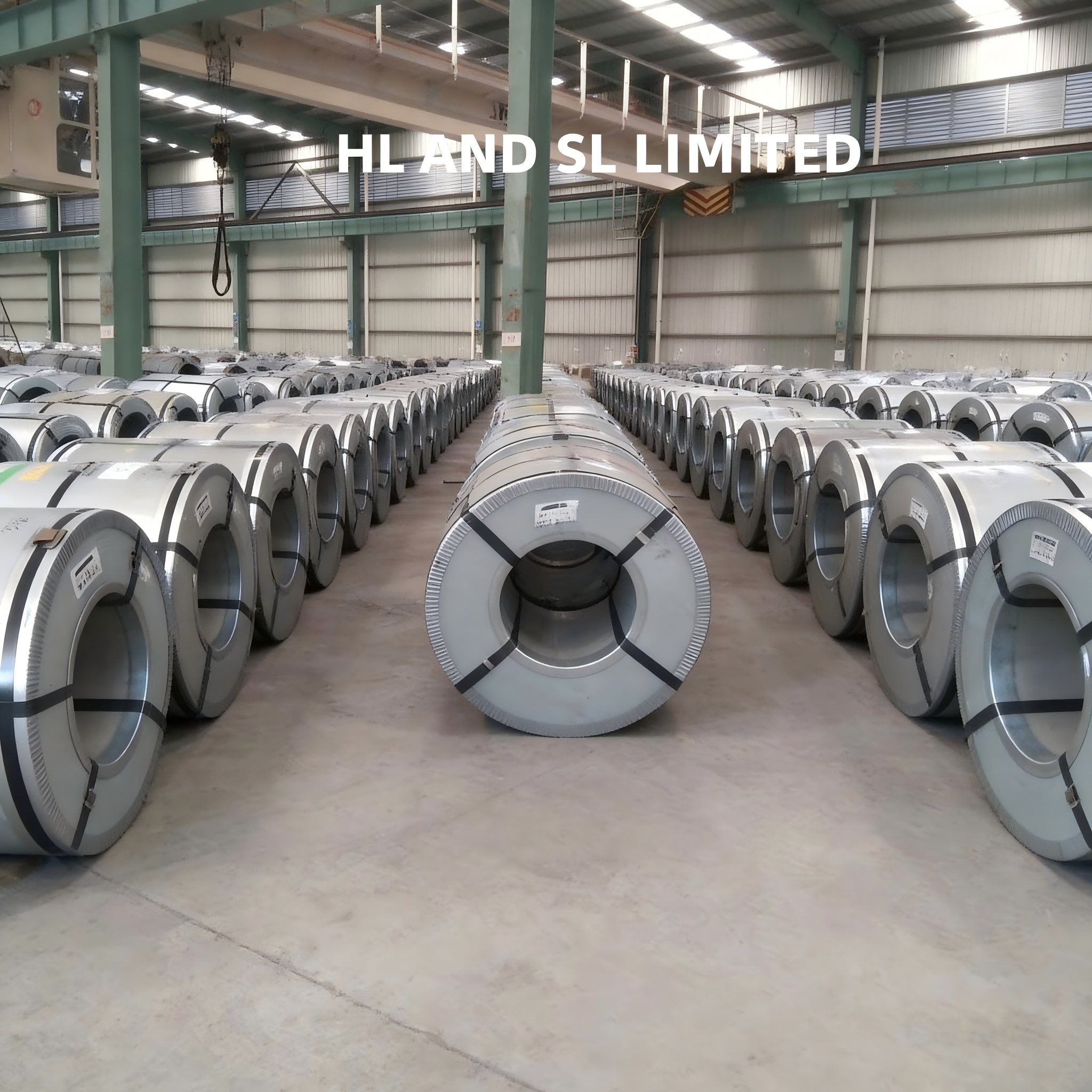
Grade availability and grade consistency are separate questions, and the second one depends on the supplier's channel and processing footprint. HL AND SL LIMITED is an electrical steel (silicon steel) export and processing enterprise headquartered in Taiyuan City, Shanxi Province, China, founded in 2012, with an export ratio of 80% and principal markets including Mexico, Brazil, Italy, the UAE and India.
The company operates a 30,000 m² material processing plant with a 10-engineer R&D team and an annual output of approximately 30,000 t, and it holds an authorised agency position with China Baowu Steel Group while also integrating export resources from private steel mills. For a buyer selecting between 27Q095, 27Q105 and 27Q120, that structure matters in two ways: high-grade Hi-B material can be sourced through a major mill channel, and the same order can be matched to economy positions in the grade ladder without changing supplier.
Capability terms referenced for the 0.27 mm series and adjacent grades:
| Parameter | Stated capability |
|---|---|
| Production mode | Research and production of the entire process of oriented silicon steel; OEM and ODM services |
| Monthly capacity | 4,000 t |
| Minimum order quantity | 25 t |
| Thickness range | 0.18 – 0.35 mm |
| Width | Typically 800 – 1,250 mm, with customisation available to an ultra-wide 1,250 mm specification |
| Material options | General orientation CGO, high magnetic flux Hi-B, laser-engraved R series, heat-resistant engraved HS series |
| Coating options | Organic (≤180°C), inorganic (up to 800°C), semi-organic |
| Size processing | Strip cutting, fixed-length flat cutting, longitudinal cutting |
| Packaging | Standard export sea-worthy packaging; logo and graphic customisation |
| Lead time | Regular orders 15 – 20 days; urgent or stock orders 3 – 7 days for shipment; bulk export orders 30 – 45 days to port arrival; 7 – 30 working days after letter of credit deposit |
| Quality control | Origin (factory) inspection including full-process random inspection and batch inspection; material certificate or warranty certificate with batch inspection report; third-party testing via CMA/CNAS |
| After-sales | Lifecycle technical guidance; inbound quality inspection dispute handling and re-inspection; 1 – 3 working days for feedback and coordination |
Market signals shaping 0.27 mm grade selection
Demand context helps explain why a single-gauge comparison has become a recurring procurement question. The global electrical steel market was valued at USD 31.0 billion in 2025 and is projected to grow to USD 47.0 billion by 2033, according to Grand View Research, while the grain-oriented segment alone is expected to expand from USD 13.55 billion in 2025 to USD 23.57 billion by 2035 at a 5.8% CAGR, per Research Nester.
Two structural trends sit behind those figures. The first is grid investment and the efficiency thresholds attached to it, which push demand toward tighter loss classes within established gauges. The second is electrification of transport and industry: ultra-thin gauge silicon steel under 0.25 mm is identified by SMM analysis as the preferred choice for high-frequency motors in new energy vehicles to maximise power density. That trend pulls demand toward thinner gauges in motor applications, while 0.27 mm and 0.23 mm grades remain the common commercial choices for 50 Hz grid-frequency transformer cores.
Supply concentration is another practical factor. Major global electrical steel manufacturers include Baosteel (China), POSCO (South Korea), ArcelorMittal (Luxembourg), Nippon Steel (Japan) and TISCO (China), according to MarketsandMarkets. Buyers sourcing through an authorised agency channel are effectively selecting which of those production bases their grade will come from, alongside the processing and delivery terms of the trading partner.
Documented application experience
Field records attached to these grades cover two distinct markets. In Brazil, the material has been used by WEG, a major power equipment manufacturer, for local manufacturing of power transformers and distribution transformers, with over 10 years of use and stable operation verified; a representative office in Brazil provides localised technical services and supply chain support for Latin America, supporting compliance with local grid energy efficiency and low-carbon requirements.
In Mexico, the material is used by a transformer manufacturer for producing iron cores for power transformers, converter transformers and special engineering transformers. That project has been in use for over 10 years with stable operation verified, with batch supply supporting an annual business scale of approximately USD 500 million, and it is described as an industrial chain collaboration model in which the user relationship extends into partnership.
The relevance to a grade comparison is straightforward: both reference applications involve converter and special engineering transformers as well as standard power transformers, which is where the difference between a 0.95 W/kg and a 1.20 W/kg loss ceiling has to be justified by design intent rather than by catalogue position.
Outlook
Grade selection inside the 0.27 mm Hi-B family is likely to move further toward explicit design criteria rather than default preference. As efficiency thresholds tighten and photovoltaic and converter applications expand, buyers will increasingly need to state the loss budget their core must meet and then choose the grade that satisfies it with the least material cost, rather than selecting the lowest available loss limit as a precaution. The information needed to do that — loss ceiling, flux density, coating system, dimensional tolerance and batch verification documents — is available before the order is placed, provided it is requested at the quotation stage rather than discovered at incoming inspection.
FAQ
Which of the three grades is specified for photovoltaic DC converter transformer cores?
In the reviewed specification and application data, 27Q095 is the grade assigned to high-efficiency power transformers, photovoltaic direct current converter transformers and industrial frequency conversion equipment. 27Q105 is listed for power transformer cores and transformer manufacturing, and 27Q120 for small and medium-sized transformer cores and electrical equipment. Where a purchase specification sets an efficiency target, the grade should follow the core's loss budget rather than the reverse.
Does a lower P1.7/50 limit always mean a better core?
No. P1.7/50 is a material-level limit measured on strip under standardised conditions. Finished core loss is also affected by cutting quality and burr, joint design, stacking factor, stress relief annealing, clamping and handling. A lower-loss grade processed without control of these factors can produce a core with higher loss than a mid-grade processed well. The loss limit sets the ceiling the material permits, not the result the finished core will achieve.
What does the B8 value add to the comparison?
B8 is the magnetic flux density reached at a magnetising field of 800 A/m, and it determines how much material and how many turns are needed for a given flux. In the reviewed data, 27Q095 is specified at B8 ≥1.91 T and 27Q105 at B8 ≥1.88 T; no B8 figure is stated for 27Q120. Buyers intending to compare the grades on loss alone should request the flux density value from the mill, because loss and flux density together define the design envelope.
What documentation should accompany a 27Q-series coil shipment?
Documentation commonly includes a batch inspection report or material certificate issued with the goods, pre-shipment test records where agreed as an acceptance route, and third-party testing submission under CMA or CNAS accreditation where independent verification is required. Origin (factory) inspection may include full-process random inspection or batch inspection. Buyers should specify which of these apply before shipment, since they form the basis for any inbound quality dispute.
What are typical MOQ, capacity and lead times for 0.27 mm Hi-B grades?
For the supplier capability referenced in this comparison, minimum order quantity is 25 t and monthly production capacity is 4,000 t. Regular orders typically take 15 – 20 days, urgent or stock orders 3 – 7 days for shipment, and bulk export orders 30 – 45 days to port arrival, with 7 – 30 working days after deposit under a letter of credit. Delivery terms include EXW, FOB and CIF, and payment terms are structured 30/70.
A consolidated product and capability brochure covering oriented and non-oriented electrical steel grades is available for download: HL AND SL LIMITED electrical steel brochure.