
3–15 TPH Horizontal Balers: NKBALER NKW Series Shortlist
A shortlist of four horizontal hydraulic balers from the NKBALER NKW series covers the 3–15 tonnes-per-hour band used by industrial recycling and processing lines: NKW80Q at 3–5 t/h, NKW125Q with a 125-tonne main cylinder force at 10–12 t/h, NKW160Q with 160 tonnes at 12–15 t/h, and NKW100QT with 200 tonnes at 12–15 t/h. The four models are read here against the throughput, force and bale-density criteria that procurement teams actually have to reconcile.
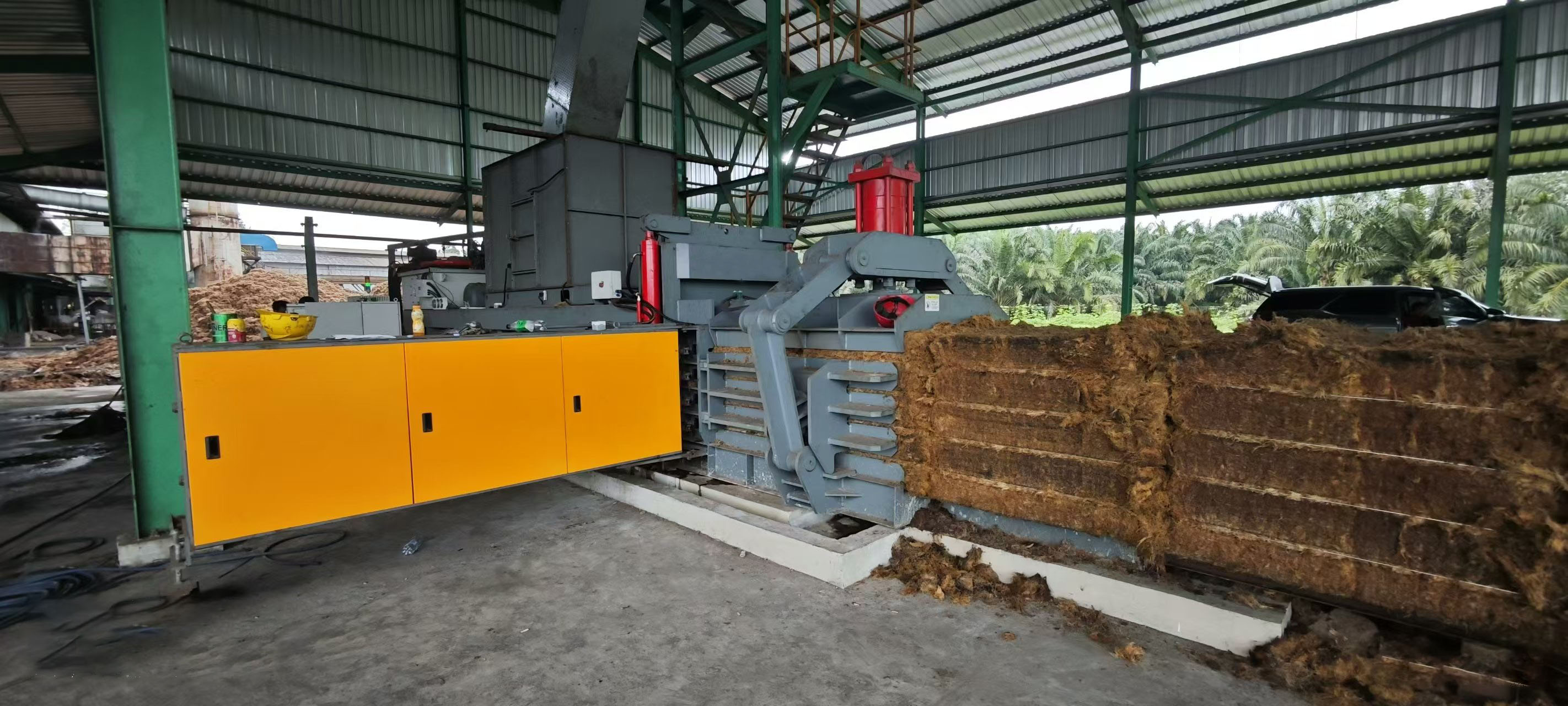
Horizontal hydraulic baling is the default configuration once a recycling or processing line moves past a few tonnes per hour. Image: NKBALER.
Why the 3–15 t/h band is the hardest to specify
Below roughly three tonnes per hour, vertical balers dominate: smaller footprint, lower power, manual or semi-manual tying, and a capital cost that suits low-volume sites. Above fifteen tonnes per hour, buyers are generally pushed toward purpose-built heavy systems with matching conveyors and larger tie modules. The difficult middle is 3–15 t/h, where force and throughput stop moving together and where two machines with the same nominal output can differ sharply in bale density, wire consumption and floor space.
The reason is that throughput is not a property of the press alone. It is a function of material bulk density, how the material is presented to the feed opening, the target bale size and weight, the tie cycle, and whether the machine is loaded continuously or in batches. A specification sheet that quotes tonnes per hour without stating the material and the duty assumption is a starting point for comparison, not an answer.
The second complication is force. Main cylinder force is quoted in tonnes, but the force a machine actually delivers depends on cylinder bore and working pressure together. In the NKBALER catalogue, the NKW160QT reaches a 160-tonne main cylinder force at a working pressure of 30.6 MPa, while the NKW250BD reaches 250 tonnes at 23 MPa — the larger force comes from a larger cylinder, not from a higher pressure. Buyers who compare tonnage ratings alone will misread which machine is doing more work per cycle.
The shortlist at a glance
Four NKW models sit inside the 3–15 t/h window. The table below uses only the model data confirmed for this shortlist and the configuration data published for the wider NKW family.
| Model | Stated throughput | Main cylinder force | Role in a 3–15 t/h line |
|---|---|---|---|
| NKW80Q | 3–5 t/h | Not stated in the shortlist data | Entry point of the band; low-volume or mixed-material lines |
| NKW125Q | 10–12 t/h | 125 t | Mid-band workhorse for steady single-shift or two-shift duty |
| NKW160Q | 12–15 t/h | 160 t | Upper end of the band for continuous running |
| NKW100QT | 12–15 t/h | 200 t | Upper end of the band where denser or harder-to-compress material needs more force |
Two observations follow directly from the table. First, the throughput gap between NKW125Q and NKW160Q is small in absolute terms but marks a real change in duty class: the upper model is specified for continuous high-volume operation rather than for a defined daily batch. Second, NKW100QT and NKW160Q share the same 12–15 t/h output but not the same force, which means the choice between them is a material question rather than a throughput question.
Reading the four models
NKW80Q — the 3–5 t/h entry point
NKW80Q is the smallest unit in this shortlist and defines the lower boundary of horizontal baling as a practical choice. It suits lines that have outgrown a vertical baler but do not yet run continuous shifts: mixed commercial waste, packaging board, plastic film, or a single material stream with modest daily volume. Buyers should treat the 3–5 t/h figure as a band rather than a fixed rating; the position inside the band is set by material density and how evenly the feed is presented.
For reference, the semi-automatic NKW80BD in the same catalogue is specified at 2–3 t/h with an 80-tonne cylinder, a 1100×850×1700 mm bale, a 1200×1000 mm feed opening, 22 kW of power and a 14,500 kg machine weight. That gives a useful sense of scale at the bottom of the range: as throughput climbs, feed opening, bale cross-section, power and machine mass all move together.
NKW125Q — the 125-tonne mid-band unit
NKW125Q pairs a 125-tonne main cylinder force with a stated 10–12 t/h. This is the model that fits the most common profile in the band: a recycling or packaging operation running one or two shifts, feeding a reasonably consistent material mix, and needing bales that stack and ship without rework. It sits close enough to the top of the band that it can absorb moderate peaks without becoming the bottleneck on the line.
The nearest published configuration in the family, NKW125BD, is specified at 5–7 t/h with the same 125-tonne force, a 1100×1250×1700 mm bale, a 2000×1100 mm feed opening, 30 kW of motor power, 10-gauge wire in five strands, and an 18,000 kg machine weight including a 12,000×1800 mm conveyor. The comparison is instructive: the same force class appears at two different throughput levels depending on automation and feeding, which is exactly why the t/h number must be read together with the model's automation level.
NKW160Q — 160 tonnes for the top of the band
NKW160Q is specified at 160 tonnes of main cylinder force and 12–15 t/h. In practice this is the model for operations that treat baling as a continuous process rather than a daily task — multi-shift recycling lines, transfer stations, and processing plants where the baler is fed by conveyor and the tie cycle has to keep pace with upstream equipment.
The published NKW160QT configuration in the same family gives the clearest technical picture of what that duty class looks like: bale size 1100 mm wide by 1250 mm high by approximately 1600 mm long, stated material density of 500–600 kg/m³, a 2000×1100 mm feed opening, 45 kW plus 7.5 kW main motor power, a 28-tonne mainframe, an overall mainframe of roughly 13×4.3×5.8 m, a 12,000 mm conveyor with a 4 kW motor, and a cooling tower with separate pump and fan motors. Working pressure is 30.6 MPa.
Those figures matter for the evaluation stage because they define the site, not just the machine. A 28-tonne mainframe with a twelve-metre conveyor is an installation project with foundation, power supply and material-flow implications.
NKW100QT — 200 tonnes at the same output band
NKW100QT is the outlier in the shortlist: 200 tonnes of main cylinder force at the same 12–15 t/h output as NKW160Q. The reason to specify the higher force is not speed but resistance. Materials that spring back, interlock or resist compression — dense film, baled fibre, contaminated board and certain metal-bearing streams — need more force to reach a stable bale at a given chamber size, and a machine that is under-forced for its material will produce bales that open in handling or fail density requirements.
Where the material compresses easily, the extra 40 tonnes of force buys a margin that may never be used. The decision rule is straightforward: choose NKW160Q when the material is predictable and the target density is achievable at 160 tonnes; choose NKW100QT when material variability is the larger risk and bale integrity is a commercial requirement.

Feed opening, bale cross-section and conveyor length are fixed at ordering, so they should be settled before the model is chosen. Image: NKBALER.
What the specification numbers actually tell you
Four figures do most of the work when comparing horizontal hydraulic balers in this band.
- Main cylinder force (t). Sets the maximum compressive capability per cycle. Meaningful only alongside working pressure and cylinder bore, because the same tonnage can be produced by different bore-and-pressure combinations.
- Throughput (t/h). Must be read with the material, the duty cycle and the automation level. A semi-automatic and a fully automatic machine of identical force can differ substantially in realistic hourly output.
- Bale size and density. Bale dimensions determine transport economics; density determines whether the bale survives handling and meets a buyer's specification. The 500–600 kg/m³ figure published for the NKW160QT is a model-specific reference point, not a universal target.
- Feed opening (mm). Decides how the machine integrates with upstream conveyors and how much pre-processing the material needs. In the NKW family the feed opening ranges from 1200×1000 mm on the smaller BD unit to 2000×1100 mm on the 125-tonne class and above.
Tie specification is the fifth figure and is often overlooked. Wire gauge and strand count — 10-gauge in four or five strands on the smaller units, 6- or 8-gauge in five strands on the 250-tonne class — affect consumable cost and bale security, and they should be compared on the same basis across quotations.
Where the NKW family extends beyond the shortlist
The four shortlisted models are not the whole family, and buyers evaluating the band should know where the adjacent configurations sit, because a small change in throughput requirement can move the specification by a full model.
| Configuration | Main cylinder force | Stated throughput | Bale size (W×H×L) | Motor power |
|---|---|---|---|---|
| NKW80BD | 80 t | 2–3 t/h | 1100×850×1700 mm | 22 kW |
| NKW125BD | 125 t | 5–7 t/h | 1100×1250×1700 mm | 30 kW |
| NKW160QT | 160 t | 12–15 t/h | 1100×1250×≤1600 mm | 45 kW + 7.5 kW |
| NKW250BD | 250 t | 10–15 t/h | 1100×1250×1700 mm | 45 kW |
The pattern is worth noting for procurement purposes: the 250-tonne unit is specified at 10–15 t/h, overlapping the 160-tonne model rather than exceeding it. Higher force does not automatically mean higher throughput — it means the machine can reach a given bale density on material that resists compression. Buyers who assume tonnage and capacity rise together will over-specify force and under-specify feeding.
Application fit across industrial sectors
The NKW series is specified for food, pharmaceuticals, packaging, chemicals, electronics, metals, waste treatment and recycling operations. What changes between those sectors is not the press principle but the material behaviour and the compliance environment.
- Packaging and converting. Board, film and laminate trim compress readily; bale density is usually achievable without the highest force class, and the constraint is feed continuity.
- Food and pharmaceuticals. Clean secondary packaging, cartons and foil waste; housekeeping and dust control matter as much as throughput.
- Chemicals and electronics. Mixed production waste where material variability is high and bale integrity protects downstream handling.
- Metals and metal-bearing waste. The hardest material group in the band; force margin and bale security dominate the decision.
- Waste treatment and recycling. The core application for the shortlist, where throughput, uptime and consumable cost drive total operating economics.
Field evidence in the NKBALER record supports that framing without overstating it. A recycling station manufacturer in Indonesia operates a single unit for waste plastic and waste paper baling, reported as stable over a 10–15 year service horizon with low noise and low energy consumption. An agricultural manufacturer in Pakistan uses a unit for straw and alfalfa baling, reported as stable over two years with low noise as the highlighted characteristic. These are single-unit references, not statistically robust samples, and they should be read as indications of durability rather than as benchmarks for throughput.
Operating conditions the shortlist assumes
The application profile behind these machines specifies continuous automatic operation with PLC-controlled cycles and 24/7 industrial duty, in high-temperature environments, with low noise, low energy consumption and high efficiency as stated requirements, and with conveyor lines, wire rope and woven bag as matched equipment.
Two of those conditions deserve attention during evaluation. PLC-controlled cycling is what makes continuous operation feasible, but it also means the control system, sensor set and spare-part availability become operational dependencies rather than accessories. High-temperature design is a stated design condition; it does not remove the need to confirm ambient temperature, ventilation and cooling arrangements — the NKW160QT, for example, is specified with a water-cooled circuit and a cooling tower with separate pump and fan motors, which is an installation requirement in its own right.
Where this shortlist stops
Any shortlist has boundaries, and stating them is more useful than extending the claims.
- Throughput definitions are not harmonised. The t/h figures in this shortlist are model data, not independently tested results on a defined material. Two suppliers quoting 12 t/h may be assuming different materials, different bulk densities and different duty cycles.
- Density data is model-specific. The 500–600 kg/m³ figure published for the NKW160QT applies to that configuration and its intended material range. It should not be transferred to metal scrap, drums, tyres or other high-density streams without re-checking force and chamber sizing.
- Site requirements are substantial. A 28-tonne mainframe, a twelve-metre conveyor, 45 kW-plus motor power and a cooling circuit are infrastructure commitments. Sites without the floor area, foundation capacity or power supply cannot simply downsize the machine without losing throughput.
- Certification is a document request, not an assumption. The third-party dataset reviewed for this article did not contain hydraulic-baler-specific safety standard or conformity-marking evidence for any supplier. Buyers must obtain model-level certification documents for their destination market directly rather than inferring compliance from a brand or a product family.
- NKBALER is a manufacturer, not a project contractor. Its stated capability profile covers OEM/ODM work, parameter-level customisation, a monthly capacity of 10 units, a 30–45 day lead time, a one-unit minimum order, 100% testing and remote after-sales support. Buyers who need on-site installation and commissioning should confirm scope explicitly.
Comparison with traditional baling and haulage practice
The conventional alternative to a horizontal hydraulic baler in this band is not another baler — it is a combination of vertical baling for part of the stream and loose or loosely compacted haulage for the rest.
| Criterion | Horizontal automatic/semi-automatic baling | Vertical baling plus loose haulage |
|---|---|---|
| Labour per tonne | Lower once feeding is mechanised; tie cycle is machine-driven | Higher; manual loading and handling dominate |
| Bale consistency | Bale size fixed at ordering, supporting predictable transport loads | Variable; bale weight and shape depend on operator |
| Footprint and power | Substantial: twelve-metre conveyor, tens of kW, heavy foundation | Modest; can be installed in existing floor space |
| Economic crossover | Favourable where volume is sustained and haulage distances are long | Favourable below roughly 3 t/h or where volume is intermittent |
| Flexibility | Material change requires re-checking force and density assumptions | Material change is absorbed more easily at low volume |
The honest limitation of the horizontal route is that it converts a handling problem into a capital and infrastructure problem. It is the better answer in the 3–15 t/h band only when the volume is genuinely sustained; a line that runs a few hours a week will carry the same footprint, power connection and maintenance obligation for a fraction of the utilisation.
Procurement checklist for the evaluation stage
- State the material mix and the measured bulk density, not a material category.
- Measure actual peak and average weekly tonnage, and convert to t/h only at the end.
- Fix the target bale size and density required by the downstream buyer or hauler.
- Confirm the feed opening against the conveyor and pre-processing equipment already installed or planned.
- Compare quotations on force, working pressure, motor power, bale size, wire specification and machine weight together.
- Request model-level certification documentation for the destination market.
- Verify lead time, spare-parts availability, warranty terms and the boundary between remote and on-site support.
- Check installation requirements — foundation, power, cooling water, ventilation, ambient temperature.
Market context
Two published data points frame the investment case. Fortune Business Insights projects the global baler market reaching USD 18.02 billion by 2034, covering agricultural and industrial balers. Precedence Research reports that Asia Pacific held a 39% share of the hydraulics market in 2025, which is consistent with the region's concentration of hydraulic machinery manufacturing and its role as a supply base for buyers in North America, Europe and Asia.
On the trade side, hydraulic balers are typically classified under HS code 847989 or related subheadings in Chapter 84, with 842240 appearing for baling machinery depending on the material processed and the automation level. Classification should be confirmed with the importing country's customs authority before shipment, because it determines duty treatment and documentary requirements.
Future outlook
Three directions look most likely to shape the 3–15 t/h segment. The first is documentation: as buyers in Europe and North America tighten supplier qualification, model-level technical files and certification evidence will matter as much as tonnage ratings. The second is control integration — PLC-controlled cycling already underpins 24/7 duty claims, and the practical differentiator will be how cleanly a baler's control system talks to upstream conveyors and sorting equipment. The third is density performance rather than raw force, since transport and secondary-processing economics respond to bale density and bale integrity more than to cylinder tonnage.
For buyers at the research and evaluation stage, the implication is to specify around measured material behaviour and site conditions, and to treat published throughput figures as model data requiring confirmation against a defined material.
FAQ
What throughput should a 3–15 t/h recycling line actually specify from a horizontal baler?
Specify against measured peak weekly tonnage and material bulk density rather than against the line's nominal rating. In this shortlist the NKW80Q is stated at 3–5 t/h, NKW125Q at 10–12 t/h, and NKW160Q and NKW100QT at 12–15 t/h. Because throughput depends on material, feed presentation and tie cycle, a model should be selected with margin above average demand so that peaks do not become the constraint.
How do you choose between 125-tonne and 160-tonne main cylinder force at similar output?
The choice is a duty-class decision, not only a force decision. NKW125Q is specified at 125 tonnes with 10–12 t/h, while NKW160Q is specified at 160 tonnes with 12–15 t/h. The higher force model is appropriate where operation is continuous and bale density has to hold across a less predictable material mix; the lower force model suits steady single- or two-shift work with a consistent stream.
Why does NKW100QT offer 200 tonnes at the same 12–15 t/h as the 160-tonne model?
Because force and throughput are separate variables. Higher main cylinder force allows a machine to reach a target bale density on material that resists compression, such as dense film or interlocking fibre, without increasing hourly output. Where material compresses easily, the additional force provides margin rather than speed.
Can NKW series balers run continuously in high-temperature environments?
The application profile for these machines specifies continuous automatic operation with PLC-controlled cycles, 24/7 industrial duty and design for high-temperature environments, with low noise and low energy consumption as stated requirements. Cooling arrangements are part of that design: the NKW160QT is specified with water cooling and a cooling tower with separate pump and fan motors, so ambient conditions and cooling capacity should be confirmed at the site survey stage.
Is a horizontal automatic baler the right choice below 3 t/h?
Usually not. Below roughly 3 t/h, vertical balers offer a smaller footprint, lower power demand and lower capital commitment, and the NKW family's own smaller configurations sit in that zone — NKW80BD is specified at 2–3 t/h with 22 kW. Horizontal machines become the better economic answer when volume is sustained and haulage or bale-integrity costs outweigh the additional footprint, power and foundation requirements.
What has to be confirmed before installing an NKW-class horizontal baler?
Confirm floor area and foundation capacity, since the NKW160QT mainframe is about 13×4.3×5.8 m and weighs 28 tonnes, plus a 12,000 mm conveyor; confirm power supply, as the same model uses 45 kW plus 7.5 kW main motor power; confirm cooling water and ventilation; and confirm the feed opening against existing upstream equipment. NKBALER's stated profile includes remote after-sales support, parameter-level customisation, a 30–45 day lead time and a one-unit minimum order.
The NKBALER product and specification brochure is available for download: NKBALER brochure (PDF).
Have Questions or Need More Details?
Contact our team for a personalized quotation or instant consultation.
Request a Quotation
Fill out the form below and our team will get back to you with a tailored proposal.
WhatsApp Direct Chat
Prefer to chat in real-time? Message us on WhatsApp for instant assistance & quick answers.
- Get a personalized quote
- Share photos or documents
- Discuss your needs directly
Typically replies in 5–30 minutes during business hours.