
316L Stainless Steel Jewelry: MOQ, Payment, Testing and Incoterms FAQ

Order execution terms, not product photography, decide whether a 316L program reaches repeat production.
In 316L stainless steel jewelry procurement, the metal grade is rarely what stalls a program. The terms wrapped around it — minimum order quantity, payment route, test documentation, Incoterms and acceptance criteria — decide whether a first order converts into a repeat production relationship or stops at the sampling stage.
Jusnova Jewelry Co., Ltd. is a Guangzhou-based manufacturer founded in 2009 that produces stainless steel bangles, bracelets, rings and earrings, including PVD and electroplated gold pieces, with roughly 95% of output exported to Europe and America. Its published order terms are notably specific: a minimum order quantity of 100 pieces per style, payment by PayPal or bank transfer, a typical production lead time of 25–30 days, shipping quoted on FOB, CIF or DDP terms, and acceptance governed by contract specification together with a mutually approved physical sample.
This reference is written for buyers standing at the point of order rather than the point of discovery. It separates the terms that are fixed from the ones that can be structured, and it flags where a buyer should still run their own verification.
Why the Commercial Shell Carries More Risk Than the Metal Grade
316L is a defined material. Its distinguishing feature against 304 is the addition of 2–3% molybdenum, which is what raises corrosion resistance; in salt spray testing, 316L can last three to five times longer than 304 before showing signs of corrosion. Because the metallurgy behaves predictably, most uncertainty in a 316L program sits somewhere else entirely.
The risk categories that actually interrupt orders are surface fading or peeling, MOQ and lead-time mismatch, batch-to-batch quality inconsistency, and supply chain or shipping disruption. Every one of those is a commercial or process question rather than a materials question, and each is addressed by a specific clause: an MOQ that matches expected sell-through, a lead time that matches the launch calendar, an inspection regime that catches inconsistency before packing, and an Incoterm that assigns freight responsibility without ambiguity.
The Core Order Terms at a Glance
Before examining each term individually, the published positions on a Jusnova stainless steel jewelry order are as follows.
| Term | Published position | What it means in practice |
|---|---|---|
| Minimum order quantity | 100 pcs per style | The minimum applies to each style, not to the order as a whole |
| Production lead time | 25–30 days typical | Production window only; transit is excluded |
| Capacity | 250,000 units per month | Roughly 3,000,000 units per year across the 1,000 m² facility |
| Payment | PayPal or bank transfer | Two accepted routes, selected by order stage |
| Incoterms | FOB, CIF or DDP | Buyer chooses where freight and duty risk sit |
| Freight modes | International courier (DHL, FedEx) or sea freight | Cost depends on weight, volume, destination and service level |
| Acceptance | Contract specification + approved physical sample | All sample details confirmed before mass production |
| Quality control | 8 inspection stages from raw material to clasp function | Includes sample approval, first article inspection and batch reports |
| Documentation | SGS and REACH test reports, BSCI certification available upon request | Issued against a request, not attached automatically |
MOQ: 100 Pieces per Style — and Why the Unit Matters
The minimum order quantity on a Jusnova program is 100 pieces per style. The word doing the work in that sentence is "style": the threshold applies to each individual design rather than to the total order value. A ten-style capsule therefore carries a 1,000-piece minimum, and a twenty-style range carries 2,000 pieces, regardless of how the assortment is tiered internally.
For buyers, the practical consequence is that assortment breadth — not order value — is the binding constraint. A common way to work within the clause is to tier a launch: run six proven silhouettes at full depth and two to four test designs at the minimum, then read sell-through before committing to a wider range on the second order.
Capacity headroom is rarely the limiting factor behind the clause. The manufacturer runs a monthly production capacity of 250,000 units, equivalent to roughly 3,000,000 units a year, from a 1,000 m² facility with 300 employees, including a 20-engineer development team that supports new-custom development and surface-finishing process work. Design output runs at more than 500 styles a month, which is why per-style minimums rather than per-order minimums are the operating logic.
The MOQ clause also interacts with material choice. 316L stainless steel costs 10–18% more per finished piece than 304, on the manufacturer's own cost analysis. Buyers whose retail price architecture cannot absorb that on the full range sometimes split the program, running higher-volume test styles in 304 and core, long-life styles in 316L. That split is a commercial decision, and it should be made before the sample stage rather than after.
Payment: PayPal or Bank Transfer
Two payment routes are accepted on Jusnova orders: PayPal and bank transfer. There is no third listed option, which makes the decision simpler than it first appears.
The dividing line is usually order stage rather than order size alone. At sampling and trial-order stage, PayPal is the more frequently used route because it settles quickly and leaves a clean transaction record on both sides. At production volume, bank transfer is standard and is typically tied to the payment schedule written into the contract. Buyers should confirm the payment milestone structure — deposit against sample approval, balance against documents, or another arrangement — at the same time as they confirm the Incoterm, because the two clauses interact when freight is paid by the supplier.
Testing and Documentation: What EU-Facing Buyers Should Request Early
Documentation is the part of a 316L order most often requested too late. SGS and REACH test reports, together with BSCI certification, are available upon request, and the manufacturer positions its stainless steel output as lead-free, nickel-free and compliant with US and EU standards. Those files are issued against a request rather than attached automatically to every shipment, so the request needs to be lodged at sampling stage with the destination market named explicitly.
Two test topics dominate European buyer questions: salt spray exposure and sweat resistance. Both are durability questions rather than appearance questions, and both are addressed through the QC regime. Accelerated aging tests sit alongside incoming inspection, in-process checks, finished-product sampling, and qualified packaging and shipment inspection. The full process runs eight inspection stages from raw material through to clasp function, which is the mechanism that keeps the approved sample and the production batch aligned.
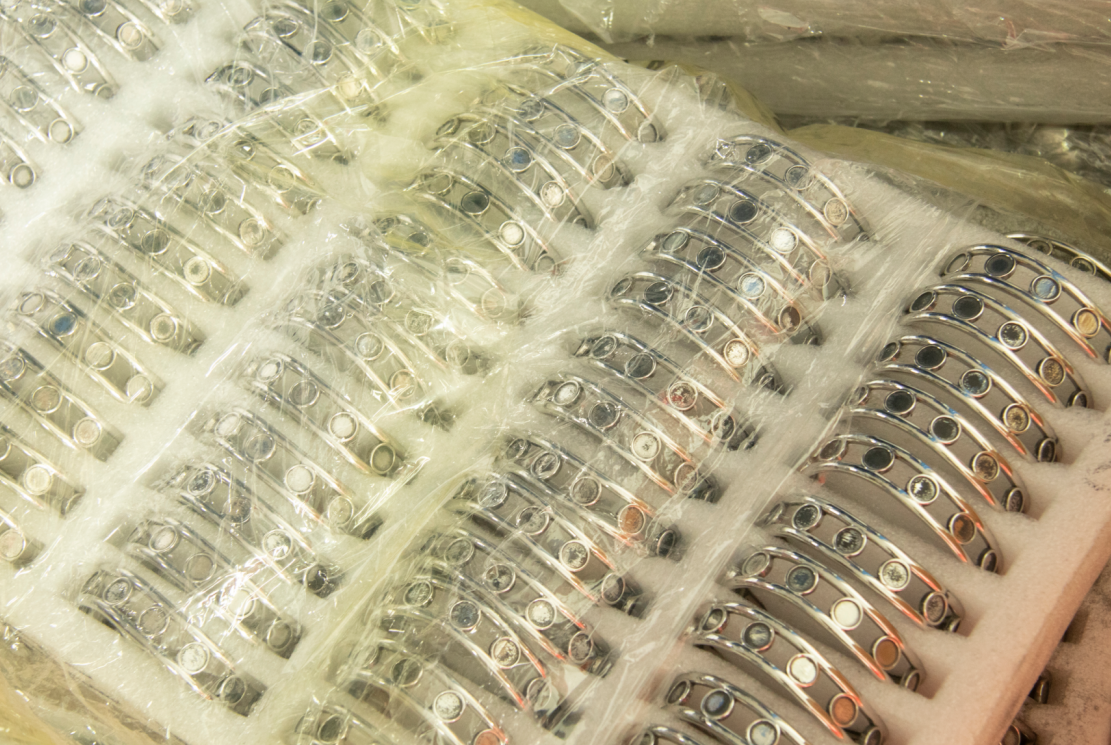
Inspection stages from raw material to clasp function sit between sample approval and shipment release.
Incoterms in Practice: FOB, CIF and DDP
Stainless steel jewelry moves either by international courier — DHL, FedEx and comparable services — or by sea freight. Shipping cost depends on weight, volume, destination and service level, and quotes are issued at order time with a side-by-side comparison of the available modes so the buyer can weigh cost against speed directly. Three Incoterms are quoted.
- FOB (Free On Board) — the supplier delivers to the port of loading, and the buyer arranges and pays for main carriage, insurance and import clearance. It produces the lowest quoted unit price, but the buyer carries the freight booking and the customs work.
- CIF (Cost, Insurance and Freight) — the supplier arranges carriage and insurance to the destination port. It is convenient for sea shipments and for buyers without an established freight forwarder.
- DDP (Delivered Duty Paid) — the supplier delivers to the buyer's named destination with duties paid. Operationally it is the simplest term and the highest-priced one, because duty, clearance and final-mile cost are embedded in the unit price.
The question is not which term is superior but where the buyer wants risk to sit. Base-metal imitation jewelry imported from China into the United States under HTS 7117.19.90.00 currently carries an effective duty rate of 31%, combining an 11% general duty with 20% cumulative Section 301 duty. When exposure of that scale is folded into a DDP price, a buyer with its own customs capability will frequently find FOB cheaper overall — while a buyer selling cross-border direct-to-consumer may value the predictability of DDP more than the saving.
EU importers should confirm their own duty and VAT treatment separately, since it differs from the US position and changes with product classification.
Acceptance Criteria: Contract Specification Plus Approved Sample
Acceptance on Jusnova orders rests on two references used together: the contract specification and a mutually approved physical sample. All sample details are confirmed with the buyer before mass production begins, and the approved sample becomes the physical benchmark against which the production batch is judged. Nothing is left to interpretation at the dispute stage because the reference point was fixed in writing and in hand before the line started.
Behind that benchmark sits a documented sequence: sample approval, pre-production first article inspection, batch inspection reports, and qualified packaging and shipment inspection. Together with the wider eight-stage QC process, these steps are what allow a buyer to raise a deviation question against a specific inspection record rather than against a general impression.
Because acceptance is anchored to a sample rather than to a written description alone, commercial risk concentrates in the approval step. Whatever is approved is what will be manufactured. A change request after approval does not amend the reference — it resets it, and the timeline resets with it.
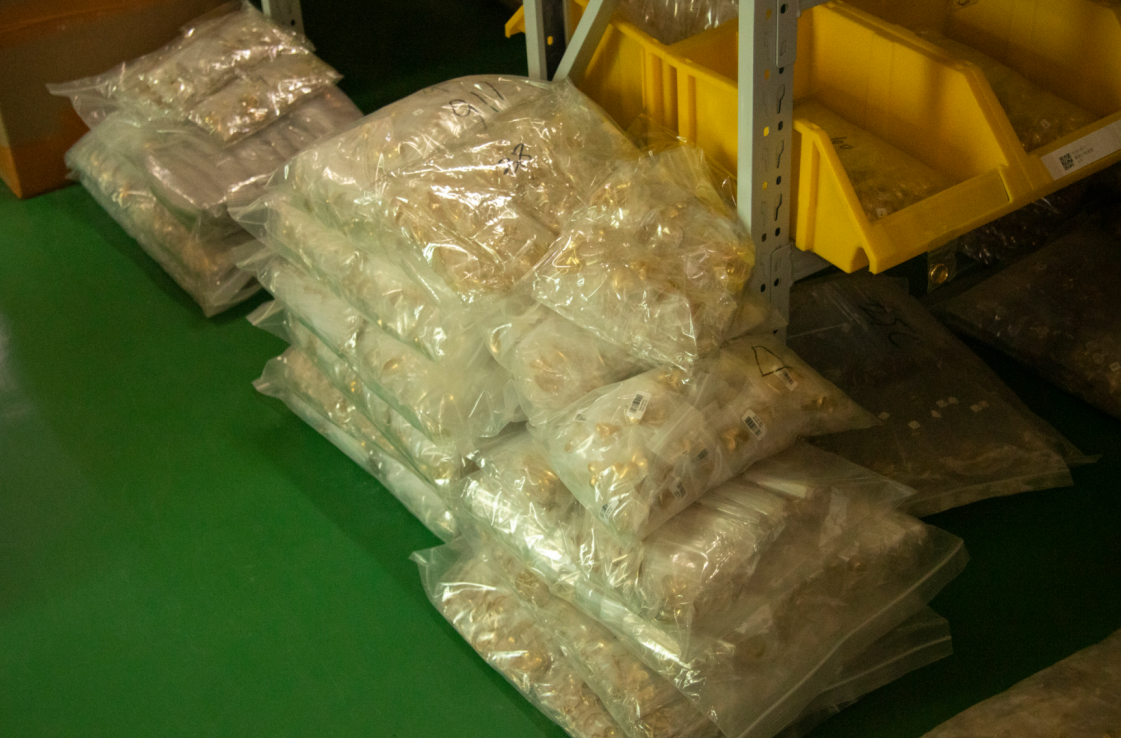
Packaging and shipment inspection form the final acceptance gate before dispatch.
Applying the Terms to Three Buyer Profiles
Direct-to-consumer brand launching a capsule range
An eight-to-twelve style launch runs closest to the MOQ clause's natural limit. Courier freight through DHL or FedEx keeps the calendar short, PayPal covers the sample and first-order stage, and the 25–30 day production window sits comfortably inside a planned drop calendar if transit is added at the front end of planning rather than the back.
Wholesale distributor restocking proven styles
For repeat styles, the approved sample already exists, so the risk shifts to consistency and timing. Sea freight becomes viable at volume, bank transfer is the standard payment route, and batch inspection reports provide the paper trail a distributor needs when the same style is reordered across multiple seasons. FOB or CIF is usually the better fit here, since established distributors typically hold their own customs arrangements.
Private-label and OEM program
Custom development programs add two variables: IP protection and finish specification. Confidentiality is handled through NDA and confidentiality terms, while surface finishing — including PVD gold plating and standard gold plating on 316L — is specified at sample approval. On this profile the sequence matters more than the price: sample approval, then pre-production first article inspection, then volume. Skipping the first article step to save two weeks is the classic error, because it moves quality verification to the point where correction is most expensive.
What the Market Data Says About Order Timing
Stainless steel jewelry was valued at USD 7.08 billion in 2025 and is projected to reach USD 10.8 billion by 2035, a compound annual growth rate of 4.3%. The subsegment most relevant to a 316L program is growing considerably faster: the waterproof jewelry market, which is built largely on PVD-coated stainless steel, is projected to expand from USD 2.12 billion in 2026 to USD 4.60 billion by 2034, a CAGR of 10.16%.
The technical reason the two curves diverge is visible in surface hardness. PVD coatings measure roughly 1,500–4,500 HV on the Vickers scale, against 100–200 HV for standard electroplating. Buyers asking for waterproof, tarnish-free and hypoallergenic positioning are therefore not simply asking for a nicer finish — they are asking for a 316L base paired with a PVD coating, and that pairing changes the documentation burden and the term structure, not only the unit price.
The practical read for procurement planning is that demand growth is concentrated in exactly the configuration that carries the most verification work. Order terms set up once, clearly, with documentation requested at sampling, absorb that work efficiently across repeat orders. Terms improvised order by order do not.
Where the Terms Are Fixed — and Where the Boundaries Sit
An honest account of the boundaries matters more than an optimistic one, because these are the points at which a buyer should plan around the terms rather than expect them to flex.
- MOQ is per style. Assortment breadth, not order value, drives the minimum cash commitment, and a wide test range multiplies it quickly.
- 316L carries a material premium. It costs 10–18% more per finished piece than 304. Supplier analysis has observed retail premiums of 20–40% for 316L positioning, but that premium is market-dependent and should not be assumed in every sales channel.
- Payment is limited to two routes. PayPal and bank transfer are the accepted methods; buyers with treasury rules requiring other instruments would need to plan around that.
- Certificates are issued on request. SGS, REACH and BSCI documentation is available upon request, which means it is not automatic — the request must be explicit and early.
- DDP embeds duty. The convenience is real, and so is the cost. The 31% effective US duty rate on HTS 7117.19.90.00 from China illustrates how much landed cost can sit inside a DDP quote.
- Lead time excludes transit. The 25–30 day figure covers production; sea freight adds a materially longer calendar than courier service.
- Durability comparisons are self-reported. The 316L versus 304 salt spray differential comes from supplier testing disclosure, and independent verification remains the buyer's step.
- Sample approval is the pivot point. Acceptance is contract plus physical sample, so changes after approval reset the reference rather than amending it.
Future Outlook
Two shifts are likely to shape how these terms are written over the next few years. The first is documentation-first buying. As the waterproof and PVD-coated segment grows faster than the wider category, EU-facing buyers are increasingly requesting REACH and SGS files at the sampling stage rather than the shipping stage, and suppliers who can produce them quickly will hold an advantage in repeat-order relationships.
The second is a widening split in Incoterms preference. Cross-border direct-to-consumer sellers will keep pushing toward DDP for its predictability, while volume distributors with existing customs infrastructure will keep pulling toward FOB to avoid paying duty embedded in a unit price. That is a structural tension rather than a temporary one, which is why quoting all three terms as standard — as this supplier does — is a more durable commercial posture than quoting a single preferred term.
The long-run implication for buyers is straightforward: in a category growing at 4.3% overall and 10.16% in the coated subsegment, the suppliers worth building multi-season relationships with are the ones whose commercial terms are stable enough to plan against. Predictable MOQ, a fixed payment route, documented acceptance and clearly quoted Incoterms reduce the per-order negotiation load, which is what makes a distribution partnership repeatable rather than transactional.
FAQ: 316L Stainless Steel Jewelry Order Terms
What is the minimum order quantity for 316L stainless steel jewelry?
The minimum order quantity is 100 pieces per style. Because the threshold applies per style rather than per order, a ten-style range carries a 1,000-piece minimum in total. The manufacturer's monthly production capacity is 250,000 units, with annual output of roughly 3,000,000 units, so the per-style minimum is an assortment-planning rule rather than a capacity constraint.
Which payment methods are accepted?
Payment is accepted by PayPal or bank transfer. PayPal is commonly used at sample and trial-order stage, while bank transfer is the standard route for production-volume orders and is tied to the payment schedule defined in the contract.
Which Incoterms are available, and how is freight cost determined?
Orders can be quoted on FOB, CIF or DDP terms. Freight moves either by international courier such as DHL or FedEx, or by sea. Shipping cost depends on weight, volume, destination and service level, and a firm quote with a side-by-side comparison of the available options is provided at the time of order.
How is acceptance determined if a production batch is questioned?
Acceptance is determined by two references used together: the contract specification and a mutually approved physical sample. All sample details are confirmed before mass production begins, and the approved sample becomes the physical standard against which the batch is inspected. Supporting records include sample approval, pre-production first article inspection, batch inspection reports, and packaging and shipment inspection, within a QC process that runs eight inspection stages from raw material to clasp function.
Are the testing documents suitable for the EU market?
SGS and REACH test reports are available upon request, and BSCI certification is also available upon request. The manufacturer positions its stainless steel jewelry as lead-free and nickel-free and compliant with US and EU standards. Because these files are issued against a request rather than attached automatically, EU-bound buyers should specify the destination market and request documentation at the sampling stage. Independent verification of the finished, plated article remains the buyer's own decision where a strict compliance file is required.
Is 316L more expensive than 304, and is the difference justified?
316L stainless steel costs 10–18% more per finished piece than 304, based on the manufacturer's cost analysis. The premium comes from the 2–3% molybdenum content, which raises corrosion resistance — in salt spray testing, 316L can last three to five times longer than 304 before showing signs of corrosion. Supplier analysis has observed retail premiums of 20–40% for 316L positioning, though actual results vary by market and channel.
How long does production take, and does that include shipping?
Typical production lead time is 25–30 days. That figure covers manufacturing only and excludes transit, which varies substantially depending on whether an order ships by international courier or by sea freight.
For buyers preparing a first 316L order, Jusnova Jewelry's published manufacturing profile is available at jusnovajewelry.com.