
3300 kW Data Center Standby Generator Comparison
3300 kW Data Center Standby Generator Comparison
A 3300 kW data center standby generator is specified as a system, not as an engine. The choice between a standard single-layer container and a dual-level acoustic enclosure, between EPA Tier 2 and EPA Tier 4 Final, or between a single set and a paralleled N+1 or 2N bus changes cost, permitting route and maintenance access long before any supplier is selected. This comparison sets out those configuration decisions on documented characteristics for the 3300 kW class, using MECCA POWER's data center generator programme as the reference case. It does not rank suppliers, and it does not rely on side-by-side test data, because no comparable third-party test record for this class was supplied.
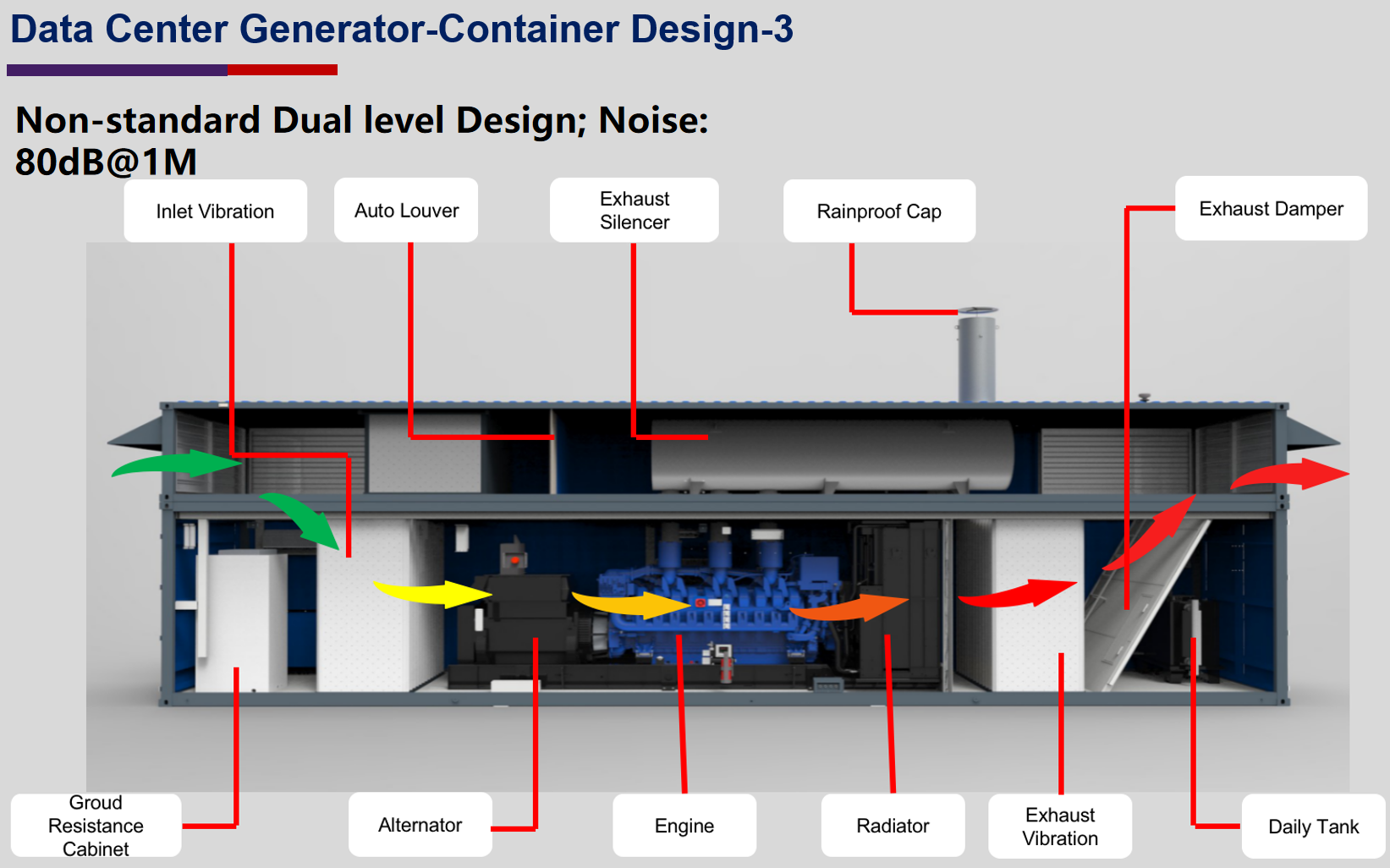
Dual-level containerized enclosure developed for data center standby power. Image supplied by MECCA POWER.
Why configuration, not nameplate capacity, decides the award
The number 3300 kW defines the electrical class, not the delivered package. Two bids at the same rating can differ in acoustic treatment, emission tier, enclosure architecture, cooling margin, busbar design and the paralleling scheme behind the switchgear. For a data center buyer at decision stage, those differences determine whether the unit can be permitted on the site, whether it can sit near a residential boundary, and how quickly the maintenance team can reach a cylinder head at 3 a.m.
The practical consequence is that a 3300 kW comparison should be run on configuration axes rather than on a single headline figure. The axes below are the ones that carry the most commercial weight in this class, and each is documented for the MECCA POWER data center programme.
The configuration axes that change the package
| Decision axis | Option A | Option B |
|---|---|---|
| Emissions route | EPA Tier 2, positioned for emergency standby applications | EPA Tier 4 Final, positioned for strict air-quality jurisdictions, non-emergency prime power or extended runtime |
| Electrical listing | UL 2200 listed for the US; CSA certified for Canada | ISO 8528 performance compliance with CE directives for Europe, the Middle East, Asia and other markets |
| Rating basis | Standby duty with NFPA 110 Level 1 (Type 10) start and transfer behaviour | Data Center Continuous (DCC) rating allowing 100% continuous operation |
| Enclosure architecture | Standard single-layer sound-attenuated container | Non-standard dual-level design, stated at 75–80 dB(A) at 1 m |
| Climate package | Standard containerized enclosure | Engineered enclosure for high altitude, high temperature, high humidity and high cold, with a stated outdoor envelope of −45 °C to +55 °C |
| System architecture | Single 3300 kW set with ATS | Paralleled N+1, 2N or multi-megawatt bus using DeepSea, ComAp or Deif controllers with motorized circuit breakers |
| Powertrain selection | Baudouin, Cummins, MTU, Mitsubishi, Perkins, Weichai or Yuchai engines | Stamford, Leroy-Somer or Marathon alternators |
Read as a matrix rather than a menu, the table shows why configuration drives the bid comparison. A Tier 4 Final set on a DCC rating is a different commercial object from an EPA Tier 2 standby set, even when both carry the same 3300 kW nameplate.
The integration layer behind the 3300 kW block
MECCA POWER CO.,LTD. is a generator set manufacturer and application integrator founded in 2013, operating 34,000 m² of manufacturing space with 311 employees, a 41-person R&D team and an annual output of 3,600 units. The company reports a 100% export ratio across Europe, Africa, Asia, Australia, the Middle East, the Americas, Oceania and Latin America, and lists diesel generators, high-voltage generators and load banks among its main products, with a generator range stated from 10 kVA to 4000 kVA.
For a 3300 kW buyer, the relevant structural fact is where that class is built. MECCA POWER operates factory bases in Fujian and Jiangxi provinces; the Nanchang plant in Jiangxi focuses on high-power generator sets of 1000 kW and above, and reports monthly output rising from 132 units to 212 units. The 3300 kW class therefore sits inside the plant's stated production focus, not at the edge of a general-purpose line.
Three specialised production lines are dedicated to container, open-type and mixed-assembly builds, supported by six testing stations with digital tightening, intelligent oil and water filling and cloud-based process data management under APS+MES. The stated maximum lifting capacity is 45 tons, sufficient to support simultaneous production testing of three units exceeding 2000 kW.
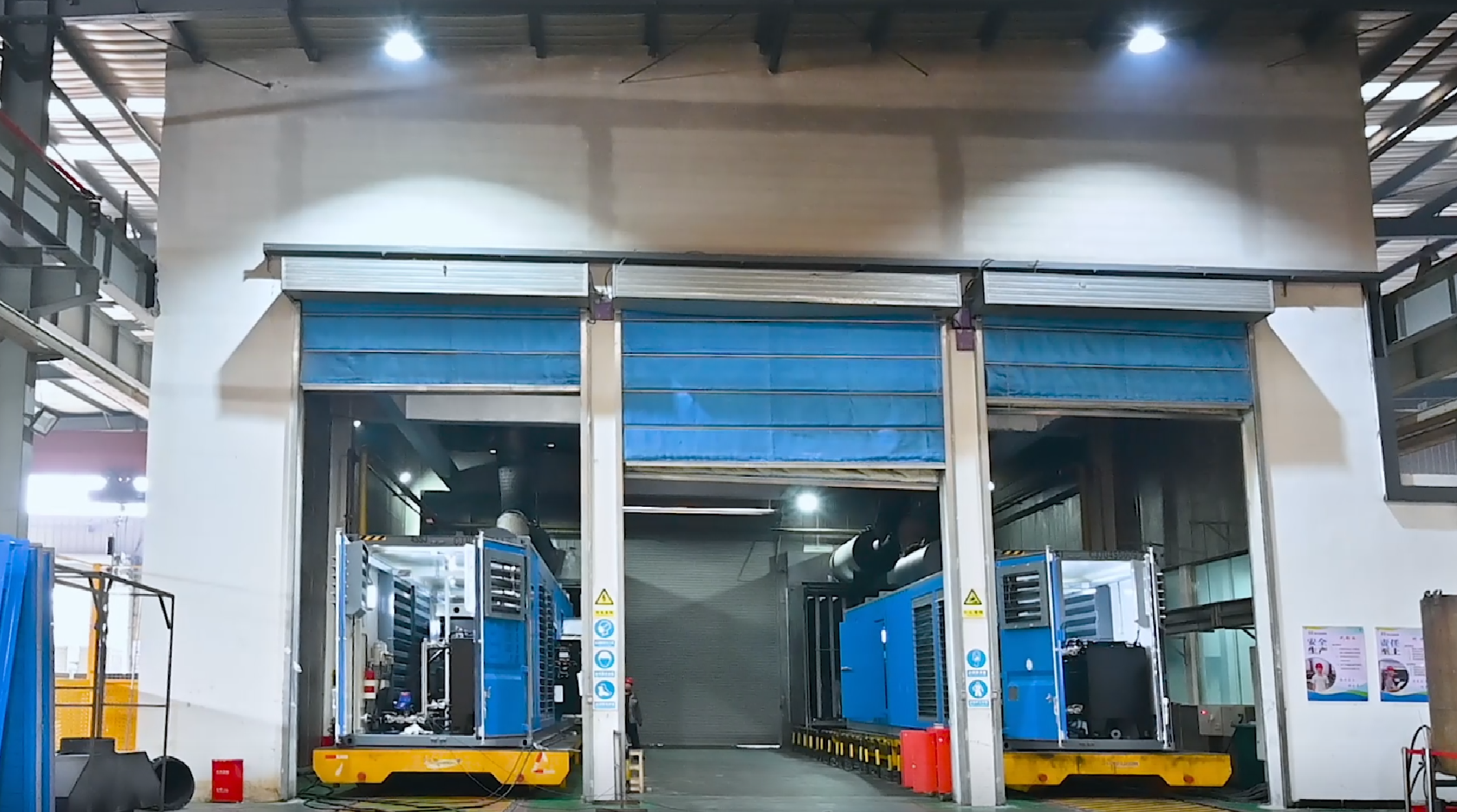
High-voltage, high-capacity generator set in the test bay. Image supplied by MECCA POWER.
The integration model matters for how the comparison should be read. MECCA POWER describes itself as an OEM working with Cummins, Perkins, MTU, Mitsubishi, FPT, Volvo, Baudouin, Stamford, Leroy Somer, Mecc Alte, DeepSea and ComAp, alongside Chinese engine brands. Engine and alternator content therefore comes from partner manufacturers, while enclosure engineering, packaging, testing and application support are the manufacturer's own scope. Buyers standardising on a specific fleet should confirm that the chosen engine and alternator combination is available for the 3300 kW build rather than assuming it from a catalogue range.
Acoustic configuration: single-layer versus dual-level enclosure
Acoustics is usually the first axis that forces a cost decision, because it is the one most often fixed by a planning condition rather than by the electrical design. MECCA POWER's standard sound-attenuated containers are documented to achieve 75 dBA or lower at 7 metres under full load, using 100 mm high-density fireproof rock wool lined with perforated galvanized steel sheets, critical-grade residential exhaust silencers and baffled air intake and discharge plenums. For ultra-sensitive urban or campus sites, custom 65–70 dBA super-silent configurations are also offered.
The alternative is a non-standard dual-level container design, documented at 75–80 dB(A) at 1 metre, which the comparison record describes as a reduction of 10 to 15 dB against a standard single-layer design. Two qualifications belong beside that figure. First, the standard figure is quoted at 7 metres and the dual-level figure at 1 metre; the two should not be placed in the same column without normalising the measurement distance. Second, the 10 to 15 dB reduction is stated against a single-layer baseline, so the baseline definition should be written into the technical offer before the acoustic performance is treated as contractually comparable.
The documented fit profile for the dual-level design is specific: data centers in urban core areas and city centres, campus-style and high-density IDC facilities, Tier III and Tier IV environments serving finance, government and cloud providers, projects near residential quarters, schools and hospitals, and sites where a comfortable O&M environment is part of the design intent. The comparison record states a slightly higher one-time cost, offset by lower overall operating cost, with easier routine maintenance and no negative impact on generator efficiency, as the ventilation design is optimised to maintain stable performance.
For a buyer, the decision rule is straightforward. If the site has no binding noise condition, the single-layer container delivers the same electrical output at lower capital cost. If the site sits inside an urban boundary or adjacent to sensitive receptors, the acoustic premium is the cost of the permit, and the comparison should be run on total installed cost rather than on enclosure price alone.
Climate and environment packages
The second axis is environmental. A standard containerized diesel generator is engineered for ordinary conditions; a data center campus in a desert, a high-altitude plateau or a sub-arctic region needs the enclosure and cooling system re-engineered rather than derated after the fact. MECCA POWER documents an environment-adaptation package with stated outdoor use from −45 °C to +55 °C, positioned against standard containerized types for high-altitude, high-temperature, high-humidity and high-cold conditions. The comparison record notes a higher cost than the standard type, together with less maintenance demand and higher efficiency than the standard type; because neither of those two attributes is quantified in the supplied documentation, they are best treated as directional claims to be evidenced in the technical offer.
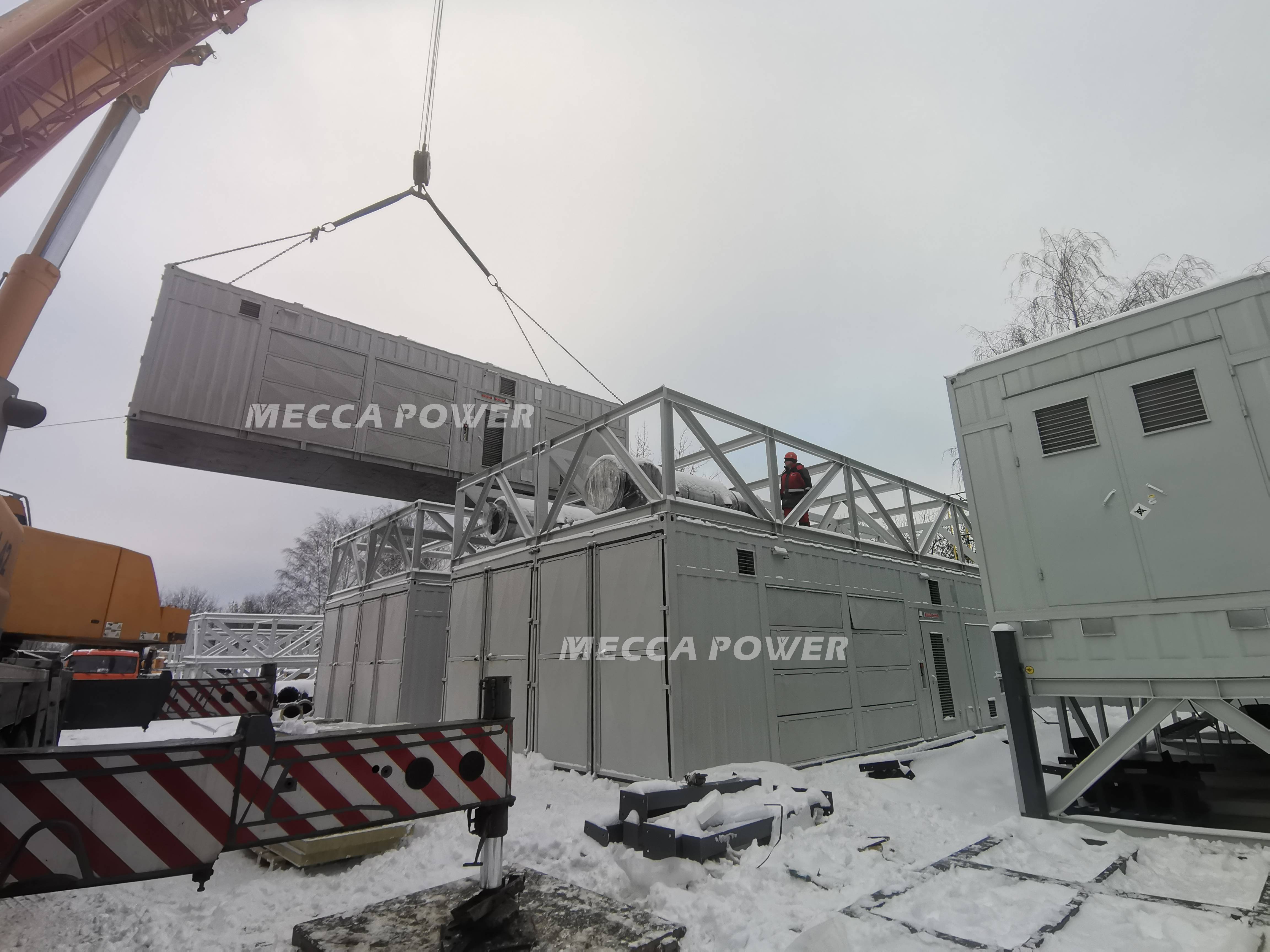
Containerized generator enclosure built for cold-climate sites. Image supplied by MECCA POWER.
The cold-climate content is defined at component level, which is the useful part for specification review: integrated engine block coolant heaters, lube oil heaters, heated fuel lines and filters, alternator anti-condensation space heaters and automated motorized air louvers, described as enabling instant cold starts without mechanical stress. The high-ambient and coastal package covers radiators rated for 50 °C and above, desert sand pre-filters and marine-grade C4 or C5-M anti-corrosion coating systems for heat, dust and salt spray.
One point needs flagging rather than smoothing over. The supplied records state different lower bounds for cold-climate operation: the arctic package is described down to −40 °C, while the environment-adaptation comparison entry states outdoor use from −45 °C. Because no supersession note resolves the difference, the contract should carry one confirmed figure with its test basis, and the buyer should not assume the lower of the two.
Emissions and the compliance route
Compliance in this class is a permitting decision, not a quality ladder. MECCA POWER documents UL 2200 listing for stationary engine generator assemblies in the United States, CSA certification for Canada, and ISO 8528 performance compliance with CE directives for Europe, the Middle East, Asia and other international markets. On emissions, the company offers both EPA Tier 2, positioned for emergency standby applications, and EPA Tier 4 Final, positioned for strict air-quality jurisdictions, non-emergency prime power and extended runtime.
The selection logic follows from the duty, not from the price sheet. A Tier 2 standby set is the lower-cost route where the unit runs only on outage and the local jurisdiction permits it. Where the 3300 kW block is used for prime power, extended runtime or continuous duty, Tier 4 Final becomes the relevant configuration, and the DCC rating allowing 100% continuous operation should be specified alongside it. The two choices should be settled with the permitting authority before the technical offer is frozen, because the emission tier propagates into after-treatment, enclosure volume and service routines.
On emergency response, the sets are described as engineered to comply with NFPA 110 Level 1 (Type 10), with startup and full load transfer within 10 seconds of a utility outage. The documentation states that compliance is tailored to state or provincial permitting requirements but does not reproduce listing file numbers, issuing bodies or certificate expiry dates. That is a documentation request, not an evidence of a gap: buyers should obtain the actual listing and certification scope for the assembled 3300 kW package rather than for its components alone.
Single set or paralleled N+1 and 2N
Multiple 3300 kW units can be paralleled for N+1, 2N or multi-megawatt configurations. The documented implementation uses DeepSea, ComAp or Deif paralleling controllers with motorized circuit breakers, with synchronising and closing onto the bus typically within 10 to 15 seconds, and full BMS and SCADA integration through Modbus RTU/TCP, SNMP or RS485 for remote monitoring and automated load sharing.
Buyers should read the two timing figures separately. The 10-second figure refers to NFPA 110 startup and load transfer for the emergency power supply system; the 10 to 15 second figure refers to the paralleling sequence, synchronising and closing onto the bus. These describe different events in the sequence. In a paralleled topology the buyer should confirm with the supplier how the paralleling sequence interacts with the project's NFPA 110 timing requirement, rather than assuming the two figures combine into a single guaranteed response time.
Where the configurations fit, and where they do not
The dual-level enclosure fits urban and campus sites with binding acoustic constraints; it does not fit a remote industrial site with no noise condition, where the slightly higher one-time cost buys no planning benefit. The environment-adaptation package fits sites outside the standard operating envelope; it does not fit a temperate site that never approaches the extremes, where the cost premium is unrecovered. EPA Tier 4 Final fits prime-power and extended-runtime duty in strict jurisdictions; Tier 2 remains the appropriate route where the duty is emergency standby and the local rules accept it.
Two boundaries belong in the comparison record. First, MECCA POWER's documented role is the design, production and application support of the generator set and its enclosure; engines and alternators are sourced from the named partner brands, so fleet-standardisation questions belong to those brands' service networks as well as to the packager. Second, the supplied documentation does not include measured fuel consumption, dimensions, weight or an independent acoustic test report for the 3300 kW configuration. Those are items to request with the technical offer; their absence from a marketing document is not evidence that the capability is unavailable.
A verification checklist for the award stage
- Confirm that the UL 2200 listing and CSA certification cover the assembled 3300 kW package, not only individual components.
- Match the emission tier to the actual duty — standby, prime or DCC — and confirm it with the local air-quality authority before freezing the offer.
- Fix the acoustic figure with its measurement distance, load condition and boundary conditions; if the dual-level design is specified, define the single-layer baseline used for the 10 to 15 dB reduction claim.
- Resolve the cold-climate lower bound into one contractual figure with a stated test basis, since the records quote both −40 °C and −45 °C.
- Confirm how the paralleling sequence interacts with the NFPA 110 10-second startup and transfer requirement in the chosen topology.
- Confirm the specific engine and alternator combination for the 3300 kW build, and the spare-parts route in the destination market given the company's 100% export profile.
- Request the derating basis for altitude and ambient temperature, including the high-ambient radiator specification and any high-altitude cooling derating.
- Request the factory test protocol and records, including which of the six test stations the unit will run on and the load profile applied.
What shifts in this class
As data center power blocks are specified at multi-megawatt scale, the differentiating weight moves from nominal capacity to the documented configuration envelope: what acoustic performance is achievable at what distance, which emission tier survives the permit, how the enclosure behaves at the site's temperature extremes, and whether the paralleling scheme can be commissioned without rework. Capacity at 3300 kW is available from multiple suppliers; a documented configuration matrix with declared limits is harder to obtain.
That is the practical reading of the MECCA POWER position. The manufacturing base, the dedicated high-power plant, the container, open-type and mixed-assembly lines and the multi-unit test capability describe a supplier structured to build and test large packaged sets. The configuration options — dual-level acoustic design, climate packages, Tier 2 and Tier 4 Final routes, DCC rating and paralleling — describe what a buyer can actually specify. The unresolved items are documentation items, and they are resolvable through the technical offer rather than through another brochure.
The company's product brochure is available for download: MECCA POWER brochure.
FAQ
Do 3300 kW diesel generators meet UL, CSA, EPA and NFPA 110 requirements?
Documented compliance covers UL 2200 listing for stationary engine generator assemblies in the United States and CSA certification for Canada. Emissions are offered in both EPA Tier 2, for emergency standby applications, and EPA Tier 4 Final, for strict air-quality jurisdictions, non-emergency prime power or extended runtime. The sets are described as engineered to comply with NFPA 110 Level 1 (Type 10), with startup and full load transfer within 10 seconds of a utility outage. For other markets, the sets are built to ISO 8528 performance standards and CE directives. Compliance is tailored to state or provincial permitting requirements, so the applicable route should be confirmed against the specific project location.
What noise level can a sound-attenuated 3300 kW container achieve?
Standard sound-attenuated containers are documented at 75 dBA or lower at 7 metres under full load, using 100 mm high-density fireproof rock wool lined with perforated galvanized steel sheets, critical-grade residential exhaust silencers and baffled air intake and discharge plenums. Custom 65–70 dBA super-silent configurations are available for ultra-sensitive urban or campus sites. The non-standard dual-level container design is documented at 75–80 dB(A) at 1 metre, described as a 10 to 15 dB reduction against a standard single-layer design. Because the standard and dual-level figures are quoted at different measurement distances, they should be normalised before being compared directly.
Can multiple 3300 kW units be paralleled for N+1 or 2N redundancy?
Yes. The documented implementation integrates DeepSea, ComAp or Deif paralleling controllers with motorized circuit breakers to support N+1, 2N or multi-megawatt parallel synchronisation, typically synchronising and closing onto the bus within 10 to 15 seconds. Full BMS and SCADA integration is provided through Modbus RTU/TCP, SNMP or RS485 for real-time remote monitoring and automated load sharing. The paralleling timing describes the synchronising and breaker-closing sequence, which is a separate event from the NFPA 110 startup and load transfer requirement.
Have Questions or Need More Details?
Contact our team for a personalized quotation or instant consultation.
Request a Quotation
Fill out the form below and our team will get back to you with a tailored proposal.
WhatsApp Direct Chat
Prefer to chat in real-time? Message us on WhatsApp for instant assistance & quick answers.
- Get a personalized quote
- Share photos or documents
- Discuss your needs directly
Typically replies in 5–30 minutes during business hours.