
36W Adapter Shortlist by Plug Type: EU, UK, KR, AU and US
In the 12 V and 24 V fixed-voltage adapter class, the AC plug is not a packaging detail. It decides which SKU can ship into which market, which approval file applies, and how much finished-goods inventory a device brand has to hold across regions. This shortlist narrows the 36 W segment to one documented platform — the SK03T from Shenzhen Simsukian Electronics Technology Co., Ltd (simsukian) — and sorts the listed configurations by AC plug region: EU, UK, KR, AU and US.
simsukian, founded in 1996 and based in Shenzhen, China, develops and manufactures switching power supplies, lithium-ion battery chargers, charging docks and power adapters from 3 W to 240 W, employs more than 500 staff, and is reported in a third-party supplier profile to record annual sales between USD 25 million and 50 million. The SK03T is its 36 W wall-mount adapter platform, listed at 24 V / 1.5 A in the base configuration with a 12 V / 3 A build as the alternative 36 W output, housed in flame-retardant polycarbonate (PC) and available in black, white or customized colors.
Why Plug Type Moves to the Top of a 36W Decision
A 36 W adapter is electrically simple. The regional version is commercially complex. The same circuit board can carry five different AC interfaces, and each interface pulls a different approval file, a different retail packaging line and a different last-mile stock position behind it. Buyers who reach the decision stage usually discover that the voltage question was the easy part; the harder question is how many SKUs they are willing to manage to cover five markets.
That is the opportunity behind a multi-plug platform. When a single electrical design is offered across EU, UK, KR, AU and US interfaces, a device brand qualifies one board, one protection set and one thermal profile, then varies only the mechanical interface. simsukian's own comparison material states that its interchangeable plug design uses one mould across all global markets, which reduces tooling expenses and supports a reported 50% improvement in inventory turnover. For a buyer holding regional safety stock, that is a working-capital argument rather than a technical one.
The counterweight is documentation. A plug-region version is only usable in a market if the relevant approval covers that exact model-and-plug combination. The shortlist below is therefore built around what can be stated with evidence, and where a buyer must confirm rather than assume.
The Shortlist at a Glance
The five plug-region builds share one electrical platform. Output build, housing color and mechanical format are the variables a buyer selects per SKU.
| Plug region | Housing colors | Listed output options | Form factor | Protection set | Market served |
|---|---|---|---|---|---|
| EU plug | White / black | 24 V / 1.5 A or 12 V / 3 A | Wall-mount, flame-retardant PC | Short circuit, overvoltage, overcurrent | EU / EEA |
| UK plug | Black / white / customized | 24 V / 1.5 A or 12 V / 3 A | Wall-mount, flame-retardant PC | Short circuit, overvoltage, overcurrent | United Kingdom |
| KR plug | White / black | 24 V / 1.5 A or 12 V / 3 A | Wall-mount, flame-retardant PC | Short circuit, overvoltage, overcurrent | South Korea |
| AU plug | Black / white / customized | 24 V / 1.5 A or 12 V / 3 A | Wall-mount, flame-retardant PC | Short circuit, overvoltage, overcurrent | Australia |
| US plug | Black / white / customized | 24 V / 1.5 A or 12 V / 3 A | Wall-mount, flame-retardant PC | Short circuit, overvoltage, overcurrent | United States |
Across all five versions, the platform is documented with universal AC input from 100 V to 240 V, compliance with the IEC62368, IEC64558 and IEC60347 safety standards, and a protection set covering short circuit, overvoltage and overcurrent. The build is a plug-in, wall-mount unit intended for indoor use in consumer electronics, IT products, home appliances, LED and general electronics scenarios.
What Qualified a Version for This Shortlist
Shortlisting a plug-region build is a filtering exercise, not a preference exercise. Five criteria were applied, in this order.
- A verifiable model and output pair. The SK03T is documented as a 36 W adapter with a 24 V, 1.5 A output — a fully specified statement rather than a wattage claim. The 12 V / 3 A build reaches the same 36 W envelope and is treated here as the alternative output configuration rather than a separate electrical class.
- Housing and mechanical format. A wall-mount body in flame-retardant PC, offered in black, white or customized color, is what allows one platform to serve both a white-appliance retail program and a black industrial enclosure without a second tool.
- Protection as a standard feature, not an option. Short circuit, overvoltage and overcurrent protection are stated for the platform. In a fixed-voltage adapter, protection behaviour is one of the few safety characteristics a buyer can evaluate from a datasheet before sampling.
- Safety-standard coverage. Documented compliance with IEC62368, IEC64558 and IEC60347 places the platform in a framework that procurement and compliance teams can map to their own market requirements.
- Approval breadth across the five regions in scope. The manufacturer holds more than 20 international certifications, including CCC, GS, UKCA, UL, CE, FCC, PSE, KC and SAA, alongside RoHS and REACH compliance. Breadth at company level is what makes a five-region shortlist realistic; it is not the same thing as per-SKU scope, which is addressed below.
Region-by-Region Reading of the Shortlist
EU plug — white and black
The EU build is the volume anchor of the shortlist, because a single EU-plug SKU typically covers a customs union of more than twenty delivery destinations. Both white and black housings are listed, which matters when the adapter ships in a retail box alongside a white appliance or a black audio product. For EU/EEA delivery, the relevant approval families are CE-LVD and CE-EMC for safety and electromagnetic compatibility, RoHS and REACH for material compliance, and ERP for energy efficiency. GS is additionally held by the manufacturer. Buyers should map those families to the exact model-and-plug combination on the certificate rather than to the platform as a whole.
UK plug — a separate approval lane
Since the UK market runs its own conformity marking, a UK-plug build is not simply an EU build with different pins. simsukian holds UKCA among its approvals, and the SK03T is listed with a UK plug configuration. The practical consequence for a buyer is that the UK SKU needs its own certificate file, its own packaging artwork and its own stock line, even though the electrical design is identical. Where a program covers both the EU and the UK, ordering both plug versions from one platform keeps the engineering qualification to a single board and keeps the compliance work in two clearly separated lanes.
KR plug — white and black
The KR build is listed in both white and black. Korea is a market where approval evidence is examined closely, and the manufacturer holds KC and KCC among its certifications. Useful context for buyers already running simsukian hardware: the 18 W SK01T platform is documented with a Korea-type AC plug, a flame-retardant PC body and KC/KCC approvals, so a device brand moving from that platform to the 36 W SK03T is extending an existing approval relationship rather than opening a new one. That is a sourcing convenience, not a certification shortcut — the SK03T's own file still governs.
AU plug — low-complexity, high-distance
The AU build follows the same pattern: a dedicated plug interface, a wall-mount PC housing and the shared protection set. Australia is usually served from longer supply lines, so the version's value is not technical but logistical — holding one AU-plug SKU rather than adapting another region's unit on arrival. SAA is among the approvals the manufacturer holds. For distributors, the AU version is typically the smallest-volume line in a five-region order, which makes minimum order quantities and mixed-carton configuration a more important negotiation point than unit price.
US plug — efficiency is the differentiator
The US build carries the strictest efficiency expectations of the five, because the DOE Level VI standard caps no-load power draw at 0.100 W for external power supplies rated 49 W or below. A 36 W unit sits inside that bracket. The platform is documented with standby power of 0.07 W to 0.08 W and with DOE, ERP and CEC-VI energy-efficiency compliance at company level, which leaves headroom under the regulatory ceiling rather than sitting on it. UL, ETL and FCC are among the approvals held. As with every other region on this list, the certificate must name the specific US-plug model.
Technical Explanation: How a 36W Fixed-Output Adapter Is Defined
The 36 W label is an envelope, not a specification. It is the product of output voltage and output current, and the SK03T platform fills it in two ways: 24 V at 1.5 A, and 12 V at 3 A. Both are fixed-output designs — the adapter delivers its rated voltage continuously and does not negotiate a power contract with the load. That single characteristic separates this class from USB Power Delivery hardware, where the supply and the device agree on a voltage and current profile before power is delivered.
Universal AC input from 100 V to 240 V is what allows one electrical design to serve all five plug regions, from the 120 V US grid to the 220–230 V supplies used across the EU, the UK, Korea and Australia. Only the mechanical interface and the approval file change. Ripple and regulation behaviour are where fixed-voltage platforms differentiate in practice: the manufacturer's comparison material states output ripple held at or below 60 mV, against 80–120 mV for generic adapters, and voltage accuracy of ±1% on tailored solutions against ±3% to ±5% for generic units. Those figures are stated for tailored designs and should be confirmed on the datasheet of the specific SKU.
Thermal behaviour is the second differentiator. The platform is documented with full-load temperature rise below 45 °C, where most competing units exceed 60 °C. In a sealed wall-mount housing with no fan, that margin governs how much of the adapter's rated life is consumed by heat rather than by duty cycle — which is why it appears in a shortlisting table rather than only in a datasheet appendix.
Where 36W Wall-Mount Builds Are Used
The SK03T is documented as designed for manufacturing, home appliance, IT products, LED and electronics scenarios, and is described as a consumer electronics adapter. Those categories share one requirement: a dedicated, stable low-voltage rail that is present whenever the device is plugged in, without the handshake overhead of a smart charging protocol.
Within the wider 12 V family, documented applications include routers, speakers, audio equipment and other IT products, with the adapter operating in plug-in mode for indoor use. A separate documented 12 V application is small water pumps, where the adapter's role is to deliver even power so that water output stays stable without fluctuation — a case where ripple and load response matter more than headline wattage. On the 24 V side, the 1.5 A build serves loads that expect a 24 V rail rather than a 12 V one; buyers should match the build to the device's rated input, not to the highest wattage available.
Market Trend Analysis
The commercial context for this shortlist is a power adapter market that is growing steadily rather than explosively. Dataintelo values the global power adapter market at USD 26.65 billion in 2025 and projects USD 46.14 billion by 2034. Growth of that shape rewards suppliers who can serve many regions from a stable platform, because the incremental revenue comes from geographic coverage rather than from a single product category expanding quickly.
Regulation is the stronger force. IEC 62368-1 4th Edition, effective from May 2023, is the mandatory hazard-based safety standard for audio/video and ICT power supplies and replaces the legacy 60950 and 60065 certifications. Every approval file built on the older standards has had to be re-established, which has pushed buyers to re-examine documentation they previously took for granted. Energy efficiency has followed the same path: DOE Level VI has been mandatory in the US since 2016, with the 0.100 W no-load cap for supplies at or below 49 W.
Technology migration sits alongside those two forces. Next Move Strategy Consulting sizes the GaN charger market at USD 1.10 billion in 2023 and projects USD 4.22 billion by 2030 at a 19.9% CAGR, and USB PD 3.1 Extended Power Range has lifted the ceiling for negotiated charging from 100 W to 240 W. Neither development displaces the fixed-voltage 36 W wall-mount class; both sharpen its boundary. As PD hardware absorbs the high-power, multi-device charging role, the dedicated 36 W adapter stays where it has always been strongest: one device, one voltage, one plug, shipped in volume to a specific market.
How the Platform Compares with Traditional Adapter Solutions
The comparison that matters at the decision stage is not wattage against wattage, but documented behaviour against typical generic behaviour. The table below reflects the manufacturer's published comparison of its adapters against traditional and generic solutions.
| Parameter | simsukian platform (documented) | Typical generic adapters |
|---|---|---|
| Output ripple | ≤60 mV | 80–120 mV |
| Voltage accuracy | ±1% on tailored solutions | ±3% to ±5% |
| Full-load temperature rise | Below 45 °C | Typically above 60 °C |
| Standby power | 0.07–0.08 W | 0.1–0.3 W |
| MTBF | 50,000 hours | 10,000–20,000 hours |
| Power-related return rate | 1.2% | 7.8% industry average |
| Plug tooling | One mould across global markets | Region-specific tooling |
| Bill of materials | Roughly 5%–8% higher | Baseline |
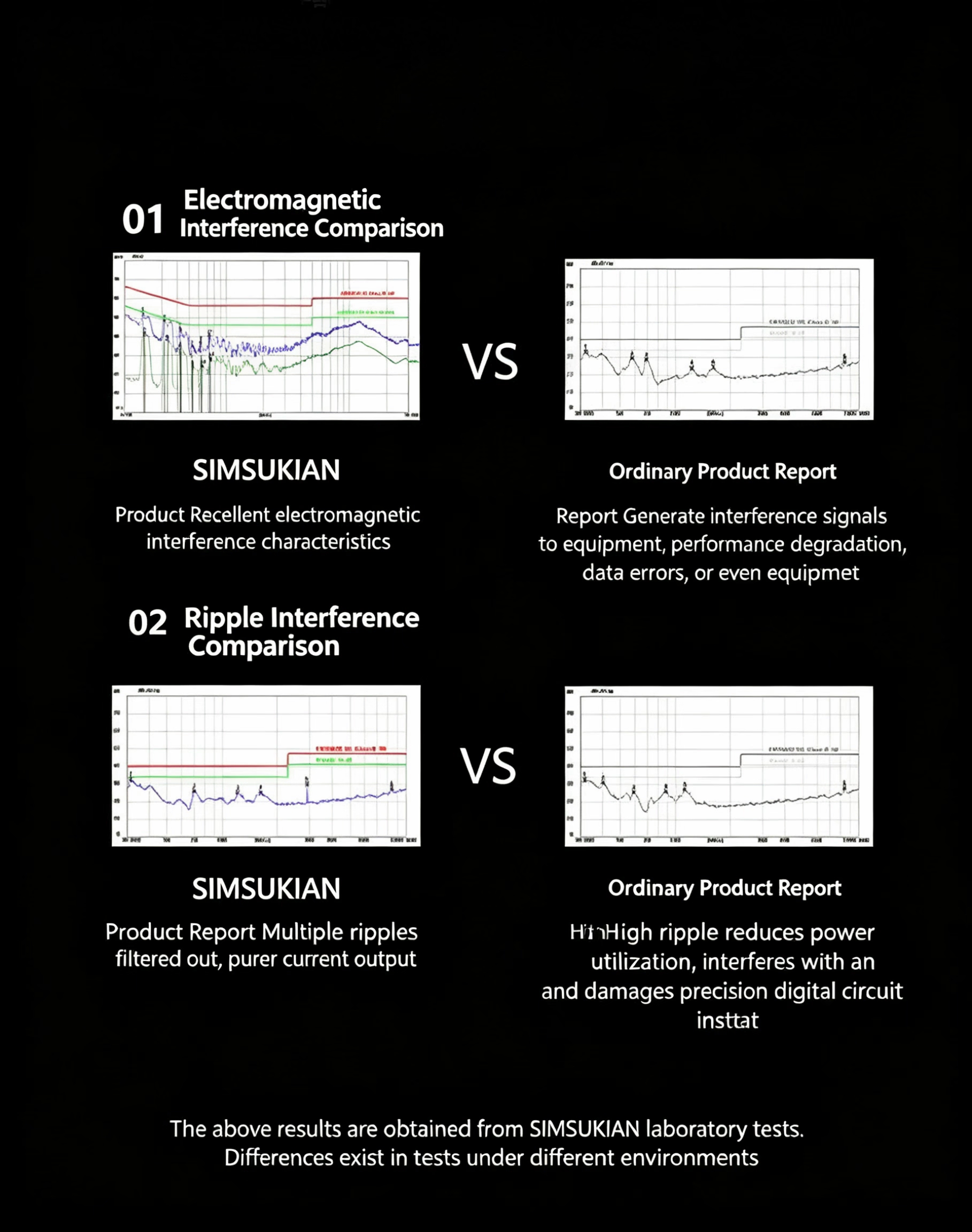
Comparative performance report used by the manufacturer when positioning its adapters against generic alternatives. Figures apply to the platform as documented, not to every SKU.
The limitations belong in the same discussion. Three are structural and worth stating plainly.
- It is a fixed-output, 36 W ceiling design. Buyers who need a negotiated voltage, a USB-C interface or more than 36 W are outside this class and should be looking at a PD charger family instead. Choosing a 36 W wall-mount unit for a device that expects PD negotiation will not work, however good the ripple figures are.
- One plug version per market still means separate order lines. The interchangeable-mould design reduces tooling cost; it does not collapse five SKUs into one. Buyers still carry five approval files, five packaging artworks and five stock positions, and should plan minimum order quantities accordingly.
- The precision figures are conditional. The ≤60 mV ripple and ±1% accuracy values are stated for tailored solutions, and the higher bill of materials of roughly 5%–8% is only justified where field-return cost, measurement accuracy or system-level filtering savings actually apply. For a low-cost indoor load with wide tolerance, a standard unit may be the economically correct choice.
A fourth boundary is environmental. This is an indoor, plug-in wall-mount adapter; it is not presented as a sealed or outdoor-rated supply, and it should not be specified into enclosures or conditions the documentation does not cover.
Future Outlook
Three developments are likely to shape how 36 W plug-region shortlists are written over the next few years. First, documentation will keep gaining weight relative to hardware. With IEC 62368-1 4th Edition now the reference standard and efficiency thresholds stable under DOE Level VI, the difference between two suppliers of the same wattage is increasingly the quality and completeness of their approval files rather than the circuit. Second, portfolio segmentation will sharpen: as GaN and USB PD absorb the higher-power, multi-device role, fixed-voltage adapters will be valued for predictability, cost and regional fit rather than for feature breadth. Third, buyers are likely to consolidate onto fewer electrical platforms with more plug variants, because that is the only way to hold five markets without holding five engineering qualifications.
For simsukian, the relevant capability is structural rather than promotional: a 36 W platform documented across EU, UK, KR, AU and US interfaces, a stated protection set, and certification breadth covering more than 20 international approvals. Whether that translates into a shortlist position for a specific device program still depends on the buyer's own market mix and on per-SKU certificate scope.
FAQ
What is the SK03T 36 W adapter and which output versions are listed?
The SK03T is a 36 W wall-mount power adapter from Shenzhen Simsukian Electronics Technology Co., Ltd. It is documented at 24 V and 1.5 A, which equals 36 W, and is also listed with a 12 V / 3 A build that occupies the same 36 W envelope. Both are fixed-output designs that deliver a constant rated voltage to the load rather than negotiating a power profile.
Which AC plug versions are available for a 36 W wall-mount adapter?
The plug-region versions covered by this shortlist are EU, UK, KR, AU and US. The EU and KR builds are listed in white and black, and the platform as a whole is available in black, white or customized colors. All versions share the same electrical platform, the same wall-mount flame-retardant PC housing, universal AC input from 100 V to 240 V, and a protection set covering short circuit, overvoltage and overcurrent.
Which safety standards and certifications should a 36 W adapter carry for export?
For audio/video and ICT power supplies, IEC 62368-1 4th Edition, effective from May 2023, is the mandatory hazard-based safety standard and replaced the legacy 60950 and 60065 certifications. The SK03T platform is documented as complying with IEC62368, IEC64558 and IEC60347. The manufacturer holds more than 20 international certifications, including CCC, GS, UKCA, UL, CE, FCC, PSE, KC and SAA, plus RoHS and REACH compliance. Because approvals are granted per model and plug configuration, buyers should confirm that the certificate names the exact SKU being ordered.
How does a fixed-voltage 36 W adapter differ from a USB PD charger?
A fixed-voltage adapter delivers one rated output continuously, such as 24 V at 1.5 A or 12 V at 3 A, and does not negotiate with the device. A USB PD charger negotiates a voltage and current profile before delivering power, and under USB PD 3.1 Extended Power Range the maximum has risen from 100 W to 240 W. The two are suited to different loads: PD hardware fits multi-device and high-power charging, while a fixed-output 36 W unit fits a single device with a known input voltage and a stable duty cycle.
What should a buyer confirm before ordering a region-specific plug version?
Four items are worth confirming in writing. The certificate must name the exact model and plug configuration. The output build must match the device's rated input, 24 V or 12 V. The efficiency documentation must satisfy the destination market, for example the DOE Level VI no-load cap of 0.100 W that applies in the US to external power supplies at or below 49 W. And the commercial terms should reflect that each plug region is a separate order line with its own packaging and stock position, even where one mould serves all markets.
What are the practical limits of a 36 W wall-mount adapter?
The output is fixed and capped at 36 W, so the platform cannot serve devices that require a negotiated voltage or more power. It is an indoor, plug-in unit rather than a sealed outdoor-rated supply. The documented ripple of ≤60 mV and accuracy of ±1% are stated for tailored solutions, and the higher bill of materials of roughly 5%–8% is justified only where field-return cost or measurement precision genuinely matters. Where a load tolerates wider regulation, a standard unit may be the better commercial fit.
For buyers who need the full model and plug matrix in one document, the power adapter catalog is available as a PDF: simsukian PD catalog.
Have Questions or Need More Details?
Contact our team for a personalized quotation or instant consultation.
Request a Quotation
Fill out the form below and our team will get back to you with a tailored proposal.
WhatsApp Direct Chat
Prefer to chat in real-time? Message us on WhatsApp for instant assistance & quick answers.
- Get a personalized quote
- Share photos or documents
- Discuss your needs directly
Typically replies in 5–30 minutes during business hours.