
3D Massage Chair Compliance: How to Read Scope, Issuer and Standard
3D Massage Chair Compliance: How to Read Scope, Issuer and Standard
A 3D massage chair certificate becomes useful to an importer only when the document can be tied to four things: a certificate or registration number, an issuer, a standard or regulation, and a product or model scope. A logo on a sales sheet does not do that work. The practical task is to read the certificate as a controlled document and then turn its scope into purchase-order language.
This guide sets out a repeatable reading method for buyers at the research and evaluation stage. It uses certificate records supplied for the 3D Massage Chair category, including ISO 9001, ISO 13485, FDA registration, CE, CB and ETL examples. The aim is not to treat any single document as a universal passport. The aim is to establish what each document actually says, what it does not say, and how to make it part of an acceptance decision.
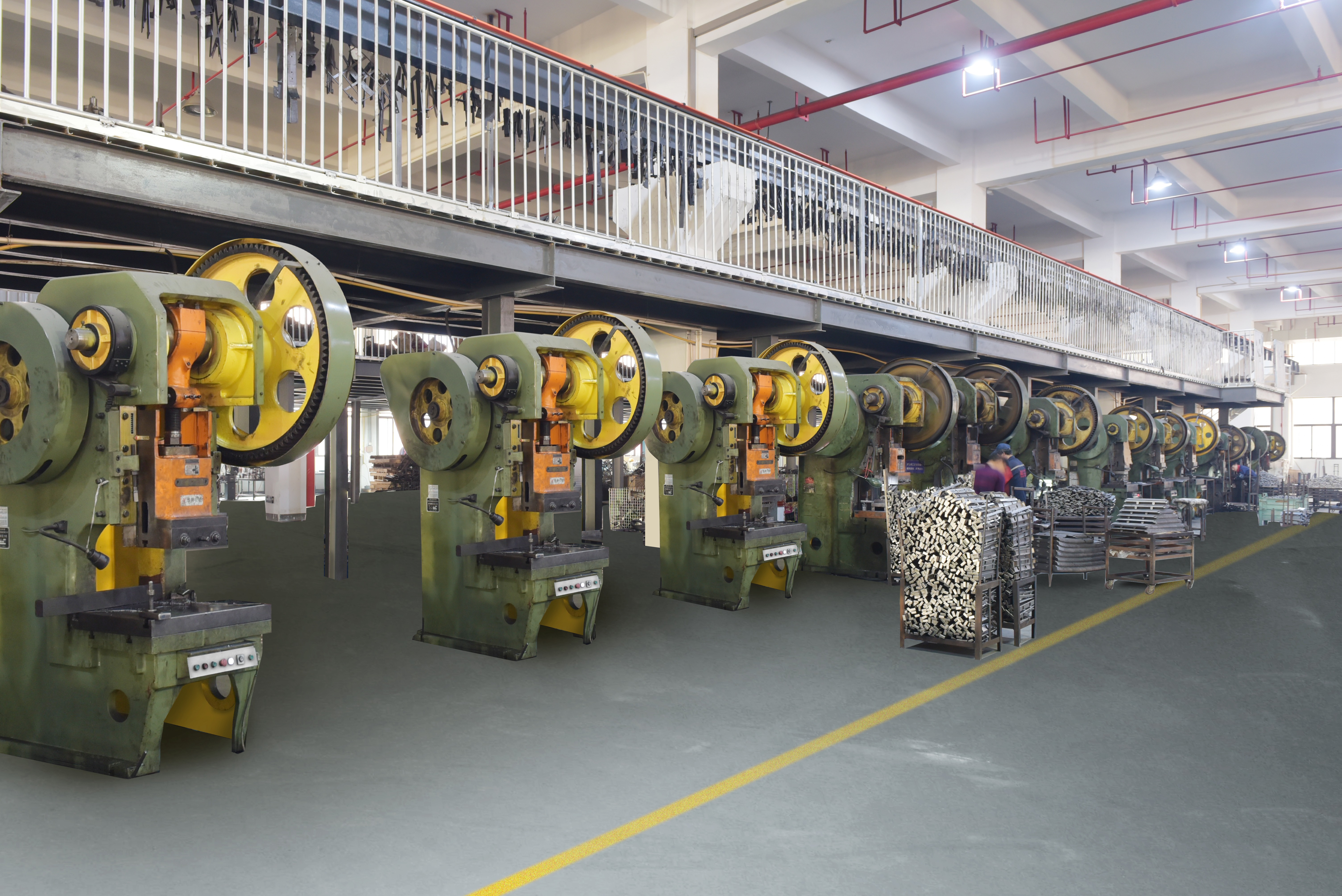
Industry scene: manufacturing equipment at a massage chair production site.
A logo is not a scope statement
Importers often receive a certificate pack as a set of images. The supplier may highlight a familiar mark, and the buyer may treat that mark as sufficient proof. The more useful question is narrower: does this exact document name the exact product I am buying, under the exact standard revision stated, for the market I intend to serve?
The risk is rarely that a certificate is obviously false. The more common risk is a real certificate used outside its scope. A quality-management certificate may cover a factory process rather than a product model. A product certificate may list certain models but not a new variant. A registration record may be confused with an approval. A CB certificate may be read as global market access when it is evidence against listed IEC standards. These are document-reading problems before they are commercial problems.
The opportunity for buyers is equally practical. A standard reading method makes supplier comparisons cleaner, reduces acceptance disputes, and gives quality and purchasing teams a shared vocabulary. It also makes it harder to substitute a logo for evidence during a model change or a new market launch.
Six checks that turn a certificate into evidence
A certificate reading can be organised around six checks. Each check should be recorded in the buyer’s own file, not just left in the supplier’s presentation.
- Certificate or registration number. Record the exact number, including prefixes and suffixes. A generic mark without a number cannot be traced back to a document.
- Issuer. Record the organisation named as the issuer. The issuer is not automatically the standards body, and it is not automatically the manufacturer.
- Standard or regulation. Record the full standard code and revision. Where a regulation is named, keep the exact reference.
- Product and model scope. Record whether the document names a product category, a product series, or specific models. A category statement does not automatically cover a new SKU.
- Market coverage. Record the countries or regions stated in the document. Treat this as a scope statement, not as a legal guarantee of customs clearance.
- Validity and status. Record issue and expiry dates, and check current status with the issuer where a verification route exists.
These six checks are not a substitute for legal advice or destination-market research. They are the minimum evidence discipline that lets a buyer ask a precise follow-up question instead of arguing over a logo.
Worked example: reading a six-document 3D massage chair set
The certificate records supplied for this article provide a useful worked example. They relate to the 3D Massage Chair category from Ningbo Zhouqi Health Technology Co., Ltd. (ZHOUQI), a massage chair manufacturer based in Cixi, Zhejiang, China, that integrates research and development, production and sales. The purpose here is not to present the company as certified in every market. It is to show how a buyer should read each document’s own scope.
| Document | Number | Issuer named in record | Standard or regulation | Scope stated in record | Market coverage stated in record |
|---|---|---|---|---|---|
| ISO 9001 | 02424Q32202999R1S | SHENZHEN UNIVERSAL CERTIFICATION CENTRE CO., LTD. | GB/T19001-2016/ISO9001:2015 | Intelligent massagers | EU, Middle East, SE Asia, US |
| ISO 13485 | 133640 | NQA | ISO 13485:2016 | Massage chairs | US, South Korea, SE Asia |
| FDA registration | 3017618816 | Shenzhen CTB Testing Technology Co., Ltd. | 21 CFR 807.39 | 3D Massage Chair product series | US |
| CE | ENB2311240186E00401C | EMTEK | EN IEC 55014-1:2021; IEC 60335-1:2010; IEC 60335-2-32:2019 | 3D Massage Chair models 5200, 5900, 5910, 3100, 6710, 8700, 3600, 3212, 6520, 5100, 6530, 3104, 3109, 6750, 6720 and 6721 | EU, Middle East, SE Asia |
| CB | NO127967 | Nemko | IEC 60335-1:2010; IEC 60335-1:2010/AMD1:2013; IEC 60335-1:2010/AMD2:2016; IEC 60335-2-32:2019 | Massage chairs | EU, Middle East, SE Asia |
| ETL | 5030347 | INTERTEK | UL 1647:2015 Ed.6+R:30Jul2020; CSA C22.2#68:2018 Ed.8+U1 | Massage chairs | US, Canada |
The CE record also lists additional electromagnetic compatibility standards in the supplied certificate data: EN IEC 61000-3-2:2019/A1:2021, EN 61000-3-3:2013/A2:2021/AC:2022-01 and EN IEC 55014-2:2021. That detail matters because a buyer should read the whole standard list, not only the first line. The records also carry dates: ISO 9001 is shown as issued on 2021-12-09 and expiring on 2027-12-02; ISO 13485 as issued on 2024-03-15 and expiring on 2027-03-15; and the FDA registration as issued on 2024-12-16 and expiring on 2026-12-31. The CE, CB and ETL records in the supplied set show an expiry date of 2099-01-01, but a future date on the document is still not a substitute for checking current status.
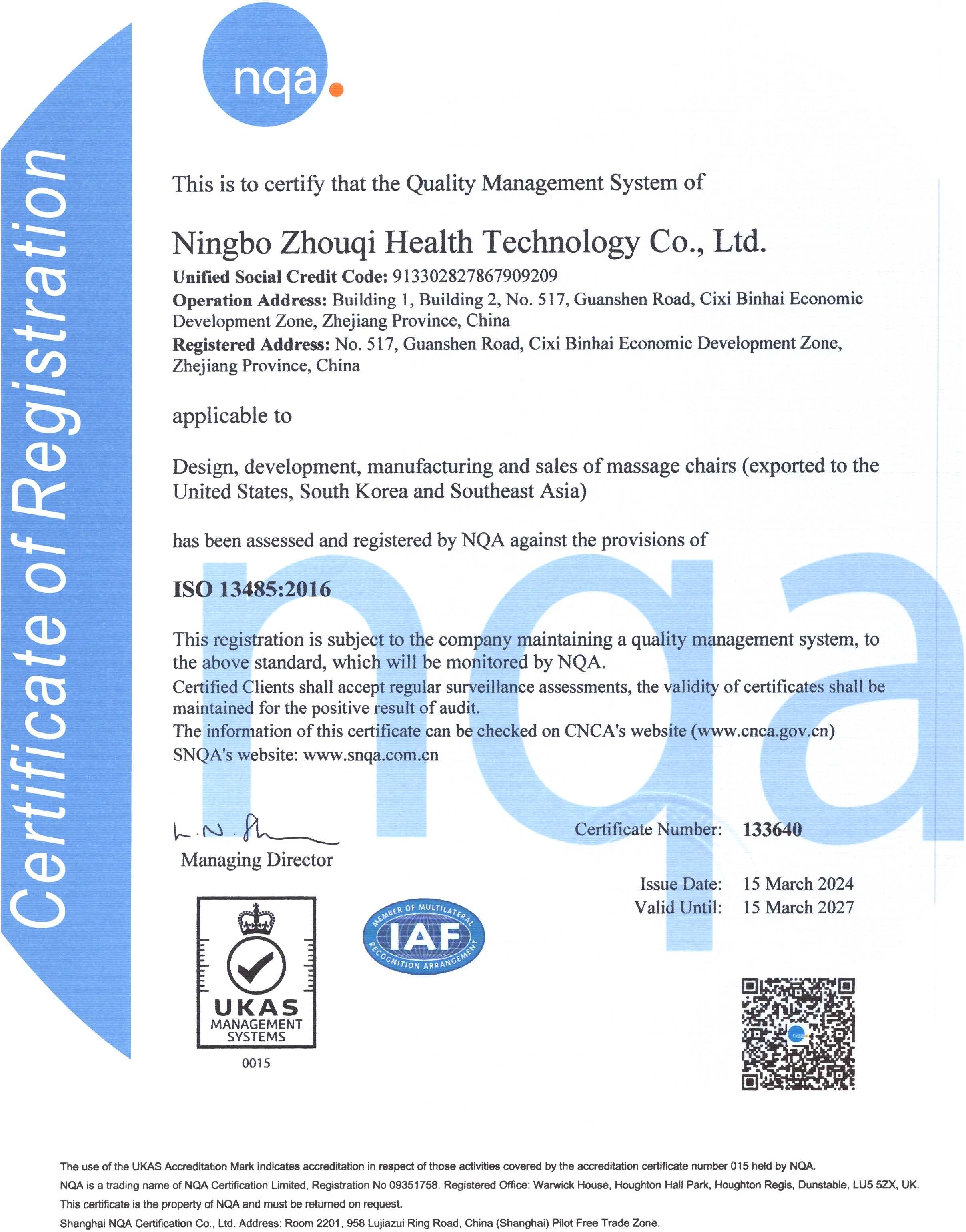
Certificate reading example: ISO 13485 document with a stated scope of massage chairs.
Issuer: read the body, not the brand
The issuer is the organisation named on the document as responsible for issuing it. In the supplied set, the ISO 9001 record names SHENZHEN UNIVERSAL CERTIFICATION CENTRE CO., LTD.; the ISO 13485 record names NQA; the FDA registration record names Shenzhen CTB Testing Technology Co., Ltd.; the CE record names EMTEK; the CB record names Nemko; and the ETL record names INTERTEK. These names should be copied exactly into the buyer’s certificate register.
Reading the issuer prevents a common confusion. The standards body, the testing laboratory, the certification body and the manufacturer are different roles. Nemko issuing a CB certificate does not make Nemko the author of IEC 60335. EMTEK issuing a CE certificate does not make EMTEK the European Commission. INTERTEK issuing an ETL certificate does not make INTERTEK the US government. The correct reading is: this named organisation issued this document, under this standard or regulation, with this scope.
Where a buyer needs to verify a document, the issuer is also the first place to look. A certificate number is more useful when it can be checked in the issuer’s own system or confirmed through the issuer’s stated process. That verification step should be recorded, but it should not be invented. If no public verification route is available, the buyer can still require a legible certificate, a matching test report reference and a signed consistency statement from the supplier.
Standard: match the standard to the claim
The standard or regulation tells the reader what kind of assurance the document is about. This is where many certificate packs become misleading. ISO 9001 under GB/T19001-2016/ISO9001:2015 is a quality-management-system standard. It can support evidence that a supplier operates a documented quality process, but it is not a product safety certificate. ISO 13485:2016 is also a quality-management-system standard, with a medical-device focus; the supplied record states a scope of massage chairs. That scope is useful, but the buyer should still ask whether the destination market treats the product as a medical device, a household appliance, furniture, or another category.
The CE record in the supplied set is different in function. It lists EN IEC 55014-1:2021, IEC 60335-1:2010 and IEC 60335-2-32:2019, with additional EMC standards in the certificate data. Those references point to safety and electromagnetic compatibility evidence, not merely to a factory management system. The CB record lists IEC 60335-1:2010, its amendments and IEC 60335-2-32:2019. The ETL record lists UL 1647:2015 Ed.6+R:30Jul2020 and CSA C22.2#68:2018 Ed.8+U1 for the US and Canadian markets.
A buyer should therefore ask a direct question: which claim in the sales discussion is this certificate meant to support? If the claim is factory process control, ISO 9001 may be relevant. If the claim is massage-chair quality-system scope, ISO 13485 may be relevant. If the claim is electrical safety for the US or Canada, the ETL record and its UL/CSA standards are the ones to read. If the claim is European safety and EMC evidence, the CE record and its EN/IEC standards are the ones to read. If the claim is CB testing against IEC standards, the CB record is the one to read. None of these should be used to support a different claim.
Scope: from model list to purchase order
The scope statement is the part of the certificate most often lost in a sales pack. The CE record in the supplied example lists specific 3D Massage Chair models: 5200, 5900, 5910, 3100, 6710, 8700, 3600, 3212, 6520, 5100, 6530, 3104, 3109, 6750, 6720 and 6721. The ISO 13485 record states a scope of massage chairs and the related product data lists the 3D product line. The FDA registration record covers the 3D Massage Chair product series. The CB and ETL records state a scope of massage chairs.
Those are not equivalent levels of specificity. A model list is the strongest form for purchasing because it can be matched line by line against the order. A product-series statement is useful but needs a mapping annex if the buyer is ordering a new variant. A category statement such as massage chairs is relevant context but should not be read as automatic coverage of every future model. When the certificate does not list the exact SKU, the buyer should ask for a model-scope annex, a certificate schedule, or a written statement that maps the ordered model to the certified series.
This is also where model changes become a compliance issue. If a supplier changes the mechanism, control system, electrical architecture, model name or factory line, the previous scope statement may no longer describe the product being shipped. The buyer does not need to assume a problem. The buyer needs a change-control trigger: any material change to the ordered model should reopen the certificate-scope review before shipment.
Market coverage: what the record does and does not say
Market coverage in a certificate record tells the buyer where the document is stated to apply. In the supplied set, ISO 9001 states EU, Middle East, SE Asia and US; ISO 13485 states US, South Korea and SE Asia; the FDA registration states the US; CE states EU, Middle East and SE Asia; CB states EU, Middle East and SE Asia; and ETL states US and Canada. These statements are useful for building a market-access matrix, but they should not be rewritten as legal conclusions.
A CE certificate listing EN/IEC standards does not automatically settle every European product obligation. A CB certificate is evidence against listed IEC standards and does not by itself replace destination-market requirements. An ETL certificate for US and Canadian standards does not open the European market. FDA registration under 21 CFR 807.39 is a registration reference in the supplied record, not an FDA product approval. A buyer who needs a market-entry decision should combine the certificate reading with destination-specific regulatory review.
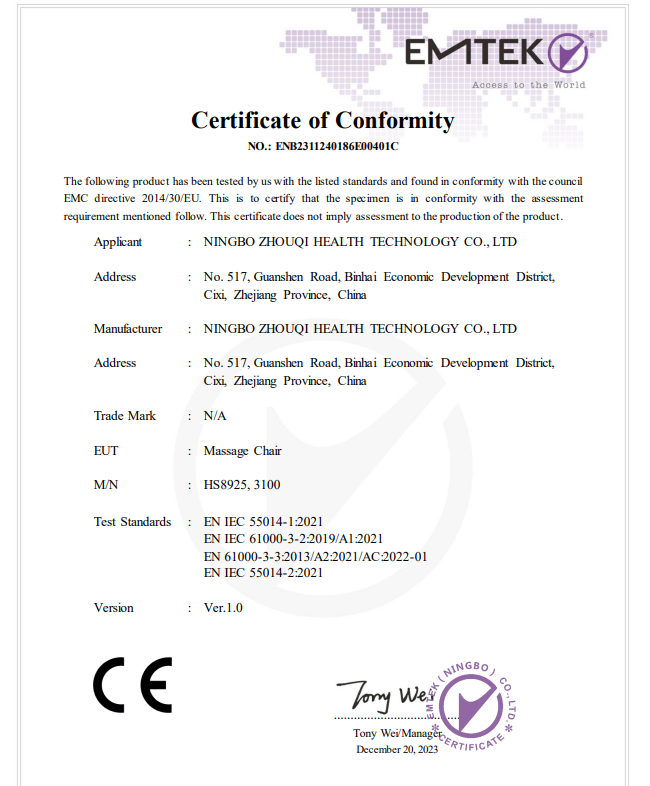
Certificate reading example: CE EMC document used to check standard and market scope.
Turning scope checks into purchase terms and acceptance criteria
The reading method becomes commercially useful when it is written into the purchase order and the acceptance process. A buyer can require a certificate schedule as an annex to the order. The schedule should list the exact document number, issuer, standard or regulation, product and model scope, market coverage, issue date and expiry date. It should also state which document supports which claim, so that a quality-system certificate is not used to answer a product-safety question.
Acceptance criteria can then be written as pass or hold conditions. A practical set includes:
- Model match: the ordered 3D Massage Chair model appears in the certificate scope, or is covered by a signed model annex that references the certificate.
- Standard match: the standard or regulation in the certificate matches the claim and the destination market being evaluated.
- Issuer match: the issuer named on the certificate matches the issuer named in the supplier’s document list and test report reference.
- Validity: the certificate is valid on the planned shipment date and remains valid through the agreed acceptance period, or a renewal plan is documented.
- Market bundle: the buyer has identified which document supports which market. For example, ETL for the US and Canada, CE and CB for the stated EU, Middle East and SE Asia coverage, and ISO 9001 or ISO 13485 for quality-system evidence.
- Change control: any change to model, factory line, critical electrical component or standard revision triggers a new document review before shipment.
- Document quality: the certificate is legible, complete and consistent with the product label, model name and quotation.
These criteria do not require the buyer to make a legal determination. They require the buyer to keep evidence aligned. If the supplier cannot provide a model-scope mapping, the buyer can treat that as an open item rather than assuming coverage. If the certificate is valid but the standard is not the one needed for the intended market, the buyer can request the correct document instead of accepting a generic pack.
Application fit: the same reading method across venues
The same certificate-reading method applies whether the 3D Massage Chair is planned for a retail showroom, a shopping mall, an office wellness room, a spa house, a hotel, a nursing home, a hospital setting or a 4S showroom. The venue changes the buyer’s risk profile, not the document logic. A shared pay-per-use venue may place more weight on electrical safety and maintenance documentation. A care setting may ask more about ISO 13485 scope and product-series coverage. A retailer may ask for a simple market matrix that shows which certificate supports which sales channel.
In all cases, the buyer should keep the certificate scope aligned with the actual deployment. A certificate for a product series does not prove that every accessory, replacement part or installation condition is covered. A CE record listing models does not prove that a future model will be added. A CB record for massage chairs does not replace a model-specific purchase-order annex. The reading method is therefore a control point, not a one-time filing task.
Limitations and fit boundaries
Certificate reading has clear limits. A certificate is not an independent performance test of massage depth, durability, user comfort or therapeutic effect. ISO 9001 does not prove product safety. ISO 13485 scope does not by itself establish that a product is a regulated medical device in every market. A CE certificate listing EMC and safety standards does not cover every possible European obligation. A CB certificate is not a global approval. An ETL certificate for US and Canadian standards is not a European conformity document. FDA registration is not FDA approval.
These boundaries should be stated beside the claim they qualify. They do not make the certificates less useful. They make the buyer’s interpretation more accurate. The correct conclusion is not that certificates are unimportant. The correct conclusion is that a certificate is evidence of a defined scope, issued by a defined body, against a defined standard, for a defined market and period. Anything outside that sentence needs separate evidence.
Future outlook: from certificate images to a certificate register
The practical outlook for importers is a shift from collecting certificate images to maintaining a certificate register. A register can link each document to a model, a market, a standard revision, an expiry date and a purchase-order line. It can flag missing model mappings, upcoming renewals and market gaps before a shipment is approved. This is an operational improvement rather than a prediction about any particular supplier.
For 3D Massage Chair sourcing, that register is likely to become more useful than a folder of logos. It gives the buyer a defensible way to compare suppliers, to ask for missing evidence and to keep acceptance criteria consistent across markets. It also gives the supplier a clearer standard for what a complete document pack should contain.
FAQ: reading 3D massage chair certificates
What should an importer check first on a 3D massage chair certificate?
The first check is whether the certificate names the exact product or model being purchased. After that, record the certificate number, the issuer, the standard or regulation, the market coverage and the validity dates. A familiar logo without a traceable number and a clear scope is not enough for an acceptance decision.
How can I tell whether a certificate covers my specific 3D Massage Chair model?
Look for a model list or a product-series statement in the certificate scope. In the supplied example, the CE record lists specific 3D Massage Chair models, while the CB and ETL records state a scope of massage chairs. If the certificate names only a category or series, ask for a model-scope annex that maps the ordered model to the certified scope.
Does an ISO 9001 certificate prove that a 3D Massage Chair is safe?
No. ISO 9001 under GB/T19001-2016/ISO9001:2015 is a quality-management-system standard. It supports evidence about process control, not product safety. Product safety and market-access claims need the relevant product standards, registrations or market-specific documents, read within their own scope.
What is the difference between CE, CB and ETL in the supplied record set?
In the supplied records, CE certificate ENB2311240186E00401C is issued by EMTEK and lists EN IEC 55014-1:2021, IEC 60335-1:2010 and IEC 60335-2-32:2019 for EU, Middle East and SE Asia coverage. CB certificate NO127967 is issued by Nemko against IEC 60335 series standards for EU, Middle East and SE Asia coverage. ETL certificate 5030347 is issued by INTERTEK against UL 1647 and CSA C22.2#68 for US and Canadian coverage. They serve different evidence roles and should not be treated as interchangeable.
Is FDA registration the same as FDA approval?
No. The supplied record describes FDA registration number 3017618816 under 21 CFR 807.39 for the 3D Massage Chair product series in the US market. That should be read as a registration reference, not as an FDA product approval or clearance.
How should certificate scope be written into a purchase order?
Attach a certificate schedule that records the exact number, issuer, standard or regulation, model scope, market coverage and validity dates for each document. Make acceptance conditional on the ordered model matching the certificate scope, the standard matching the intended market claim, and any model or standard change triggering a new document review before shipment.
Product reference: the company’s 2026 E-catalogue is available at 2026 E-catalogue.
Have Questions or Need More Details?
Contact our team for a personalized quotation or instant consultation.
Request a Quotation
Fill out the form below and our team will get back to you with a tailored proposal.
WhatsApp Direct Chat
Prefer to chat in real-time? Message us on WhatsApp for instant assistance & quick answers.
- Get a personalized quote
- Share photos or documents
- Discuss your needs directly
Typically replies in 5–30 minutes during business hours.