
3D Massage Chair Scenario Fit: Power, Grounding and Placement in Shared Venues
Industry Reference · Furniture & Wellness Equipment
An evaluation-stage briefing for venue operators, facility managers and distribution partners
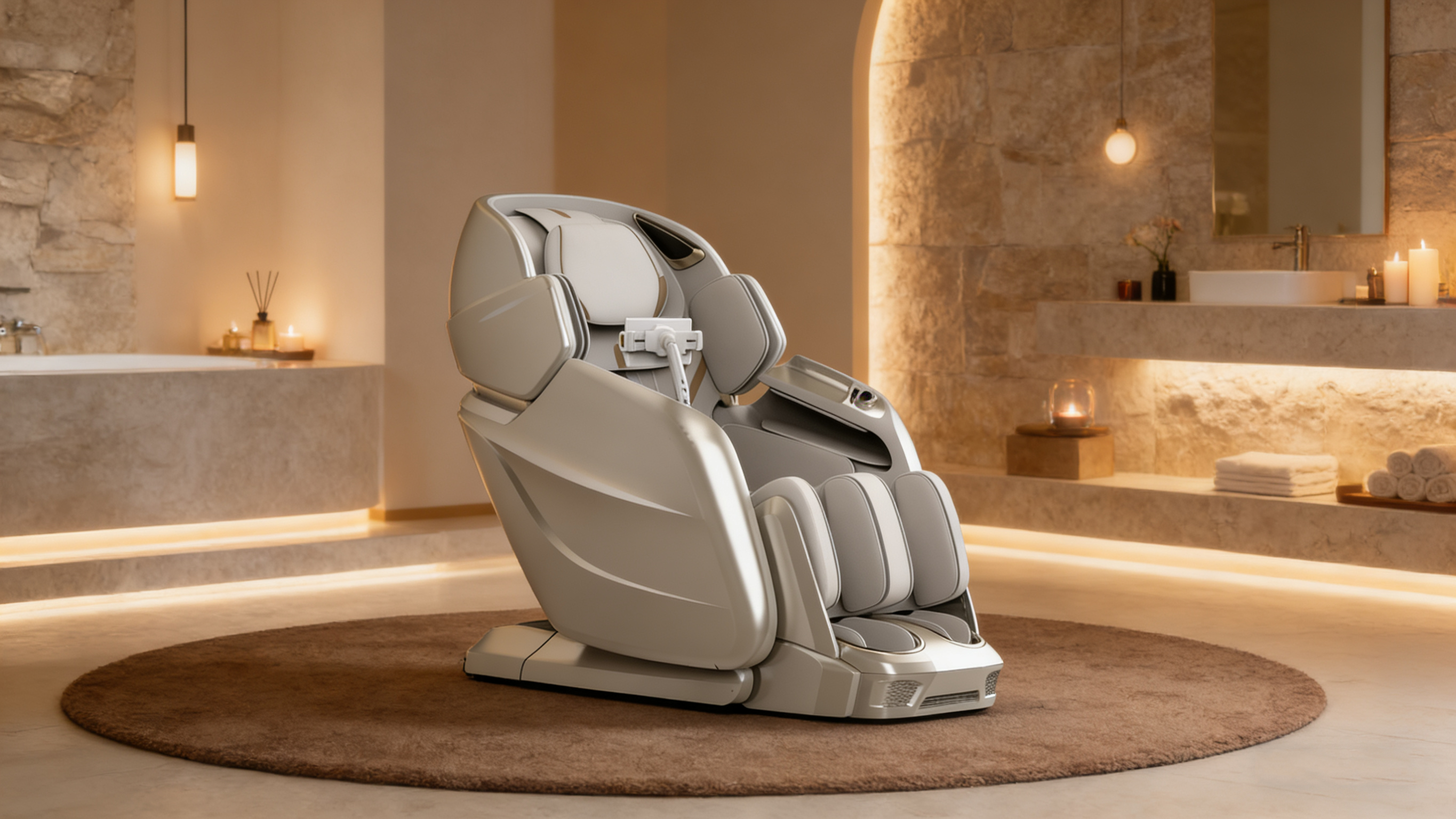
Spa houses are one of several shared venue types where 3D massage chairs are now deployed. Grounded power access and backrest clearance are the two site constraints most often discovered late.
Adding a 3D Massage Chair to a Shared Venue Is an Infrastructure Decision, Not a Furniture Decision
A 3D massage chair is a motorised, powered wellness device with a moving massage mechanism, a zero-gravity recline function and an electronic control system. Placing one in a private home is a delivery problem. Placing one in a shopping mall, a railway station, an airport, an office or a spa house is an infrastructure problem — because the venue, not the household, owns the socket, the grounding, the traffic flow and the daily inspection routine.
That distinction matters at the evaluation stage, before a purchase order is raised. The questions venue operators and distribution partners actually need answered are practical ones: How much power does the chair draw? Does the site socket need to be grounded? Which plug configuration applies in which market? How much floor space must be reserved when the chair reclines? Who checks the unit every morning?
This article works through those questions using the 3D Massage Chair product entry (Product 6980) from Ningbo Zhouqi Health Technology Co., Ltd. (ZHOUQI), a massage chair manufacturer based in Cixi, Zhejiang Province, China, that integrates R&D, production and sales and exports roughly half of its output to the USA, EU, Southeast Asia and the Middle East.
Why Shared, Pay-Per-Use Environments Change the Evaluation Checklist
The same chair that satisfies a household can fail in a public venue — not because the massage quality is different, but because the operating context is different. In a shared setting, four conditions change simultaneously.
Electrical duty profile. A domestic chair may run once a day. A chair in a mall or a transport hub may be started and stopped many times within a single operating shift, with idle periods in between. That places weight on stable input voltage handling and on the automatic shut-off timer built into the product.
Public safety exposure. In a private home, the people touching the chair are the people who bought it. In a public venue, the users are strangers who have not read the manual. Electrical certification, grounded circuits and a clear single-use time limit become part of the venue's duty of care.
Non-specialist installation. Chairs in shared venues are usually installed by facility maintenance staff or a fit-out contractor, not by a factory engineer. That means the installation instructions and maintenance manual are not paperwork — they are the installation method.
Space under constraint. Shared venues place equipment along walls, near entrances or in recesses. A zero-gravity chair changes footprint when it reclines, so the reserved space must be measured in the reclined position, not the upright position.
The opportunity here is straightforward. A 3D massage chair is a relatively undemanding electrical load. The product entry 6980 in ZHOUQI's 3D Massage Chair line operates on a 110V–240V, 50/60Hz input with a rated power of 150W. The engineering challenge is not supplying power; it is supplying the right power, in the right place, with the right grounding and the right surrounding space.
Scenario Fit Framework: Five Shared Venue Types and What Each One Demands
ZHOUQI's 3D Massage Chair (Product 6980) lists an applicable industry scope that spans the home furniture industry, the cultural-tourism and hospitality industry, the wellness and beauty industry, the healthcare industry, the corporate office sector, real estate and property management, transportation, retail and entertainment, public-service venues, automobile 4S stores and high-end showrooms, bank branch VIP lounges and university faculty lounges.
That breadth is useful, but it does not mean every venue type asks the same question. Below is how the infrastructure requirements diverge across the five shared settings most commonly considered for pay-per-use or amenity deployment.
| Venue type | Typical usage pattern | Power & grounding focus | Placement focus |
|---|---|---|---|
| Shopping mall | High foot traffic, short sessions | A fixed, grounded socket near the unit; avoid extension leads across public circulation routes | Must not block fire exits or main walkways; unit must return to upright position cleanly |
| Railway station / airport | High throughput, continuous turnover | Relies on venue distribution boards; grounded socket and documented electrical certification expected | Clear of gates, queues and evacuation paths; robust against repeated start-stop cycles |
| Office | Clustered use at lunchtime and after hours | Standard office socket is sufficient; avoid sharing the circuit with high-draw appliances | Near break areas; noise and footprint are the deciding factors |
| Spa house | Bundled with treatment flow, longer sessions | Stable dedicated socket; do not share a power strip with humidifiers or aroma diffusers | Visual fit with interior design; upholstery that can be cleaned between clients |
| Hotel, resort & care facility | Amenity use, long dwell time | Grounded socket; uninterrupted supply during guest hours | Integration with interior finishes; simple, readable controls for older users |
Looking across the five rows, a pattern emerges: the electrical requirement is almost identical everywhere, while the placement and operational requirements diverge sharply. That is why scenario fit should be evaluated as a site checklist rather than as a product variant decision.
Power: A Light Load, but a Precision Installation
Rated power on the 3D Massage Chair product entry 6980 is 150W, with an input range of 110V–240V at 50/60Hz. In practical terms this means three things for a venue.
First, the same product platform can be deployed in markets operating on 220–240V/50Hz and in markets operating on 110–120V/60Hz, provided the input stays within the stated range. Second, no dedicated high-capacity circuit is required for the chair itself. Third, the limiting factor is not current draw but socket location — if the nearest socket is several metres from the intended position, the temptation is to bridge the gap with an extension lead, and an extension lead running across a mall concourse or an office corridor is a trip hazard and a maintenance liability.
The correct sequence is therefore to fix the socket position first and place the chair second, not the other way around. In shopping malls, stations and airports, the power point is normally installed by the venue or its fit-out contractor during the site preparation stage, before the chair is delivered. For that reason, the installation documentation supplied with the product is better treated as a briefing document for the contractor than as an after-sales leaflet.
ZHOUQI provides installation videos and a maintenance manual with the 3D Massage Chair line, alongside a one-year warranty, so that venue maintenance teams can work from a documented reference rather than from assumption.
Grounding: The Safety Step Most Often Rushed in Public Installations
Grounding connects exposed metal parts of an appliance to earth so that, if a fault develops, current is diverted away from the person touching the equipment. A 3D massage chair contains motors, an air pump system and a control board, and therefore falls into the category of powered equipment where protective earthing is part of the safety design.
This is reflected in the certification the product carries. The 3D Massage Chair is covered by a CB certificate (certificate number NO127967, issued by Nemko) tested against IEC 60335-1:2010 and its amendments together with IEC 60335-2-32:2019, the international standard covering safety of electric massage appliances. The same product line holds an ETL certificate (certificate number 5030347, issued by INTERTEK) covering the United States and Canada against UL 1647:2015 Ed.6+R:30Jul2020 and CSA C22.2#68:2018 Ed.8+U1, and a CE certificate (certificate number ENB2311240186E00401C, issued by EMTEK) covering EU EMC requirements under EN IEC 55014-1:2021, EN IEC 61000-3-2:2019/A1:2021, EN 61000-3-3:2013/A2:2021/AC:2022-01 and EN IEC 55014-2:2021.
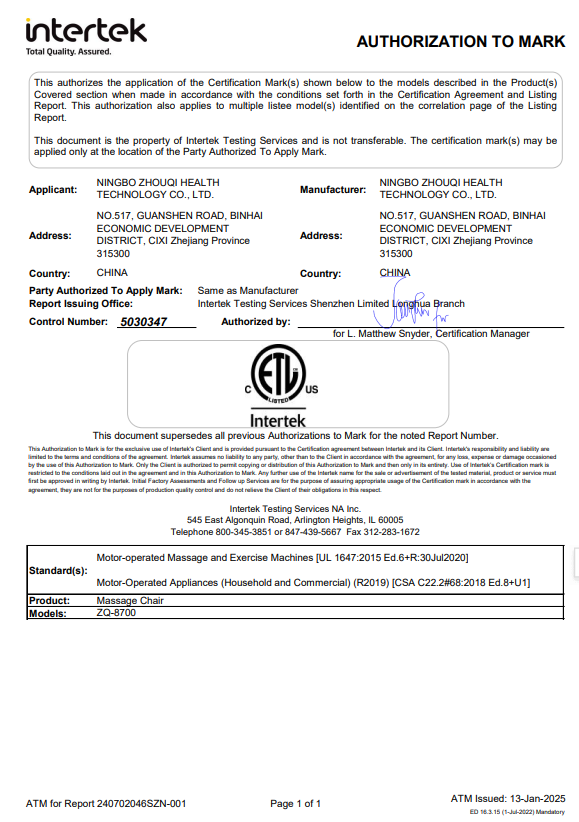
The ETL certificate covering US and Canadian markets is one of the compliance documents venue operators typically request during site approval.
What this means operationally is that the chair's own electrical safety has already been independently tested against recognised standards. It does not mean the building is safe. A product certificate cannot compensate for a socket that is not properly earthed. Where the venue's circuit grounding is incomplete or unknown, the correct action is to have the circuit checked by a qualified electrician before commissioning the chair — not to rely on the appliance certificate.
Plug configuration is a separate matter. A product platform covering 110V–240V will be supplied with the plug type appropriate to the destination market, and the CB certificate scope explicitly lists the EU, Middle East and Southeast Asia alongside the ETL scope for the US and Canada. Adapting a plug on site with a travel adapter is not a compliant substitution for supplying the correct plug in the first place.
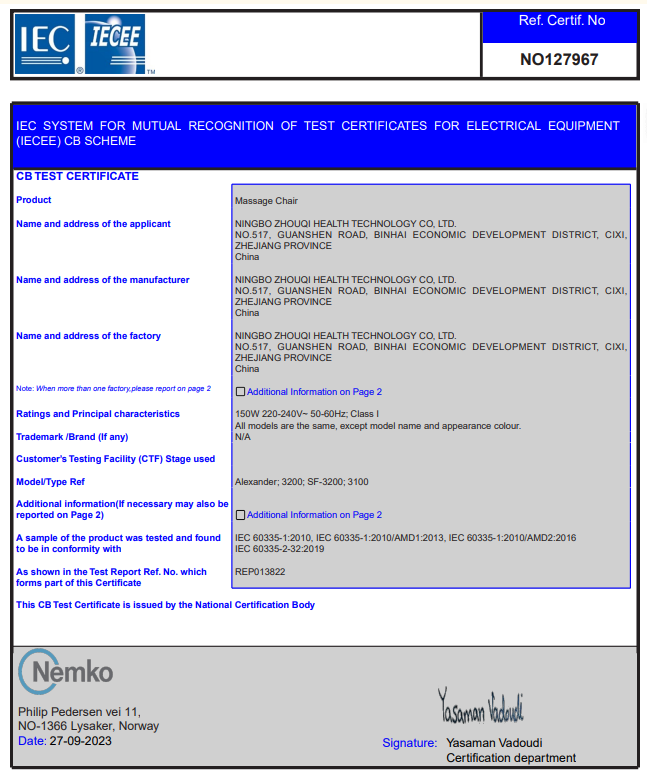
The CB certificate scoped to IEC 60335-1 and IEC 60335-2-32 supports deployment in EU, Middle East and Southeast Asia markets.
Placement and Clearance: Measure the Reclined Chair, Not the Upright Chair
The most common site planning error in shared venues is measuring the chair in its upright position and treating that as the footprint. A zero-gravity 3D massage chair changes its envelope when it reclines.
| Parameter | Value |
|---|---|
| Power input | 110V–240V, 50/60Hz |
| Rated power | 150W |
| Auto timer | 15 minutes |
| Upright dimensions | 1590 (L) × 800 (W) × 1160 (H) mm |
| Reclined dimensions | 1895 (L) × 800 (W) × 940 (H) mm |
| Box dimensions | 1950 (L) × 810 (W) × 880 (H) mm |
| N.W. / G.W. | 111 / 135 kg |
| Materials | Iron, foam, leather, ABS plastic |
The reclined length of 1895 mm is roughly 305 mm longer than the upright length of 1590 mm. Planning from the upright figure alone leaves the backrest with nowhere to travel. In venues where chairs are lined up along glazed partitions or against decorative features, that missing 300 mm is exactly where damage happens — either to the fixture or to the chair.
Mass also matters during the site survey. At a net weight of 111 kg and a gross weight of 135 kg, the unit is not something two people can reposition casually, and upper floors without a service lift in older buildings should be checked for floor loading and for corridor width before delivery. The boxed dimension of 1950 × 810 × 880 mm defines the minimum door and corridor envelope for the delivery itself.
In malls, stations and airports, placement also has to respect evacuation routes. A massage chair positioned in a public concourse must not narrow an exit path or sit across a queue line even when fully reclined. Where the venue requires the unit to be repositionable for cleaning, this is decided at the survey stage, not after installation.
Manual Safety Precautions: Who Owns What in Daily Operation
Because shared venues rely on staff rather than factory engineers, the safety routine around a 3D massage chair is manual by nature. Splitting responsibility clearly avoids the usual gaps.
Installation side. Commissioning should be carried out by personnel working from the supplied installation video and maintenance manual. Electrical work at the socket should be completed by a qualified electrician, and the plug supplied must match the local socket outlet.
Venue side, daily. A short visual check before opening hours covers the practical failure points: upholstery integrity, visible cabling, correct upright resting position and unobstructed clearance behind the backrest. Contact surfaces — armrests, remote control and seat — are the most frequently touched parts in a public setting and need cleaning between user sessions.
User side. Clear, readable signage stating the single-session duration, how to start and stop the chair, and which health conditions should prompt a user to consult a doctor before use. The 15-minute automatic timer built into Product 6980 acts as a hard operational boundary here: the session ends whether or not the user intervenes.
None of these steps require specialist skill, but all of them require someone to be named as responsible. In practice, the venues that run shared 3D massage chairs smoothly are the ones that wrote the routine down before the first unit arrived.
What the 3D Intelligent Massage Mechanism Contributes in a Shared Setting
A 3D massage mechanism moves the massage heads not only up and down along the track but also forward and back, which is what allows the depth of pressure to be adjusted rather than fixed. In a home, a user gradually tunes that depth to personal preference. In a shared venue, that tuning time does not exist — a first-time user sits down and needs a default setting that already feels right.
The application outcomes documented for this product line are the ones that make a shared installation worthwhile: releasing muscle stiffness and body fatigue, boosting blood circulation, reducing physical pressure and discomfort, relaxing nerves and improving sleep, and relieving soreness from long sitting and tiredness. These describe the experience the chair is intended to deliver in contexts such as rest areas, waiting lounges and staff break rooms, rather than clinical treatment.
That distinction should also appear in the user-facing signage. A wellness benefit statement is not a medical claim, and any user with a relevant health condition is best directed to a doctor before using the chair.
Market Context: Why Scenario Fit Is Worth Assessing Separately
Third-party market research supports the view that powered massage equipment is moving from a niche household purchase into a broader commercial deployment category.
Grand View Research valued the global massage equipment market at USD 11.6 billion in 2024, with a projected path to USD 21.8 billion by 2033, and reported that massage chairs and sofas held the largest product share at 39.5% in 2024. The same source recorded North America as the leading region in 2024 with a 36.9% revenue share.
Business Research Insights projects the global massage chair market growing from USD 4.28 billion in 2026 to USD 8.78 billion by 2035, a compound annual growth rate of 8.3%, and estimates that around 41% of new massage chair models in 2026 will integrate AI-based body-scanning sensors. Credence Research identifies Asia Pacific as the fastest-growing region, holding a 34.8% share of the luxury segment in 2024.
There is a practical implication buried in those figures. Every added capability — body scanning, zero-gravity positioning, multi-language interfaces — runs on the same electrical foundation. As the category becomes more capable, the installation prerequisites do not disappear; they become the baseline that determines whether the capability can be used at all.
Comparing Deployment Options — and Where This Approach Does Not Fit
| Option | Electrical / installation profile | Strengths | Boundaries |
|---|---|---|---|
| 3D massage chair (Product 6980 as reference) | 110V–240V, 50/60Hz, 150W, grounded socket, reclined clearance required | Full-body massage, three-dimensional head travel, zero-gravity recline, independent electrical certificates, suitable across multiple venue categories | Large single-unit footprint, fixed socket point needed, not suited to temporary stands or floors with limited load capacity |
| Compact fixed-programme coin or app-operated unit | Low power, simple installation, smaller envelope | Fast deployment and lower unit cost | Limited to localised massage, no adjustable 3D depth, shallower user experience |
| Staffed manual massage service | No installed equipment; relies on trained personnel | Fully personalised treatment | Labour-dependent, limited service hours, not suited to unattended self-service use |
Two limits deserve to be stated plainly rather than glossed over. The first is commercial, not technical: a shared massage chair depends on dwell time. In a shopping mall or a transport hub, sessions are short and turnover may be high but each individual experience is shallow; in an office break room or a spa house, dwell time is longer, which can deepen the experience while lowering the number of sessions per day. That trade-off belongs to the venue operator's site and pricing decisions, and no product specification resolves it.
The second limit is physical. At 111 kg net weight in a 1895 mm reclined footprint, this is not equipment for every location. Temporary exhibition stands, upper floors without lift access, and interiors with insufficient backrest clearance are genuinely unsuitable, and should be identified during the site survey rather than discovered on delivery day.
Future Outlook
Three shifts are likely to shape how 3D massage chairs are integrated into shared venues over the next few years.
The first is the normalisation of electrical documentation. As more powered massage equipment enters public spaces, venue operators and their contractors are becoming accustomed to requesting test certificates and confirming earthing before commissioning. Products already holding recognised certification — such as the CB, ETL and CE coverage on the 3D Massage Chair line — will clear this stage faster than products that do not.
The second is the industrialisation of maintenance routines. Because shared venues have no resident engineer, installation videos, maintenance manuals and simple daily checklists shift from being nice-to-have support materials to being core evaluation criteria. ZHOUQI's stated capability set — OEM/ODM support with customisation across colour, logo, OEM files, pillow and backrest design, UI and language, monthly capacity of 16,000 units, a lead time of 30–45 days and a minimum order quantity of 1×40HQ — reflects the operational reality of supplying venue-based deployments rather than one-off household purchases.
The third is scenario differentiation. Malls, stations, airports, offices and spa houses will continue to diverge in how they operate a shared chair — pricing models, session lengths, cleaning cycles and placement rules — while the underlying electrical envelope remains broadly uniform. That means buyers should expect to standardise on the equipment and customise on the operation, not the reverse.
Frequently Asked Questions
What power supply does a 3D massage chair need in a mall or station?
No heavy-duty circuit is required. The 3D Massage Chair product entry 6980 from ZHOUQI operates on a 110V–240V, 50/60Hz input with a rated power of 150W and a 15-minute auto timer. What the installation needs is a correctly positioned, grounded socket near the unit, not a higher power capacity.
Does a 3D massage chair used in a shared venue have to be grounded?
Yes. A 3D massage chair contains motors, an air pump and a control board, so protective earthing forms part of its safety design. Product 6980 is covered by a CB certificate (NO127967, Nemko) tested to IEC 60335-1 and IEC 60335-2-32, and by an ETL certificate (5030347, INTERTEK) tested to UL 1647 and CSA C22.2#68. These certificates confirm the appliance itself has been independently tested; they do not substitute for verifying that the building circuit is properly earthed, which remains the venue's responsibility.
How does one 3D massage chair model work across different countries and plug types?
The 110V–240V, 50/60Hz input range on Product 6980 covers the main international supply voltages. Plug type is configured per destination market at the supply stage rather than adapted on site. The CB certificate scope lists the EU, Middle East and Southeast Asia, while the ETL scope covers the US and Canada, giving buyers a starting point for local compliance documentation. A CE certificate (ENB2311240186E00401C, EMTEK) additionally covers EU EMC requirements.
How much floor space should be reserved for a shared 3D massage chair?
Plan from the reclined position, not the upright position. Product 6980 measures 1590 × 800 × 1160 mm upright and 1895 × 800 × 940 mm when reclined — roughly 305 mm longer once the zero-gravity function is engaged. The boxed shipping dimensions are 1950 × 810 × 880 mm, with a net weight of 111 kg and gross weight of 135 kg, so delivery routes and floor loading should be checked during the site survey.
What manual safety measures should a venue put in place around a 3D massage chair?
Three layers. At installation, commissioning should follow the supplied installation video and maintenance manual, with electrical connections completed by a qualified electrician. Daily, staff should check upholstery integrity, visible cabling and rear clearance, and clean armrests, remote control and seat between users. For users, clear signage should state the single-session duration, how to start and stop the chair, and the need to consult a doctor if a relevant health condition applies. The 15-minute automatic timer on Product 6980 limits each session regardless of user action, and the product carries a one-year warranty with documented support materials.
Dimensional drawings, certification scope and the full model list for the 3D Massage Chair series are compiled in ZHOUQI's 2026 e-catalogue, available here: 2026 E-catalogue. Company information is published at www.cn-zhouqi.com.