
3D Massage Chair Venue Fit: Power, Grounding & Placement
3D Massage Chair Venue Fit: Power, Grounding & Placement
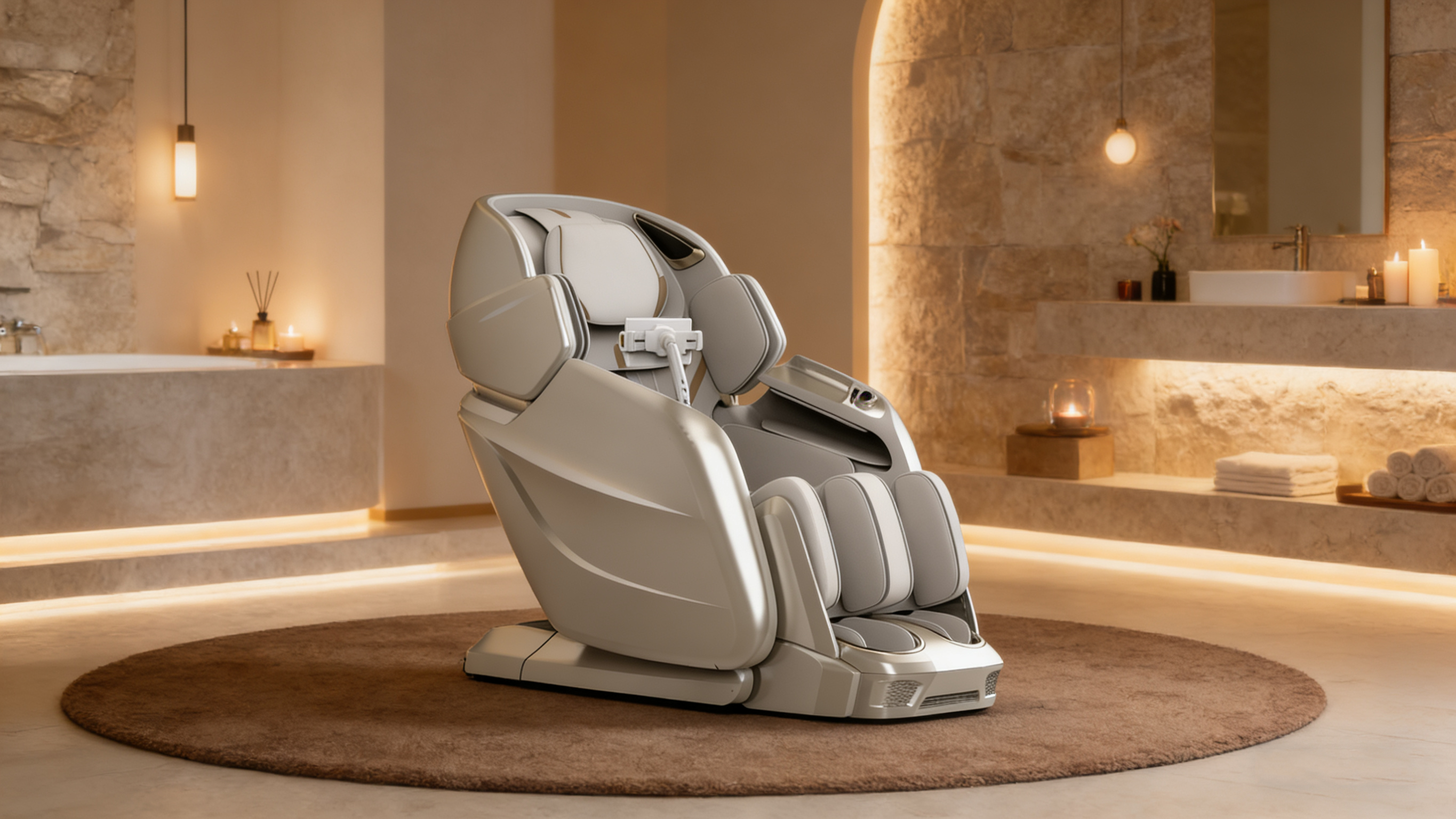
A shared wellness venue such as a spa house combines verified power access, staff supervision and adequate recline clearance - three of the four criteria that decide whether a 3D massage chair can run on a pay-per-use basis.
A shared, pay-per-use massage installation is an electrical and spatial project before it is a wellness one. The mechanism decides what a user feels inside a fifteen-minute session; the socket, the grounding path, the plug configuration, the recline clearance and the manual safety routine decide whether the venue can deliver that session reliably, day after day.
For operators, importers and distributors evaluating a 3D massage chair for public or semi-public use, venue type is therefore the first filter, not the last. Shopping malls, railway stations, airports, offices and spa houses each impose a different combination of power access, grounding quality, supervision and floor space - and those differences, more than product tier, usually determine whether a metered unit earns its place on the floor.
The commercial reason to take that filter seriously is visible in the category data. The global massage chair market is projected to grow from USD 4.28 billion in 2026 to USD 8.78 billion by 2035, a compound annual growth rate of 8.3% (Business Research Insights, 2026). Massage chairs and sofas accounted for 39.5% of the wider massage equipment market in 2024 (Grand View Research, 2024). Growth of that scale depends on chairs being placed where people already are - and those places are shared, metered and electrically regulated environments.
This industry reference explains how to match a 3D massage chair to five indoor venue types and to distribution, retail and shared pay-per-use projects. It treats power supply, grounding, plug matching, placement geometry and manual safety as the primary decision variables, and uses the 3D Massage Chair from Ningbo Zhouqi Health Technology Co., Ltd. (ZHOUQI), product reference 6980, as the reference application.
Ningbo Zhouqi Health Technology Co., Ltd. (ZHOUQI) is a massage chair manufacturer based in Cixi, Zhejiang Province, China. The company was founded in 2008, operates a 130,000 m² facility with 450 employees and an annual output of 200,000 units, and maintains a 34-engineer R&D team; its export ratio is approximately 50%, with main markets in the USA, the EU, Southeast Asia and the Middle East.
Why Venue Type Changes the Installation Requirement
In a home, one chair connects to one household circuit and serves one household. In a shared venue, the same chair becomes shared equipment: it is used by people who never read the manual, at a far higher number of sessions per day, in a space that must also satisfy cleaning, insurance and tenancy rules. The chair does not change; the surrounding requirements do.
Four checks decide whether a venue can host the unit. First, a power socket the operator controls and does not share with other heavy loads. Second, a grounding path that has been verified rather than assumed. Third, a plug that matches the local socket without an adapter. Fourth, floor space and supervision that fit the chair's recline geometry and public access pattern. A venue that fails any one of these checks becomes a maintenance or safety issue regardless of how good the massage mechanism is.
This is also where pay-per-use projects differ from retail sales. A retail buyer who misjudges a socket can move the chair to another room. A venue that misjudges the socket has already committed floor space, installation labour and, in many cases, a lease.
Reference Configuration: The 3D Massage Chair (Product 6980)
Evaluation is easier with a fixed configuration. ZHOUQI lists the 3D Massage Chair under product reference 6980 with the specification below.
| Parameter | Listed value |
|---|---|
| Product type | Massage Chair (zero-gravity type in the certification records) |
| Power input | 110V-240V, 50/60Hz |
| Rated power | 150W |
| Auto timer | 15 minutes |
| Upright dimensions | 1590 (L) x 800 (W) x 1160 (H) mm |
| Reclined dimensions | 1895 (L) x 800 (W) x 940 (H) mm |
| Box dimensions | 1950 (L) x 810 (W) x 880 (H) mm |
| Net / gross weight | 111 kg / 135 kg |
| Materials | Iron, foam, leather, ABS plastic |
The model set covered by the product documentation includes 5200, 5900, 5910, 3100, 6710, 8700, 3600, 3212, 6520, 5100, 6530, 3104, 3109, 6750, 6720 and 6721. The applicable industries recorded for the platform include the home furniture industry, cultural-tourism and hospitality, wellness and beauty, healthcare, corporate offices, real estate and property management, transportation, retail and entertainment, public-service venues, automobile 4S stores and high-end showrooms, bank VIP lounges and university faculty lounges.
What the numbers mean for a venue
- An input range of 110V-240V at 50/60Hz means one product platform covers both 110V and 230V markets, but plug type and socket standard still have to be confirmed market by market before shipping.
- A rated power of 150W is a light electrical load compared with many commercial appliances, yet it is still a load that should sit on a circuit the operator controls rather than on a shared, daisy-chained extension lead.
- A 15-minute automatic timer defines the natural session length and the safety envelope for unattended use.
- A reclined length of 1895 mm and width of 800 mm set the minimum practical floor zone; upright, the chair occupies 1590 mm x 800 mm x 1160 mm.
- At 111 kg net and 135 kg gross, the unit is semi-permanent equipment: delivery routes, lifts, door widths and floor loading should be checked against the 1950 mm x 810 mm x 880 mm box before the purchase order, not after.
The Three Infrastructure Checks: Socket, Grounding, Plug
Socket
A 3D massage chair in a shared venue should be connected to an outlet dedicated to the chair or, at minimum, to a circuit whose other loads are known and stable. The reference configuration draws 150W rated, which is modest, but public areas accumulate loads over time - signage, vending, cleaning equipment, payment terminals. Choosing and labelling the socket during venue fit-out is far cheaper than relocating it after the first nuisance trip.
Cable management is part of the same decision. In high-traffic venues the supply cable should be routed behind or beneath the chair rather than across a walkway, and the socket should sit close enough that no extension lead is needed in a public area.
Grounding
Grounding is a safety path, not a performance feature, and in a shared venue it cannot be assumed. The appliance side is covered by certification: the 3D Massage Chair is listed under ETL certification 5030347, issued by INTERTEK for the US and Canadian markets against UL 1647:2015 Ed.6+R:30Jul2020 and CSA C22.2#68:2018 Ed.8+U1, and under CB certification NO127967, issued by Nemko against IEC 60335-1:2010 with amendments A1 and A2 plus IEC 60335-2-32:2019.
Certification of the appliance does not certify the building. Continuity of the protective earth at the socket remains a venue responsibility and is normally confirmed by a qualified electrician during fit-out. Where several units share a floor with other electrical equipment, the EMC side of the same file becomes relevant to landlord approval: for the EU, CE reference ENB2311240186E00401C issued by EMTEK cites EN IEC 55014-1:2021, EN IEC 61000-3-2:2019/A1:2021, EN 61000-3-3:2013/A2:2021/AC:2022-01 and EN IEC 55014-2:2021.
Plug match
Because the reference configuration accepts 110V-240V at 50/60Hz, plug selection is a market decision rather than a product limitation. It is nonetheless one of the most common commissioning failures in cross-border venue projects: a technically compatible chair arrives with a plug that does not match the socket, and the installation team reaches for an adapter. An adapter is tolerable as a temporary measure in a private setting; in a public, unsupervised venue it adds a connection point that can be pulled, overloaded or left partially seated. The practical rule is to settle socket type, plug type and cable length inside the order specification, not on site.
Manual Safety and Supervision in Public Areas
Documentation and supervision replace the household assumption that someone is always nearby. Four practices cover most of the exposure in a shared venue.
- Clear the recline zone. The chair travels from 1590 mm upright to 1895 mm reclined, so anything behind or beside it inside that sweep - display stands, bins, planters, cables - should be removed and the zone marked as no-storage.
- Respect the session limit. The 15-minute automatic timer defines the standard session and, in pay-per-use operation, prevents open-ended occupancy of a single unit.
- Keep user instructions at the unit. Cleaning staff, security staff and venue staff rotate constantly; a short laminated instruction card plus a named fault-reporting route reduce both misuse and downtime.
- Present the chair as wellness equipment, not a medical device. The application record for ZHOUQI projects lists release of muscle stiffness and body fatigue, support of blood circulation, reduction of physical pressure and discomfort, relaxation of nerves and improved sleep, and relief of soreness from long sitting and tiredness as the intended effects. Users with medical conditions should follow their own clinician's advice.
Venue Fit Matrix: Ranking Five Indoor Scenarios
The five venue types below are ordered by how easily this framework expects them to be operated, using power access, grounding verification, supervision, dwell time and available space as criteria. The ordering is a deployment-planning lens, not a claim about any venue type's commercial performance.
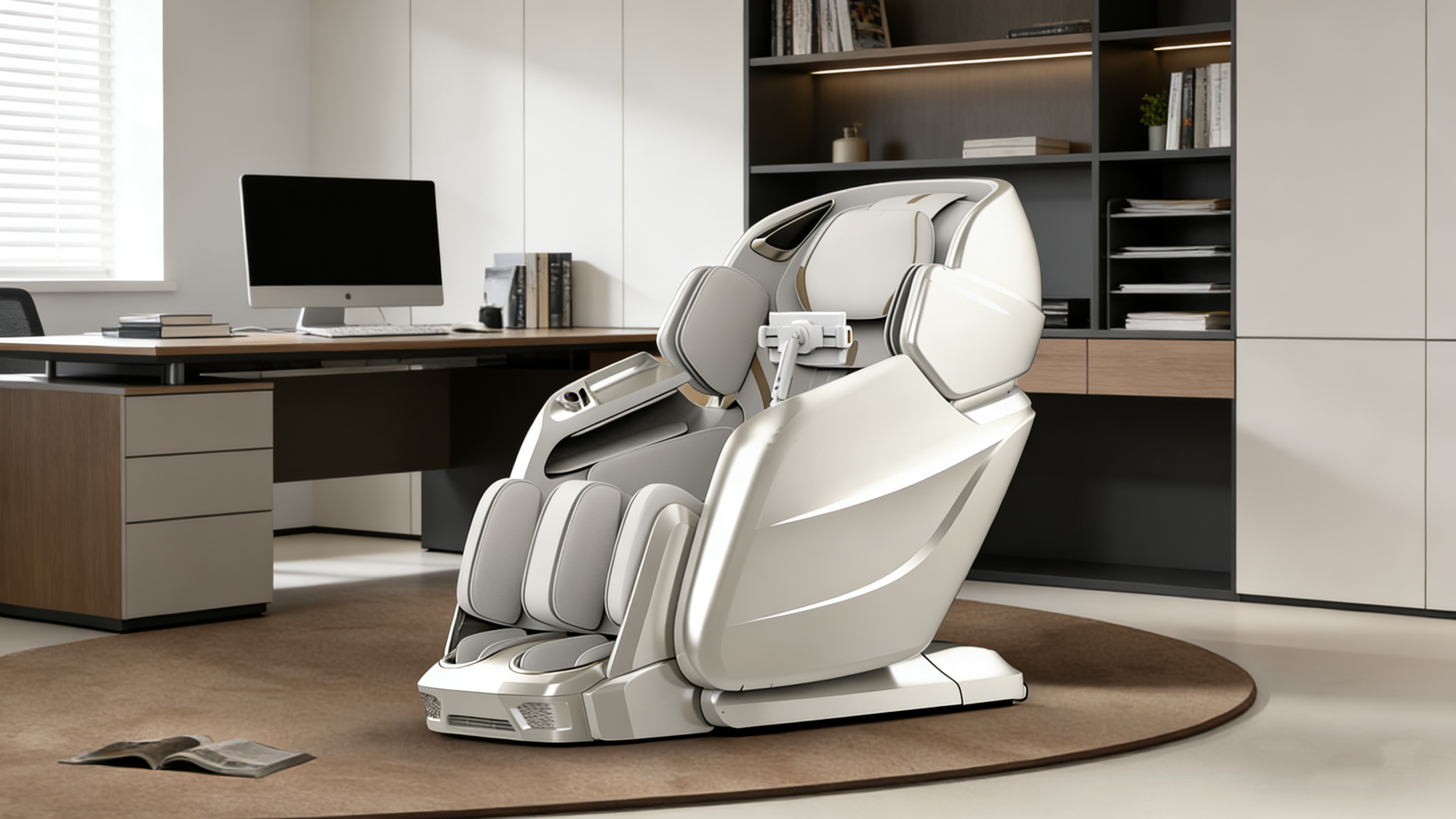
Office wellness rooms are the easiest electrical fit: a labelled internal socket, controlled access and predictable duty cycles, but lower traffic per unit than retail venues.
| Priority | Venue type | Power and grounding profile | Space and placement | Supervision | Why it ranks here |
|---|---|---|---|---|---|
| 1 | Spa house | Fixed in-room wiring installed during fit-out; grounding confirmed as part of the same work | Dedicated treatment or relaxation room; the recline zone can be reserved permanently | Staff on site throughout operating hours | Power, grounding, space and supervision are all resolved by the venue's normal building standard, which makes the unit easiest to commission and easiest to keep running. |
| 2 | Shopping mall | Landlord approval required; socket under tenant control; grounding verified through mall facilities team | Common-area floor zone of roughly 2 m by 1 m, plus queuing space | Attendant, or remote monitoring with an on-call technician | Long dwell times and repeat casual traffic suit session-based use, provided the tenancy agreement allows dedicated power and floor marking. |
| 3 | Airport | Terminal operator approval; dedicated circuit preferred; grounding verified on site | Space exists but is allocated by concession contract | Monitored, with restricted access outside operating hours | Long passenger dwell time is favourable, but electrical and fire approvals dominate the timeline. |
| 4 | Office | Easiest electrical fit: internal circuit and a labelled socket | Staff lounge or wellness room; low traffic per unit | Reception or facilities staff | Strong fit for staff-welfare and B2B placements; lower traffic per unit makes pure pay-per-use revenue harder to reach. |
| 5 | Railway station | Highest compliance burden: strict electrical, fire and access rules; cable protection essential | Concourse space is contested and cleaning cycles are frequent | Security staff only | Very high pedestrian volume, but the shortest dwell time and the greatest wear-and-tear pressure; unit economics depend on throughput and maintenance response. |
Read the matrix as a filter rather than a ranking of revenue potential. A railway station that fails grounding verification is not a low-priority site; it is a site that cannot host the unit until the electrical work is complete.
Placement Geometry and Service Access
Placement planning starts from the chair's own movement envelope, not from whatever corner happens to be free.
| Parameter | Listed value | Planning implication |
|---|---|---|
| Upright dimensions | 1590 x 800 x 1160 mm | Resting footprint and height to check against signage, shelving and ceiling fixtures |
| Reclined dimensions | 1895 x 800 x 940 mm | The recline sweep that must stay clear at all times |
| Box dimensions | 1950 x 810 x 880 mm | Delivery route: door widths, lift dimensions, corridor turns |
| Net / gross weight | 111 kg / 135 kg | Two-person handling, floor loading and floor protection |
| Power input / rated power | 110V-240V, 50/60Hz / 150W | Single outlet, market-specific plug, planned cable routing |
| Auto timer | 15 minutes | Natural session length for pay-per-use configuration |
Two practical points follow. First, the difference between upright and reclined length is only about 30 cm on paper but decisive in a corridor or alcove, because the sweep happens while a person is seated and cannot be blocked by furniture. Second, service access matters as much as user access: a unit placed tight against a wall with no technician space will take longer to return to service after any fault.
Matching the 3D Intelligent Mechanism to Session Value
A 3D massaging mechanism adjusts the working depth of the massage rather than following a single fixed path along the back, which is the practical difference between a shallow surface routine and a session that can be tuned to the user. In a shared venue that adjustability is an operational asset: the same unit can serve a visitor who wants light relief after a long walk and one who wants firmer treatment after a long day of sitting.
The recorded application effects are consistent with that positioning. The project record lists release of muscle stiffness and body fatigue, support of blood circulation, reduction of physical pressure and discomfort, relaxation of nerves and improved sleep, and relief of soreness from long sitting and tiredness. For a venue operator, those effects translate into session framing - short, comfortable, repeatable relief rather than a clinical claim - which is also the framing that keeps venue marketing inside defensible limits.
Operational Evidence from Distributor and Venue Projects
Venue fit is ultimately tested by repeat orders. The ZHOUQI case record documents approximately 70,000 units delivered to Vietnam over four years and approximately 20,000 units delivered to the United States over three years, with client types that include massage chair sales showrooms and 4S showrooms, furniture and home-appliance malls, e-commerce sellers, hotels and resorts, and wellness and senior-care institutions. The recorded result is a market that continues to improve, and the recorded case highlights are a popular design, good quality and a favourable price.
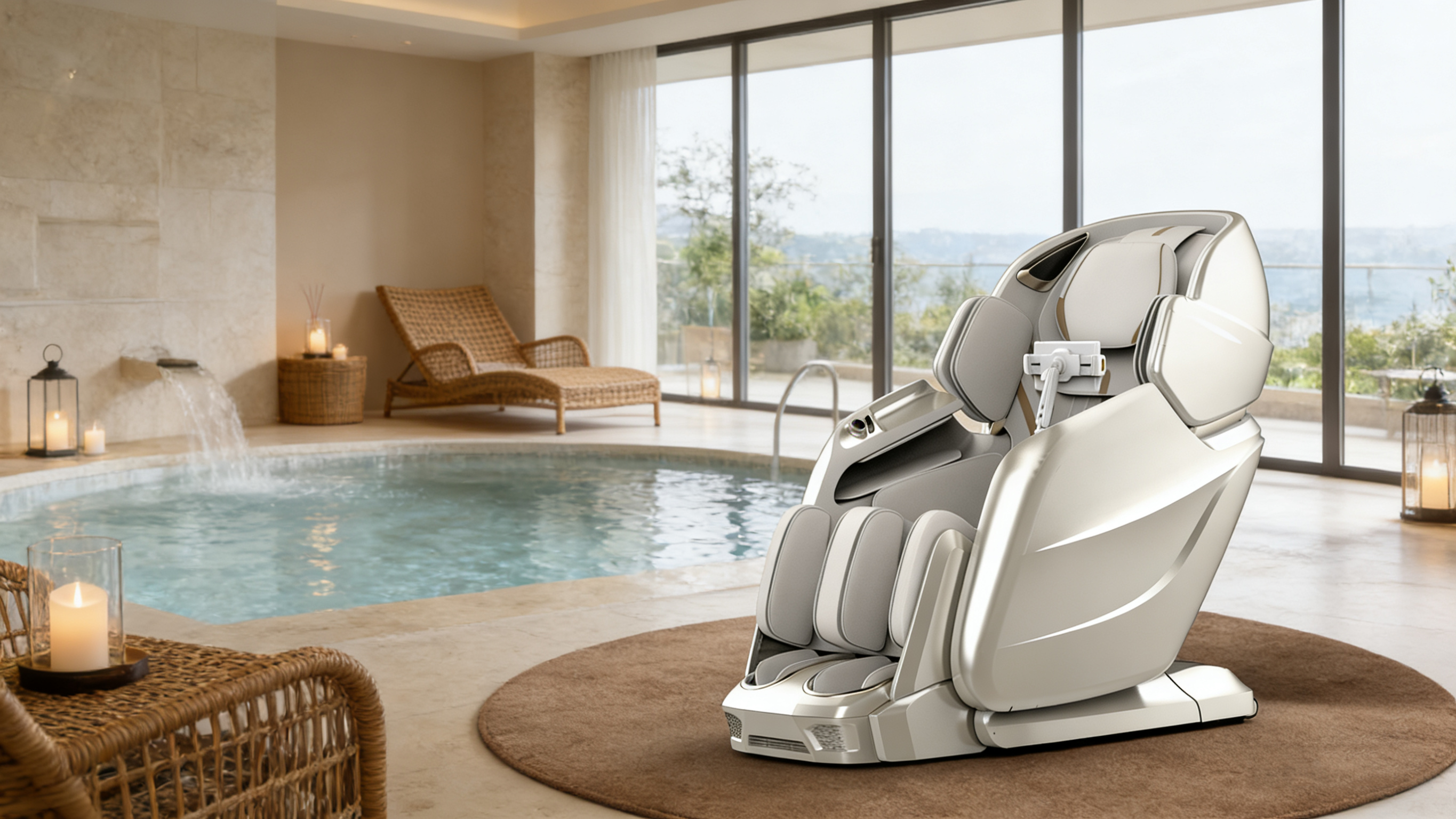
Hotels and resorts appear among the client types recorded for the platform - shared hospitality settings where socket placement, grounding and guest supervision follow the building's standard fit-out.
On the supply side, the manufacturer applies 100% quality control testing to all products, operates a monthly capacity of 16,000 units with a 30-45 day lead time and a minimum order quantity of one 40HQ container, and offers OEM/ODM customisation covering colour, logo, OEM files, pillow and backrest design, user interface and language. After-sales support is a one-year warranty supported by installation videos and a maintenance manual - the two documents that matter most when a venue's own staff, rather than a dealer technician, handle first-line support.
For compliance planning, the certificates below are the ones a venue landlord, importer or distributor is most likely to request.
| Certification | Reference | Issuing authority | Market | Standard |
|---|---|---|---|---|
| ETL | 5030347 | INTERTEK | US, Canada | UL 1647:2015 Ed.6+R:30Jul2020; CSA C22.2#68:2018 Ed.8+U1 |
| CB | NO127967 | Nemko | EU, Middle East, SE Asia | IEC 60335-1:2010 (+A1:2013, +A2:2016); IEC 60335-2-32:2019 |
| CE (EMC) | ENB2311240186E00401C | EMTEK | EU, Middle East, SE Asia | EN IEC 55014-1:2021; EN IEC 61000-3-2:2019/A1:2021; EN 61000-3-3:2013/A2:2021/AC:2022-01; EN IEC 55014-2:2021 |
| ISO 13485 | 133640 | NQA | US, South Korea, SE Asia | ISO 13485:2016 |
| ISO 9001 | 02424Q32202999R1S | SHENZHEN UNIVERSAL CERTIFICATION CENTRE CO., LTD. | EU, Middle East, SE Asia, US | GB/T19001-2016 / ISO9001:2015 |
| FDA registration | 3017618816 | Shenzhen CTB Testing Technology Co., Ltd. | US | 21 CFR 807.39 |
The certificates above cover massage chairs and a defined model set. Two clarifications are worth stating plainly: ISO 9001 and ISO 13485 are management-system certificates, and ISO 13485 is not a medical device approval; the FDA entry recorded under 21 CFR 807.39 is a registration reference, not a product approval. The current international safety standard specifically for electric massage appliances, including massage chairs, is IEC 60335-2-32:2024. Buyers should confirm that a certificate scope lists the exact model being ordered.
Comparison with Traditional Alternatives, and Where This Approach Reaches Its Limits
| Option | Strength | Constraint | Where it fits |
|---|---|---|---|
| Manual massage service with a therapist on site | Adapts to each client in real time | Throughput limited by staff availability; higher operating cost | Spa houses and wellness centres with service-led positioning |
| Simple token-operated massage seats and pads | Low unit cost; easy to relocate | Limited massage depth; lower perceived value per session | Short-dwell, high-traffic locations |
| Shared 3D massage chair deployment (product reference 6980 as the example) | Adjustable massage depth; documented power, weight, dimension and certification profile; suited to semi-permanent installation | Requires a grounded socket, roughly 1.9 m of reclined length, and planned handling and installation | Malls, spa houses, offices, lounges and comparable indoor venues |
| High-end 4D and AI-assisted models | Additional body-scanning and programme features | Higher cost and specification pressure; venue-level infrastructure constraints still apply | Premium lounges and flagship venues |
Boundaries belong in the specification. The following limits apply to the reference configuration and should be checked before any multi-unit rollout.
- Footprint. A reclined length of 1895 mm rules out narrow corridors, tight alcoves and glass-fronted cut-outs that look adequate until the chair reclines.
- Weight. At 111 kg net this is installed equipment, not portable furniture. Frequent relocation between sites is impractical, and floor loading should be confirmed for mezzanine or raised floors.
- Electrical dependence. The unit needs a correctly rated, grounded socket. An ungrounded outlet, an overloaded shared circuit or a long adapter chain is a disqualifying condition, not a compromise.
- Certificate scope. The certificates list a specific model set. A new OEM configuration, a changed control system or a different plug standard may fall outside the existing scope and require additional verification.
- Session and supervision limits. The 15-minute automatic timer shapes both safety and throughput, and unattended public use still requires a cleaning, fault-reporting and supervision routine.
- Positioning limits. The chair is wellness equipment. It should not be presented as a treatment for a medical condition, and medical language should stay out of venue-facing material.
Market Signals Behind Venue-Based Deployment
Category data explains why venue-level infrastructure planning is becoming a normal part of procurement rather than an afterthought.
- Growth is steady and forecast-driven. The massage chair market is projected to move from USD 4.28 billion in 2026 to USD 8.78 billion by 2035 at 8.3% CAGR, while the smart massage chair segment is projected to reach USD 14.2 billion by 2033, driven by AI-powered body scanning and smart connectivity (Business Research Insights; Dataintelo).
- Technology adoption is broadening. Approximately 41% of new massage chair models in 2026 are expected to integrate AI-based sensors for body scanning (Business Research Insights), which raises both the value of a session and the importance of stable power and well-planned placement.
- Regional demand is unevenly distributed. North America held a 36.9% revenue share of the massage equipment market in 2024 (Grand View Research), while Asia Pacific is the fastest-growing region and accounted for 34.8% of the luxury massage chair segment in 2024 (Credence Research). Sourcing for both regions requires one platform with market-appropriate plugs and certificate coverage.
Consumer behaviour reinforces the venue case. In the United States, 81% of consumers choose massage solutions based on client referrals (AMTA / Fortune Business Insights) - a pattern that favours venues where a first session is easy to try and easy to repeat.
Future Outlook
Two changes are likely to shape the next planning cycle. The first is documentation. Venue landlords increasingly ask for the electrical characteristics of equipment before approving a concession or tenancy, which turns a power-and-plug checklist into a sales document rather than an installation detail. Manufacturers that can supply a clear configuration sheet - input voltage, rated power, plug variant, upright and reclined dimensions, net and gross weight, and certificate scope - will shorten venue approval cycles.
The second is fleet management. As AI-assisted sensing becomes more common in new models, shared-venue operators will be able to standardise session programmes across sites and monitor usage and faults remotely. That shift increases the value of an installable, serviceable platform with consistent documentation, and it reduces the value of ad-hoc placements that were never checked for grounding or clearance in the first place.
FAQ
Which indoor venues are the best fit for a shared pay-per-use 3D massage chair?
Using power access, grounding verification, supervision, dwell time and available floor space as criteria, spa houses and shopping malls generally rank first: both can resolve electrical work during fit-out and can supervise the unit during operating hours. Airports and offices follow, with offices requiring the least electrical adaptation but generating lower traffic per unit. Railway stations rank last in this framework - not because of traffic, but because electrical approvals, cleaning cycles and wear-and-tear pressure are highest there.
What power supply does the 3D Massage Chair (product reference 6980) require?
The reference configuration accepts 110V-240V at 50/60Hz with a rated power of 150W and a 15-minute automatic timer. In practice that means the chair can be supplied for either 110V or 230V markets, while plug type, socket standard and cable length are settled per order. The venue-side requirement is a correctly rated outlet that the operator controls, ideally used by the chair alone.
Does a commercial venue need special grounding for a 3D massage chair?
Grounding is a general electrical safety requirement rather than a product-specific feature. The appliance is certified - for example ETL certification 5030347 against UL 1647:2015 Ed.6+R:30Jul2020 and CSA C22.2#68:2018 Ed.8+U1, and CB certification NO127967 against IEC 60335-1 and IEC 60335-2-32 - but certification of the chair does not certify the building's wiring. Continuity of the protective earth at the socket is normally verified by a qualified electrician during venue fit-out and should be re-checked if the outlet is moved or the circuit is modified.
How much floor space should be reserved for one unit?
Plan around the reclined position, not the resting position. The reference configuration measures 1590 x 800 x 1160 mm upright and 1895 x 800 x 940 mm reclined, so the recline sweep must stay clear of furniture, displays and cables at all times. Delivery adds a second constraint: the box measures 1950 x 810 x 880 mm, and the unit weighs 111 kg net and 135 kg gross, so door widths, lift dimensions and floor protection should be checked in advance.
Which certifications should be verified before a US or EU rollout?
For the United States and Canada, the relevant file in this configuration is ETL certification 5030347 issued by INTERTEK, covering massage chairs against UL 1647:2015 Ed.6+R:30Jul2020 and CSA C22.2#68:2018 Ed.8+U1. For the EU, CE reference ENB2311240186E00401C issued by EMTEK cites EN IEC 55014-1:2021, EN IEC 61000-3-2:2019/A1:2021, EN 61000-3-3:2013/A2:2021/AC:2022-01 and EN IEC 55014-2:2021, supported by CB certification NO127967. Buyers should check that the certificate scope names the exact model ordered, and should treat ISO 9001 and ISO 13485 as quality-management evidence rather than product approvals. The current international safety standard for electric massage appliances is IEC 60335-2-32:2024.
Venue fit is decided by infrastructure: a socket the operator controls, a grounding path that has been verified, a plug that matches without adapters, and a placement that respects the chair's reclined geometry and service access. Venue type determines how much of that work the building has already done.
ZHOUQI's 2026 product catalogue, covering the 3D Massage Chair range, can be downloaded here: 2026 E-catalogue (PDF). Company reference: www.cn-zhouqi.com.