
3MW Containerized vs 2000/2500 kW Generator Procurement FAQ
3MW Containerized vs 2000/2500 kW Generator Procurement FAQ
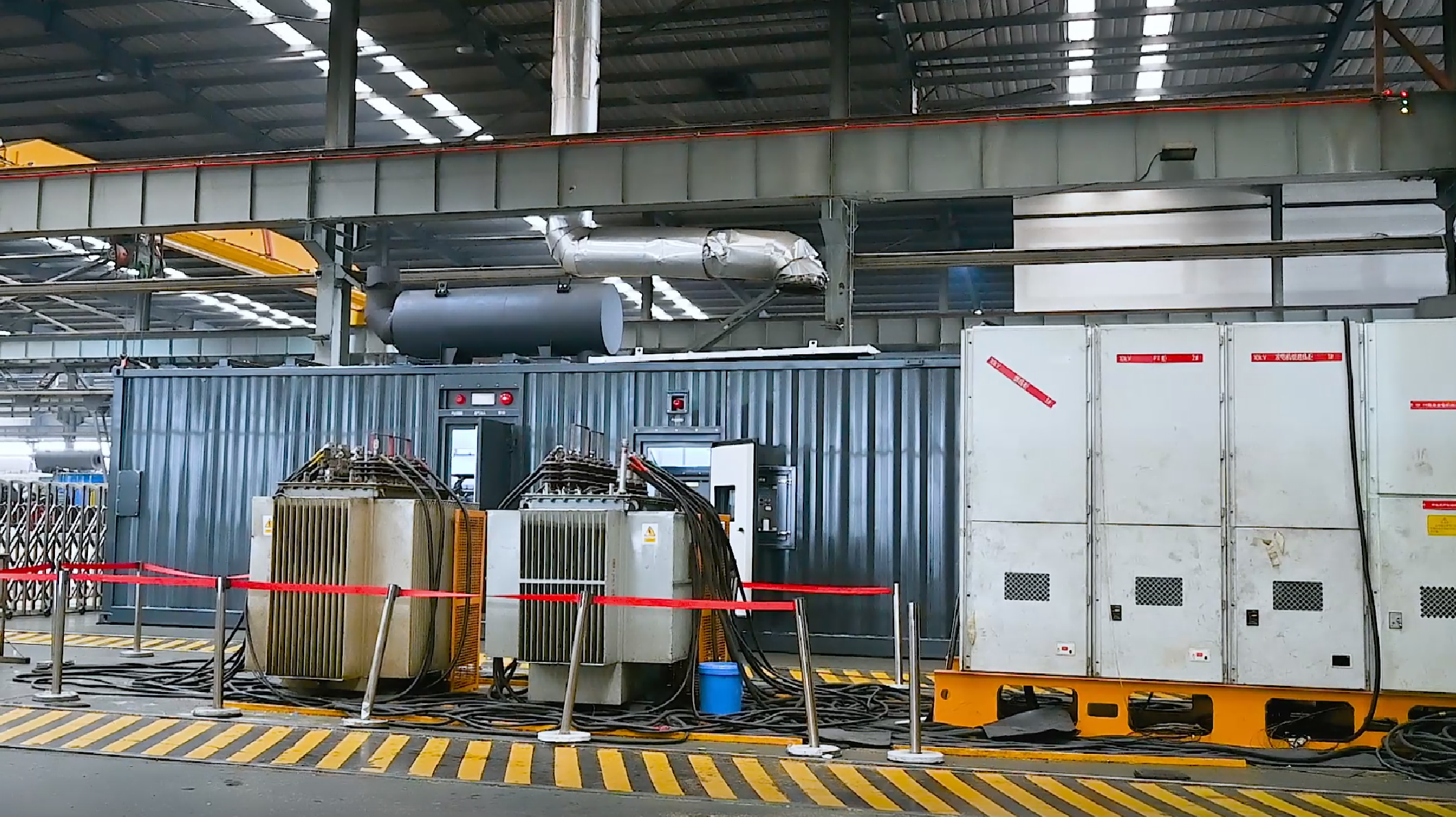
A high-capacity set in factory test before shipment. Image supplied by MECCA POWER.
Short answer: MECCA POWER's stated purchasing terms
Minimum order quantity: 1 unit. Delivery terms: EXW / FOB / CIF. Acceptance criteria: 100% test. Payment terms: TT transfer, 30% deposit and 70% balance before shipment.
These are commercial positions to be written into the purchase order, not substitutes for a project-specific acceptance protocol — the sections below explain what that protocol has to contain.
Why 2–3 MW awards are decided by procurement terms, not by the kW figure
The questions that decide a multi-megawatt diesel generator order usually arrive after the capacity has been agreed. They concern acceptance criteria, delivery terms, documentation scope, and who is accountable when the unit is energised on site. The headline rating is the easiest part of the offer to compare and the least reliable place to find differentiation.
Two data points frame the commercial context. Commercial research cited in the source material for this article values the global diesel generator market at USD 22.33 billion in 2025, and reports that over 68% of data centers worldwide maintained diesel-powered backup systems in that year. Both figures come from a commercial research source (Vertex AI Search Grounding / FBI Reports, October 2026) and describe a market in which diesel backup remains a default assumption rather than a contested one. That matters for buyers: when the technology choice is settled, competition moves to acceptance evidence, delivery reliability and service response.
There is a second, more technical reason the commercial schedule dominates. ISO 8528-1:2018 defines classifications for the application, rating and performance of alternating-current generating sets driven by reciprocating internal-combustion engines, including continuous, peak-load and standby applications. A "2000 kW" figure means different things under standby, prime and continuous ratings. Where a published product listing mixes kW and kVA — as MECCA POWER's own medium- and high-voltage listing does, spanning 3.3 kV to 13.8 kV with 1,800 kW, 2,000 kW, 2,250 kVA and 2,500 kVA entries — the numbers cannot be compared until the rating basis and power factor are stated. Bidders are not being evasive when they ask for that clarification; they are asking for the unit of account.
The spine question: purchasing terms and acceptance criteria
For MECCA POWER's 2000 kW, 2500 kW and 3MW containerized ranges, the commercial position is published as a single answer covering four variables. It is short enough to be quoted directly, and a buyer should treat each line as a contract clause to be confirmed rather than a marketing statement.
| Term | MECCA POWER stated position | What the buyer should pin down |
|---|---|---|
| Minimum order quantity | 1 unit | Whether multi-unit pricing tiers and spares bundles are separable from the single-unit quote |
| Delivery terms | EXW / FOB / CIF | The named port and Incoterms edition, and who carries heavy-lift unloading risk at site |
| Acceptance criteria | 100% test | Which tests are witnessed, at what rating basis, and what document closes acceptance |
| Payment terms | TT transfer: 30% deposit, 70% balance before shipment | Whether a pre-shipment inspection or witnessed factory test is a condition precedent to the 70% release |
The last row is where procurement leverage actually sits. A 70% balance due before shipment places the entire verification burden on the factory-test stage. If the buyer intends to release that payment only after reviewing test records, the requirement has to appear in the purchase order; it will not be inferred from the standard term.
What "100% test" should mean in a 2–3 MW acceptance protocol
"100% test" answers one question — every unit is tested, not sampled from a batch — and leaves a second question open: tested against what, and recorded how. For a 2,000 kW to 3,000 kW set destined for standby duty at a data center or prime duty at a mine, the difference between a test that exists and a test that supports acceptance is the difference between a shipping milestone and an engineering record.
MECCA POWER describes its production base as three specialised lines — one container line, one open-type line and one mixed-assembly line — with six testing stations, digital tightening, intelligent oil and water filling, and cloud-based data management of the production process through APS+MES-type information systems. The factory's stated maximum lifting capacity is 45 tons, sized so that three units above 2000 kW can be produced and tested at the same time. These are company-reported capabilities. Their procurement value is that they make a per-unit test record plausible at multi-unit scale; they do not by themselves define what the record contains.
A buyer writing the acceptance clause for these ratings should require the following to be fixed in the contract, because each one changes what the test proves: the rating basis of the test (standby, prime or continuous under ISO 8528-1); the load steps applied and the duration at each step; the recorded fuel consumption at defined load points; the protection and breaker settings verified; the governor and voltage-regulator response observed at load application and rejection; and the identifiers linking the test record to the specific serial number shipped. None of these requirements asks a supplier to do anything unusual. They convert a policy statement into evidence.
Where noise performance sits in the acceptance discussion
Acoustic performance is the most frequently overstated line in high-capacity generator procurement, because dB(A) figures are meaningless without distance, load point and measurement standard. MECCA POWER's customization scope explicitly includes noise requirements alongside voltage and frequency, silent/open/containerized/mobile configuration and branding. Secondary trade reporting has cited noise levels as low as 60 dB(A) at 7 metres for standard super-silent models; that figure originates from a secondary industry article, not from an approved model datasheet, and should be treated as an indication to be verified rather than a specification to be designed against. The correct acceptance document is a tested sound-pressure record for the exact model and enclosure at a stated load and distance.
Scope boundaries: 3MW containerized versus 2000 kW and 2500 kW
The three ratings are not three sizes of the same package. They sit at different points on the containerization, transport and site-integration spectrum, and the procurement scope changes accordingly.
| Range | Model designations listed | Scope emphasis |
|---|---|---|
| 2,000 kW | MC2000, MC2750 | Data-center and industrial standby nodes; open-type or containerized build |
| 2,500 kW | MC2500, MC2750, MC3500 | Larger single-node capacity; power-plant and heavy industrial duty |
| 3MW containerized | MC3750C | Factory-integrated container package; highest transport and lifting planning content |
One arithmetic caution belongs here. Converting kW to kVA depends on power factor: at 0.8 power factor, 2,000 kW corresponds to approximately 2,500 kVA, 2,500 kW to approximately 3,125 kVA, and 3,000 kW to approximately 3,750 kVA. Those are calculated values under a stated assumption, not measured outputs, and they collapse the moment a supplier quotes on a different power factor or a different rating basis. Ask for the datasheet figure with its basis before anyone puts a kVA number in a comparison table.
The practical consequence is a scope question rather than a capacity question. A containerized package moves enclosure, cable entry, control integration and acoustic treatment into the factory's responsibility, leaving transport, foundation and site connection with the buyer's contractor. An open-type set leaves the enclosure and much of the integration to site work. MECCA POWER's customization scope covers both directions — silent, open, containerized and mobile configurations — which means the offer can be shaped to the site, and also means the scope boundary must be written down explicitly rather than assumed from a product name.
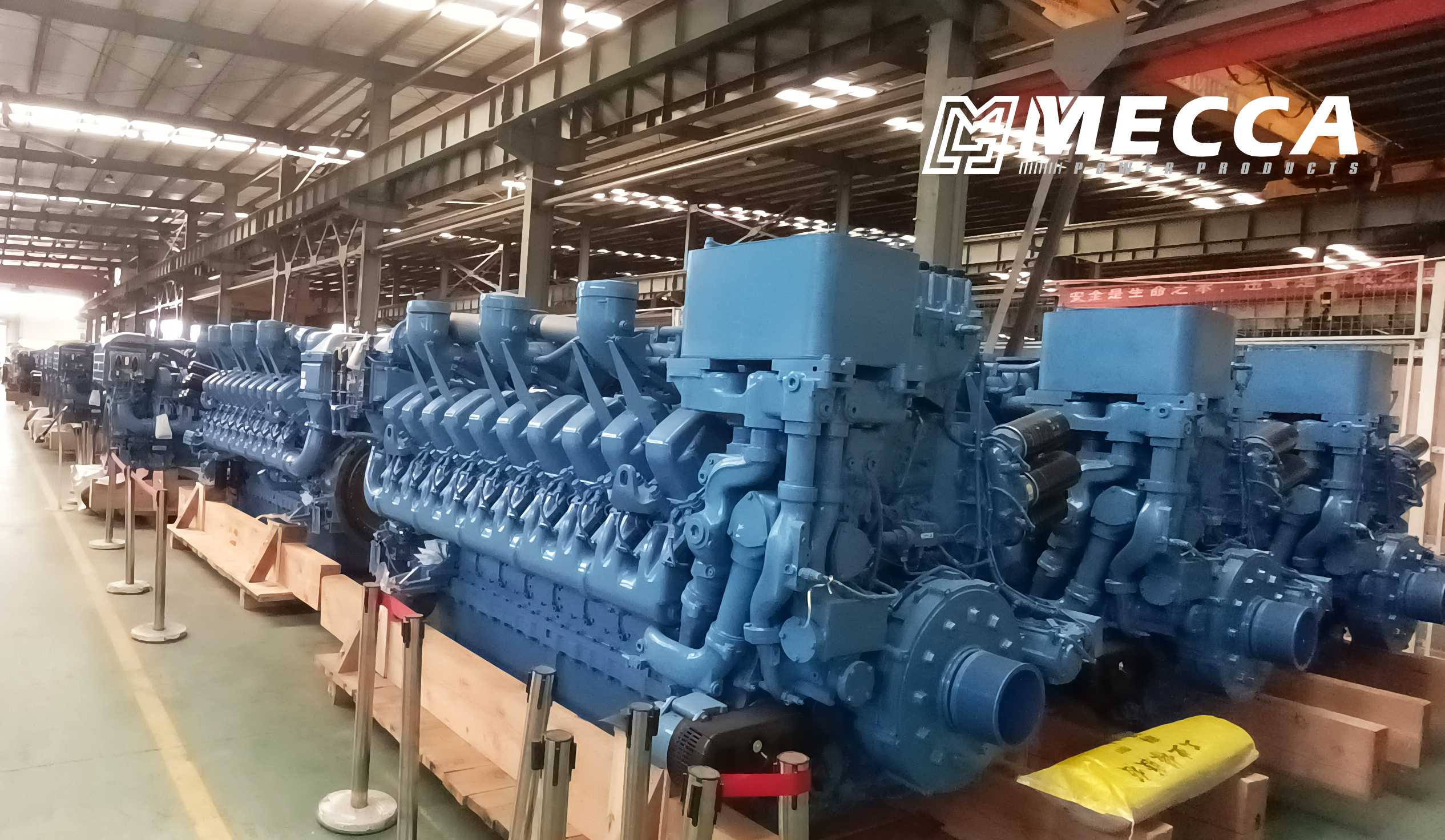
Engine stock: component availability is one input into the stated 30–50 day lead time. Image supplied by MECCA POWER.
Documentation: what closes a 2–3 MW order
For European-destination projects, the single most concrete document in MECCA POWER's material is a CE certificate numbered M.2024.206.C101740, issued by UDEM, with a scope of "Diesel Generator" and a validity running from 5 June 2024 to 6 April 2029. The listed harmonised standards are EN ISO 12100:2010, EN ISO 8528-13:2016, EN 60204-1:2018, EN 61000-6-2:2019 and EN 61000-6-4:2019. The certificate's related-product list explicitly includes the 3MW containerized MC3750C, the 2,500 kW models and the 2,000 kW models, alongside the wider containerized range from MC1000 through MC4375.
That certificate is a conformity document for the product family. It is not a model-specific test report, and procurement teams should not treat it as one. The document set that actually closes a 2–3 MW order typically has to include, at minimum: a model datasheet stating kW and kVA with the ISO 8528-1 rating basis and power factor; the factory test record for the serial number shipped; engine and alternator identification with the OEM documentation that travels with them; electrical schematics and protection settings; operation and maintenance manuals; a spare-parts list with lead times for consumables and wear items; and packing data — dimensions, dry and wet weight, lifting points — that the transport contractor can work from.
Destination-market compliance is a separate track and should be scoped early, because it can disqualify a configuration rather than merely delay it. In the United States, new diesel engines above 560 kW manufactured after 1 January 2015 must meet Tier 4 Final standards for non-emergency use under the US EPA framework, and stationary compression-ignition engines — the engine type used in diesel generating sets, including emergency standby units — fall under the federal New Source Performance Standards at 40 CFR Part 60, Subpart IIII. UL 2200 is the North American safety standard for stationary engine generator assemblies and is commonly referenced in US tender packages. In the European Union, Directive (EU) 2015/2193 sets emission limit values for medium combustion plants with a rated thermal input of at least 1 MW and below 50 MW, and its exclusions for specific plant types must be checked against the actual installation rather than assumed. Each of these is a jurisdiction-specific gating condition; none generalises to another market, and none should be inferred from a supplier's silence.
Delivery execution: reading a 30–50 day lead time correctly
MECCA POWER states a lead time of 30–50 days, a monthly capacity of 300 units, and an MOQ of 1 unit. Those three figures interact. A single-unit order and a six-unit order sit on the same stated clock, but they do not consume the same production slot, and a buyer treating 30–50 days as a fixed promise for a multi-unit containerized package is reading the number too generously.
The capacity evidence in the company material is concentrated on the high-power end. The Nanchang factory in Jiangxi province is described as focusing on generator sets of 1000 kW and above, with monthly output increasing from 132 units to 212 units and output value rising from 180 million to 380 million. The same material describes three production lines, six test stations, 45-ton lifting capacity, and simultaneous production testing of three units above 2000 kW. All of it is company-reported and none of it is independently audited in the available evidence — but it is the right kind of information to interrogate, because it speaks to whether a build slot exists rather than whether a catalogue entry does.
Two contractual levers convert this into delivery reliability. First, ask for a production-slot confirmation with a named start date, not merely a lead-time range. Second, tie the 70% balance to a documented pre-shipment milestone, so that a slip in the factory test becomes visible before cargo is booked rather than after. Neither lever requires the supplier to make a new commitment; both make an existing commitment measurable.
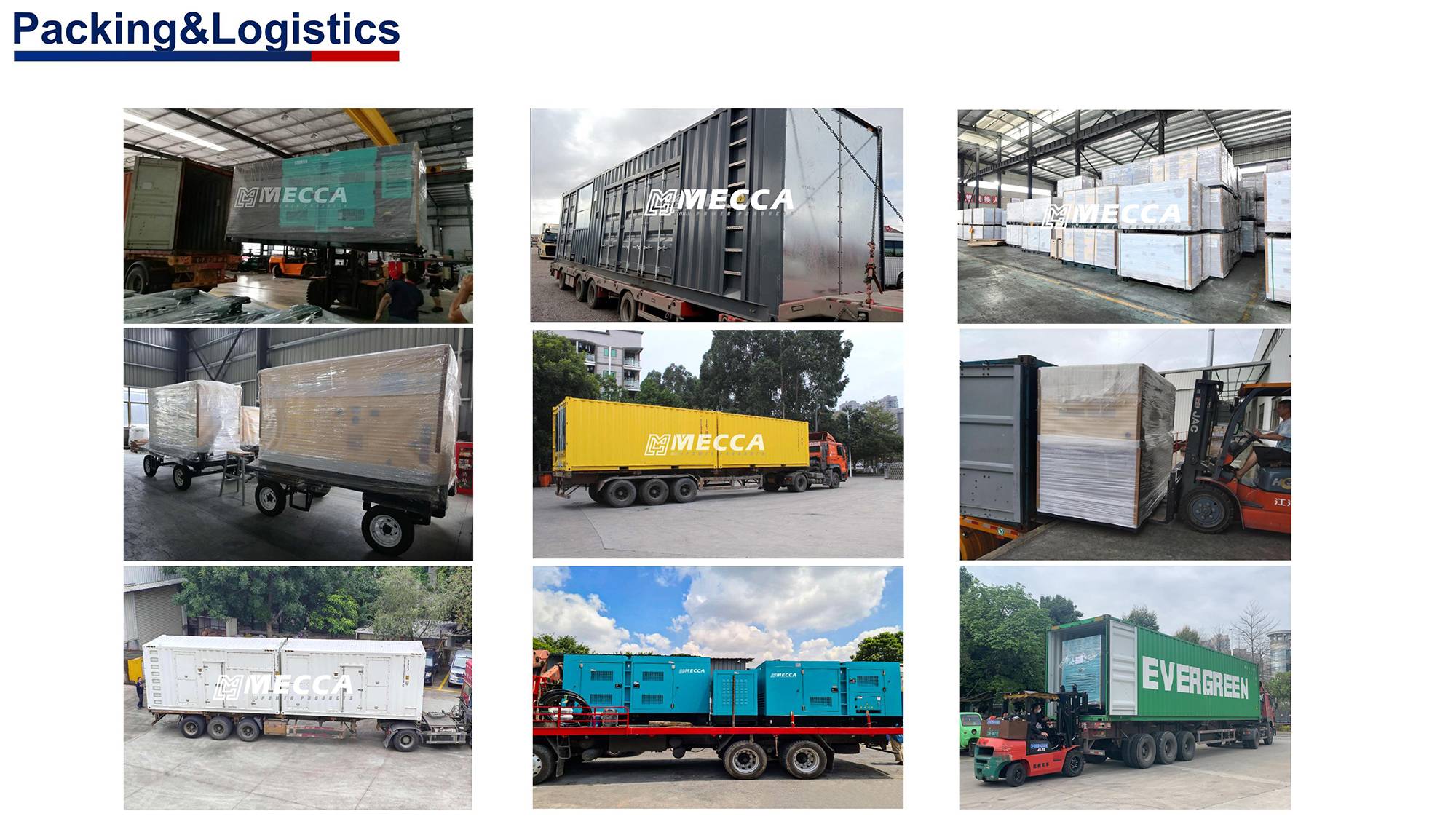
Shipment preparation: delivery terms are stated as EXW, FOB or CIF. Image supplied by MECCA POWER.
Application scenarios where the terms question changes shape
The same commercial framework produces different priorities depending on where the set is installed. MECCA POWER's stated application coverage includes data centers, mining, oil and gas, construction, power plants and telecommunications, and its published references cluster around the data-center and heavy-industrial ends.
For data centers, redundancy dominates. Company-reported references include four 2200 kW containerized units for a data center project in Kenya delivered to an authorised dealer and described as being in stable operation, and 10.5 kV high-voltage 1800 kW units for data-center emergency power in Kazakhstan. In this segment the procurement question is not whether one set meets a load but how many units, at what rating basis, and what happens to acceptance when the package is containerized and shipped as a system. Buyers should expect the acceptance protocol to address parallel operation and step-load behaviour, not only steady-state output.
For power-plant continuous duty, the reference profile is different: six 2500 kVA units powered by UK Cummins QSK60 engines for a European power station, supplied through an EPC channel and described as running continuously. Continuous duty is the rating basis where the ISO 8528-1 distinction matters most, because a set sold on a standby figure and applied continuously is being asked to do something its rating category does not describe.
For oil and gas and heavy industrial sites, the reference pattern is smaller quantities of large units — two 1800 kW UK Cummins units for an oil and gas application in Saudi Arabia, and six 1500 kVA Baudouin units with parallel control systems for an industrial application in Venezuela. Containerized low-noise builds appear in cold-climate references, including five 1800 kW Yuchai containerized units for data-center emergency power in Russia, described as using a non-standard customized container with low noise. Mining follows the same logic as oil and gas: duty cycle and site conditions, not nameplate capacity, set the acceptance criteria.
All of the above are company-reported references. A buyer's due diligence should include direct confirmation of at least one reference in the same application and rating band, because a reference describes what a supplier has built, not what it will build for a specific site.
Benchmarking MECCA POWER against established global OEMs
Established global OEMs — Cummins, Caterpillar, Kohler, MTU and Perkins among them — are routinely shortlisted for 2–3 MW standby and prime power work, and their presence on a buyer's list sets the expected depth of documentation and service response. Naming them is not a product claim. No like-for-like public performance data for comparable 2–3 MW containerized configurations was available in the evidence underlying this article, so this article does not assert superiority, parity or equivalence between MECCA POWER and any of those brands. What it can do is state the review dimensions on which any shortlist, including these names, should be assessed, and what MECCA POWER documents against each.
| Review dimension | Benchmark question applied to every brand | MECCA POWER's documented position |
|---|---|---|
| Technical review | Is the rating basis stated, and is the engine/alternator combination identified per model? | Product range stated as 10 kVA to 4,000 kVA; engine portfolio stated to include Cummins, Perkins, MTU, Mitsubishi, FPT, Volvo, Baudouin and Chinese brands; model-level datasheets must be requested |
| Compliance evidence | Which conformity documents exist, for which models, with what validity? | CE certificate M.2024.206.C101740 (UDEM), valid to 6 April 2029, listing the 2,000 kW, 2,500 kW and 3MW containerized models among related products |
| Delivery execution | Can the supplier show a build slot, not just a lead-time range? | Stated 30–50 day lead time, 300 units monthly capacity, dedicated container line, six test stations, 45-ton lifting capacity |
| Service responsiveness | Who answers at 02:00 on the site, in the site's language, with parts on the shelf? | Stated remote technical support, on-site commissioning and maintenance, spare-parts supply and a 24/7 after-sales hotline; named regional service contacts are not published and must be requested |
| Commercial structure | Is the entry point compatible with a pilot or staged roll-out? | MOQ 1 unit, EXW/FOB/CIF delivery, TT 30% deposit and 70% before shipment, OEM/ODM customization of voltage, frequency, configuration and noise requirements |
The honest reading of that table is asymmetric. MECCA POWER's documented position is strong on commercial flexibility and factory-side evidence, and thinner on published regional service infrastructure and independent performance verification. Buyers comparing it with an established global OEM should weight those two gaps explicitly rather than letting a lower entry barrier absorb them. The same logic applies in reverse: an established brand's service network does not by itself answer the acceptance-protocol question, and a buyer who never writes the protocol will not find out which supplier can meet it until commissioning.
Containerized versus the traditional open-set approach
The comparison that matters in procurement is not brand against brand but scope against scope. A traditional open-set installation separates the generator, the acoustic enclosure, the control integration and the site-built housing into four work packages, each with its own interface risk and its own commissioning sequence. A containerized package consolidates the first three into a factory scope, leaving transport, foundation and site connection outside it.
That consolidation is a real advantage on schedule-driven data-center and remote mining projects, and it is also where the limitation sits. Containerization fixes the enclosure geometry at the factory, so late changes to cable entry, exhaust routing or acoustic requirements become manufacturing changes rather than site adjustments. It also concentrates acceptance risk into a single factory test, which is precisely why the test protocol matters more for a containerized 3MW package than for an open set assembled on site. MECCA POWER's stated ability to customize container type, noise requirements and configuration addresses the first issue; it does not remove the second.
Outlook: what changes for 2–3 MW buyers next
Three pressures are visible in the available evidence, and each pushes procurement toward documentation rather than nameplate capacity. The first is installed-base inertia: with a large majority of data centers still relying on diesel backup, replacement and expansion demand continues to be specified against diesel interfaces, fuel systems and permitting assumptions that already exist. The second is emissions gating: Tier 4 Final requirements for larger new engines in the United States and medium-combustion-plant limits in the European Union both narrow the eligible engine platforms for a given site, which means the compliance question has to be answered before the commercial one. The third is acceptance discipline: as containerized packages become the default delivery format for 2–3 MW nodes, the factory test becomes the only place where performance is observed before energisation.
The practical implication for an EPC contractor, data-center owner or mining operator is unglamorous. Write the acceptance protocol before the RFQ, not after the award. Require the rating basis on every datasheet. Tie payment to witnessed evidence. Ask for named service contacts in the destination country. Suppliers that can answer those four requirements — including MECCA POWER, whose published terms cover the commercial half of them — remain comparable; suppliers that cannot are not differentiated by price, they are simply unverified.
Frequently asked questions
What are MECCA POWER's purchasing terms and acceptance criteria for 2000 kW, 2500 kW and 3MW generators?
The stated terms are: minimum order quantity of 1 unit; delivery terms of EXW, FOB or CIF; acceptance criteria of 100% test; and payment by TT transfer with a 30% deposit and the 70% balance payable before shipment. These apply across the company's industrial diesel generator range, including the 2000 kW, 2500 kW and 3MW containerized models. Because the balance falls due before shipment, the factory test is the only pre-payment verification point, and any witnessed-test or inspection requirement must be written into the purchase order rather than assumed.
What does "100% test" cover, and what should accompany the acceptance record?
"100% test" states that every unit is tested rather than sampled. MECCA POWER describes six testing stations, digital tightening, intelligent oil and water filling, and cloud-based production data management across three production lines, with lifting capacity allowing three units above 2000 kW to be produced and tested simultaneously. The policy does not by itself define test content. A buyer's acceptance record should specify the rating basis tested, the load steps and duration, recorded fuel consumption at defined load points, protection and breaker settings verified, and the serial-number link between the record and the shipped unit.
Does the CE certification cover the 3MW containerized unit as well as the 2000 kW and 2500 kW models?
MECCA POWER's CE certificate M.2024.206.C101740, issued by UDEM, has a scope of "Diesel Generator" against EN ISO 12100:2010, EN ISO 8528-13:2016, EN 60204-1:2018, EN 61000-6-2:2019 and EN 61000-6-4:2019, and runs from 5 June 2024 to 6 April 2029. Its related-product list explicitly includes the 3MW containerized MC3750C, the 2,500 kW models and the 2,000 kW models. The certificate is a product-family conformity document; it is not a model-specific performance test report, so the model datasheet and factory test record remain separate items to obtain.
How do the 2000 kW, 2500 kW and 3MW ratings compare once converted to kVA?
Conversion depends on power factor and rating basis. At 0.8 power factor, 2,000 kW corresponds to approximately 2,500 kVA, 2,500 kW to approximately 3,125 kVA, and 3,000 kW to approximately 3,750 kVA. These are calculated values under a stated assumption, not measured outputs. Under ISO 8528-1:2018, generating sets are classified by application, rating and performance, including continuous, peak-load and standby applications, so a kW or kVA figure quoted without its rating basis is not comparable with another supplier's figure even when the arithmetic matches.
What lead time and production capacity apply to a multi-unit 2–3 MW order?
MECCA POWER states a lead time of 30–50 days and a monthly capacity of 300 units, with an MOQ of 1 unit. The Nanchang factory in Jiangxi province is described as focusing on sets of 1000 kW and above, with monthly output rising from 132 to 212 units, supported by three production lines including a dedicated container line, six test stations and 45-ton lifting capacity. These figures are company-reported. For a multi-unit order, the lead-time range should be converted into a confirmed production-slot date and a pre-shipment milestone attached to the 70% payment.
Can the generators be customized for noise, voltage or high-altitude sites, and how is after-sales handled?
The stated OEM/ODM scope covers customization of voltage and frequency, silent, open, containerized and mobile configurations, logo and noise requirements. After-sales support is stated as remote technical support, on-site commissioning and maintenance, spare-parts supply and a 24/7 hotline. Two boundaries should be checked before relying on this for a specific project: the regional service footprint and response commitment for the destination country is not published and must be requested, and model-specific high-altitude derating data was not available in the approved material for these ratings, so derating curves should be obtained from the manufacturer rather than inferred.
For readers who need the full specification set and company documentation, MECCA POWER publishes its company profile and can be reached through MECCA POWER. The current product brochure is available here: MECCA POWER brochure (PDF).
Have Questions or Need More Details?
Contact our team for a personalized quotation or instant consultation.
Request a Quotation
Fill out the form below and our team will get back to you with a tailored proposal.
WhatsApp Direct Chat
Prefer to chat in real-time? Message us on WhatsApp for instant assistance & quick answers.
- Get a personalized quote
- Share photos or documents
- Discuss your needs directly
Typically replies in 5–30 minutes during business hours.