
440V Switchgear in Kenya: Sourcing and Maintenance Guide
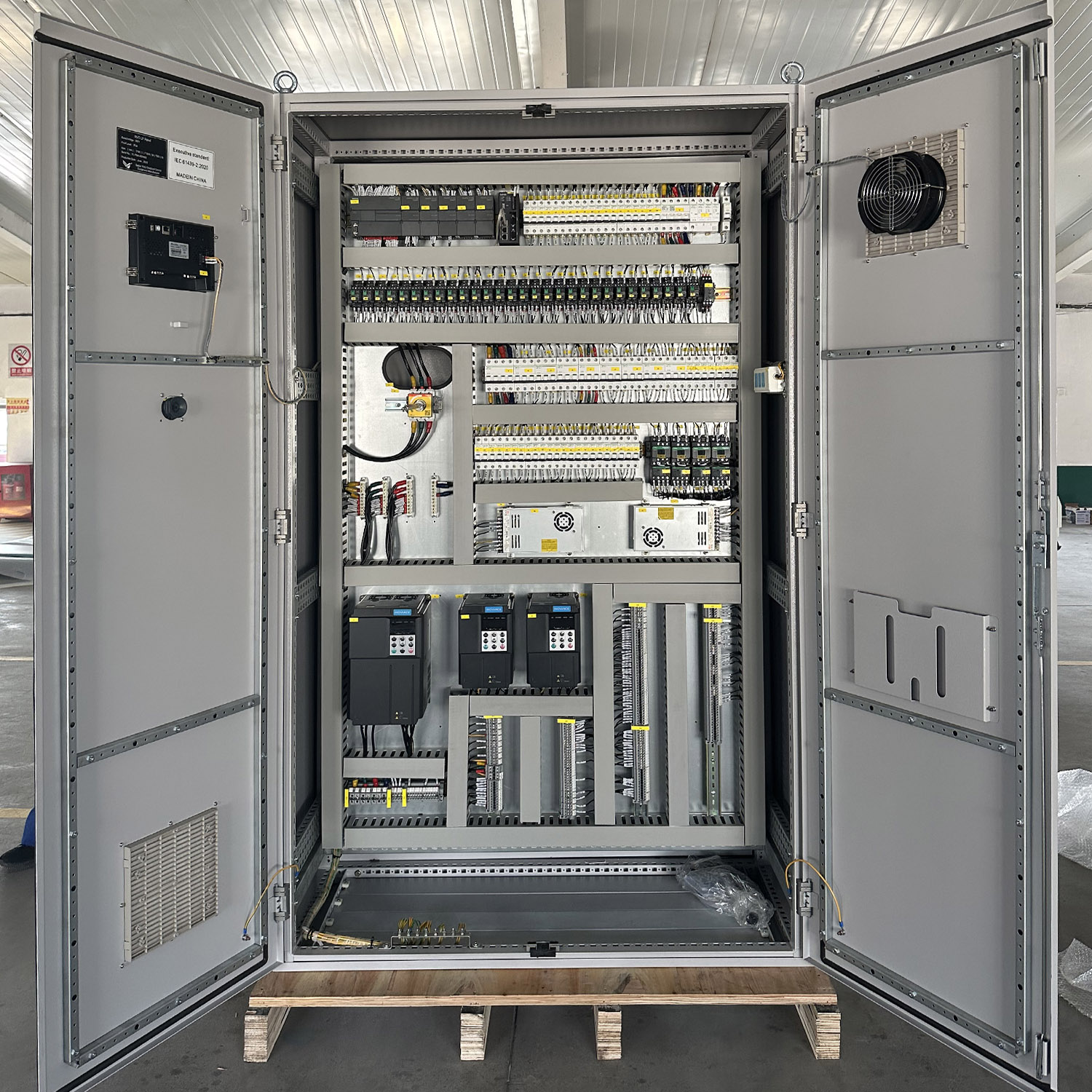
Low-voltage switchgear for 440V/50Hz distribution: the assembly must coordinate current rating, busbar condition, ingress protection and maintenance access.
Kenya's three-phase 440V distribution environment places specific demands on low-voltage switchgear. In hotels, schools, factories and large supermarkets, the distribution panel is not merely an enclosure around breakers; it is the point where continuous current, short-circuit withstand, busbar condition, heat, dust and maintenance access meet. For buyers in the research and evaluation stage, the practical question is how to source a 440V/50Hz assembly that fits the site, can integrate mainstream components and remains serviceable over time.
Key procurement facts at a glance
- The documented low-voltage switchgear supports AC 400V, 415V and 440V three-phase five-wire systems at 50Hz.
- Current ratings cover 630A, 800A and 1250A depending on configuration, with breaking capacity of 50kA or 65kA.
- The busbar is T2 copper with tin plating to resist oxidation.
- The enclosure is 2.5mm cold-rolled steel, RAL7035, IP55, with double doors, EPDM sealing and optional filtered axial fans.
- The product is documented as compatible with ABB, Schneider and Siemens components in Kenya; compatibility refers to integration, not brand endorsement.
Why 440V switchgear sourcing needs a separate evaluation
Low-voltage switchgear procurement often begins with a bill of quantities and a target price. That can be enough for a simple sub-distribution box, but it is weak for a 440V main distribution assembly serving a hotel, school, factory or large supermarket. The reason is that the switchgear carries the combined consequences of load growth, fault current, ambient heat, dust, humidity and maintenance access. A cabinet that looks adequate on a quotation sheet can become difficult to service if the busbar, thermal design or door access was not specified.
The opportunity is equally clear. Kenya's commercial and institutional projects continue to add loads such as HVAC, lighting, refrigeration, ICT equipment and motor-driven machinery. A documented low-voltage electrical distribution panel allows the project team to match continuous current, short-circuit rating, busbar material and enclosure protection to the actual site. That is a different exercise from buying a generic control panel enclosure.
In procurement language, the same asset may be described as low-voltage switchgear, a low-voltage electrical distribution panel or an electrical distribution panel. These terms overlap, but they should not be confused with a control panel. A control panel coordinates a process or machine; an electrical distribution panel distributes power to downstream circuits. A PLC control panel may sit downstream of the switchgear, but it does not replace the main distribution assembly.
Technical basis: matching the switchgear to a 440V/50Hz system
The documented low-voltage switchgear is designed for a three-phase five-wire system at AC 400V, 415V or 440V and 50Hz. That range matters in Kenya because project documentation and utility interfaces may refer to 415V or 440V, while the equipment has to be configured for the actual site condition. The buyer should confirm the supply voltage, frequency, earthing arrangement and neutral configuration before approving the assembly.
Current rating and breaking capacity should be read as two separate decisions. The 630A, 800A and 1250A figures describe continuous current capability depending on configuration. The 50kA or 65kA breaking capacity describes the assembly's ability to interrupt fault current. A switchgear selected only by continuous current, without a fault-level study, may be mechanically complete but commercially risky. The project engineer should provide the prospective short-circuit current and protection coordination requirements before the busbar and breaker selection is frozen.
The busbar is specified as T2 copper with tin plating. In a humid or dusty environment, bare copper surfaces can oxidise and develop contact resistance. Tin plating is an anti-oxidation measure that supports stable joints and long-term maintainability. It does not remove the need for correct torqueing, inspection and thermal checks during commissioning and service.
The enclosure is built from 2.5mm cold-rolled steel with phosphating and electrostatic powder coating in RAL7035 light gray. The double-door structure uses heavy-duty hinges and MS lever locks, with an EPDM rubber seal for tightness. Back and side heat dissipation louvers are provided, and optional industrial axial fans with filter mesh can be added to reduce dust ingress while improving airflow. Lifting eyes are reserved on top for factory lifting and site handling. The cabinet is fixed by foot bolts to a concrete floor to C20 standard.
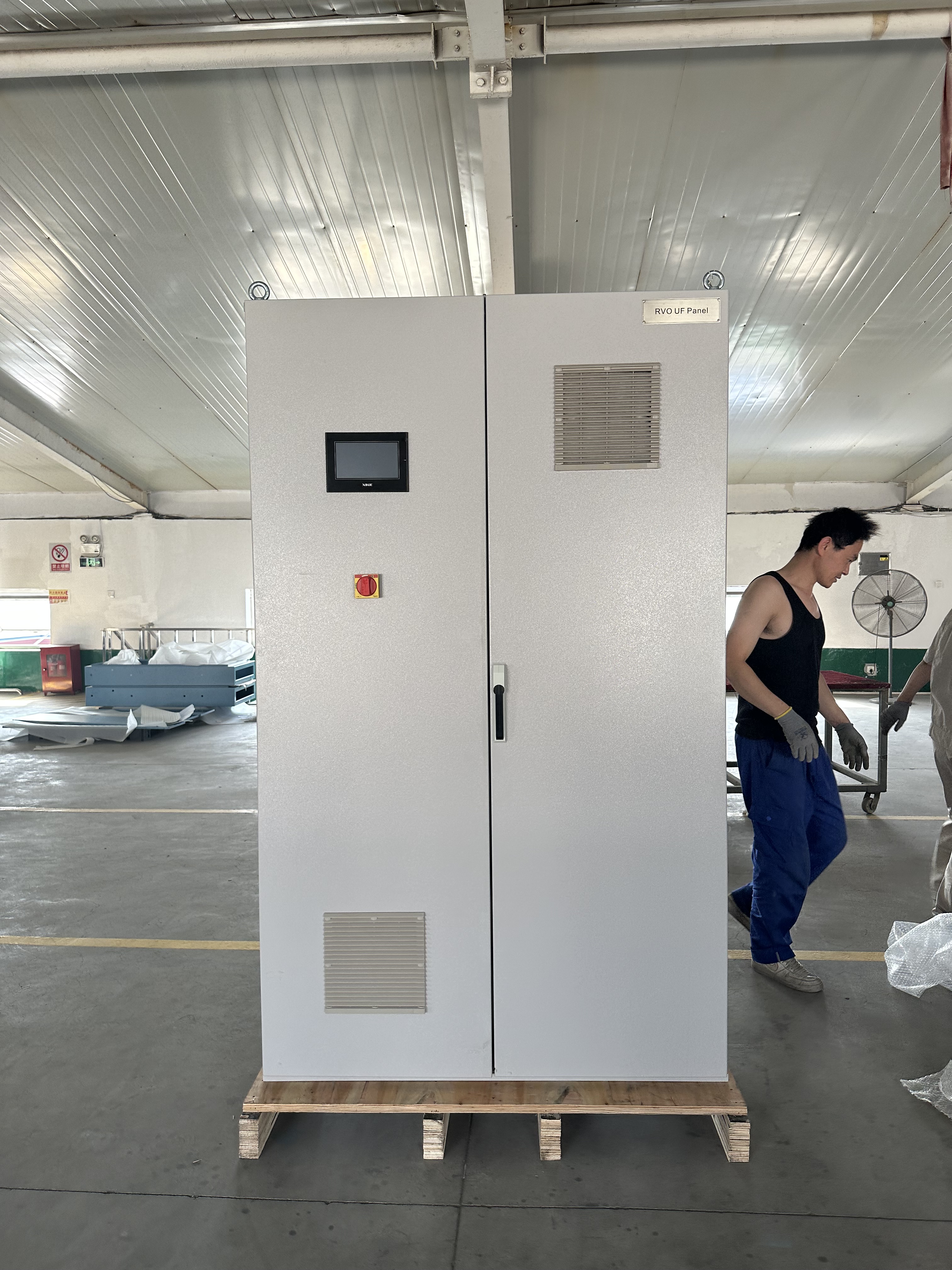
Double-door switchgear construction: the door sealing, busbar chamber and thermal path should be inspected together, not as separate purchasing line items.
Documented low-voltage switchgear parameters
| Parameter | Documented value | Procurement interpretation |
|---|---|---|
| Voltage | AC 400V / 415V / 440V, three-phase five-wire | Confirm site voltage and neutral/earthing arrangement before ordering. |
| Frequency | 50Hz | Matches the Kenyan grid frequency context stated in the product documentation. |
| Current rating | 630A / 800A / 1250A depending on configuration | Select from the load schedule and future capacity, not from the cabinet size alone. |
| Breaking capacity | 50kA / 65kA | Must be checked against the project fault level and protection coordination. |
| Busbar | T2 copper busbar with tin plating | Tin plating supports oxidation resistance in humid conditions. |
| Enclosure | 2.5mm cold-rolled steel, RAL7035, IP55 | IP55 addresses dust and water jets; it is not a submersion rating. |
| Door and sealing | Double doors, heavy-duty hinges, MS lever locks, EPDM rubber seal | Seal condition and door alignment become maintenance checkpoints. |
| Thermal design | Back and side louvers; optional axial fans with filter mesh | Filter cleaning must be part of the maintenance plan in dusty sites. |
| Ambient range | -5°C to +55°C; RH up to 95% non-condensing | The documentation notes Kenyan high temperature up to 45°C; verify local heat gain. |
| Altitude | Up to 2000m | Documented as covering most areas of Kenya; higher sites need engineering review. |
| Protection | Overload, short-circuit and leakage protection; RCD/RCBO optional; IEC 60439 referenced | Confirm the applicable standard edition and project specification. |
| Component compatibility | ABB, Schneider and Siemens components in Kenya | Compatibility means the assembly can integrate these components, not that it is a brand partnership. |
Sourcing criteria for 440V switchgear in Kenya
A distribution panel manufacturer should be evaluated on the information it can provide before shipment, not only on the enclosure finish. For a 440V system, the following criteria help separate a project-grade assembly from a price-led cabinet.
- Load schedule and diversity. Provide the connected load, demand factor, spare capacity and future expansion. A 630A assembly may suit a medium-sized facility, while 800A or 1250A may be more appropriate for larger factories or supermarkets. The final rating must follow the load calculation.
- Fault level and protection coordination. The 50kA or 65kA breaking capacity must be checked against the prospective fault current. Breaker selection, discrimination and cascading need to be reviewed together.
- Busbar and jointing. Confirm T2 copper with tin plating, joint preparation and torque values. Ask for the busbar inspection record and the method used to prevent loosening during transport.
- Thermal path. Review the heat load of breakers, cables and any future additions. The optional filtered axial fans are useful only if the filter maintenance plan is realistic for the site.
- Ingress and corrosion. IP55 is appropriate for dusty and hose-down-adjacent areas, but it is not a guarantee against prolonged water exposure. For coastal or highly humid sites, the cold-rolled steel and powder coating should be reviewed against the actual corrosion risk.
- Component ecosystem. The assembly is documented as compatible with ABB, Schneider and Siemens components in Kenya. Buyers should request the proposed breaker, metering, terminal and cable-entry schedule so that spare parts and future replacements remain practical.
- Documentation and certification scope. Ask for model-specific test records, wiring diagrams, torque records, protection settings and O&M instructions. Do not accept a certificate for a different cabinet model as automatic proof for the switchgear assembly.
- Access and handling. Check door opening, cable entry, lifting eyes, floor fixing and maintenance clearance. A floor-standing cabinet that cannot be safely inspected is a false economy.
Price band is often the least transparent part of the evaluation. No public price band is asserted here because the final cost depends on current rating, breaker selection, busbar, enclosure finish, component brand and logistics. Buyers should compare quotations on a like-for-like technical schedule, not on cabinet dimensions alone.
Certification note: Dalian Yinlu Electrical Control Equipment Manufacturer holds CE Verifications of Conformity from SGS-CSTC for specific control cabinet and control box models. Certificate IN-DL-5805-22013-1 covers the DLYL-ES-C electric control cabinet and certificate IN-DL-5805-22013-2 covers the DLYL-AE-B electric control box, both to EN 60529:1991+A1+A2 for the EU market. These are model-specific documents and should not be read as automatic certification of every low-voltage switchgear assembly. The switchgear documentation references IEC 60439; project teams should confirm whether the specification requires IEC 61439 and request the corresponding evidence.
Maintenance planning for switchgear in Kenyan conditions
Switchgear maintenance is not the same as wiping down a control panel enclosure. The assembly combines busbar joints, breaker mechanisms, cable terminations, seals, filters and thermal paths. In dusty, warm or humid conditions, each of these can degrade at a different rate. The maintenance plan should be based on the manufacturer's instructions, the site environment and the criticality of the load.
| Maintenance stage | Focus | Reason |
|---|---|---|
| Commissioning | Torque checks, insulation resistance, earthing continuity, door alignment, seal compression, protection settings | Establishes a baseline before load is applied. |
| First service after energisation | Thermal scan of busbar and terminations, inspection for loose connections, filter condition | Early thermal anomalies often appear after initial load cycles. |
| Periodic inspection | Clean louvers and filters, inspect EPDM seals, exercise breakers and RCD/RCBO where fitted, check cable glands | Dust and heat are the main practical stressors in many Kenyan sites. |
| Annual or planned review | Busbar inspection, torque verification, protection coordination review, spare parts check | Loads and site conditions change; settings can become outdated. |
| After a fault or trip | Inspection of breaker, busbar, cable terminations and any sign of overheating | A trip may be electrical, thermal or mechanical; resetting without inspection can repeat the fault. |
Thermal imaging is a practical diagnostic aid, but it should be supported by torque records and a visible inspection of joints. In humid conditions, anti-condensation measures and seal condition deserve attention. In dusty locations, clogged filter mesh can turn a thermal solution into a heat trap. The maintenance team should know which fans and filters were supplied and whether they are optional or essential for the installed load.
Spare parts planning is part of maintenance. If the switchgear integrates ABB, Schneider or Siemens components, the project file should record the exact component schedule so that replacements are not guessed later. A distribution panel manufacturer that can supply as-built drawings, terminal schedules and protection settings reduces the risk of a long outage caused by an unidentifiable part.
Application fit: hotels, schools, factories and large supermarkets
The documented switchgear is intended for high-power distribution and protection in hotels, schools, factories and large supermarkets. Each environment places a different emphasis on the same technical choices.
Hotels
Hotels combine guest-area lighting, HVAC, kitchen equipment, laundry loads, pumps and common-area services. The switchgear should be planned with clear separation of essential and non-essential circuits, accessible maintenance space and a thermal design that accounts for long operating hours. A 630A or 800A main assembly may be considered depending on the load schedule, but the final rating must follow the electrical design.
Schools
Schools often have a mix of classrooms, laboratories, ICT rooms, workshops and outdoor lighting. Loads may be seasonal and uneven. The enclosure should resist dust and occasional water jets, while the door layout should allow safe inspection without disrupting teaching areas. Protection against overload and leakage is particularly relevant where students and staff access equipment rooms.
Factories
Factories introduce motor loads, production lines, compressed-air systems, ventilation and maintenance workshops. The switchgear may feed PLC control panels, VFD cabinets and local distribution boards. In this setting, fault level, busbar strength, protection coordination and spare parts are more important than a low first cost. The 800A and 1250A ratings are relevant where the connected load and future expansion justify them.
Large supermarkets
Supermarkets combine refrigeration, lighting, HVAC and point-of-sale loads. Refrigeration is sensitive to supply interruptions and protection nuisance trips. The distribution panel should be specified with a clear circuit schedule, adequate neutral and earthing arrangements, and maintenance access that does not obstruct trading hours. The IP55 enclosure is useful for back-of-house areas, but it should not be treated as a substitute for correct room conditions.
Comparison with traditional price-led panel assembly
The traditional approach often starts with a sheet-metal enclosure and a breaker list, then adds a busbar to fit the remaining space. That can work for light-duty distribution, but it becomes fragile when the load grows, the fault level is higher than assumed, or the site is dusty and hot. A documented switchgear assembly takes the opposite sequence: fault level and load first, then busbar, breaker, thermal path, ingress protection, access and documentation.
| Evaluation area | Price-led panel assembly | Documented 440V switchgear |
|---|---|---|
| Design basis | Often driven by cabinet size and breaker fit | Driven by load schedule, fault level and protection coordination |
| Busbar | Material and plating may be unspecified | T2 copper with tin plating is documented |
| Current and breaking capacity | May be stated without a clear configuration basis | 630A/800A/1250A and 50kA/65kA are stated as configuration-dependent |
| Thermal design | Louvers or fans added after the layout | Back and side louvers, optional filtered axial fans |
| Ingress protection | May be claimed without a maintenance plan for seals and filters | IP55 with EPDM seal and documented ambient limits |
| Documentation | Wiring diagram may be minimal | Model-specific records, drawings and protection settings should be requested |
Boundaries and limitations
The documented switchgear has clear boundaries. IP55 protects against dust and water jets, not prolonged immersion. The ambient range is -5°C to +55°C with relative humidity up to 95% non-condensing; condensing conditions require an engineering review. The altitude limit is 2000m, which covers most areas of Kenya but not every highland site. The enclosure is cold-rolled steel with a powder coating; coastal salt-spray exposure should be assessed rather than assumed to be solved by the standard finish. The product documentation also references IEC 60439, while some current project specifications may call for IEC 61439 evidence. Finally, the assembly requires qualified installation, correct cable termination and protection coordination; it is not a plug-and-play substitute for electrical design.
Market trend analysis: what the global data suggests for buyers
The global electrical control panel market is estimated at USD 60.4 billion in 2026 and is projected to reach USD 98.6 billion by 2036, growing at a CAGR of 5.0%, according to Research and Markets. Custom Market Insights places Asia Pacific as the largest regional market, with 38.9% revenue share in 2026. Within the wider category, low-voltage distribution panels are projected to grow from USD 1.8 billion in 2026 to USD 2.9 billion by 2035 at a CAGR of 5.9%, also according to Custom Market Insights. These figures cover different scopes and should not be added together, but they point to a simple procurement reality: low-voltage distribution remains a large, competitive and technically segmented category.
For Kenyan buyers, the supply-chain implication is not simply to buy from the largest region. It is to ask for clearer evidence. When supply is globally competitive, documentation becomes a differentiator: busbar material, current rating, breaking capacity, ingress protection, ambient limits and component compatibility should be visible in the offer. UL Solutions notes that UL 508A is the benchmark for industrial control panels in North America, while IEC 61439 is the international standard. That distinction matters when a project mixes Kenyan site requirements, European component brands and Asian manufacturing. The buyer should confirm which standard framework the project specification actually requires, then request evidence against that framework rather than accepting a generic certificate.
Where Yinlu's low-voltage switchgear fits
Dalian Yinlu Electrical Control Equipment Manufacturer is a China-based supplier of sheet metal fabrication, enclosures, electrical control cabinets, intelligent control boxes and electrical distribution equipment. Its documented low-voltage switchgear product is a customizable power distribution cabinet for the Kenyan and East African market, with the 440V/50Hz compatibility, 630A/800A/1250A ratings, T2 copper tin-plated busbar and IP55 enclosure described above.
The product is positioned for high-power distribution in hotels, schools, factories and large supermarkets. Its enclosure uses 2.5mm cold-rolled steel, RAL7035 powder coating, double doors, EPDM sealing, heat dissipation louvers and optional filtered axial fans. The assembly is documented as compatible with ABB, Schneider and Siemens components in Kenya, which is useful for projects that standardise on those component ecosystems. That statement should be read as integration compatibility, not as a claim of partnership or brand endorsement.
On the manufacturing side, Yinlu documents OEM/ODM capability with customization of material, color, logo, size, IP rating, surface treatment and cutouts. Its stated monthly capacity is 2,000 units, with MOQ of 1 to 5 units and quality-control steps covering visual, wiring, function, safety, sealing and packaging. After-sales support is documented as 7×24 online support with a one-year warranty. The wider company export record covers North America, Europe, Australia and Japan; the Kenya-specific switchgear should therefore be evaluated on its own project documentation, not on general export claims alone.
For a procurement team, the most useful way to assess Yinlu is to request a project-specific package: single-line diagram, load schedule, busbar and breaker schedule, IP55 seal detail, thermal calculation or fan selection basis, protection settings, packing and lifting plan, and model-specific certification evidence. The CE documents for the DLYL-ES-C and DLYL-AE-B control cabinet models show that the manufacturer works with SGS-CSTC verification to EN 60529, but they do not replace the switchgear assembly documentation.
Future outlook: documentation, heat and serviceability
The next phase of low-voltage switchgear sourcing in Kenya is likely to be less about cabinet appearance and more about evidence. As loads become denser and projects add HVAC, refrigeration, ICT and motor-driven equipment, the distribution panel has to be selected with a clearer thermal and fault-current basis. Buyers will increasingly ask for as-built drawings, protection settings, busbar inspection records and spare-parts schedules because these reduce downtime and make maintenance less dependent on guesswork.
Ingress protection will also be read more carefully. IP55 is a useful baseline for dusty and water-jet-adjacent areas, but it does not answer every coastal, washdown or condensation problem. The practical direction is to match the enclosure, material and thermal strategy to the room, not to rely on a single IP number. The same logic applies to component compatibility: ABB, Schneider and Siemens compatibility is valuable when the project already standardises on those components, but it should be supported by a clear component schedule.
Finally, the distinction between switchgear and control panels will remain important. A low-voltage distribution panel is part of the power path; a control panel is part of the process path. Projects that keep those roles separate tend to produce clearer specifications, safer maintenance and more predictable spare-parts planning.
FAQ: sourcing and maintaining 440V switchgear in Kenya
What voltage and frequency should a low-voltage switchgear for Kenya be specified for?
The documented low-voltage switchgear supports AC 400V, 415V and 440V in a three-phase five-wire system at 50Hz. Buyers should confirm the actual site voltage, frequency, neutral arrangement and earthing before approving the assembly, because project documentation may use 415V or 440V terminology while the equipment must match the installed supply.
Which current ratings are available for high-power distribution?
The documented ratings are 630A, 800A and 1250A depending on configuration. These are continuous current ratings and should not be used as a substitute for a load schedule or fault-level study. The breaking capacity is stated as 50kA or 65kA, which is a separate short-circuit performance characteristic.
Why does the busbar specification matter in Kenya?
The busbar is T2 copper with tin plating, which is an anti-oxidation measure. In warm and humid conditions, oxidation at joints can raise contact resistance. Tin plating supports stable joints, but it does not replace correct torqueing, thermal inspection and periodic maintenance.
Is the switchgear compatible with ABB, Schneider and Siemens components?
The product documentation states compatibility with mainstream brands such as ABB, Schneider and Siemens in Kenya. This means the assembly can be configured to integrate those components. It does not mean the switchgear is manufactured by those brands or that a formal partnership is implied; the exact component schedule should be confirmed in the quotation.
What does IP55 mean for a Kenyan installation?
IP55 indicates protection against dust and water jets. It is useful for many indoor and semi-protected distribution rooms, but it is not a submersion rating. Coastal salt spray, condensation and washdown areas require a separate review of material, sealing and maintenance practice.
What ambient conditions are documented?
The switchgear is documented for -5°C to +55°C, relative humidity up to 95% non-condensing, and altitude up to 2000m. The product documentation notes Kenyan high-temperature conditions up to 45°C. Sites above the altitude limit or with condensing humidity need an engineering review.
Do the CE certificates for Yinlu control cabinets apply to this switchgear?
No, not automatically. The CE Verifications of Conformity IN-DL-5805-22013-1 and IN-DL-5805-22013-2 from SGS-CSTC cover the DLYL-ES-C electric control cabinet and DLYL-AE-B electric control box to EN 60529:1991+A1+A2 for the EU market. They are model-specific. The low-voltage switchgear should be assessed on its own documentation, and buyers should confirm the applicable standard and evidence for the exact assembly being supplied.
How should maintenance be planned?
Maintenance should cover torque checks, insulation resistance, earthing continuity, door and seal condition, filter and louver cleaning, breaker exercise and thermal inspection of busbar joints and terminations. The exact intervals should follow the manufacturer's instructions and the site conditions. After a trip or fault, the assembly should be inspected before re-energisation rather than simply reset.
Technical reference and further reading
Market data references: Research and Markets, Global Electrical Control Panels Market Size reached US$60.4 Billion in 2026, 2026; Custom Market Insights, Global Electrical Control Panel Market Size, Share 2026-2035, 2026; UL Solutions, UL 508A vs IEC 61439: A Comprehensive Comparison for Panel Builders, 2026. Product and certification facts are drawn from Dalian Yinlu Electrical Control Equipment Manufacturer documentation for the Low-voltage Switchgear / Power Distribution Cabinet and related control cabinet certificates.
Product brochure: Dalian Yinlu product brochure (PDF).
Have Questions or Need More Details?
Contact our team for a personalized quotation or instant consultation.
Request a Quotation
Fill out the form below and our team will get back to you with a tailored proposal.
WhatsApp Direct Chat
Prefer to chat in real-time? Message us on WhatsApp for instant assistance & quick answers.
- Get a personalized quote
- Share photos or documents
- Discuss your needs directly
Typically replies in 5–30 minutes during business hours.