
4D Massage Chair Compliance Matrix: ETL, CE, FDA, ISO Scope
4D Massage Chair Compliance Matrix: ETL, CE, FDA, ISO Scope
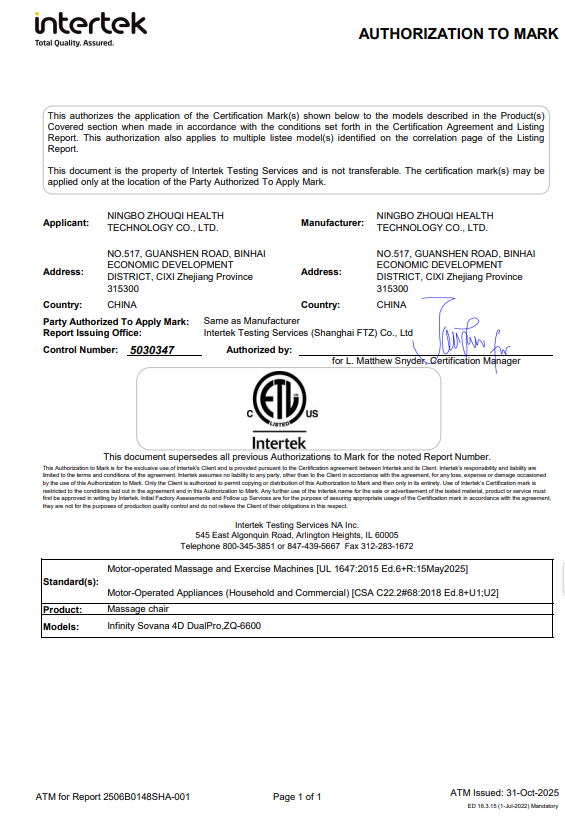
A 4D massage chair quotation usually arrives with four or five documents attached, and a buyer who reads them as four versions of the same proof will misjudge what has actually been demonstrated. ETL certificate 5030347 from INTERTEK covers electrical safety for the United States and Canada against UL 1647:2015 Ed.6+R:15May2025 and CSA C22.2#68:2018 Ed.8+U1;U2. CE file ENB2311240186E00201C from EMTEK records European Union compliance with a standard set led by EN IEC 55014-1:2021 and EN IEC 61000-3-2:2019/A1:2021. The United States record 3017618816 cites 21 CFR 807.39. ISO 13485:2016 certificate 133640 from NQA and ISO 9001 certificate 02424Q32202999R1S describe management systems at the manufacturer rather than a single chair.
Read as a matrix rather than a badge collection, those records answer a procurement question that neither a specification sheet nor a factory visit settles: for this exact model, in this exact destination market, under this exact standard, issued by this exact body, is the evidence current and inside its stated scope? That question is the subject of this article. It does not argue that any one certificate is stronger than another; it sets out how to read each of them without collapsing their different legal and technical functions.
Why four certificates are not four versions of the same proof
The documents attached to a massage chair offer sit at different layers, and each layer proves something narrower than the word 'certified' suggests. A product safety certificate such as the ETL record tests a product type against an appliance safety standard. A CE file records conformity with a named list of harmonised-type standards, which in this case are electromagnetic compatibility standards. A United States record citing 21 CFR 807.39 belongs to a regulatory registration and listing framework, not to a product safety test. ISO 9001 and ISO 13485 certificates attest to a quality management system operating at a manufacturer, not to the performance of an individual unit.
Importers run into trouble at the seams between those layers. A certificate may be genuine, current and well known, and still be unusable for a particular purchase because the scope names a product range rather than the ordered model, because the market field excludes the destination country, or because the standard string has been abbreviated until the edition number and revision date disappear.
The four fields that decide whether a certificate is usable
Every record in the matrix below can be checked with the same four questions, plus a fifth that tells the reader whether the document is still alive. Applied consistently, the method removes the ambiguity that turns a compliance discussion into a comparison of logos.
- Market. Which countries or regions does the record name? 'International certification' is not a market. A US and Canada entry, an EU entry, or a list of US, South Korea and South-East Asia are each different in effect.
- Standard. Which exact designation, including edition, revision and any amendment or update suffix? 'UL 1647' and 'UL 1647:2015 Ed.6+R:15May2025' are not the same statement, because the second fixes a version and the first does not.
- Issuing body. Which organisation issued the certificate, and whose name appears as certificate holder? The second half of that question matters when an OEM produces for several brands.
- Product scope. Does the scope text name a product category, a product range, or identifiable models? A category such as 'massage chairs' or a range such as 'intelligent massagers' requires a separate link to the SKU being shipped.
- Record dates. Issue date and expiry date, read against the delivery schedule rather than against the day the file was received.
The 4D Massage Chair compliance matrix
The table consolidates the five records as they appear in the manufacturer's certification documentation for the 4D Massage Chair series. Nothing has been rounded, paraphrased into a shorter standard name, or merged across markets.
| Certificate | Market | Standard or reference | Issuing body | Record number | Scope and dates |
|---|---|---|---|---|---|
| ETL | US, Canada | UL 1647:2015 Ed.6+R:15May2025; CSA C22.2#68:2018 Ed.8+U1;U2 | INTERTEK | 5030347 | Massage chairs; issued 31 October 2025 |
| CE | EU | EN IEC 61000-3-2:2019/A1:2021; EN IEC 55014-1:2021; record also lists EN 61000-3-3:2013/A2:2021/AC:2022-01 and EN IEC 55014-2:2021 | EMTEK | ENB2311240186E00201C | Massage chairs; issued 20 December 2023 |
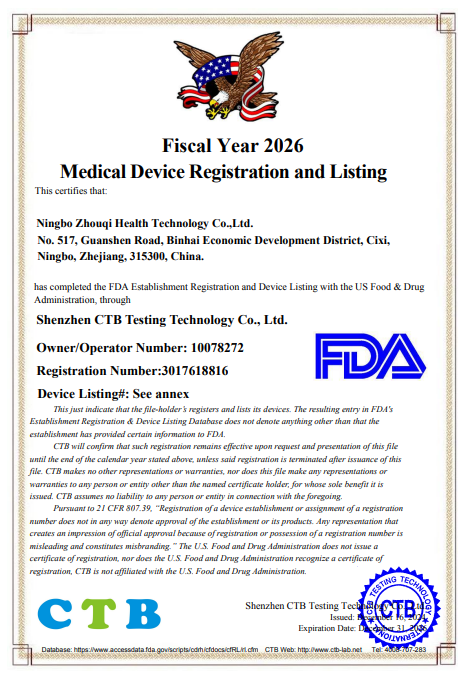
| FDA | US | 21 CFR 807.39 | Shenzhen CTB Testing Technology Co., Ltd. | 3017618816 | 3D and 4D massage chairs; issued 16 December 2024; record expiry 31 December 2026 |
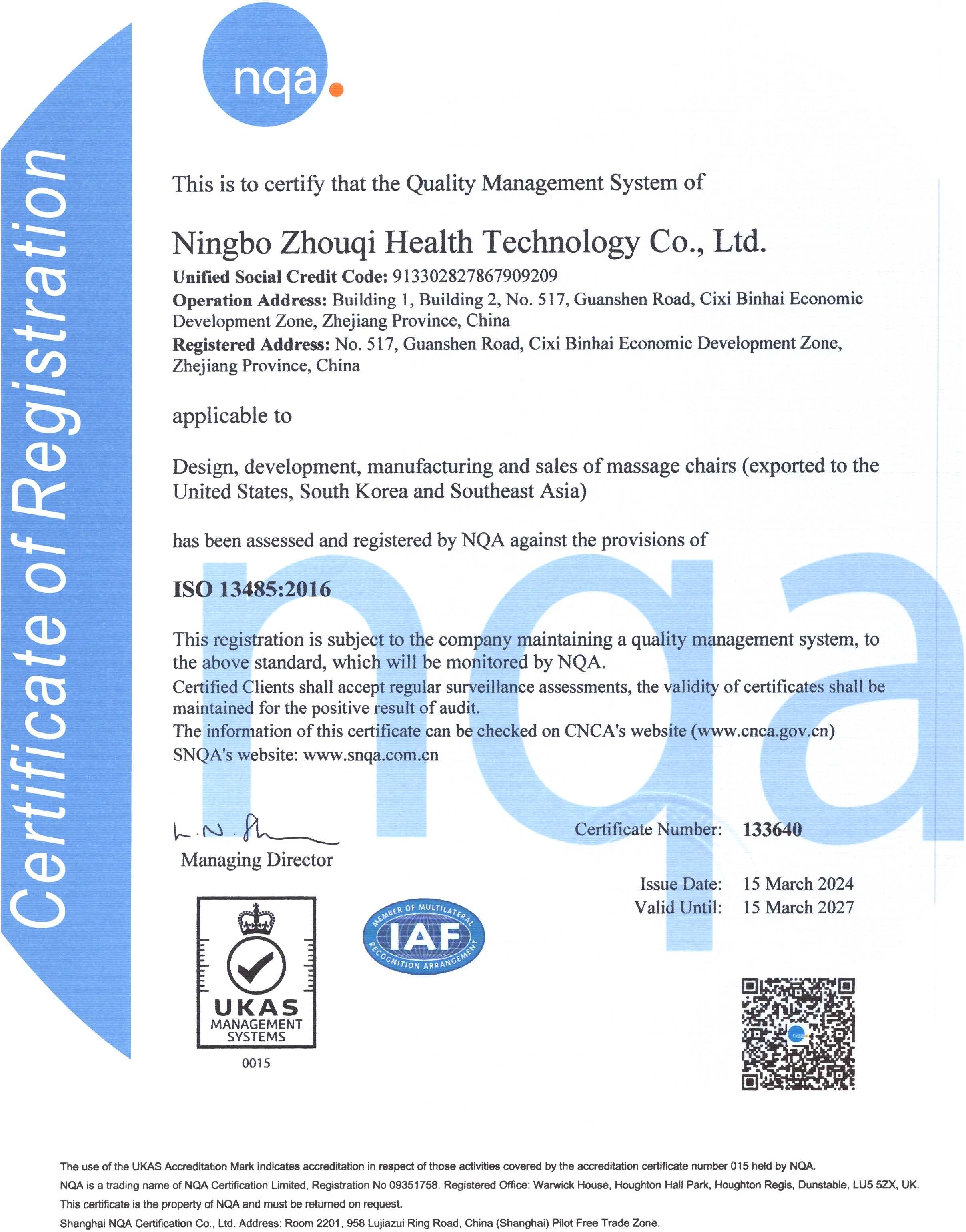
| ISO 13485 | US, South Korea, SE Asia | ISO 13485:2016 | NQA | 133640 | Massage chairs; issued 15 March 2024; valid to 15 March 2027 |
| ISO 9001 | EU, Middle East, SE Asia, US | GB/T19001-2016/ISO9001:2015 | SHENZHEN UNIVERSAL CERTIFICATION CENTRE CO., LTD. | 02424Q32202999R1S | Intelligent massagers, product range; issued 9 December 2021; valid to 2 December 2027 |
ETL 5030347: reading the US and Canada record
ETL certificate 5030347 is the record that matters for a chair entering the United States or Canada. It is issued by INTERTEK, covers massage chairs, and cites two standards rather than one, because the two markets sit under different frameworks: UL 1647:2015 Ed.6+R:15May2025 for the United States and CSA C22.2#68:2018 Ed.8+U1;U2 for Canada. A buyer who accepts 'ETL approved' as a phrase, without the number and the standard string, has no way to tell whether the record covers one market or two.
The suffixes are worth reading rather than skimming. 'Ed.6' fixes the edition of UL 1647, 'R:15May2025' adds a revision dated 15 May 2025, and 'U1;U2' records update designations attached to the CSA standard. The practical consequence is that a truncated claim of 'UL 1647' does not identify which version was tested, and standards move. The revision date carried in this record is itself evidence that the current version of the standard is not the edition that circulated several years ago.
The scope statement on the record reads 'massage chairs', which is a category description. That is normal for a product safety certificate covering a manufacturer's programme, but it means the buyer still has to bridge category to SKU. The bridge is the model list and the electrical configuration: the 4D Massage Chair series in this programme is offered at 110V–240V, 50/60Hz with a rated power of 200W, and the shipped unit must be built for the destination voltage and plug standard. A certificate that covers the product type does not by itself confirm that a particular 110V build was the configuration assessed.
CE ENB2311240186E00201C: what the EU file actually evidences
CE certificate ENB2311240186E00201C is issued by EMTEK and applies to the EU market. Its standard list is the part buyers most often misread. EN IEC 55014-1:2021 governs emission requirements for household appliances and similar equipment; EN IEC 55014-2:2021, also listed on the record, governs immunity; EN IEC 61000-3-2:2019/A1:2021 covers harmonic current emissions; and EN 61000-3-3:2013/A2:2021/AC:2022-01 covers voltage fluctuations and flicker. All four are electromagnetic compatibility standards. None of them is a massage chair product safety standard in the way UL 1647 is.
That is not a defect in the file; it is a description of what the file evidences. A European buyer looking at this CE record can reasonably conclude that electromagnetic compatibility for the listed products was assessed against the named standards by an identified body. What the record does not do is answer every product-safety question an EU distributor, insurer or retail chain may raise, because those questions are governed by other documentation. Two requests close that gap: the EU declaration of conformity accompanying the shipment, and confirmation of which economic operator is responsible for it.
One more scope point deserves attention. The certification record's market field names the EU, and also lists the Middle East and South-East Asia. CE is a European marking, so a buyer shipping to the other listed regions should ask which document is being relied on there rather than assuming the EU file transfers unchanged. The question costs one email and prevents a category error in a tender response.
FDA record 3017618816 and the 21 CFR 807.39 reference
The United States record 3017618816, issued by Shenzhen CTB Testing Technology Co., Ltd., cites 21 CFR 807.39 and covers both the 3D and the 4D Massage Chair lines. It is a separate document from the ETL file and should stay separate in a buyer's mind: the ETL record speaks to electrical safety for US and Canadian markets, while this record speaks to a United States regulatory reference point. Treating the two as substitutes, or as duplicates, misreads both.
The dates on this record are the most time-sensitive item in the matrix. It was issued on 16 December 2024 and the record carries an expiry of 31 December 2026. For an article published in late November 2026, that is roughly five weeks away. A buyer placing a 2027 programme should therefore ask for the renewed record before the purchase order, not after the production slot is booked, and should confirm with the seller exactly what the record covers rather than inferring scope from the regulation number alone.
United States market entry also involves customs classification, which is a different question again. The U.S. Customs and Border Protection ruling NY N313795 classifies massage chairs under HTSUS 9019.10.2045. Tariff classification determines duty treatment; it is not a conformity assessment, and a certificate pack should not be expected to answer it.
ISO 13485:2016 certificate 133640: the management-system layer
ISO 13485:2016 certificate 133640 is issued by NQA and covers massage chairs for the US, South Korea and South-East Asia markets, with an issue date of 15 March 2024 and validity to 15 March 2027. As a management-system certificate it describes the quality system under which products are designed and manufactured; it does not certify an individual chair, and it cannot be used to argue that a specific unit meets a particular performance level.
The market field is where this record earns its place in a procurement file. A buyer in South Korea or South-East Asia running a senior-care, wellness-centre or hospitality project often needs a quality-system reference in addition to a product certificate; a buyer in a market not named on the record should ask what applies instead rather than generalise from a certificate issued for other destinations.
ISO 9001 certificate 02424Q32202999R1S: range-level scope versus model-level proof
ISO 9001 certificate 02424Q32202999R1S is issued by SHENZHEN UNIVERSAL CERTIFICATION CENTRE CO., LTD. under GB/T19001-2016/ISO9001:2015, and it is the clearest example in the matrix of a range-level document. Its scope reads 'intelligent massagers' — a product range that includes the 3D Massage Chair and the 4D Massage Chair — and its market field lists the EU, the Middle East, South-East Asia and the US. It was issued on 9 December 2021 and is valid to 2 December 2027.
Range-level scope is not a weakness; it is the normal shape of a quality-system certificate, because a management system is certified once for the products a plant makes rather than once per model code. The consequence for buyers is procedural. A range-level certificate should be paired with the model list and the shipment configuration before anyone writes 'ISO 9001 certified model' into a tender response. The 4D series in this programme runs across a long model list, from 6510, 5300, 5380, 8620, 6920, 8600, 3900 and 3910 through to 9100, 8520, 6540, 6600, 7100 and 8710; a range statement covers the family, and a model-level claim requires the additional documentation request described later in this article.
The five records also differ in vintage: the ISO 9001 certificate dates from 2021, the CE file from 2023, the ISO 13485 and FDA records from 2024, and the ETL record from 2025. A mixed-vintage pack is normal in manufacturing. It becomes a problem only when a buyer applies a single currency check to the whole folder instead of checking each record against its own dates.
What the matrix does not establish
The matrix answers scope, market, standard and validity questions. It does not answer several things a procurement team may assume it does. It does not establish massage performance, roller force, noise level, durability under commercial traffic, upholstery wear, or the outcome a hotel guest or a clinic visitor will experience. Those are performance questions, and they require test reports, sample evaluation or field evidence rather than certificates.
It also does not constitute an independent inspection of the certificate documents themselves. The figures above are taken from the manufacturer's certification records and are reproduced here as recorded; confirming that a certificate number is live and belongs to the named holder is a step the buyer performs with the issuing body, and the sequence below treats it as a distinct step rather than an assumption.
A third boundary concerns feature claims. The 4D Massage Chair specification includes automatic body-shape detection, a 130 cm flexible SL track, a 4D massage manipulator, zero-gravity recline, foot and waist heating, 24 automatic programmes and AI health detection. Those are product features. None of the records above establishes AI health detection as a diagnostic or medical function, and a buyer should keep feature language and conformity language in separate sections of the evaluation file.
Matching the matrix to market and application
Application and market usually decide which record becomes decisive. A United States hotel, resort or 4S showroom installation puts the ETL record first, because the chair will be inspected in a commercial setting in the US or Canada; the FDA record then sits alongside it for the US regulatory reference, and the customs classification applies at the border. A European retail or wellness deployment puts the CE file and the declaration of conformity first, with the EMC standard list read for what it does and does not cover. A South Korean or South-East Asian senior-care or wellness project often looks for the ISO 13485 market scope in addition to the product record, because institutional buyers there frequently ask for a quality-system reference.
Middle East buyers will find the region inside the ISO 9001 market list and inside the CE record's additional market field, which makes the earlier question about which document is relied on locally the practical starting point rather than an afterthought.
The electrical and installation envelope deserves the same discipline. The 4D Massage Chair programme is rated at 110V–240V, 50/60Hz, 200W, with a 15-minute auto timer, a net weight of 103 kg and a gross weight of 118 kg. The application guidance attached to the product is explicit that the chair must use a socket matching its plug, that improper grounding may lead to electric shock, and that the device should not be modified without authorisation. Those are installation instructions, not certification claims, and a certificate pack should never be read as removing them.
A verification sequence buyers can run before the purchase order
The following sequence converts the matrix into an auditable file. It is deliberately document-based, so it can be completed before any deposit is paid.
- Request the certificate PDFs, not screenshots or brochure extracts, and record the certificate number, issuing body and holder name exactly as printed.
- Match each record to the destination market. Confirm that the market field names the country or region of the shipment, and treat regional lists cautiously where the underlying framework is market-specific.
- Copy the full standard string into the file, including edition, revision date and update suffixes, and refuse abbreviated versions in supplier declarations.
- Match the scope statement to the ordered model. Where the scope is a category or range, add the model list and the shipment configuration to the file as the bridge.
- Check the dates against the delivery schedule, not against today. The FDA record's 31 December 2026 expiry is the clearest illustration of why this step is separate.
- Verify each certificate number with the issuing body where a public verification route exists, and confirm the certificate holder matches the contracting seller.
- Request the model-level documentation your own quality system requires, such as a test report for the specific build, the declaration of conformity for the EU, or the packaging and installation documents for a commercial site.
- Write renewal and documentation duties into the contract, so that an expiring record becomes a scheduled supplier obligation rather than a discovery at port.
For reference, the manufacturer behind this certification set is Ningbo Zhouqi Health Technology Co., Ltd., which operates a 130,000 ㎡ facility with 450 employees, 34 engineers, an annual output of 200,000 units and a monthly capacity of 16,000 units, and which describes its service model as OEM and ODM with a 30–45 day lead time and 100% QC testing. The 2026 product catalogue is also available for download for buyers who want the model list beside the certificate matrix.
Outlook: certificate management is becoming a scheduled routine
Two signals in this matrix point the same way. First, standards move: the UL 1647 citation carries a revision dated 15 May 2025, which means the edition a buyer sees in an older file is not automatically the edition in force today. Second, records expire on different clocks, from the FDA entry at the end of 2026 to the ISO certificates running into 2027. Together they suggest that compliance will be managed increasingly as a calendar and a document trail rather than as a one-off badge collected at first order.
The commercial context reinforces the point without explaining it away. IMARC Group reports the global massage chair market at USD 4.1 billion in 2025, projected to reach USD 6.3 billion by 2034; published forecasts for the category vary with scope and methodology, so the figure is best read as an order of magnitude rather than a precise trajectory. What matters for compliance work is narrower: as more chairs move through hospitality, senior-care and retail channels, the number of parties asking to see a certificate — and the number able to check it — rises.
For buyers, the durable position is straightforward. Treat every certificate as a scoped record with four fields and two dates. Match it to the model and the market. Then let the supplier's documentation prove the rest.
FAQ
Does ETL certification for a 4D massage chair cover Canada as well as the United States?
For this programme, yes. ETL certificate 5030347, issued by INTERTEK, applies to the US and Canada markets and cites UL 1647:2015 Ed.6+R:15May2025 for the United States together with CSA C22.2#68:2018 Ed.8+U1;U2 for Canada. A buyer should confirm that both the certificate number and the full standard string appear on the document, because a general reference to 'ETL' does not show which markets or which standard version were assessed.
Is CE certification the same thing as an EU declaration of conformity?
No. CE file ENB2311240186E00201C from EMTEK records conformity with a named standard set — EN IEC 61000-3-2:2019/A1:2021, EN IEC 55014-1:2021, EN 61000-3-3:2013/A2:2021/AC:2022-01 and EN IEC 55014-2:2021 — and those are electromagnetic compatibility standards. The declaration of conformity is a separate document, and a European buyer should request it and identify which economic operator is responsible for it, rather than treating the certificate as the complete EU file.
Which matters more for a 4D massage chair, ISO 9001 or ISO 13485?
They answer different questions, so 'more important' is the wrong frame. ISO 9001 certificate 02424Q32202999R1S covers the product range described as intelligent massagers under GB/T19001-2016/ISO9001:2015, valid to 2 December 2027. ISO 13485:2016 certificate 133640 from NQA covers massage chairs with a market scope of the US, South Korea and South-East Asia, valid to 15 March 2027. A buyer selects whichever matches the requirement in front of them; institutional and senior-care buyers often ask for both.
How do I confirm a certificate covers the exact 4D massage chair model I am ordering?
Start with the scope statement. Where it names a category such as massage chairs or a range such as intelligent massagers, add the model list and the shipment configuration to the file as the bridge, and request the model-level test report or technical document your own quality process requires. The 4D Massage Chair series in this programme spans models from 6510, 5300, 5380, 8620, 6920, 8600, 3900 and 3910 to 9100, 8520, 6540, 6600, 7100 and 8710, so the model code should be named explicitly in the order documentation.
Why does the FDA record's expiry date matter for orders delivered in 2027?
Because the record 3017618816, issued by Shenzhen CTB Testing Technology Co., Ltd. under 21 CFR 807.39, carries an expiry of 31 December 2026. Any programme shipping after that date should have the renewed record on file before the purchase order is placed, and the buyer should also confirm what the record covers rather than inferring its scope from the regulation number alone.
Do the certificates replace the installation requirements?
No. The product guidance states that the chair must use a socket matching its plug, that improper grounding may lead to electric shock, and that the device should not be modified without authorisation. At 200W rated power and 110V–240V, 50/60Hz input, the electrical interface is a site-planning matter for hotels, showrooms and clinics, and conformity documentation does not remove those conditions.
Have Questions or Need More Details?
Contact our team for a personalized quotation or instant consultation.
Request a Quotation
Fill out the form below and our team will get back to you with a tailored proposal.
WhatsApp Direct Chat
Prefer to chat in real-time? Message us on WhatsApp for instant assistance & quick answers.
- Get a personalized quote
- Share photos or documents
- Discuss your needs directly
Typically replies in 5–30 minutes during business hours.