
4D Massage Chair Supplier Evidence: Certificates & Criteria
4D Massage Chair Supplier Evidence: Certificates & Criteria
A 4D massage chair supplier's capability is not established by the word 4D, and not by a page of certificate thumbnails. It is established by a document set an importer can check line by line: the issuing body, the certificate number, the standard edition cited, the scope recorded, the models covered, and the dates the document runs from and to. Once those attributes are visible, the same document set can be converted into acceptance criteria attached to a purchase order, which is the point at which supplier qualification stops being an opinion.
This article works through that conversion using the documentation held for the 4D massage chair range produced by Ningbo Zhouqi Health Technology Co., Ltd. (ZHOUQI), a massage chair manufacturer founded in 2008 and based in Cixi, Zhejiang Province, China. The company operates a 130,000 ㎡ factory with 450 employees, a 34-engineer R&D team and a recorded annual output of 200,000 units.
The scope is deliberately narrow. Five compliance records and one deployment record are mapped onto the models those records list — 6510, 5300, 5380, 8620, 6920, 8600, 3900, 3910, 9100, 8520, 6540, 6600, 7100 and 8710 — and then translated into checkpoints a buyer can hold a supplier to.
Three tiers of supplier evidence — and why they are not interchangeable
Procurement teams routinely receive three kinds of capability information in the same conversation, and most of the risk sits in treating them as equivalent.
Tier one is a company statement. Holding ETL, CE, FDA and ISO is a sentence. It carries no issuer, no number, no scope and no validity window, so it cannot be checked at source and cannot be enforced in a contract.
Tier two is a third-party record. A certificate number issued by a named body against a named standard edition, with a recorded scope and validity period, is verifiable independently. This is the tier that belongs in a supplier file.
Tier three is a deployment record. Shipment volumes over a stated period in a stated market answer a different question: not whether the design was assessed, but whether it has been produced and shipped repeatedly into a market where it had to clear import requirements.
None of the three substitutes for another. A certificate does not prove repeat supply; a shipment total does not prove type-test compliance; a company claim proves only that the claim was made. A workable qualification file holds all three and keeps them labelled separately, because each one is checked by a different person and at a different stage of the purchase.
The document set behind a 4D massage chair
Five records form the compliance layer for this range. Read across each row, the record answers four questions: issued by whom, against which standard edition, covering what and which markets, and valid when.
| Document | Number and issuing body | Standard cited | Scope and markets recorded | Dates recorded |
|---|---|---|---|---|
| ETL | 5030347 — INTERTEK | UL 1647:2015 Ed.6+R:15May2025; CSA C22.2#68:2018 Ed.8+U1;U2 | Massage chairs; US and Canada | Issued 31 October 2025 |
| CE (EMC) | ENB2311240186E00201C — EMTEK | EN IEC 55014-1:2021; EN IEC 61000-3-2:2019/A1:2021; EN 61000-3-3:2013/A2:2021/AC:2022-01; EN IEC 55014-2:2021 | Massage chairs; EU, Middle East, Southeast Asia | Issued 20 December 2023 |
| ISO 9001 | 02424Q32202999R1S — SHENZHEN UNIVERSAL CERTIFICATION CENTRE CO., LTD. | GB/T19001-2016/ISO9001:2015 | Intelligent massagers; EU, Middle East, Southeast Asia, US | 9 December 2021 to 2 December 2027 |
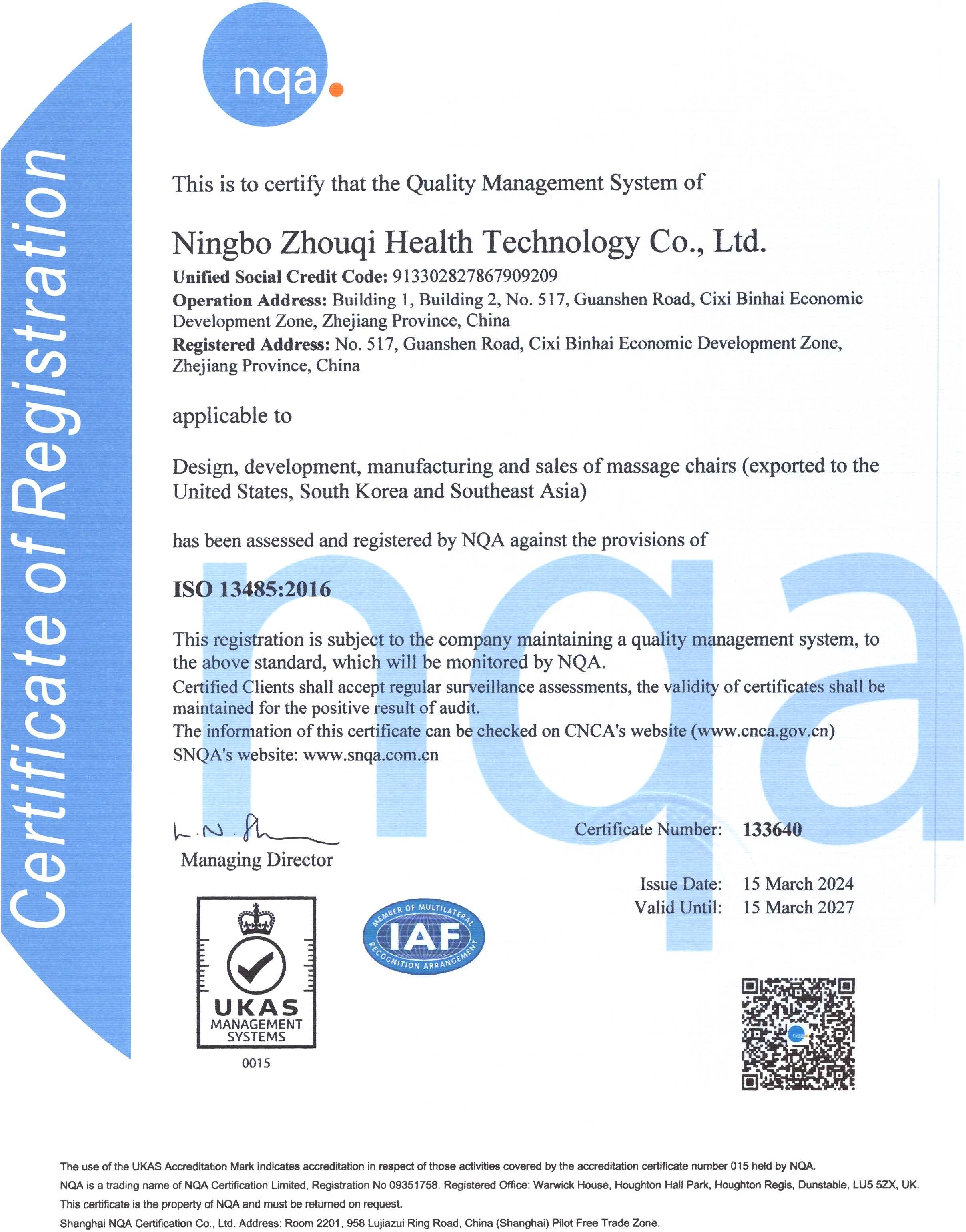
| ISO 13485 | 133640 — NQA | ISO 13485:2016 | Massage chairs; US, South Korea, Southeast Asia | 15 March 2024 to 15 March 2027 |
| FDA | 3017618816 — record lists Shenzhen CTB Testing Technology Co., Ltd. | 21 CFR 807.39 | Massage chairs; US | 16 December 2024 to 31 December 2026 |
All five records list the same 4D model group — 6510, 5300, 5380, 8620, 6920, 8600, 3900, 3910, 9100, 8520, 6540, 6600, 7100 and 8710 — as related products. That model-level link is the most useful single attribute in the set, because it converts a factory-level claim into a SKU-level one. A supplier that holds certificates for a category but cannot show the ordered model on the listing has given the buyer a different, weaker assurance.
What each record establishes — and where its authority stops
ETL 5030347 (INTERTEK): electrical safety for the US and Canada
The ETL record is certificate 5030347 issued by INTERTEK against UL 1647:2015 Ed.6+R:15May2025 and CSA C22.2#68:2018 Ed.8+U1;U2, with an issue date of 31 October 2025 and a scope recorded as massage chairs. Two details repay attention. The citation includes a revision dated 15 May 2025, and the certificate itself was issued later that year — so the file is not resting on a superseded edition of the standard. The U1 and U2 suffixes on the Canadian reference indicate that updates to that standard are included in the citation rather than left open.
What it establishes: an independent assessment of the appliance against the cited North American electrical safety standards, for the listed models. What it does not establish: massage performance, mechanical endurance, noise level or reliability over years of use. Those are separate questions requiring separate evidence.
CE EMC file ENB2311240186E00201C (EMTEK): electromagnetic compatibility
The CE record is certificate ENB2311240186E00201C issued by EMTEK on 20 December 2023, covering massage chairs for the EU, Middle East and Southeast Asia. The standards cited are EN IEC 55014-1:2021, EN IEC 61000-3-2:2019/A1:2021, EN 61000-3-3:2013/A2:2021/AC:2022-01 and EN IEC 55014-2:2021.
Those four standards sit in the electromagnetic compatibility family: emissions from the appliance, harmonic current behaviour, voltage fluctuation, and immunity to external interference. What the file therefore evidences is that the electrical design has been assessed for interference behaviour — a real and often underestimated issue for a motorised chair carrying multiple actuators and control electronics into a residential or hospitality circuit. What it does not evidence is mechanical durability or massage quality, and an importer should not describe an EMC file as a complete product conformity statement covering every market requirement.
ISO 9001 certificate 02424Q32202999R1S: process control
Certificate 02424Q32202999R1S was issued by SHENZHEN UNIVERSAL CERTIFICATION CENTRE CO., LTD. against GB/T19001-2016/ISO9001:2015, runs from 9 December 2021 to 2 December 2027, and records its scope as intelligent massagers across the EU, Middle East, Southeast Asia and US markets.
A quality management certificate speaks to process: how incoming components are checked, how production steps are documented, how nonconformities are handled and corrected. It is the record most directly relevant to whether a defect found in month three produces a documented corrective action or an unrecorded repair. Its limitation is scope and place. A QMS certificate covers defined activities at a defined site, so the operational check is whether the certified scope and site correspond to the factory that will actually build the order.
ISO 13485 certificate 133640 (NQA): medical-device quality disciplines
Certificate 133640 was issued by NQA against ISO 13485:2016 on 15 March 2024, valid to 15 March 2027, with a scope recorded as massage chairs for the US, South Korea and Southeast Asia markets.
ISO 13485 is the quality-system standard written around medical-device manufacturing disciplines — risk management, design control, traceability and process validation. Its presence in a massage chair file matters because several markets regulate massage equipment along a spectrum rather than across a single line, and a supplier already operating under 13485 disciplines is easier to qualify for the more demanding end of that spectrum. It remains a system certificate: it does not convert a massage chair into a medical device, and it should not be presented as product approval.
FDA registration 3017618816: an establishment record
The FDA record is registration 3017618816, citing 21 CFR 807.39, issued 16 December 2024 with an expiry of 31 December 2026. The record lists Shenzhen CTB Testing Technology Co., Ltd. alongside the registration.
21 CFR 807.39 concerns establishment registration, so this is an establishment-level filing rather than a product-level authorisation. Three checks follow directly. Confirm the registration is current: with a recorded expiry of 31 December 2026, an order shipping after that date should be accompanied by refreshed documentation. Confirm the registered establishment corresponds to the manufacturing site rather than only to a trading address. And do not let the number imply that a model has been cleared or approved, because that is a different mechanism resting on different evidence.
Where the whole stack stops
Read together, the five records answer a specific question: has an independent body assessed this product family for electrical safety in North America, for electromagnetic compatibility in the EU-facing markets, under two recognised quality-system standards, and filed an establishment registration in the United States? That is a substantial and checkable answer, and it is the answer an importer should be able to obtain within days rather than weeks.
They do not answer what the field failure rate is, how many cycles the mechanism completes, how roller force compares with another supplier, or how the chair reads after four years of daily hotel use. Those require test reports, sample evaluation and warranty data. A supplier file should state that boundary explicitly rather than letting a stack of certificates imply more than it establishes.
Specifications that can be checked at goods-in
Certificates describe a design envelope; the physical unit has to match it. The specifications recorded for this range give an inspector something concrete to measure.
- 4D mechanism. 4D movement is defined by the rollers changing speed and rhythm within a programme, moving in four dimensions: up, down, side-to-side, and depth with rhythmic speed variation. An inspector can observe this directly — run a programme and watch whether roller speed varies, not only roller position. Judging 4D by roller travel alone tests a 3D behaviour.
- 130 cm flexible SL track. The recorded track length is 130 cm, following an S-to-L curve that tracks the spine and then extends under the seat. Because track measurement conventions differ between suppliers, the length should be measured on a stated basis — guide-rail length along the curve — and that basis written into the specification so later comparisons remain like for like.
- 24 auto programmes. A count in the interface, reconciled against the programme list in the manual, closes this item. Programme count is simple to verify and therefore a useful proxy for whether the shipped unit matches the sampled unit.
- 110 V–240 V input, 200 W rated power. The nameplate is the document an inspector actually reads. A wide input range simplifies holding one SKU across 120 V and 230 V markets, but the acceptance condition is that the nameplate matches both the certificate file and the destination supply.
- Net weight approximately 103 kg. Weight drives handling, floor loading, two-person installation and freight planning. It is also the figure that separates a genuine home-use placement from a showroom placement, because stairs and door widths become part of the decision.
The recorded product description also lists zero-gravity recline, automatic body-shape detection, foot and waist heating, a 7-inch touch remote, Bluetooth and voice control, wireless charging and AI health detection. These are company product descriptions rather than certified performance claims, and they belong in a dated specification annex where they can be attributed — not in the compliance column of a supplier file.
Deployment records: what 70,000 and 20,000 units do and do not tell you
The deployment evidence for this range is a four-year record in Vietnam of 70,000 units and a three-year record in the United States of 20,000 units, with the result recorded as market improving and the positioning recorded as popular design with good quality and favourable price.
The buyer base behind those shipments is broader than a single channel, which is the part that carries procurement weight: massage chair sales showrooms and 4S showrooms, furniture and home-appliance malls, e-commerce sellers, hotels and resorts, and wellness and senior-care institutions. A range that has moved through showroom, retail, hospitality and institutional channels has met more than one set of expectations about finish, packaging and documentation — and hospitality in particular punishes equipment that cannot survive shared, continuous use.
The honest boundary is that a shipment total is a continuity indicator, not a reliability measurement. The record does not report defect rates, return rates, model mix or after-sales claim trends. A buyer who needs those should request them directly — shipment references covering the stated periods, the model split within each market, and the warranty claim trend — rather than infer them from the totals. What the totals do support is a defensible statement that the platform has been produced and shipped at volume into two regulated markets across multiple years.
Capacity, lead time and the limits of customization
Production capability for this range is recorded as 16,000 units per month against a 30–45 day lead time, a minimum order quantity of 1×40HQ, 100% QC testing and a one-year warranty supported by installation videos and a maintenance manual. The plant figures are a 130,000 ㎡ facility, 450 employees and a recorded annual output of 200,000 units, with an export ratio of 50% across the US, EU, Southeast Asia and Middle East.
Customization is listed as colour, logo, OEM files, pillow and backrest design, UI and language, under both OEM and ODM arrangements. That list is itself a useful boundary: it covers cosmetic, interface and soft-goods variation. A request that changes mechanism, track geometry or electrical architecture sits outside the listed scope and should be handled as a separate engineering question with its own timeline and validation, not as a line item added to a colour change.
Capacity figures state what a plant can produce; they do not reserve line time. The practical step is to confirm in writing the allocation for the specific model and shipment window, and to ask what the quoted lead time assumes — component availability, tooling readiness, or an existing production slot in the schedule.
Purchasing terms and acceptance criteria
The recorded commercial terms are straightforward and, more importantly, checkable: MOQ 1×40HQ, delivery FOB Ningbo, payment of 30% by T/T in advance as deposit with the 70% balance by T/T before shipment, and acceptance based on a pre-shipment test plus third-party inspection by SGS.
One structural point deserves attention before the checklist. Because the balance falls due before shipment, the inspection must be scheduled, completed and its report accepted before that payment date — otherwise the buyer pays in full against an inspection that has not yet happened. Sequencing inspection ahead of the balance is the single most effective condition an importer can hold inside this payment structure, and it costs nothing to specify at the quotation stage.
| # | Checkpoint | Evidence to hold | Acceptance condition |
|---|---|---|---|
| 1 | Certificate currency | ETL 5030347; CE ENB2311240186E00201C; ISO 9001 02424Q32202999R1S; ISO 13485 133640; FDA 3017618816 | Each number verified with the issuing body; holder name matches the contracting entity |
| 2 | Model coverage | Related-model list attached to each record | The ordered SKU appears on the list; a new SKU needs an updated listing before it ships |
| 3 | Site identity | Scope and site shown on the certificate | Certified site matches the producing factory, not only a trading address |
| 4 | Nameplate match | Certificate file and unit nameplate | 110–240 V and 200 W recorded on both; destination supply confirmed |
| 5 | 4D mechanism | Sample unit and programme list | Roller speed and rhythm vary within a programme, not position alone |
| 6 | Track and programme set | Specification annex and manual | 130 cm SL track measured on the stated basis; 24 programmes counted and matched |
| 7 | Pre-shipment test | 100% QC test records | Test format, sample size and record template agreed before production starts |
| 8 | Third-party inspection | SGS inspection report | Scope, AQL and timing defined; report issued and accepted before the balance payment |
| 9 | Commercial terms | Purchase order and payment schedule | MOQ 1×40HQ, FOB Ningbo, 30% deposit and 70% before shipment, confirmed in writing |
| 10 | Renewal risk | FDA record showing expiry on 31 December 2026 | Refreshed documentation supplied for any shipment after that date |
| 11 | After-sales deliverables | Warranty statement | One-year warranty, installation videos and maintenance manual listed as PO deliverables |
When this evidence set is sufficient — and when it is not
For a standard residential or commercial import into markets requiring electrical safety, electromagnetic compatibility and quality-system evidence, this set — the five records, the model-level link, the specification anchors and the deployment record — is enough to support a qualification decision, provided the buyer adds sample evaluation and a pre-shipment inspection under its own control.
It is not sufficient, on its own, for a buyer who needs model-level field-failure data, a warranty longer than the recorded one year, certification against a standard edition not listed on the file, or a market route that requires product-level authorisation rather than establishment registration. In each of those cases the gap is a scoping question to put to the supplier, and the correct response is an additional document — not a broader reading of the documents already held. Recognising which case applies is the difference between a qualification file that protects the order and one that only decorates it.
What this means for procurement going forward
The shift visible in this document set is from comparing claims to comparing records. A certificate number that can be checked at the issuing body, a model list that ties that certificate to the SKU being ordered, a nameplate that matches the file, and an inspection report issued before the balance payment do more for import risk than any number of additional marketing pages. Suppliers able to produce those four items quickly will be easier to keep in a programme, because the qualification conversation moves from whether documentation exists to how current it is and how precisely it applies to the next order.
The 2026 product catalogue, covering the 4D range and its recorded model specifications, is available for download: ZHOUQI 2026 E-catalogue (PDF).
Frequently asked questions
What documents should an importer request before approving a 4D massage chair supplier?
Request the full certificate for every standard the destination market requires, not a logo or a summary line, and check five attributes on each: issuing body, certificate number, standard edition or revision, scope, and validity dates. For the 4D range described here that means ETL 5030347 issued by INTERTEK, CE EMC certificate ENB2311240186E00201C issued by EMTEK, ISO 9001 certificate 02424Q32202999R1S, ISO 13485 certificate 133640 issued by NQA, and FDA registration 3017618816. Also request the model list attached to each document, because a certificate covering a factory does not automatically cover a newly added SKU.
Does an ETL certificate cover massage performance or durability?
No. The ETL record for these chairs cites UL 1647:2015 Ed.6+R:15May2025 and CSA C22.2#68:2018 Ed.8+U1;U2, which address electrical safety of the appliance for the US and Canadian markets. The certificate supports a safety and construction assessment for the listed models. It does not measure massage force, programme quality, mechanical endurance or user outcomes, so those items have to be verified through sample evaluation, endurance test reports and pre-shipment inspection rather than through the certificate.
What are the purchasing terms and acceptance criteria for this 4D range?
The recorded terms are: minimum order quantity 1×40HQ; delivery FOB Ningbo; payment of 30% by T/T in advance as deposit with the 70% balance by T/T before shipment; and acceptance based on a pre-shipment test plus third-party inspection by SGS. In practice the payment sequence and the inspection sequence have to be aligned, so that the inspection report is issued and reviewed before the balance falls due — otherwise the buyer settles in full ahead of the inspection it is relying on.
How should a buyer read the Vietnam and United States deployment figures?
As continuity indicators. The record shows 70,000 units shipped to Vietnam over four years and 20,000 units to the United States over three years, across showroom, furniture and appliance retail, e-commerce, hospitality, and wellness and senior-care channels, with the result recorded as market improving. That supports a claim about sustained export volume and repeat supply into two regulated markets. It does not report defect rates, return rates or model-level splits, so a buyer who needs those figures should request them directly instead of inferring them from shipment totals.
What production capacity and lead time can be verified?
The recorded figures are 16,000 units per month, a 30–45 day lead time, a 130,000 ㎡ factory, 450 employees, a 34-engineer R&D team and an annual output of 200,000 units, with 100% QC testing and a one-year warranty supported by installation videos and a maintenance manual. Capacity states what the plant can produce; it does not reserve line time. A buyer should confirm the allocation for the specific model and shipment window in writing, and ask what the quoted lead time assumes about component availability and tooling readiness.
Have Questions or Need More Details?
Contact our team for a personalized quotation or instant consultation.
Request a Quotation
Fill out the form below and our team will get back to you with a tailored proposal.
WhatsApp Direct Chat
Prefer to chat in real-time? Message us on WhatsApp for instant assistance & quick answers.
- Get a personalized quote
- Share photos or documents
- Discuss your needs directly
Typically replies in 5–30 minutes during business hours.