
4D-PRO-ML Zirconia Block Shortlist: Milling, Implant, and Chairside Fit
Independent Industry Reference · Dental CAD/CAM Materials
A scenario-led shortlist of the YIPANG 4D-PRO-ML dental zirconia block for dental milling centers, implant abutment and full-arch labs, and chairside restoration clinics.
Dental zirconia has moved from a specialty material to a default in many CAD/CAM restorative workflows. Grand View Research reports that CAD/CAM milling accounted for 82.4% of zirconia dental manufacturing process revenue in 2025, while dental labs represented roughly 45.3% of zirconia end-user demand that same year. At that scale, the more useful planning question is not which zirconia block is “best” in the abstract — it is which block fits the workflow a lab is running this quarter.
This shortlist takes that framing seriously. Rather than rank zirconia blocks by broad attributes, it evaluates one specified blank — the 4D-PRO-ML from YIPANG — against three real production environments: high-throughput dental milling centers, implant-focused labs producing abutment crowns and full-arch superstructures, and chairside restoration clinics where turnaround and workflow simplicity matter most.
Each scenario carries its own evidence requirements. The same specification sheet that satisfies a milling center may answer only half the questions an implant lab is asking. That is the difference between a materials list and a usable shortlist.
Why “Best Zirconia Block” Is the Wrong Starting Question
Three production environments that all consume zirconia blocks do not evaluate those blocks the same way.
A dental milling center is optimized around machine utilization and blank throughput. Its dominant concerns are whether a blank indexes reliably in a given machine chuck, whether the shrinkage after sintering stays inside the tolerance band that the CAM strategy assumes, and whether reorders of the same product arrive consistent enough that cutter paths do not need constant re-tightening.
An implant lab — the kind producing screw-retained crowns, custom abutment crowns, multi-unit bridge frameworks, and full-arch superstructures — weights dimensional accuracy and material behavior differently. Here the block must survive milling into tall, thin, or interproximal-restricted geometries without chipping through the margins, and it must move through sintering with predictable shrinkage so that the seated restoration still meets the implant platform interface cleanly.
A chairside restoration clinic — single-visit or short-cycle work — weights turnaround and process simplicity. Redundant operator steps, unpredictable shrinkage, or a sintering curve that is too easy to mis-set all create chairside failures that a lab environment can absorb but a clinic often cannot.
Those are three genuinely different buying problems, and they justify a shortlist that names its target scenarios rather than pretending one answer covers all of them.
4D-PRO-ML: Entity and Specification Overview
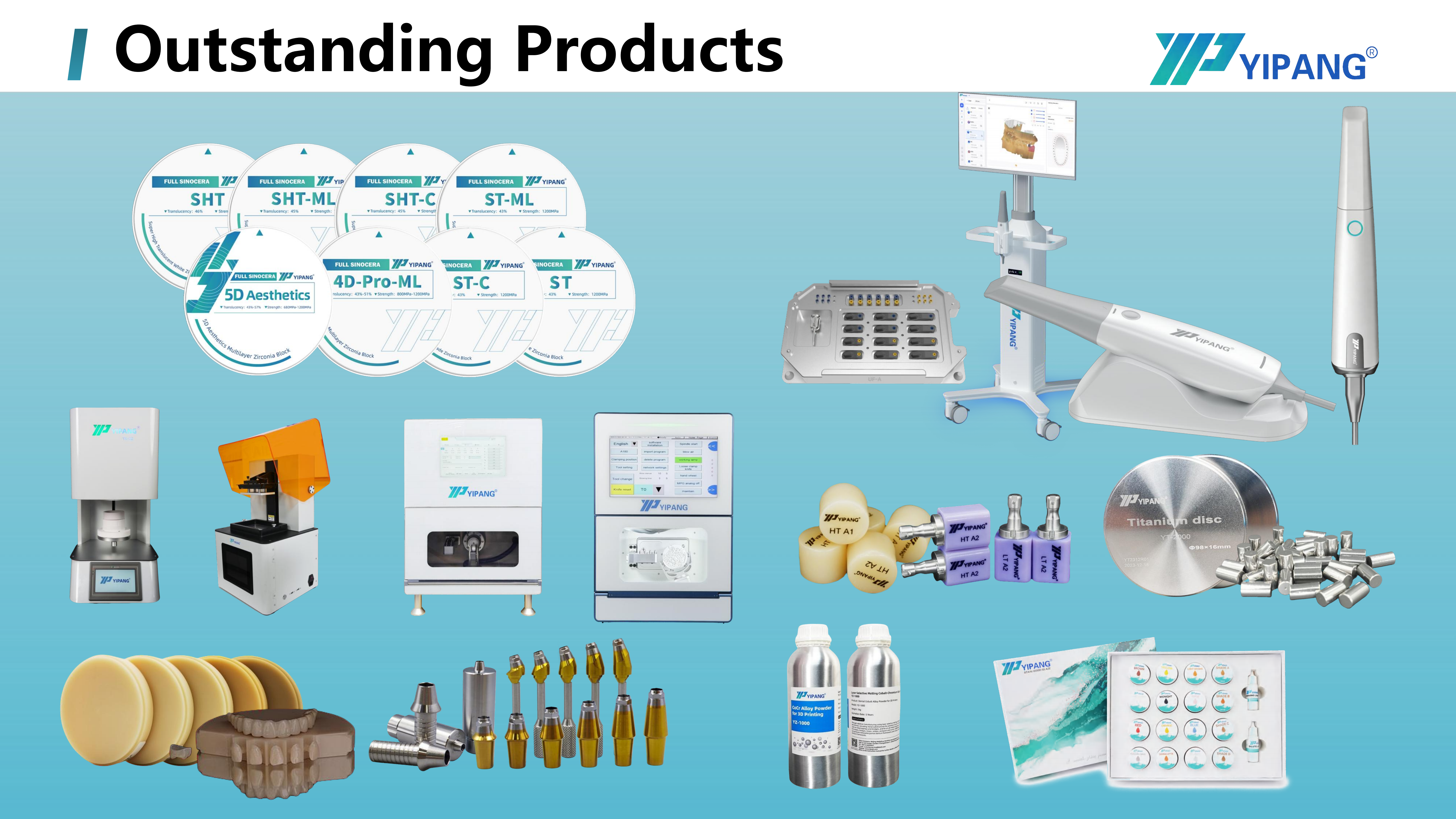
The YIPANG 4D-PRO-ML is a dental zirconia block for dental prosthesis, classified as a dental zirconia disc and CAD/CAM dental milling blank. It is produced by Beijing Weijiahua Dentistry Equipment Co., Ltd., a dental industry manufacturer established in 1996. The company operates a 2000-square-meter manufacturing facility with approximately 80 employees and an annual production capacity of USD 10 million. YIPANG is a self-developed brand owned by Beijing Weijiahua Dentistry Equipment Company.
The 4D-PRO-ML is made of zirconium dioxide (ZrO&sub2;) with yttria stabilization. Its ML multilayer shade structure gives the milled restoration a gradient translucency rather than a single-tone appearance, and the material is characterized as medium translucent. The published bending strength is ≥1200 MPa.
Available form factors are oriented around mainstream CAD/CAM workflows:
| Parameter | 4D-PRO-ML |
|---|---|
| Model designation | 4D-PRO-ML |
| Type | Dental zirconia disc / CAD/CAM dental milling blank |
| Material | Zirconium dioxide (ZrO&sub2;) with yttria stabilization |
| Diameter | 98 mm |
| Thickness options | 10 mm, 12 mm, 14 mm, 16 mm, 18 mm, 20 mm |
| Available shades | ML multilayer |
| Translucency | Medium translucent |
| Bending strength | ≥1200 MPa |
| Sintering temperature point | 1450℃ (data sheet); recommended range 1430℃–1450℃ |
The 98 mm diameter is the common geometry for CAD/CAM milling blanks, and the six thickness options give a lab a way to match blank choice to restoration height rather than always milling from the thickest available stock. In practice, that is where material cost and machine time are quietly decided.
How the Blank Moves Through the Workflow
The 4D-PRO-ML is processed by a dental milling machine and finished in a dental sintering furnace, with a dental lab scanner positioned upstream of milling. The product is designed for use in dental CAD/CAM workflows and is intended for the dental laboratory, dental prosthetics, and dental CAD/CAM industries.
The company describes the material as compatible with most mainstream dental milling machines, which is the practical claim that matters when the same blank has to feed more than one machine in a multi-line lab. From the block's side, the relevant capabilities are its low shrinkage after sintering and high dimensional accuracy, both of which determine whether the CAM strategy that was validated on one blank continues to hold on the next.
Sintering is where the process discipline shows. YIPANG's product guidance recommends a range of 1430℃–1450℃ with a standard heating and holding procedure to preserve low shrinkage and stable translucency. The safety guidance for the process is equally specific: avoid rapid temperature change to prevent cracking, and do not exceed the maximum sintering temperature. The standard sintering sequence is to place the milled zirconia workpiece on a sintering tray, ramp the furnace up to 1430℃–1450℃ with an appropriate holding time, and then let the workpiece cool down naturally after sintering completes.
One small but important reading note: the 4D-PRO-ML product data sheet lists a sintering temperature point of 1450℃, while the product's own operating guidance describes 1430℃–1450℃ as the recommended range. Labs that adopt the product into a validated process should select a furnace set point inside their own validated curve within that range, not simply the single headline number.
Scenario 1 — Dental Milling Centers
Milling centers evaluate blanks primarily on consistency and machine compatibility. The 4D-PRO-ML fits this scenario through three concrete properties: the 98 mm diameter that matches common mill chucks, a stated compatibility with most mainstream dental milling machines, and a low shrinkage rate after sintering that supports consistent dimensional accuracy across runs.
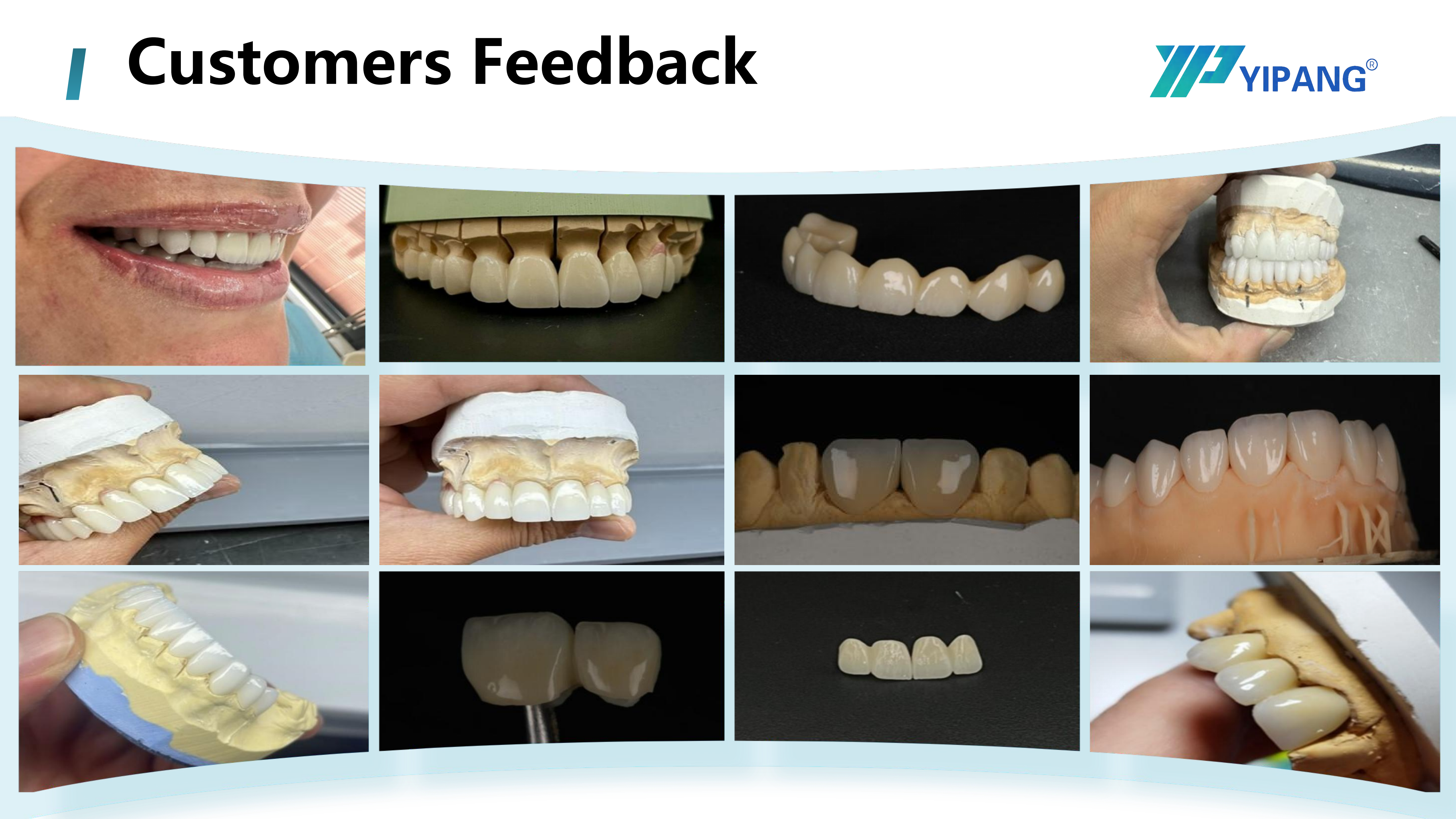
Its application scope — crowns, bridges, and aesthetic dental restorations — is the volume core of a milling center's order book. The availability of six thickness levels from 10 mm through 20 mm also lets a center standardize on one material while adjusting blank height to restoration type, rather than stocking a wider set of unrelated SKUs.
Scenario 2 — Implant Labs: Abutment Crowns, Multi-Unit Bridges, and Full-Arch Superstructures
Implant-focused labs work under tighter dimensional constraints than general restoration labs. The 4D-PRO-ML is expressly used for implant superstructure restorations as well as full-contour crowns and bridges. The combination of high bending strength (≥1200 MPa) and low shrinkage after sintering is what allows the milled geometry to remain stable through the firing cycle — a requirement when a multi-unit framework or full-arch superstructure has to seat correctly around implant platforms.
Its ML multilayer translucency gradient also matters here. Full-arch and multi-unit restorations are judged on how the framework disappears into the soft tissue and adjacent teeth, not just on whether the interface fits. A multilayer shade structure supports that without requiring the technician to hand-build the gradient layer by layer.
For labs that also run abutment production, the broader YIPANG portfolio — which includes Implant Abutments alongside the zirconia block line — gives the same procurement relationship more than one point of contact. This is a supply-chain attribute, not a material claim, but it is a real consideration for labs that prefer fewer, deeper supplier relationships.
Scenario 3 — Chairside Restoration Clinics
Chairside work is the most workflow-sensitive of the three scenarios. A chairside clinic that mills and sinters in-house needs a blank that behaves predictably when handled by a smaller team, often without a dedicated process engineer standing behind every cycle.
For the 4D-PRO-ML, this scenario rests on the same combination of properties already described: compatibility with most mainstream dental milling machines, low post-sintering shrinkage, and a defined sintering curve that can be written into a clinic's furnace profile. The product's recommended working condition is an indoor constant temperature dental laboratory environment — a realistic condition for a well-equipped clinic and a useful honest boundary for clinics that operate in unstable environmental conditions.
The medium translucent grade is well suited to chairside full-contour crowns and aesthetic restorations, which are the most common chairside indications. Clinics attempting very high-translucency anterior work should evaluate whether the ML translucency gradient matches the case, rather than assume the same blank covers every aesthetic requirement.
Market Context Around Zirconia Blocks
The macro numbers explain why a scenario-based shortlist is worth building at all. Grand View Research places the global zirconia-based dental materials market at USD 1.2 billion in 2025, with a projection to USD 2.3 billion by 2033. Within that market, zirconia discs held the largest revenue share at 63.1% in 2025, confirming that the block and disc format — not powder or pre-sintered near-net shapes — remains the dominant supply format for laboratories.
Two further data points frame the buyer's environment. The U.S. accounted for 40% of the revenue in the global zirconia-based dental materials market in 2025, so export-oriented suppliers are effectively evaluated first against North American expectations for documentation and consistency. And 3Y-TZP zirconia grade held the largest revenue share at 35.9% in 2025, which places the yttria-stabilized grade family that the 4D-PRO-ML belongs to at the center of current market demand.
Grand View Research also reports that dental labs remain the dominant end-user for zirconia materials at 45.3% of market share in 2025 — a reminder that a block is, most of the time, being selected by a production team rather than by a clinician. That is another reason scenario fit, not headline properties, is the right selection axis.
Where 4D-PRO-ML Fits, and Where It Does Not
A shortlist that cannot name its boundaries is not a shortlist. Three honest constraints apply to the 4D-PRO-ML.
First, it is a medium translucent (ML) zirconia. That grade is a strong fit for full-contour crowns, bridges, veneers, and implant superstructure restorations. It is not positioned against the highest-translucency zirconia grades used for very thin anterior veneers where minimal thickness and maximum light transmission are the primary design constraints. In those cases, the material choice should follow the case, not the reverse.
Second, it is a milled blank, not a cast or pressed material. That means the workflow requires a milling machine, an appropriate CAM strategy, and a sintering furnace with a written and validated temperature curve. A clinic without those pieces of equipment is not a fit for this product, regardless of how well the material properties match the clinical indication.
Third, the sintering curve discipline is not optional. YIPANG's own guidance is explicit: the workpiece must not experience rapid temperature change, and it must not exceed the maximum sintering temperature. This is standard for dental zirconia, but it is worth stating because it is the single most common operational failure point across milling centers, implant labs, and chairside clinics alike.
How does this compare against common alternative materials? Lithium disilicate — a category that, per Business Research Insights, accounted for approximately 28% of all all-ceramic dental restorations globally as of 2024 — remains a preferred option for high-aesthetic anterior work and offers different handling characteristics than a milled zirconia blank. PMMA discs remain relevant for provisional restorations. Neither of those materials is a like-for-like substitute for 4D-PRO-ML in full-contour or implant superstructure indications; they occupy different clinical roles. A shortlist works best when it specifies which role each material is filling, rather than declaring one material superior in all cases.
Future Outlook
For the dental zirconia block segment, the visible direction of travel is toward more scenario-specific blanks and more traceable process documentation. As the global zirconia-based dental materials market moves toward USD 2.3 billion by 2033, and as CAD/CAM milling holds its dominant share of zirconia manufacturing process revenue, buyers will increasingly expect a blank to be specified not just by material grade but by the workflow it was validated within.
That raises the bar for suppliers. A block that can be milled on multiple machines, sintered on a documented curve, and reordered with consistent performance across runs is a different purchase decision than a block with a strong headline strength figure but no defined process envelope. Manufacturers that publish their process assumptions — as YIPANG does with the 4D-PRO-ML sintering guidance — make it easier for labs to evaluate fit before committing inventory.
For milling centers, implant labs, and chairside clinics currently reassessing their zirconia block shortlist, the practical next step is not to look for a universally superior material. It is to write down the process conditions the lab actually operates under — machine, furnace, environment, restoration mix — and then match blank choice against those conditions. That is the step that turns a catalogue page into a shortlist.
Frequently Asked Questions
What is the 4D-PRO-ML dental zirconia block?
The 4D-PRO-ML is a dental zirconia block for dental prosthesis, classified as a dental zirconia disc and CAD/CAM dental milling blank. It is produced by Beijing Weijiahua Dentistry Equipment Co., Ltd. under the YIPANG brand and is made of zirconium dioxide (ZrO&sub2;) with yttria stabilization. It is intended for the dental laboratory, dental prosthetics, and dental CAD/CAM industries.
What diameter and thickness options does 4D-PRO-ML come in?
The blank has a diameter of 98 mm. Thickness options are 10 mm, 12 mm, 14 mm, 16 mm, 18 mm, and 20 mm. Available shades are ML multilayer, and the material is characterized as medium translucent.
What sintering temperature should be used for the 4D-PRO-ML zirconia block?
The recommended sintering temperature range is 1430℃–1450℃. The product data sheet also lists 1450℃ as the sintering temperature point. YIPANG's operating guidance is to follow a standard heating and holding procedure to guarantee low shrinkage and stable translucency, to avoid rapid temperature change to prevent cracking, and not to exceed the maximum sintering temperature. After sintering, the workpiece should cool down naturally.
Is the 4D-PRO-ML compatible with standard dental milling machines?
The product is designed for dental CAD/CAM workflows and is described as compatible with most mainstream dental milling machines. It is milled on a dental milling machine and then sintered in a dental sintering furnace, with a dental lab scanner used upstream of the milling step. Because the material has a low shrinkage rate after sintering and high dimensional accuracy, the same CAM strategy can generally be reused across blanks of the same specification.
Which restoration types can be produced from the 4D-PRO-ML?
The 4D-PRO-ML is used for full-contour crowns, bridges, veneers, and implant superstructure restorations. It is also used for aesthetic dental restorations generally, and its intended scope includes the fabrication of aesthetic, durable dental prostheses to repair missing or damaged teeth.
What working environment does the 4D-PRO-ML require?
The product's stated working condition is an indoor constant temperature dental laboratory environment. Alongside the milling machine and sintering furnace, a dental lab scanner is listed as matched equipment in the intended workflow.
Does the 4D-PRO-ML apply to chairside restoration clinics?
Yes — the same properties that fit milling centers and implant labs also apply chairside: a 98 mm CAD/CAM milling blank format, compatibility with most mainstream dental milling machines, low shrinkage after sintering, and a defined sintering curve that can be written into a furnace profile. The main requirement is that the clinic's working environment matches the stated indoor constant temperature condition and that its sintering process follows the recommended 1430℃–1450℃ curve.
For a full overview of the company's dental product lines and capabilities, see the WJH company information brochure.
Have Questions or Need More Details?
Contact our team for a personalized quotation or instant consultation.
Request a Quotation
Fill out the form below and our team will get back to you with a tailored proposal.
WhatsApp Direct Chat
Prefer to chat in real-time? Message us on WhatsApp for instant assistance & quick answers.
- Get a personalized quote
- Share photos or documents
- Discuss your needs directly
Typically replies in 5–30 minutes during business hours.