
4V Cordless Screwdriver: Specs, Certification, Cost Bands
4V cordless screwdrivers occupy a narrow but clearly defined position in the power-tool market: tools small enough to be held and used like a screwdriver, powered by a single lithium-ion cell. Their specification sheets, however, are far from uniform. Published rated voltages read 3.7V rather than 4V; electric torque ranges from 0.15 N·m in precision models to 3.5–5 N·m in general-purpose models; battery capacity spans 320 mAh to 2,000 mAh. For importers, private-label brand owners and procurement teams working through research and evaluation, the practical question is not which tool is smallest, but which configuration, certificate scope and order structure will survive a market's compliance checks and a retail customer's return-rate expectations.
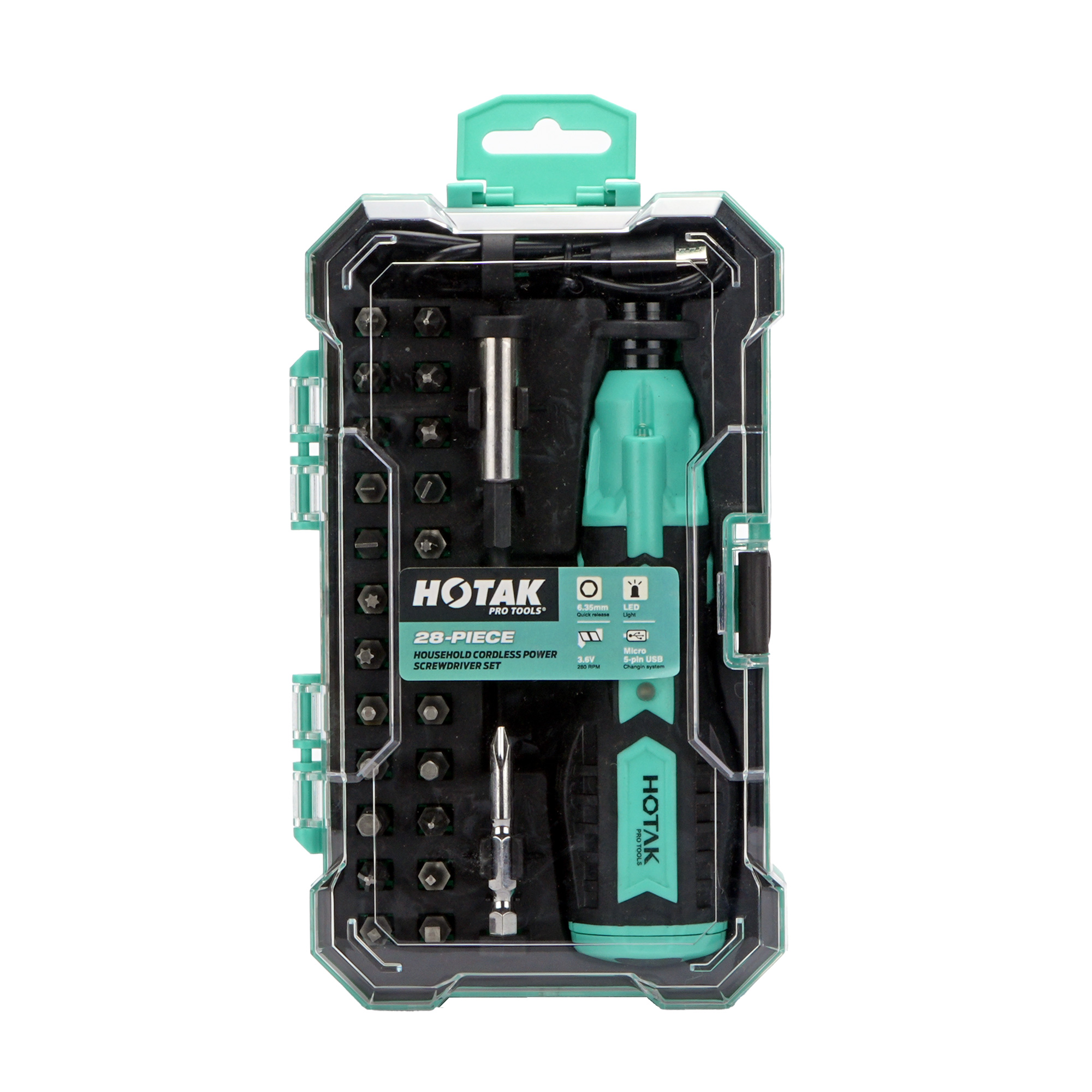
A 4V-class cordless screwdriver set: published rated voltage 3.7V, 800 mAh battery, 2.5 N·m electric torque with 10 N·m manual torque.
Why the 4V Screwdriver Is a Constraint Problem, Not a Category Problem
Three constraints separate a workable 4V screwdriver program from one that generates returns, listing disputes and after-sales complaints.
1. Naming versus rating. Retail listings describe these tools as 4V tools, while the published rated voltage on the products themselves is 3.7V, the nominal voltage of a single lithium-ion cell. A buyer who treats the two numbers as interchangeable will write an inaccurate listing and set the wrong performance expectation.
2. Torque architecture. A 4V screwdriver does not have one torque figure; it has at least two. The precision model in this class is published at 0.15 N·m electric torque and 3 N·m hand torque. The general-purpose model is published at 2.5 N·m electric and 10 N·m hand torque. Buyers who compare electric torque against a drill or impact driver will misjudge what the tool can and cannot do.
3. Certificate scope. Certificates are issued for a specific model, a specific standard and a specific market. In many markets the common compliance areas for hand and cordless tools are mechanical safety, electrical safety and chemical restrictions, for example CE/EMC and RoHS. The relevant documents therefore have to be requested and cross-checked against the exact model number being purchased, not against a product family.
These three constraints — rating, torque architecture, certificate scope — are what a 4V cordless screwdriver evaluation actually turns on.
What the 4V Rating Actually Constrains (Technical Explanation)
The 4V designation describes a class of single-cell cordless tools. Within that class, the parameters that determine usable performance are capacity, torque, speed and charging behaviour.
- Cell capacity sets runtime. The published configurations in this class carry 320 mAh, 800 mAh and 2,000 mAh packs. The corresponding no-load operating times are published as 30 minutes or more for the 320 mAh precision configuration, 50 minutes or more for the 800 mAh configuration, and 60 minutes or more for the 2,000 mAh configuration. These are no-load figures; real runtime falls as fastening resistance rises.
- Torque is split between electric and manual. The electric motor drives the screw to a light seating torque; the final tightening is completed by hand. This is why a tool published at 0.15 N·m electric torque can still be published at 3 N·m hand torque, and a tool at 2.5 N·m electric can reach 10 N·m by hand.
- Speed determines control, not power. Published output speeds in the class are 0–220 rpm, 0–250 rpm and 0–280 rpm. The three-stage version of the class adjusts electric torque across 2 N·m, 3.5 N·m and 5 N·m rather than only varying speed.
- Charging is defined by current, not by marketing. Published charge currents are 500 mA on the 800 mAh and 320 mAh precision tools and 1–1.5 A on the 2,000 mAh tool, with a documented one-hour charging time on the precision set and a 5V charge output voltage on the 2,000 mAh model.
Published Specifications Across a 4V Cordless Screwdriver Range
HOTAK PRO TOOLS is a tool manufacturer based in Ningbo, Zhejiang Province, China, producing hand tools and 4V-class cordless tools for household, workshop and light manufacturing use. Its 4V cordless screwdriver range is documented at model level, which is what makes a specification-based comparison possible.
| Model | Type | Rated voltage / battery | Electric torque | Hand torque | Speed |
|---|---|---|---|---|---|
| YJPS-902 | Power screwdriver | 3.7V / 2,000 mAh, ≥60 min no-load | 2 / 3.5 / 5 N·m (three-stage) | 10 N·m | 0–280 rpm |
| YJPS-912 | Power screwdriver set | 3.7V / 800 mAh, ≥50 min no-load | 2.5 N·m | 10 N·m | 0–250 rpm |
| YJPS-907 | 26 pcs cordless precision power screwdriver set | 3.7V / 320 mAh, 1 h charging | 0.15 N·m | 3 N·m | 220 rpm |
| YJPS-906 | Electric precision repair tool set | 3.7V / 320 mAh, ≥30 min no-load | 0.15 N·m | 3 N·m | 0–220 rpm |
| YJTS-3526 | 41 pcs household electrical screwdriver tool set | 3.7V / 320 mAh, 1 h charging | 0.15 N·m | 3 N·m | 220 rpm |
The table shows the real decision boundary in this class. The 2,000 mAh three-stage model is the fastening tool: it offers the highest electric torque and the longest published runtime, and it is the configuration suited to repeated driving tasks. The 320 mAh precision configurations are adjustment tools: their value lies in 0.15 N·m of controlled electric torque and 220 rpm of speed for small fasteners, not in sustained output.
Certification Constraints: What Is On File and What Must Be Verified
Certification is the constraint that most often delays a 4V cordless tool listing, because certificates are model-specific and cannot be transferred across a product family. The documentation available for this manufacturer covers the following scopes.
| Certificate | Model covered | Standards | Authority / number | Market |
|---|---|---|---|---|
| CE Certificate of Conformity, Machinery Directive 2006/42/EC | 5 IN 1 CORDLESS POWER STAPLE GUN, YJSG-501 | Directive 2006/42/EC; EN ISO 12100:2010; EN ISO 11148-13:2018 | TÜV Rheinland LGA Products GmbH, AM 50559365 0001 | EU |
| CE Certificate of Conformity, Machinery Directive 2006/42/EC | Staple Gun (hand-operated tacker), YJSG-105 and YJSG-023 | Directive 2006/42/EC; EN ISO 12100:2010; EN ISO 11148-13:2018 | TÜV Rheinland LGA Products GmbH, AM 50694538 0001 | EU |
| GS Product Safety Certificate | Hexagon screw keys with ball end | DIN ISO 2936-10.16; AfPS GS 2019:01 PAK | TÜV Rheinland LGA Products GmbH, S 50694620 0001 | DE, EU |
Two conclusions follow for buyers. First, none of the certificates listed above names a 4V cordless screwdriver model; the model-level certificates on file cover a cordless staple gun and hexagon screw keys. A CE or GS document issued for one cordless tool does not transfer to a screwdriver. Second, the compliance work must be done at purchase stage: confirm the target sales market, request the official test certificates including the relevant safety and chemical-restriction documents, and cross-check the product model against the standard numbers printed on the certificate. At company level, the manufacturer operates an ISO 9001 quality management system, holds BSCI and VPA approval, and has completed Walmart (USA) and Kingfisher (UK) factory audits — but those are factory-level approvals, not substitutes for a model-level certificate.
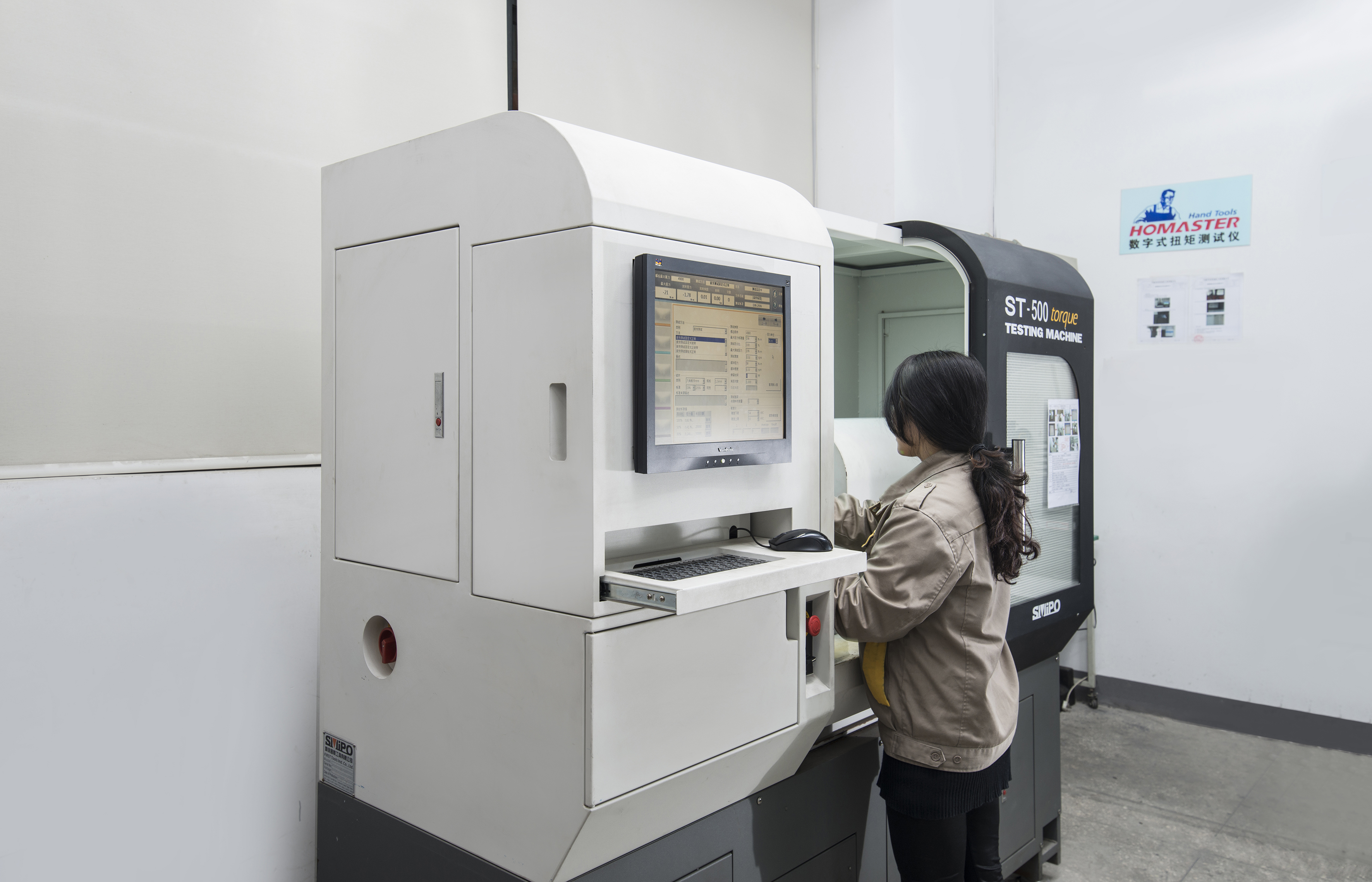
In-house testing laboratory: verification is carried out on incoming materials, in-process production and finished goods.
Order Constraints: MOQ, Lead Time, Capacity and Customisation
The commercial constraints published for this 4V cordless tool production line are as follows.
Production mode: OEM / ODM
Customisation: colour and logo
Minimum order quantity: 600 units
Lead time: 30–45 days
Monthly capacity: 1,500,000 units
Quality control: incoming inspection, in-process inspection, final inspection
After-sales: remote support
For a buyer evaluating a 4V cordless screwdriver program, the MOQ of 600 units interacts with the customisation scope: colour and logo changes are made against that order structure, and the 30–45 day lead time is the planning horizon that has to be built into a retail launch calendar. The monthly capacity figure of 1,500,000 units applies across the cordless and hand tool lines and indicates the scale available for repeat orders, not a commitment for a single screwdriver model.
Order sizes in practice for this type of customer are documented in the 5,000–50,000 unit range per order, with applications in auto repair, household fastening and workshop maintenance, and relationship durations of three to five years reported by brand owners, hardware wholesalers and retail chains in Germany, France, the United States, Canada, Mexico, Brazil, Argentina and Malaysia.
What Drives the Cost Band of a 4V Cordless Screwdriver
No unit price is published in the available product documentation, so the cost band of a 4V cordless screwdriver has to be reasoned from its bill of materials rather than quoted from a list. Four elements move the band.
Battery capacity and cell count. A 320 mAh single-cell pack and a 2,000 mAh pack are different cost structures, and the 2,000 mAh configuration also carries a higher charge current of 1–1.5 A, which requires a correspondingly stronger charging circuit.
Torque and control electronics. A fixed single-stage electric torque of 0.15 N·m or 2.5 N·m is a simpler drive than a three-stage electric torque range of 2 / 3.5 / 5 N·m, which requires switching electronics and a different control layout.
Kit content. The cost difference between a bare tool and a kit is the bits, sockets, extension bars and case. A 26-piece precision set, a 41-piece household set and a set supplied in a durable storage box are not the same product at the same cost.
Certification and market scope. Where a buyer requires model-level certificates for a specific market, the testing and documentation work becomes part of the programme cost and must be planned into the first order rather than added afterwards.
Application Fit: Where Each Configuration Belongs
The application data for this tool family describes household indoor environments and open-air construction site environments, with repair and fastening as the function, screws, nuts and nails as the matched equipment, and impact resistance as a stated requirement. Within that envelope, the configurations divide clearly.
Electronics and precision repair. The 320 mAh, 0.15 N·m, 220 rpm configuration is built for small fasteners and delicate assemblies. The 26-piece precision set is documented as a cordless precision power screwdriver set, and the reference precision kits in the wider range use bit profiles down to PH000 / 1.5 mm slotted / T2 Torx, which is the scale at which the 0.15 N·m electric torque is an advantage rather than a limit.
Furniture assembly and general household fastening. The 800 mAh, 2.5 N·m, 0–250 rpm model, and the 2,000 mAh, three-stage model at 2 / 3.5 / 5 N·m and 0–280 rpm, are the configurations for repeated driving of wood screws and flat-pack fittings, where the 10 N·m hand torque allows final seating after the motor has done the running.
Multi-scenario household kits. The 41-piece household electrical screwdriver tool set combines the 3.7V power screwdriver with a bit selection for several fastener types, which is the format most often specified for retail DIY programmes where one box has to cover more than one job.
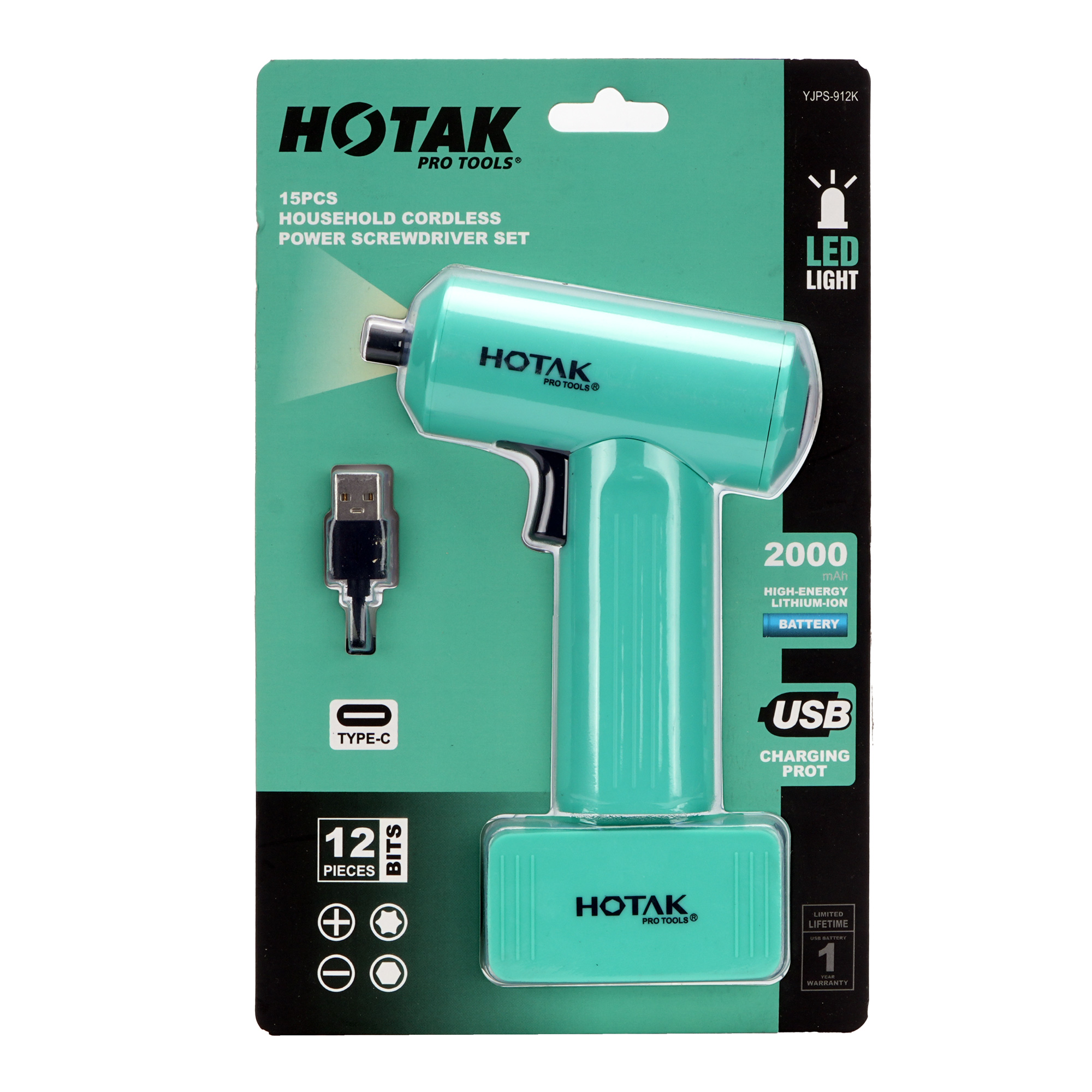
A 41-piece household electrical screwdriver tool set built on the same 3.7V / 320 mAh precision platform.
Limits and Trade-offs: Where a 4V Cordless Screwdriver Stops
A 4V cordless screwdriver is a low-torque assist tool, and the published figures show exactly where its authority ends.
- Electric torque is a fraction of hand torque. At 0.15 N·m electric against 3 N·m hand torque, and 2.5 N·m electric against 10 N·m hand torque, the motor cannot be relied on for final tightening on high-resistance joints. Removing a seized screw, or seating a screw into hard wood, still depends on manual effort.
- Runtime is quoted at no load. The 30, 50 and 60 minute figures are no-load operating times. Under continuous fastening resistance, usable time per charge is shorter, and a 320 mAh pack will not cover a full installation job without recharging.
- The class does not replace a drill or impact driver. It sits below them in the tool stack: it is the tool for repetitive small-fastener work, not for drilling, masonry, or structural assembly.
- Certificates do not travel between models. A certificate covering a cordless staple gun or a hex key set says nothing about a 4V screwdriver model. Sourcing a screwdriver on the strength of a family-level certificate is a compliance risk, not a shortcut.
- Order economics require planning. A 600-unit minimum order and a 30–45 day lead time mean trial quantities and launch dates have to be scheduled, not ordered ad hoc.
Market Trend and Outlook
Buyer behaviour in this class is shifting from single-tool purchases toward documented platform purchases. Retail and private-label buyers increasingly evaluate a 4V cordless screwdriver together with the rest of the 4V platform — precision screwdrivers, cordless staple guns, rotary tools and glue pens — because a shared cell voltage and charging approach simplifies their assortment and their spare-part position.
Two further trends are visible in how requirements are written. First, charging specifications are becoming part of the tender rather than an afterthought: charge current, charge time and charge output voltage are now listed alongside torque. Second, compliance is being asked for by model, with the certificate number, standard number and market printed on the document. Sellers who can supply that level of documentation at quotation stage move through buyer evaluation faster than those who answer with a product family.
For the next planning cycle, the most likely development is a wider choice of configurations within the same single-cell envelope — more torque stages, larger packs on general-purpose models, and tighter documentation packages per model — rather than a change in the basic 4V architecture, because the physical limits of a single lithium-ion cell are fixed.
For buyers who need the full model list, dimensions and packaging options, the manufacturer's product catalog is available here: 2025 product catalog (PDF).
FAQ
What does 4V mean if the rated voltage is 3.7V?
4V is a class label used in retail listings for single-cell cordless tools. The published rated voltage on the products in this class is 3.7V, which is the nominal voltage of one lithium-ion cell. Buyers should quote the rated voltage and the battery capacity from the specification sheet, not the class label, when writing listings or comparing models.
What is the difference between electric torque and manual torque on a cordless screwdriver?
Electric torque is the torque produced by the motor for driving the screw; manual torque is the torque available when the tool is turned by hand to finish the joint. In this class the published values are 0.15 N·m electric against 3 N·m manual on precision models, and 2.5 N·m electric against 10 N·m manual on general-purpose models. The two figures describe different tasks and should not be compared with a drill's torque rating.
Which certificates should be requested for a 4V cordless screwdriver sold in the EU?
In many markets the common compliance areas for hand and cordless tools are mechanical safety, electrical safety and chemical restrictions, for example CE/EMC and RoHS. The certificates held for this manufacturer cover a cordless staple gun (CE, Machinery Directive 2006/42/EC, certificate AM 50559365 0001, TÜV Rheinland LGA Products GmbH) and hexagon screw keys (GS, certificate S 50694620 0001). Because certificates are issued per model, a buyer should request the official test certificates for the exact screwdriver model and cross-check the model number against the standard numbers on the document.
What influences the cost band of a 4V cordless screwdriver if no price list is published?
No unit price is published in the available product documentation. The cost band is driven by battery capacity and cell count, by whether the electric torque is fixed or three-stage, by kit content such as bits, sockets and case, and by the certification scope required for the target market. These are the variables to define before requesting a quotation.
What order constraints apply to a 4V cordless screwdriver programme?
The published commercial parameters are an OEM/ODM production mode with colour and logo customisation, a minimum order quantity of 600 units, a lead time of 30–45 days, and a monthly capacity of 1,500,000 units across the tool lines. Quality control covers incoming inspection, in-process inspection and final inspection, and after-sales support is provided remotely.
When is a 4V cordless screwdriver the wrong tool?
It is the wrong tool for drilling, for masonry and structural assembly, and for removing seized or high-torque fasteners. Its electric torque — 0.15 N·m in precision models and up to 5 N·m in the three-stage model — is intended to drive small fasteners to a light seating, with final tightening completed by hand at 3 N·m or 10 N·m. Runtime figures are quoted at no load, so continuous heavy fastening shortens usable time per charge.